

Rehabilitation Robotics Redefining Clinical Excellence: Insights from Li Jian'an, Bi Sheng, and Li Luya

ANGELEXO
R&D and Manufacturer of Intelligent Rehabilitation Robots
August 19 marks China’s fifth Chinese Doctors’ Day.
Among China’s vast population of physicians, there is a distinct group who, although they do not directly save patients’ lives on the operating table, help patients improve functional impairments and return to daily life through systematic training. A significant portion of their work involves physical labor, and their presence can be seen in hospitals, communities, and homes.
It can be said that the role of rehabilitation therapists is indispensable in transitioning patient care from mere survival to enhanced quality of life. As “assistants” to rehabilitation therapists, rehabilitation robots have alleviated their workload, improved work efficiency, and, to a certain extent, promoted the development of rehabilitation medicine in China.
Li Jian’an, International Fellow of the U.S. National Academy of Medicine and Medical Director of the Zhongshan Rehabilitation Branch of Jiangsu Province Hospital; Bi Sheng, Executive Vice Chairman and Secretary-General of the Rehabilitation Medicine Professional Committee of the China Non-Public Medical Institutions Association; and Li Luya, Founding Member of the Science and Technology Management and Clinical Evaluation Committee of the Chinese Association of Rehabilitation Medicine and Founder of Angelai Technology, convened to discuss the theme: “In the Era of Intelligent Healthcare, How Rehabilitation Robots Empower Clinicians with ‘High Combat Capability’.”
Two rehabilitation medicine experts and the founder of a rehabilitation robotics company set off a “clash” between clinical practice and industry.
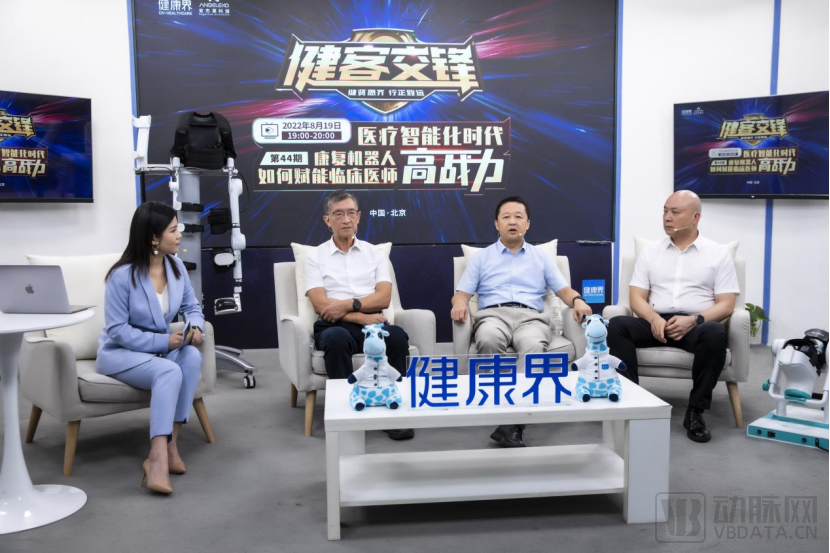 Live Photo from the Jianke Showdown Broadcast (From left to right: Health界 and Xingxing, Li Jian'an, Bi Sheng, Li Luya)
In recent years, rehabilitation medicine has developed rapidly, and clinical practice has begun to focus on whole-course management of patients.
Clinical medicine is primarily focused on disease treatment, whereas rehabilitation medicine centers on the restoration of functional impairments. For patients who do not achieve full recovery after medical treatment for injuries or illnesses, rehabilitation can help them attain optimal functional status. Li Jian’an stated, “Rehabilitation enables individuals with functional impairments to live in harmony with their environment and improves patients’ quality of life when diseases cannot be cured.”
China has a substantial demand for rehabilitation services, with patients suffering from chronic diseases constituting a key target population. There are nearly 300 million individuals with chronic conditions in China, accounting for approximately 70% of the total disease burden. According to statistics from The Lancet, China has the largest rehabilitation needs globally, with the total number of people requiring rehabilitation reaching 460 million in 2022. However, China faces a shortage of rehabilitation medical resources, resulting in insufficient clinical rehabilitation treatment rates.
According to Bi Sheng,China faces a shortage of approximately 300,000 rehabilitation therapists, and the quality of rehabilitation training within the country is uneven.. Li Jian'an mentioned,The current discussion on the shortage of rehabilitation therapy talent focuses solely on service personnel within medical institutions, yet a significant portion of rehabilitation work is conducted in community and home settings, whose needs have not yet been addressed.。
Rehabilitation robots can assist patients in multiple domains, including motor function, cognition, and communication, serving as a “third hand” for rehabilitation therapists and even freeing their hands during certain procedures. Moreover, these robots can learn from the expertise of highly skilled rehabilitation therapists and, unlike humans, are unaffected by physiological or psychological factors, thereby delivering high-quality, consistent services. The emergence of rehabilitation robots alleviates the workload of rehabilitation therapists, enhances the efficiency of clinical rehabilitation therapy, and promotes the standardization of rehabilitation care quality.
As for the question of whether rehabilitation robots will replace rehabilitation physicians, all three guests gave a negative answer.Rehabilitation robots are primarily designed to assist rehabilitation physicians by reducing repetitive physical labor and improving work efficiency; they do not replace human therapists.
With the rise in China’s economic level, the advancement of rehabilitation medicine, and heightened public health awareness, clinical demand for rehabilitation robots is becoming increasingly evident. The development of rehabilitation robots hinges on close medical-engineering collaboration, adhering to a product R&D and commercialization logic that emphasizes “from the clinic, back to the clinic.”
Li Jian’an stated, “Between the concepts of smart rehabilitation and robotics, the most critical factor is strengthening communication between medical professionals and engineering technicians. Often, clinical practitioners are unaware that engineering technologies have provided powerful ‘weapons,’ while engineering technicians do not fully understand what clinicians truly need.”
Li Luya stated, “Medical device companies must engage in communication with clinicians, nurses, rehabilitation therapists, and even patients’ family members; otherwise, the resulting products will inevitably have flaws. The development of a medical device typically requires six months for industry research and collection of clinical needs, followed by a substantial period dedicated to R&D and iteration, adjusting product design based on clinical feedback.”
Neurorehabilitation is a key subspecialty within the Department of Rehabilitation Medicine, primarily focused on rehabilitating motor, sensory, speech, and swallowing impairments resulting from neurological diseases and injuries. It also represents a significant application market for rehabilitation robots.
Patients with brain injuries, such as those caused by stroke, traumatic brain injury, or Parkinson’s disease, experience impaired central nervous system regulation of motor neurons, leading to motor dysfunction.In China, the total number of stroke patients exceeds 28 million, with more than 17 million individuals living with the condition. Stroke is associated with high rates of disability and mortality, frequently leading to paralysis, thereby generating substantial demand for rehabilitation services.
Li Jian’an stated, “Neurorehabilitation primarily targets patients with neurological disorders; however, its value also extends to neurorehabilitation for patients without such conditions, as the decline in motor function can lead to a deterioration of brain function.”
For hemiplegic patients with brain injury, rehabilitation focuses on the nervous system. In the second before onset, these patients had intact skeletal muscles; however, damage to cranial nerves disrupted the connection between the central and peripheral nervous systems, resulting in hemiplegia. Therefore, the primary application of rehabilitation robotics lies in neural remodeling based on the concept of “brain plasticity” in neuroscience, rather than merely assisting limb movement.
Li Luya mentioned: "For patients with brain injuries such as stroke,Clinical evidence has confirmed the efficacy of methods such as 'motor imagery', 'mirror therapy', 'motor relearning', and 'bilateral combined training'. However, in frontline clinical practice, the implementation and outcomes of these approaches are primarily assessed through physicians' subjective judgments or patient interviews.
In “motor imagery” therapy, physicians instruct patients to imagine themselves performing movements; however, it is impossible for clinicians to ascertain whether patients have actually engaged in such mental imagery. Technical means are therefore required to visualize these uncertain and hidden neural pathways.Human-Machine Integration Between Rehabilitation Robots and Patients: Manifesting Patients' Motor Imagery Through Physical Movement”
Rehabilitation therapy advocates for whole-cycle, full-process, and comprehensive coverage.
Driven by clinical needs, neurorehabilitation robots must possess self-learning and adaptive capabilities to automatically adjust the rehabilitation pace and deliver personalized treatment plans based on the different stages and conditions of patient recovery.An ideal rehabilitation robot product can be used from the early stage of patient paralysis and bed rest to the recovery of walking ability.
Li Jian’an explained, “The distinction between ‘wisdom’ and ‘intelligence’ is that wisdom refers to the capacity for self-learning and adaptive adjustment. A rehabilitation robot is not merely a machine capable of automatically executing tasks; it must also generate new treatment protocols through continuous learning. For instance, when a patient’s muscle strength improves to a certain level, the rehabilitation robot can automatically increase the intensity of training.”
Currently, in the field of rehabilitation robotics, lower-limb exoskeleton robots are predominant, assisting paraplegic patients with daily mobility and rehabilitation. The needs of hemiplegic patients remain unmet; as these patients retain voluntary control over their unaffected limbs, rehabilitation robots should provide personalized and active therapeutic interventions.
Li Luya mentioned: “The single-leg robot can perceive the output of the patient’s motor imagery from the brain through sensor information, and use machine learning to transfer the mechanical, kinematic, and dynamic characteristics of the healthy limb to the affected limb, controlling the affected and healthy limbs to form an interactive gait.Through this iterative process, patients with brain injuries, particularly those with acute brain injuries, can regain control over their limbs in a short period. Meanwhile, rehabilitation robots possess self-learning capabilities and can adjust personalized rehabilitation plans based on feedback from the patient’s limb movements, gait, and other parameters.
andThe application of rehabilitation robots is by no means limited to patient mobility, nor are their use cases confined to hospitals; there remains substantial untapped potential for rehabilitation needs in clinical practice.
Li Jian’an stated, “Currently, we are focusing on mobility robots, particularly lower-limb exoskeleton robots, with the hope that rehabilitation robots will expand to cover all areas involving functional impairments in the future. Meanwhile, developers are bringing rehabilitation robot products into communities and homes. There is no absolute boundary between patients with functional impairments and healthy individuals; engaging in certain exercises earlier may reduce the incidence of functional impairments.”
Li Luya stated, “In the field of rehabilitation, there is an urgent need to address the rehabilitative needs of every part of the body—from the wrist, shoulder, hip, knee, and ankle to psychological and cognitive functions—covering both physiological and psychological aspects. A successful enterprise must meet critical clinical demands.”
Rehabilitation medicine in China is still in its early stages, with discipline development and clinical education requiring further strengthening. In the face of scarce domestic medical resources and a low level of standardization in rehabilitation therapy, rehabilitation robots offer a viable solution. However, their high cost remains a major barrier to widespread clinical adoption.
In the absence of comprehensive health insurance coverage, patients exhibit high price sensitivity. On one hand, domestic companies hold significant advantages by reducing costs through localized R&D and manufacturing; however, subsequent price reductions require coordinated communication and collaboration among manufacturers, hospitals, and the government. On the other hand, national medical insurance reimbursement policies and hospital charging regulations will continue to evolve.
Li Jian’an stated, “I am working with the national healthcare security authorities to study the Function-Related Group (FRG) payment model, which determines eligibility for medical insurance reimbursement based on whether patients demonstrate functional improvement. Pilot programs are currently underway in Nanjing and Wuxi. The current medical insurance payment system is based on treatment items and Diagnosis-Related Groups (DRGs), focusing solely on service delivery without accounting for outcomes. Our focus is on clinical efficacy.”Value-Based Healthcare Centered on Functionality Will Become a Key Component and Direction of Health Insurance Reform in Rehabilitation Medical Services。”
Li Luya also mentioned, “During the product development process, we classify rehabilitation robots as either home-use or institutional-use versions, with corresponding considerations for cost.”For institutional rehabilitation robots, we need to consider factors such as rehabilitation therapy efficiency, rehabilitation outcomes, and bed turnover rate.“The future direction of medical insurance development will certainly be based on final rehabilitation outcomes, rather than the process.”
Meanwhile, under the trend of globalization, the target market for rehabilitation robots is not limited to China. Original products and patent portfolios are the stepping stones for rehabilitation robot companies to enter overseas markets. Bi Sheng stated, “Rehabilitation robot products that are innovative, demonstrate strong clinical efficacy, and have lower costs also hold advantages in the international market. China’s large population base helps amortize the R&D costs of robots. However, domestic enterprises still need to pay attention to the standardization of clinical research.”
During this live broadcast, Li Luya shared insights from an industry perspective on neuroscience-based neurorehabilitation medicine and neurorehabilitation robotics. As the company behind him, Angelai entered the rehabilitation market with its single-limb lower-extremity rehabilitation training robot. Previously,LiteStepper™ Single-Leg Rehabilitation Training Robot Receives NMPA Approval for Classification as a Class II Innovative Medical Device。
The LiteStepper™ single-limb rehabilitation training robot can intelligently assess the patient’s movement intentions and characteristics, guiding them through bilateral coordinated motor relearning exercises. This approach efficiently promotes central nervous system functional reconstruction, enabling patients to gradually restore normal neuromuscular control and achieve personalized, systematic, and precise active rehabilitation throughout the entire neurorehabilitation continuum.
Anjie Lai has an in-house multidisciplinary team comprising experts in clinical medicine, medical devices, robotics, and other fields. The company holds independent intellectual property rights in innovative technologies such as non-invasive brain-computer interfaces, human-machine intelligent interaction, autonomous machine learning, redundant sensor fusion, non-invasive sensing of musculoskeletal metabolic information, and bionic exoskeleton design.
Meanwhile, AngelEye adheres to the path of integrating medicine and engineering, establishing clinical research/trial collaborations with dozens of domestic and international medical institutions, including Yangzhi Rehabilitation Hospital (Shanghai Sunshine Rehabilitation Center) affiliated with Tongji University, the First Affiliated Hospital of Zhejiang University School of Medicine, the Second Affiliated Hospital of Zhejiang University School of Medicine, Hangzhou First People’s Hospital, and the Fifth Affiliated Hospital of Zhengzhou University.
Guided by the right direction, a robust team, and close integration with clinical practice, Angeles has developed products that address critical clinical needs and continuously upgraded them; its rehabilitation robot products have undergone five iterations.In clinical trials, the company’s LiteStepper™ single-lower-limb rehabilitation robot has demonstrated highly significant superiority over the “gold standard” rehabilitation regimen of existing clinical pathways in gait rehabilitation for patients in the acute phase of brain injury, offering substantial advantages for clinical implementation.
In terms of globalization, Angelae’s confidence in expanding overseas is underpinned by more than 70 intellectual property rights and its globally leading rehabilitation robotics products. The company has established an overseas business division in Seattle, USA, and plans to initiate clinical trials in the United States in the second half of this year, thereby paving the way for global market expansion and sales.
Reference: “Jianke Jiaofeng Issue 44” – Health界
“Anjielai Technology: Emerging as a Dark Horse in the Field of Intelligent Neurorehabilitation Robotics by Entering with a Single-Leg Rehabilitation Robot” — VCBeat