

Cardiolumina Bio Tackles Dialysate Regeneration Challenge to Bring Hemodialysis into the Home
XBP
Hemodialysis Consumables Developer
Whether in the bitter cold of winter, with winds like knives and frost like swords, or in the sweltering heat of summer, intense enough to melt metal and stone, the fate of most uremia patients becomes confined to a two-point line between the hemodialysis room and home from the moment they begin hemodialysis. Accompanying this reality are white tiled walls, oppressive ceilings, cold hospital beds, crimson bloodlines resembling chains, and hemodialysis machines in constant operation. On one side lies freedom; on the other, survival. Patients have no choice.
Three sessions per week, each lasting four hours; when including travel time to and from the hospital, patients commit approximately 20 hours per week—nearly half of a standard workweek. Amidst this year-after-year ordeal, 30%–60% of hemodialysis patients develop depression.
In addition to enduring physical and psychological stress, the most significant challenge is time. For younger patients, the substantial time commitment inevitably impacts their work and personal lives, often leading to job loss and imposing heavy financial and emotional burdens on both themselves and their families. For elderly patients with limited mobility, each round trip to medical appointments poses a formidable challenge, causing considerable anxiety for their spouses or children, who must provide constant accompaniment and care.
Home Hemodialysis (HHD) has thus emerged. Home hemodialysis is a form of hemodialysis therapy in which patients, after establishing vascular access and installing hemodialysis machines and related equipment at home, perform the treatment themselves or with assistance from family members. Compared with traditional in-center dialysis, the greatest advantage of HHD lies in the freedom it affords patients in terms of time and space. Patients can regain control over their schedules, arranging dialysis sessions around work and daily life, thereby significantly enhancing flexibility and quality of life. Moreover, by eliminating the need for frequent trips to the hospital, HHD reduces the risk of cluster infections.
Overseas practice has demonstrated that, compared with center-based hemodialysis, home hemodialysis (HHD) can reduce medical costs to 60% of the former. By eliminating the burden of frequent travel, HHD significantly improves patients’ quality of life and well-being, enhances treatment outcomes, and prolongs survival, yielding substantial health economic benefits. For dialysis centers, enabling eligible patients to undergo HHD at home not only frees up medical resources to serve more patients but also substantially lowers operational costs.
Home Hemodialysis (HHD) is not a novel concept; it has a history of over 60 years in Europe and the United States. Major medical device giants such as Medtronic, Fresenius, and Baxter, as well as next-generation hemodialysis innovators like NxStage, Outset, and Quanta, have all established their presence in this field. Currently, hemodialysis patients in China typically travel to dialysis centers for treatment. Due to high technical barriers, lengthy R&D cycles, and stringent operational requirements for patients, home hemodialysis in China is still in its early stages of development. Nevertheless, a number of pioneering enterprises have emerged, determined to carve out a path in the HHD sector by tackling these formidable challenges. Shanghai Xinguang Biomedical Co., Ltd. (hereinafter referred to as “XBP”), founded in 2018, is a representative example of such companies.
“XBP” derives its name from the motto “Love in the heart, light in the eyes.” The company is dedicated to advancing the accessibility of hemodialysis, enabling patients to return to normal life. As one of the first batch of companies selected for the JLABS@Shanghai incubator by Johnson & Johnson in 2019, XBP has spent over three years deepening its technological expertise, mastering high-barrier core technologies for applying enzymes in blood purification. Building on home hemodialysis (HHD), the company has gradually developed a comprehensive solution spanning hemodialysis consumables, vascular interventions, and portable dialysis machines. In November 2021, XBP completed its angel financing round with participation from Shanghai Force Of Investment Management Co., Ltd., Himed, and existing shareholders, raising a cumulative total of over RMB 10 million.
According to Li Xianghai, founder of XBP, hemodialysis machines primarily follow two technical routes based on dialysate processing methods: the single-pass system and the sorbent dialysis system (also known as adsorptive dialysis).
The former is highly dependent on water source and quality, thus requiring the integration of a water supply and treatment system to continuously produce pure water for dialysate preparation. While the equipment is expensive, consumables are inexpensive, making it suitable for the dialysis center model, where high equipment costs can be amortized. Typical representatives include NxStage (acquired by industry giant Fresenius), Outset Medical (listed on NASDAQ), and Quanta Dialysis Technologies. Their technological approach involves miniaturizing single-pass devices and water treatment systems for use in home hemodialysis (HHD), although commercialization remains challenging.
The latter employs a dialysate regeneration system that removes harmful components from spent dialysate using urease, zirconium phosphate, zirconium oxide, and activated carbon, allowing the fluid to be reused for hemodialysis. This approach reduces reliance on pure water and water treatment systems. While the equipment is inexpensive, the consumables are costly; however, its superior convenience and scalability make it more suitable for home settings. Medical device giant Medtronic recognized the potential of sorbent-based dialysis early on, investing ten years in research, development, and commercial strategic positioning, and gained access to China’s expedited review pathway in 2017. On May 26 this year, DaVita, a leading U.S. dialysis services provider, formally announced a partnership with Medtronic to establish a joint venture subsidiary. Medtronic will spin off its entire Renal Care Solutions (RCS) business into the subsidiary, which will be managed by an independent team. The divestiture and transaction are expected to be completed within one year, at which point the new company will emerge as a standout player in the home hemodialysis (HHD) sorbent dialysis sector.
Despite years of investment and R&D in adsorption dialysis, the issue of high consumable costs remains unresolved, severely hindering its commercialization. Other companies in the same field have yet to initiate clinical trials or launch their products on the market.
After more than three years of dedicated research and development, XBP has established an enzyme-catalyzed blood purification technology platform. This platform enables the efficient, rapid, and selective removal of harmful small molecules from blood, plasma, and dialysis waste fluid. Furthermore, XBP has innovatively developed a novel dialysate regeneration system that significantly enhances urease utilization efficiency, reducing enzyme consumption by more than tenfold while allowing for reuse. This advancement not only addresses the critical consumable cost issues associated with dialysate recycling technologies but also holds promise for future applications in treating refractory metabolic diseases, cancer, and providing renal and hepatic functional replacement.
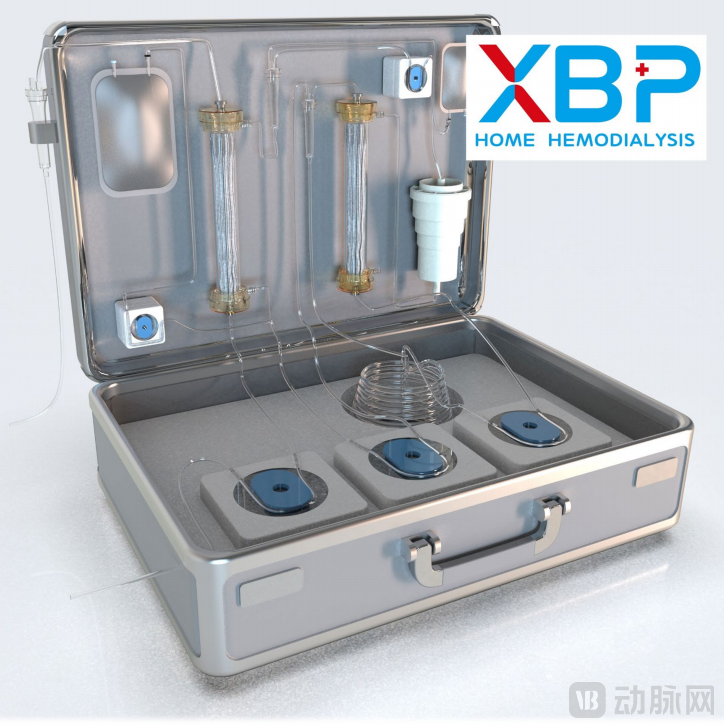
XBP Portable Hemodialysis Machine
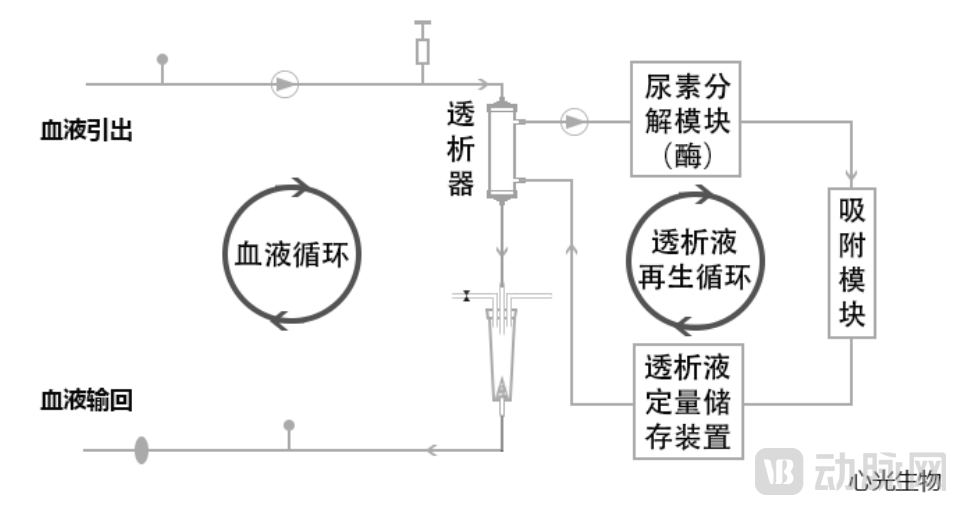
XBP - Schematic Diagram of Dialysate Regeneration-Type Dialysis Machine
XBP adopts a patient-centric approach, prioritizing ease of use and versatility across various scenarios. The device features a suitcase-style design, weighing less than 10 kg, with a discreet and minimalist aesthetic that facilitates portability and seamless integration into home environments. By utilizing 2–3 L of pre-prepared fluid, the system eliminates the need for water treatment and complex ultrafiltration control mechanisms. This design not only reduces the equipment’s footprint but also resolves dependency on water sources, requiring no modifications to household water or electrical systems. The device is ready for immediate use upon startup, minimizing environmental requirements. Ultrafiltration waste is discharged directly into the toilet, consistent with practices in dialysis centers.
Patients can freely choose the location and timing for hemodialysis, including but not limited to at home, while traveling, on business trips, or even in vehicles. This significantly reduces the impact of hemodialysis on patients’ daily lives and work, thereby lowering unemployment rates among this population. It is also suitable for special circumstances such as pandemics, emergency care, battlefield settings, and naval vessels, offering a wide range of application scenarios.
The system features an integrated consumable design and fully automated operation, minimizing operational complexity and the learning curve for users to the greatest extent.
Patient education and ensuring the safety of home use are critical components of the entire HHD process.
XBP adopts a four-step approach to HHD training.
Phase I: Patient Screening. After a patient applies to join the Home Hemodialysis (HHD) program, they must undergo rigorous physical examinations, health status assessments, and screening. Eligible patients must have stable conditions, no severe complications, a proactive willingness to participate in home hemodialysis with a clear understanding of the associated treatment risks, and have a caregiver—typically a family member or a younger patient—who has received relevant training.
Phase II: Theoretical Learning and Practical Training. Patients and their relatives will attend the hemodialysis center to receive 15–25 hours of theoretical and practical training. The curriculum covers fundamental knowledge of hemodialysis, dietary and lifestyle management for patients with uremia, vascular access care and practice, equipment operation, management of common alarms and complications during dialysis, emergency response protocols, and maintenance of dialysis machines. Practical training is conducted by professional nurses, followed by an initial assessment upon completion.
Phase III: On-machine Treatment Assessment. Upon passing the practical assessment, patients and their relatives must independently perform hands-on operations at the hemodialysis center for at least two weeks. The operator must demonstrate proficiency, independence, and composure in performing relevant procedures, managing emergencies, and communicating effectively. After successfully completing more than three treatments through collaborative efforts with both parties working independently, the on-machine assessment will be considered complete, and a corresponding training certificate will be issued.
Phase 4: During the first week of home use, nurses will conduct home visits to assess the home environment, provide guidance on equipment installation, and supervise the completion of three treatment sessions. Subsequently, patients are required to undergo regular medical examinations, including assessments of arteriovenous fistulas and complications, and to update their health status scores. Patients and their families can operate the system independently, with nurses providing remote guidance and monitoring. Meanwhile, XBP will implement dual-layer monitoring, enabling one nurse to simultaneously monitor 30–50 patients. This approach liberates both nurses and the center from cumbersome manual labor.
In terms of design, XBP’s dialysis regeneration-type dialysis machine incorporates online monitoring, an alarm system, and a remote interaction system. When patients or their families encounter unexpected situations, nurses can remotely guide operators in implementing appropriate measures. Similarly, when nurses detect abnormal physiological indicators through device monitoring, they can intervene immediately. If the patient or their relatives are unable to resolve the issue, the patient may return to the center for treatment until the problem is resolved. In case of emergencies or life-threatening conditions, the monitoring system enables immediate detection, cessation of treatment, and dispatch of physicians and ambulances to ensure patient safety.
According to Li Xianghai, over the past 30 years, hemodialysis has seen stagnation in terms of technology, cost, clinical benefits, and treatment models, with its development gradually shifting towards addressing the convenience of treatment.
Classifying hemodialysis treatment models by convenience, he divides future treatment paradigms into four generations, with each subsequent generation possessing the potential to disrupt its predecessor.
The first generation is a centralized treatment model, namely the dialysis center model that is currently widely adopted. It offers the least convenience and has the greatest impact on patients’ daily lives and work, representing a low-quality extension of life achieved at the cost of patients’ freedom.
The second generation is a community- or home-based portable hemodialysis model, allowing patients to freely choose the time and location for dialysis; this is the stage at which peritoneal dialysis currently stands.
The third generation consists of long-term, wearable, compact hemodialysis devices. These devices minimize the impact of hemodialysis on patients’ daily lives and work, while delivering greater clinical benefits. By continuously removing toxins and excess fluid, much like native kidneys, these dialysis devices have the potential to address cardiac complications in patients with uremia.
The fourth generation also represents an ideal solution: implantable artificial kidneys (such as those based on cells or animal organs) that can maintain function for years. However, their technical feasibility has not yet been scientifically validated, and commercialization remains a distant prospect.
Among these, wearable miniaturized hemodialysis devices are perhaps the most viable solution for the future, and dialysate regeneration technology represents the sole technical pathway.Multiple startups and medical device giants have already entered this sector,Over the next decade, community-based and home-based hemodialysis models will be the primary directions for innovation and development in the industry.
“Patients are dispersed; only by adopting a decentralized treatment model can we improve the overall treatment rate for uremia patients in China and enable them to return to normal life,” stated Li Xianghai firmly.
XBP will conduct clinical trials in both China and the United States simultaneously, prioritizing entry into the U.S. market. There are four reasons for this:
First, the HHD market in Europe and the United States is more mature, with well-established regulations, higher market penetration, and greater patient acceptance.
Second, the high cost of medical treatment in the United States, which is more than seven times that of China, with kidney disease treatment accounting for 20% of U.S. healthcare insurance. Starting from 2019, the U.S. government and the Centers for Medicare & Medicaid Services (CMS) actively subsidized home hemodialysis to reduce service fees, resulting in a more favorable policy environment that is more conducive to business development;
Third, hemodialysis devices are classified as Class II medical devices in the United States. Benchmark companies have obtained clearance through the 510(k) pathway, which requires only 30 clinical cases, thereby accelerating both clinical progress and regulatory approval.
Fourth, obtaining regulatory approval in the U.S. will facilitate a smoother regulatory submission process in China, where both the market and healthcare providers and patients demonstrate greater acceptance of HHD.
When asked how to compete with foreign manufacturers, Li Xianghai stated that the home hemodialysis (HHD) market is highly complex; having a good product alone is insufficient to penetrate it. Many companies have struggled despite years of operation. Most overseas HHD devices are miniaturized versions of hospital-grade equipment, featuring similar operational workflows, high complexity, and premium pricing. In contrast, XBP’s comprehensive solution for HHD offers stronger competitiveness and greater ease of use. Notably, through technological innovation and leveraging China’s manufacturing advantages, XBP has achieved significant cost advantages in both equipment and consumables. Furthermore, collaborative sales models—combining the innovative product strengths of startups with the commercialization capabilities of industry giants to achieve complementary advantages—are a key strategy for entering the U.S. market.
Finally, Li Xianghai stated that the hemodialysis industry has been stagnant for too long, and advancing the convenience of hemodialysis requires concerted efforts from the entire industry. Currently, XBP has completed the design and assembly of its prototype, as well as feasibility and safety testing in three large animal models: dogs, sheep, and monkeys. Despite lockdowns during the pandemic and market downturns, XBP has maintained rapid development and confidence in transcending market cycles. The company has now completed the design, assembly, and testing of its first-generation prototype and is preparing for large-animal testing in pigs.
Currently, XBP is initiating a new round of financing to support team expansion, the iteration of equipment and systems, and the production layout for consumables.