

Reverse Incubation and 'Science Research Enclaves': A Viable Pathway to Unlocking Innovation Resources?
Have you noticed a prevalent phenomenon? Resource concentration appears to exist across virtually every industry. In the field of medical innovation, developed regions represented by Beijing, Shanghai, Shenzhen, Suzhou, and Hangzhou have gathered the largest number of innovative enterprises and talents. Leveraging their comprehensive and robust industrial and supply chains, these regions continue to attract top-tier talent and companies, ultimately fostering a vibrant industrial ecosystem.
However, the situation is quite different in regions where industrial development is relatively immature. Due to incomplete supply chains and supporting infrastructure, as well as weak talent development, these areas face greater challenges in enterprise incubation and project attraction, leaving them with little competitiveness compared to regions with well-established ecosystems.
Consequently, the resource imbalance has become even more pronounced. Ultimately, innovation resources in developed regions have become increasingly saturated, while those in regions with less mature industrial development have grown ever scarcer, making it difficult to nurture innovative enterprises and attract talent.
In this context, the proposal of “scientific research enclaves” appears more as a measure of last resort, representing an innovation development strategy for regions at a disadvantage.
“Enclave” originated in the Middle Ages, referring to land that falls under the jurisdiction of a particular administrative region but is not contiguous with it. Strictly speaking, “scientific research enclave” is a virtual concept, whereby an administrative region allows enterprises registered within its boundaries to operate in another administrative region.
Due to the concentration of resources in the field of medical innovation, it is far more difficult for underdeveloped regions to achieve the “0 to 1” incubation of projects than for developed regions. For instance, because of immature supply chains, components, consumables, or assembly services required by project initiators can only be sourced in developed regions. In terms of industrial clustering, a greater number of peer companies and potential partners are likely located in these areas. Regarding talent recruitment, the absence of similar enterprises or specialized universities within the region hinders both talent mobility and hiring efforts. Furthermore, as developed regions already boast mature industries, most top-tier talents have settled there. Their families, daily lives, and their children’s education are deeply integrated into these cities, making it difficult for them to relocate to other locations.
Therefore, compared with the rigid introduction of projects and talent, it is more feasible to adopt a flexible approach through the “scientific research enclave” model, which allows talent to innovate and incubate locally, and then transfer the industrialization of projects back once they have matured.
Depending on the participating roles, the operational models of “scientific research enclaves” can be categorized into two types: single-entity and collaborative.
The establishment of single-type “R&D enclaves” is primarily driven by the “enclave initiator’s” demand for industrial innovation. Under this model, regions with underdeveloped industrial infrastructure allow project proponents to register companies within their jurisdiction while operating offices elsewhere. During this period, the registered companies and their team members are eligible for local policy support and talent subsidies. In return, once the projects achieve industrialization, the proponents must relocate their production bases and sales operations back to the jurisdiction of the region with underdeveloped industrial infrastructure.
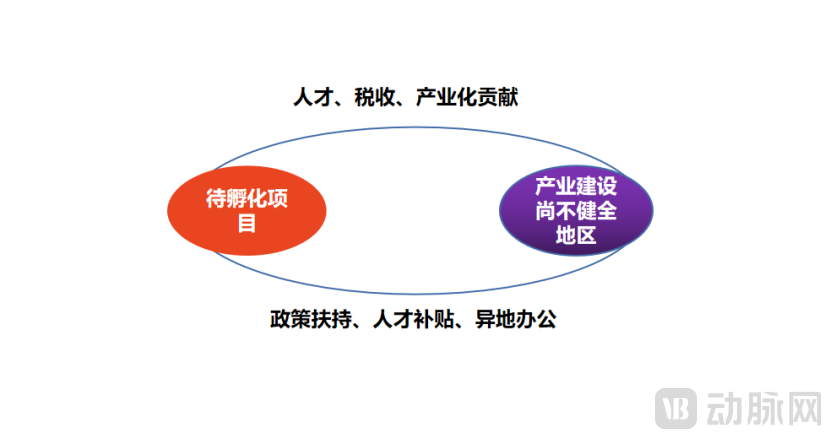 Single-Type "Research Enclave" Operation Model
Through this model, project sponsors have resolved issues related to industrial support, resources, and supply chains, enabling team members to work remotely without the need for relocation. For regions with underdeveloped industrial infrastructure, although the project sponsors do not initially conduct physical operations within their jurisdictions, these regions still retain the resulting tax revenues and outcomes, thereby meeting their needs for industrial development and innovation.
“Collaborative” research enclaves incorporate the role of the local jurisdiction hosting the enclave, building upon the model of single-type “research enclaves.” Rather than unilaterally poaching projects, this model fosters collaboration between developed regions and areas with less mature industrial infrastructure.
In developed regions, industrial competition accompanies resource abundance. The emergence of collaborative "R&D enclaves" has, to some extent, alleviated the pressure caused by high industrial congestion in these areas. This model first requires a consensus between developed regions and regions with underdeveloped industrial infrastructure, allowing project entities to register in the latter while maintaining their offices in the former. During this period, project entities can benefit from support policies and talent subsidies in both locations. Similar to single-type "R&D enclaves," production still takes place in regions with underdeveloped industrial infrastructure; however, the resulting production capacity and tax revenue are distributed through negotiation between the two participating regions involved in the incubation process.
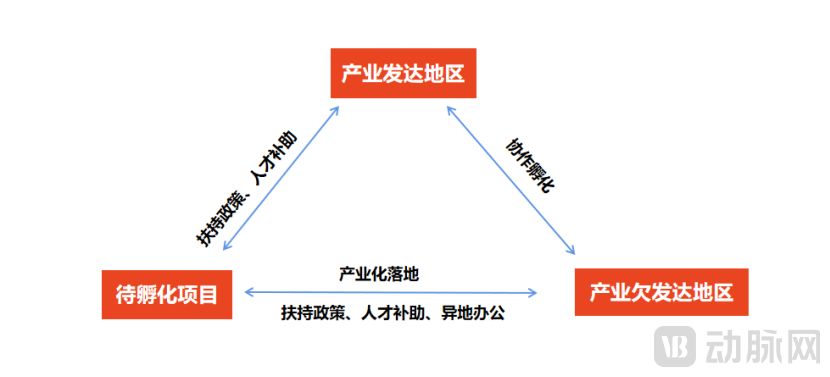
Collaborative "Research Enclave" Operational Model
The collaborative model shares certain similarities with the aforementioned one; however, it differs in that the initiators of demand include both developed regions and areas where industrial development is still underdeveloped. Unlike the unilateral exploitation of innovative resources from developed regions by areas with underdeveloped industries, this model fosters collaboration and symbiosis between two cities.
Collaborative “Research Enclaves” Emphasize Symbiosis Between Two Regions. On one hand, certain resource-rich areas may face greater challenges in production and construction. For instance, the “Chongqing Medical University Surrounding Innovation Ecosystem” is located in the urban area, where industrial land is relatively scarce. On the other hand, labor costs are higher in developed regions. For developed areas encountering difficulties in production and construction, it would represent a significant loss if project teams relocate to other cities after successful incubation due to such constraints. Therefore, collaborating with less-developed regions that have abundant industrial land, lower labor costs, and an aspiration to develop corresponding industries—despite their currently immature industrial infrastructure—proves to be a sound strategy.
This model creates a win-win-win situation for all three parties. Regions with underdeveloped industrial infrastructure secure projects, developed regions alleviate land-use pressures, and project proponents benefit from supportive policies and administrative conveniences in both locations, while also enjoying lower production costs.
In the “R&D Enclave” model, project sponsors reap short-term benefits, while regions with underdeveloped industrial ecosystems can secure long-term gains by assisting these sponsors in completing incubation. In conventional project attraction efforts, investing authorities invariably seek to have both the project entity and its team physically relocate to their jurisdiction. However, the feasibility of this approach is not always high in practice. By adopting the “R&D Enclave” model, regions with less mature industrial infrastructure temporarily forgo the immediate job creation associated with on-site project implementation, allowing project sponsors to conduct incubation in areas with more robust supporting facilities. This strategy not only reduces the difficulty of attracting projects but also mitigates risks during the early stages of incubation.
The role of developed regions exists solely within the collaborative “scientific research enclave” model, where their motivation to participate stems from pressures caused by project overload and land scarcity. The existence of the single-entity “scientific research enclave” model has, to some extent, created competition between regions with underdeveloped industrial infrastructure and developed regions, a rivalry that persists during both the project incubation and production phases. In particular, during the production phase, if regions with underdeveloped industrial infrastructure can resolve their transportation and logistics challenges, developed regions may even find themselves at a disadvantage due to rising costs associated with resource concentration. For local governments, the commencement of production marks the successful completion of the “0-to-1” incubation process and signifies contributions to tax revenue and GDP. Therefore, the collaboration in the “scientific research enclave” model serves two purposes: on one hand, it prevents project outflow; on the other, it allows resources to be concentrated on a larger number of projects to achieve higher growth.
Regardless of the model, the project initiators’ demands are clear: they seek more substantial support, a more favorable development environment, and access to industrial resources, while avoiding disruptions to their existing lives. Therefore, the proposal of “research enclaves” meets these demands and spares them from a dilemma.
Whether it is a standalone “research enclave” or a collaborative “research enclave,” project sponsors can carry out the “0-to-1” incubation in cities where resources are more concentrated or with which they are more familiar. Furthermore, as key projects introduced to regions with underdeveloped industrial infrastructure, they are bound to receive significant attention and targeted support from local authorities. This can provide substantial momentum during the early stages of project development, while talent subsidy policies can also confer advantages in recruiting personnel.
Moreover, in collaborative “scientific research enclaves,” project proponents can benefit from support by the governments of both regions, and may even enjoy double the cumulative policy incentives.
Through these two models, it is not difficult to identify that the essential parties for the formation of “research enclaves” are regions with underdeveloped industrial infrastructure and project sponsors. In either model, the demands of these two parties are more pronounced (particularly in regions with underdeveloped industrial infrastructure). As for developed regions, although they may find roles to participate in if corresponding needs exist, their involvement is not mandatory.
In the single-type “research enclave” model, what is reflected is the cooperation and consensus between regions with underdeveloped industrial infrastructure and project proponents. However, under this model, in addition to the inherent risks of early-stage project incubation, there may be other potential hazards.
First, although the project entity is registered in a jurisdiction with underdeveloped industrial infrastructure, its actual operations are conducted in other cities. Consequently, prior to any decline in the project entity’s production and construction activities, the industrial infrastructure in the underdeveloped region remains scarce, failing to attract enterprises from upstream and downstream industry chains and supply chains to establish operations there. As a result, the fundamental issue of industrial scarcity cannot be resolved.
Secondly, due to remote operations, apart from necessary reporting, there are certain barriers in communication and exchange with project partners in regions where industrial infrastructure is still underdeveloped. This hinders real-time understanding of the actual progress of projects, and may even lead to situations where project partners engage in “superficial compliance” merely to meet operational targets.
For regions with underdeveloped industrial infrastructure, project introduction under the “research enclave” model is akin to a virtual product. Consequently, some regions have begun constructing “enclave incubators” or collaborating directly with existing incubators, using these platforms as vehicles to materialize the “research enclave” concept.
The involvement of incubators has given rise to an alternative operational model for the single-type “research enclave.” In regions where industrial infrastructure is still underdeveloped, enclave projects within the city can be concentrated in a single location, or their management can be entrusted to the incubator operator.
At the incubator level, collaboration with regions where industrial infrastructure is still underdeveloped allows for access to operational subsidies and a pipeline of project opportunities. Furthermore, for incubators with specialized professional service capabilities, this model facilitates the promotion of their service-oriented businesses. Consequently, enclave incubators are gaining popularity across various regions.
Taking Jiangsu Province as an example. In recent years, Jiangsu has promoted the development of "enclave" incubation platforms and explored a "reverse innovation" model characterized by "R&D and incubation conducted elsewhere, with industrialization localized." According to incomplete statistics, the province has established more than 60 such "enclave" incubation platforms, achieving notable results in collaborative enterprise R&D, the introduction of high-end talent projects, the incubation of technology-based enterprises, and coordinated industrial development.
Overall, these vectors have three characteristics:
First, policy support has become systematic. Cities such as Suzhou and Wuxi have taken the lead in introducing policies to support the development of “enclave incubation,” encouraging the establishment of sci-tech entrepreneurship service institutions outside their respective municipalities and guiding the agglomeration of talent, technology, capital, and other factors from regions with vibrant innovation and entrepreneurship activities into their local areas. Taicang City provides subsidies covering 50% of the actual rent incurred for “enclave” incubators established outside the city and duly registered, with an annual cap of RMB 2 million. Jiangyin High-Tech Industrial Development Zone offers operational subsidies of up to RMB 5 million per year to partners involved in the branded operation of “enclave” incubators.
Second, diversified operational models. The operation of "enclave" incubation carriers adopts various approaches, including government cooperation, government-enterprise collaboration, and joint enterprise development. These include establishing new incubators in other locations to implement "enclave incubation" through resource linkage, as well as prioritizing the "commercialization of scientific and technological achievements" model for enclave incubation. For instance, Shangrao International Medical Tourism Pilot Zone, together with Osida, a renowned service provider in the medical device industry, and other partners, jointly created Shangrao Med-Inno Hub. It is committed to providing one-stop solutions for doctors, scientists, and entrepreneurs, covering R&D, production, regulatory approval, and mass production. Nantong and Shenzhen jointly established an "enclave" incubator, leveraging the local advantage of clustering well-known enterprises in the next-generation information technology sector to achieve functions such as talent aggregation, project introduction and cultivation, and industrial cluster development. Suzhou established an "enclave incubation" industrial innovation center near Tsinghua University, playing a supportive role in hosting competitions and events, policy promotion, talent referral, and project incubation.
Third, the construction layout is becoming increasingly clustered. From the perspective of the "sending" locations of enclave incubation carriers, Suzhou accounts for 31.8%, Wuxi for 20.3%, Yancheng for 13%, and Nantong for 10.1%. From the perspective of the "receiving" locations, these carriers are mainly concentrated in major regional central cities with dense innovation resources, such as the Beijing-Tianjin-Hebei region, the Yangtze River Delta, and the Guangdong-Hong Kong-Macao Greater Bay Area, among which Shanghai accounts for 43.4%, Beijing for 17.4%, and Shenzhen for 13%.
Regional incentives have also spurred enthusiasm among enterprises engaged in industrial incubation. Enclave incubators, such as Zhongguancun Incubator and Ausda Med-Innovation Hub, are flourishing across China.
Furthermore, “scientific research enclaves” with incubator involvement are not only prevalent in China but have also given rise to an offshore incubation model to facilitate the introduction of overseas projects.
Taking OSCDA MedInnoHub as an example, by establishing domestic and international sci-tech innovation and R&D platforms in industrial hubs such as Shanghai, Beijing, Shenzhen, Guangzhou, and Berlin, Germany, it has built a research and translational mechanism aligned with international standards. Implementing an open and shared operational model, it attracts high-caliber global scientific experts, physicians, and innovators/entrepreneurs to settle in. OSCDA MedInnoHub provides full-chain industrial technical services integrating R&D translation, incubation, and investment, cultivating medical device innovations with significant breakthroughs and application value, and delivering “research enclave” services across China.
As initially stated, the proposal of “scientific research enclaves” was a last-resort measure for regions with underdeveloped industrial infrastructure to foster innovative industries. So, has this model ultimately resolved the dilemmas faced by such regions? It seems that this question is difficult to answer.
The “research enclave” model has addressed some of the challenges faced by regions with underdeveloped industrial infrastructure in attracting projects. This flexible approach will help them draw in more initiatives. Indeed, the “research enclave” model has enabled developed regions to release their accumulated resources outward. These resources include talent, projects, and industrial mindset. For many projects that lack significant competitive advantages in developed areas, relocating their corporate registration may secure them more substantial support. Overall, this will create more opportunities for a broader range of projects across the industry.
However, under the “scientific research enclave” model, what these regions can ultimately introduce and operate locally is merely the production phase of projects. The “0-to-1” stage of project development continues to be incubated in more developed regions. Consequently, it is difficult for these areas to form industrial clusters before projects are implemented for production. Ultimately, industrial development still relies on reverse incubation after the projects have been established locally.
Therefore, if a black-and-white answer is desired, “scientific research enclaves” have indeed alleviated, to some extent, the difficulties faced by regions with underdeveloped industrial infrastructure. However, this represents only the first step in industrial development. To truly achieve robust industrial construction, the supply chain, talent chain, and industrial chain must all be addressed through reverse or forward incubation.
Special Acknowledgements: We extend our sincere gratitude to Mr. Zhang Feng, Chairman of OZDA Medical Device Services Group; Mr. Huang Ying, Deputy Dean of the Zhongke Yichuang Research Institute; and Mr. Chen Qiang, Director of Government-Enterprise Cooperation at Danhuang Technology, for their strong support of this article!