

WeDoctor Honored as 'Outstanding Digital Technology Enterprise of the Year' for Pioneering Innovations in AI-Driven Healthcare
On August 19, the 2022 Enterprise Digital Intelligence Application Conference and the 7th SaaS Application Conference were held. The conference focused on the application of digital intelligence technologies in industries, as well as hot topics such as enterprise digital transformation and SaaS application trends. Dr. Wang Yang, President and CTO of WeDoctor, was invited to attend and shared WeDoctor’s innovative practices in leveraging digital intelligence medical technologies to promote high-quality industry development.
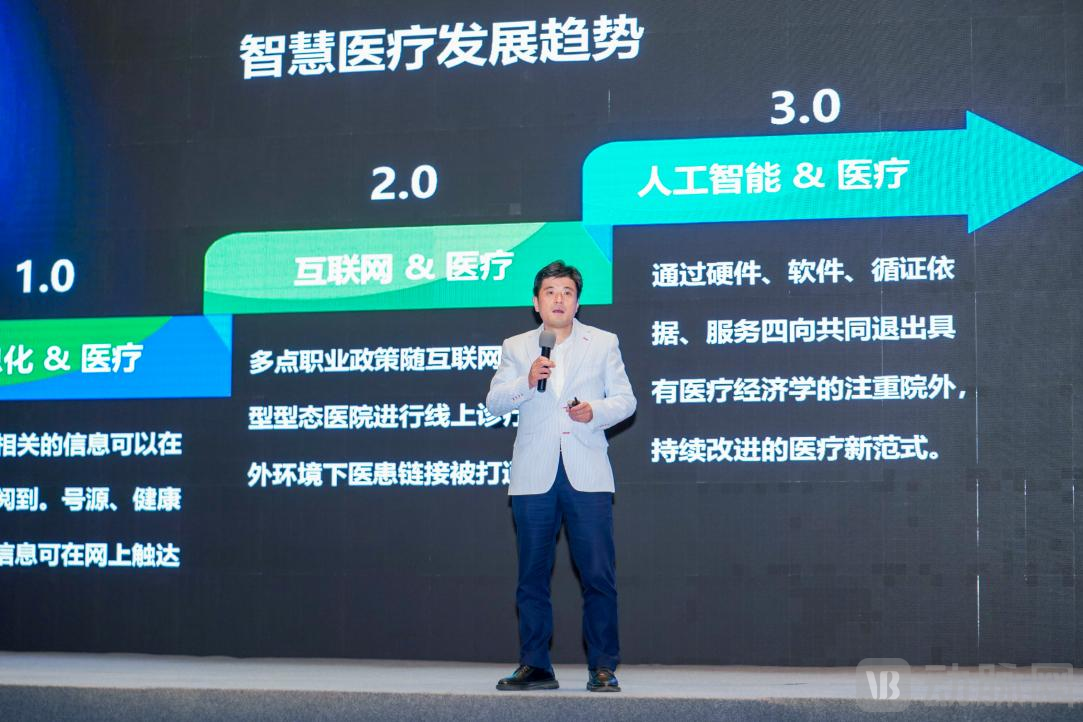
Dr. Wang Yang, President and CTO of WeDoctor
During the conference, CSIC 2022 “Cloud Awards,” a bellwether in the digital sector, announced its selection results. WeDoctor was honored with the “Outstanding Digital Technology Enterprise of the Year” award for its sustained leadership in driving the digital and intelligent transformation of the healthcare industry, particularly through its proactive exploration in the development and application of “AI + Healthcare” and innovation in digital healthcare service models.
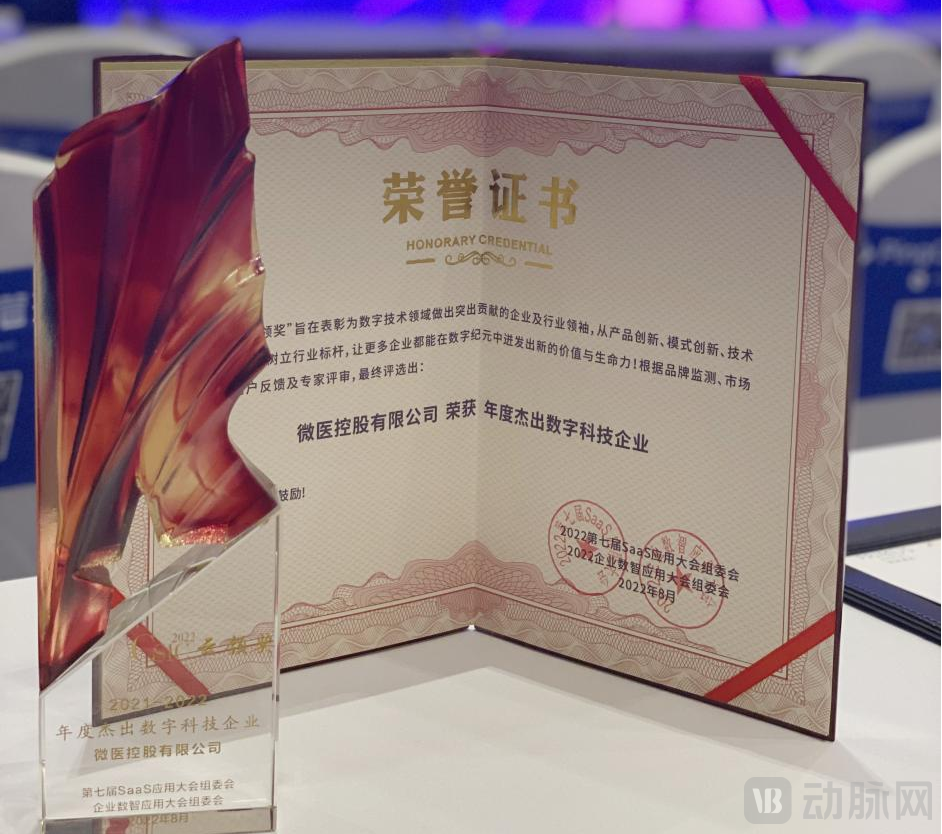
Figure | WeDoctor Wins “Outstanding Digital Technology Enterprise of the Year” Award
“The development of smart healthcare has, to date, undergone three stages: ‘Informatization + Healthcare,’ ‘Internet + Healthcare,’ and ‘Artificial Intelligence + Healthcare.’” Dr. Wang Yang believes that artificial intelligence represents the high ground in global technological competition. Advancing the application of AI technologies in the medical and health sectors is of great significance for accelerating breakthroughs in the prevention and control of major diseases, securing a leading position in the development of emerging strategic industries related to biomedicine, and optimizing China’s healthcare service system.
In 2017, the State Council issued the Development Plan for New-Generation Artificial Intelligence, which explicitly called for promoting and applying new models and methods of AI-enabled treatment, and establishing a rapid and precise intelligent healthcare system.
Dr. Wang Yang stated that, encouraged by national policies, WeDoctor has been continuously deepening its efforts in “AI + Healthcare.” In the field of Traditional Chinese Medicine (TCM), WeDoctor developed the TCM Brain “Huatuo Cloud” to assist grassroots TCM physicians in prescribing. It has now been implemented in over 2,000 hospitals, cumulatively assisting doctors in issuing 6.5 million prescriptions. In the field of Western medicine, WeDoctor jointly established the Ruiyi Medical AI Research Center with Zhejiang University. Leveraging digital technologies such as artificial intelligence, big data, and cloud computing, they developed the Ruiyi Smart Doctor, an AI-driven diagnostic and therapeutic application for Western medicine. Relying on its robust R&D and application capabilities in “AI + Healthcare,” WeDoctor has achieved breakthrough progress in multiple areas, including intelligent fundus screening, AI-assisted diagnosis of pulmonary nodules, intelligent ECG-assisted diagnosis, colposcopy-assisted diagnosis, and clinical decision support for liver cancer. Additionally, intelligent devices developed by WeDoctor, such as gene chips, smart all-in-one machines, and the WeDoctor Health Connect, have been widely adopted, significantly enhancing the quality and efficiency of primary healthcare services.
Taking intelligent fundus screening as an example, the “Computer-Aided Diagnosis Software for Fundus Imaging” supports auxiliary screening and diagnosis for nine types of fundus diseases, including diabetic retinopathy and macular degeneration, achieving an accuracy rate of 94.5%. By deploying this intelligent fundus screening system in primary healthcare institutions, fundus complications associated with chronic conditions such as diabetes and hypertension can be detected early, enabling early diagnosis and treatment. The system received Class III medical device certification from the National Medical Products Administration in April 2022.
“Cervical Colposcopy-Assisted Diagnostic System” can identify and locate cervical lesions with an accuracy rate of 85%. By being deployed in secondary hospitals or county-level hospitals, this system can assist physicians in performing colposcopy, reduce the risk of missed diagnoses, and be integrated into public health services for “two-cancer screening,” thereby improving regional coverage of cervical cancer screening.
“WeDoctor Health Connect” smart devices integrate 10 medical-grade detection modules, including those for blood pressure and blood glucose, with online medical health management services, enabling a single device to handle daily health monitoring and management for the entire family.
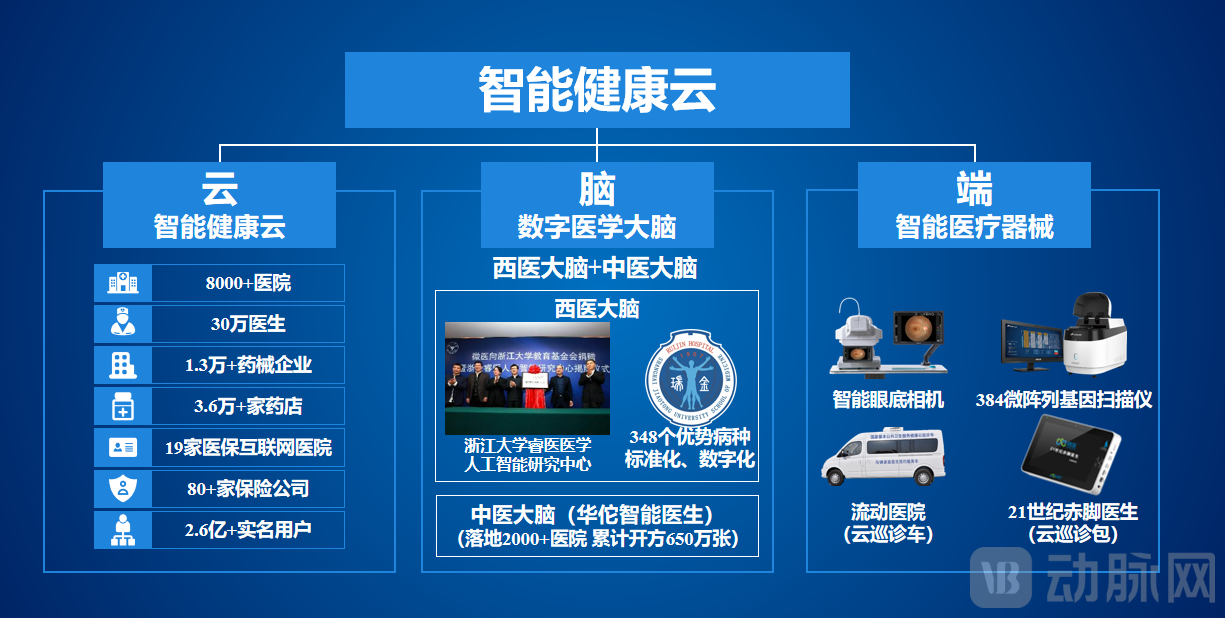
WeDoctor Smart Health Cloud
According to reports, these digital-intelligence healthcare applications, which span multiple disciplines and diverse scenarios, constitute a vital component of WeDoctor’s Intelligent Health Cloud service ecosystem. The WeDoctor Intelligent Health Cloud system comprises three core elements: “Edge” (intelligent medical devices), “Cloud” (Intelligent Health Cloud), and “Brain” (Digital Medical Brain). By leveraging intelligent terminals such as smart fundus cameras, gene scanners, and mobile hospitals, the system extends its reach to various settings, including rural areas, communities, households, and schools.Enabling residents to access, anytime and anywhere, medical resources from approximately 8,000 hospitals and 300,000 doctors across China connected via the WeDoctor Smart Health Cloud, as well as intelligent services powered by emerging technologies such as the internet, the Internet of Things (IoT), and artificial intelligence, thereby facilitating the decentralization of high-quality medical resources to grassroots levels and communities, and extending them into households.。
Meanwhile, as an open platform, WeDoctor’s Intelligent Health Cloud leverages the interconnected support of devices, cloud infrastructure, and AI capabilities to upload medical data accumulated from intelligent terminals to the cloud for processing. This further establishes a robust “Digital Medical Brain,” enabling high-level, diversified development and application of “AI + Healthcare.”
Dr. Wang Yang also stated that the development of new digital-intelligent healthcare technologies, such as “AI + Healthcare,” has not only driven technological upgrades within the industry but also facilitated the construction of new formats and models in digital healthcare. This has achieved the optimization and reshaping of the healthcare service system, holding significant importance for promoting the transformation of China’s healthcare industry.
As is well known, the healthcare management and service system suffers from “uneven distribution of medical resources,” “information asymmetry in the pharmaceutical market,” and “ineffective health insurance payment methods,” leading to persistent problems such as “difficulty in accessing medical care,” “high medical costs,” and over-treatment. China’s decade-long “Three-Medical Linkage” new healthcare reform has been launched specifically to address these three major challenges, with digital healthcare emerging as a key element of the “Chinese solution.”
“Internet + Healthcare” approaches, such as online consultations and telemedicine, have alleviated the challenges of uneven distribution of medical resources and the difficulty grassroots populations face in accessing healthcare. Centralized bulk procurement of pharmaceuticals, medical devices, and consumables has eliminated artificially inflated prices through open, transparent market bidding and economies of scale. Meanwhile, reforms in health insurance payment methods aim to shift healthcare services from fee-for-item and fee-for-volume models to a health-centric, pay-for-performance model.
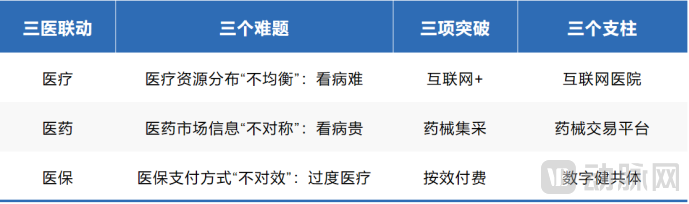
Figure | WeDoctor’s Three Innovations in Driving Healthcare Industry Upgrades Through Digitalization
In 2015, WeDoctor established China’s first internet hospital, the Wuzhen Internet Hospital. According to data from the National Health Commission, the number of internet hospitals across China has now exceeded 1,700. In 2017, the Haixi Pharmaceutical Trading Center, founded by WeDoctor to support the Sanming healthcare reform, undertook the construction of the National Healthcare Security Administration’s national platform for drug and medical consumable procurement and bidding. It was also exclusively commissioned by the Sanming Procurement Alliance (National) to conduct cross-regional joint procurement of drugs and medical supplies. Furthermore, in 2019, WeDoctor took the lead in proposing the exploration of a Chinese-style health stewardship organization—the Digital Health Community—which integrates regional healthcare institutions through digital means to provide integrated online-offline health stewardship services accessible to residents in their local areas.
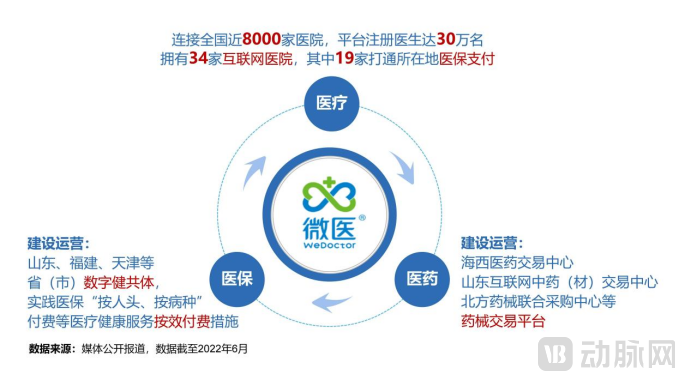
Progress of WeDoctor’s Medical Services, Pharmaceuticals, and Medical Insurance Businesses (Compiled from Public Sources)
Latest data show that, as of June 2022, WeDoctor operated 34 internet hospitals across China, 19 of which had integrated local medical insurance payment systems. Meanwhile, leveraging pharmaceutical and medical device trading platforms such as the Haixi Pharmaceutical Trading Center, the Shandong Internet Traditional Chinese Medicine (Materials) Trading Center, and the Northern Pharmaceutical and Medical Device Joint Procurement Center, WeDoctor has innovatively launched cross-regional joint procurement of pharmaceuticals and medical devices, thereby supporting healthcare reform initiatives from Sanming to the national level. Furthermore, WeDoctor’s Digital Health Community has achieved routine operations in provinces and municipalities including Shandong, Fujian, and Tianjin, with the business volume and revenue of its digital health communities in multiple cities reaching or even surpassing those of large tertiary hospitals.
It can be said that,WeDoctor has successively established and interconnected three innovative systems: its Internet Hospital, the centralized procurement platform for pharmaceuticals and medical devices, and the Digital Health Community. These initiatives are forming a digital healthcare development pathway aligned with China’s comprehensive “Three-Medical Linkage” reform—integrating medical care, pharmaceuticals, and health insurance—and have pioneered a sustainable business model for the robust growth of digital healthcare.。
Dr. Wang Yang concluded by stating that the healthcare industry is a sector with broad prospects. WeDoctor is leveraging digital power to complete the industry’s value loop and exploring the establishment of a Chinese-style Health Maintenance Organization (HMO) to serve as a “health gatekeeper” for hundreds of millions of people.