

China's First Fully Bioresorbable Zinc-Alloy Cerebrovascular Stent Breaks Through Technical Barriers with Global Leadership
Intracranial arterial stenosis is a major cause of ischemic stroke. In China, the incidence of intracranial arterial stenosis has alreadyUp to 13.2%, is one of the major diseases threatening cerebrovascular health in China.
Currently,Stent ImplantationIt is one of the effective treatments for intracranial arterial stenosis, but most cerebrovascular stents are made from traditional alloy materials and cannot be degraded.
Therefore, the stent will remain permanently implanted in the body after placement, with a high likelihood of triggering chronic vascular inflammation, delayed vascular healing, and in-stent thrombosis. Patients need toLifelong Antiplatelet Therapyto reduce the likelihood of complications, which inevitably imposes a significant psychological burden on patients and places strain on medical resources.
According to statistics,China's annual market value for cardiovascular and cerebrovascular stent consumables is approximately RMB 40 billion, with over 80% of cerebrovascular stents relying on imports.This has significantly limited the development of medical care for intracranial ischemic diseases in China.
All signs point to one issue—There is an urgent need to advance research on biodegradable cerebrovascular stents in China.
Based on 22 years of clinical research experience in cerebrovascular diseases, fromProfessor Liu Aihua, Beijing Tiantan HospitalHe and his team identified this critical unmet medical need and embarked on the development of bioresorbable cerebrovascular stents. After six years of research, they finally succeeded in developing"Biodegradable Zinc Alloy Stent for Head and Neck"(hereinafter referred to as the biodegradable cerebrovascular stent).
Professor Liu Aihua told VCBeat’s Orange Bureau: “This bioresorbable intracranial stent can be considered a first-of-its-kind innovation; it not only provides excellent radial support but also degrades rapidly, offering substantial application potential in the field of cerebrovascular disease.”
So, how exactly does the “biodegradable zinc alloy stent for head and neck” achieve degradation? What efforts have Professor Liu Aihua and his team made over these six years? With these questions in mind,VBInsight Orange BureauA Deep Dialogue with Professor Liu Aihua.
After Six Years, the Ideal “Biodegradable” Material Is Finally Found
Before discussing bioresorbable stents, we must first clarify one issue:“Biodegradable” = “Absorbable”?
To the layperson, these two statements appear to make little difference; in both cases, the stent is not removed through external intervention but instead disappears on its own within the blood vessel.
"In fact, this is not the case. Professor Liu Aihua stated, '‘Absorbable’ should by no means be equated with ‘biodegradable.’ Absorbable stents are typically made from polymer materials and are gradually stripped away and carried off by blood flow. While this approach addresses vascular complications arising from the inability to remove stents from the body, it introduces new risks. After all, being stripped away and transported by blood does not mean complete disappearance; there is a high likelihood of accumulation elsewhere, potentially triggering other vascular diseases. In contrast, the ‘biodegradable’ stents we aim to develop are completely phagocytosed and eliminated by cells, thereby fundamentally resolving the risks associated with stent implantation.'"
Thus, it would seem that achieving “biodegradability” is as simple as identifying materials that can be phagocytosed by cells.
But the process was far from simple. It took Professor Liu Aihua a full six years to identify materials that met the “degradation requirements.”
Initially, Professor Liu Aihua experimented with polylactic acid (PLA), a type of polymer material.
However, after the trials, Professor Liu Aihua found that the mechanical properties of polylactic acid (PLA) were insufficient to provide adequate support, and its apposition to the blood vessel walls required further optimization. Most critically, its safety could not be guaranteed. As previously mentioned, PLA can be degraded and washed away by blood flow, posing a significant risk of causing vascular occlusion, compressing the vascular lumen, leading to unnecessary complications, and thereby jeopardizing patient health.
Therefore, Professor Liu Aihua decided to forgo the highly popular polymer materials in the market and chart a new course.
Since the mechanical properties of metal stents can meet the required standards, efforts should be focused on metallic materials. For his second material choice, Professor Liu Aihua selected magnesium alloy.
Magnesium alloy materials can not only provide sufficient mechanical support but also undergo cellular phagocytosis and degradation, making them nearly ideal biomaterials. However, magnesium alloys degrade too rapidly, completely resorbing within 6–12 months. Such a short degradation period cannot ensure complete vascular recovery, leading to the abandonment of this material.
Subsequently, Professor Liu Aihua also experimented with iron alloy materials, but they were abandoned due to their excessively long degradation time.
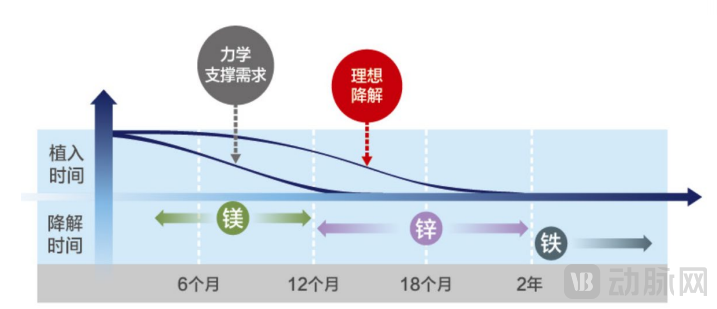 Mechanical Support and Degradation Cycle of Different Materials
Each failure provided Professor Liu Aihua with experience and inspiration. Ultimately, through screening via materials genomics, he finalizedZinc Alloyas a scaffold material.
Because the mechanical properties of zinc alloys are far superior to those of biodegradable vascular stent materials and meet the requirements for orthopedic implant materials. Furthermore, both in vivo and in vitro studies have demonstrated that zinc alloys are non-toxic and exhibit excellent biocompatibility. In summary, zinc alloys are the most ideal material in terms of both support strength and degradation rate.
Professor Liu Aihua explained to VCBeat, “Our experimental results show that zinc alloy materials begin to degrade gradually after six months, achieving 90%–95% degradation within approximately two to three years. This ensures adequate vascular support, making it an excellent material for cerebral vascular stents. Our findings are at the forefront globally; therefore, we are confident in our ability to refine this technology and transform the current landscape of cerebral vascular stents in China.”
World’s First Biodegradable Vascular Stent Developed in China
Finalizing the materials is only the first step in the research and development of biodegradable vascular stents. InStent shaping, material thickness, and drug coatingFurthermore, Professor Liu Aihua has her own ingenious ideas.
Firstly,Stent Shaping. Given that the diameter of cerebral blood vessels is extremely small, much narrower than that of coronary vessels, there is a higher requirement for the precision of stents.
However, the use of zinc alloys in stents remains limited, as full control over their shaping technology has not yet been achieved. Therefore, Professor Liu Aihua employed multiscale simulation methods to elucidate the scientific principles governing the solidification and hot/cold working processes of zinc-copper alloys.
Professor Liu Aihua has successfully elucidated the properties of zinc alloys, marking a major breakthrough in the “Biodegradable Cerebrovascular Stent” project and laying a solid foundation for future research on the application and development of zinc alloy materials.
Secondly, it is regarding theStent Thicknesscontrol. To ensure that the intravascular diameter is not compromised after stent implantation, thereby affecting blood flow, the stent must be extremely thin.
Certainly, thickness control can be achieved through industrial techniques; however, these techniques cannot achieve precise control within the 0.7–0.8 mm range. Therefore, efforts must focus on structural design.
Professor Liu Aihua adopted"Double-S" Structural Design, which reduces the material surface area while also minimizing spatial occupancy within the blood vessel.
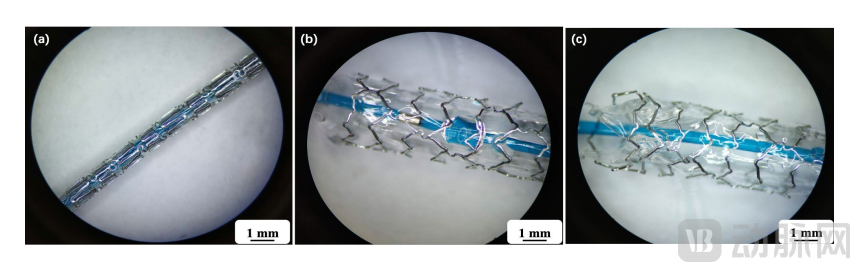 “Double-S” Structural Details
Professor Liu Aihua told VCBeat’s Orange Fruit Bureau: “The stent constructed with a ‘double-S’ structure has thinner struts than existing intracranial stents, which undoubtedly improves blood flow and reduces the risk of vascular occlusion in patients. Currently, our technology can maintain the stent thickness at 0.8 mm, while the thinnest available globally is 0.7 mm. In the next step, we aim to further reduce the stent thickness to 0.7 mm. This represents both the technical limit and our goal.”
Finally,Drug CoatingThis is equally critical. After the stent is implanted in the body, there is a high likelihood of rejection; therefore, a drug-eluting coating must be applied to the stent surface to reduce the risk of rejection.
Professor Liu Aihua employed an asymmetric coating technology. With the stent encased in a drug-eluting coating, it undergoes rapid endothelialization upon implantation and contact with the vascular endothelium. The stent becomes embedded within the vascular endothelium, significantly enhancing both its stability and vascular support.
The invention of this technology is not limited to intracranial stents; it can also be applied and expanded in fields such as cardiac stents. Professor Liu Aihua stated, “Our research on asymmetric coating drug technology is a pioneering innovation in China, and has currently obtained”International PCT Patent Grant. The next step is for our technology to enter the phase of early-stage clinical trials, with the aim of providing new insights to more peers in the field of stent development.”
Three People “Gathering Firewood” Make the Flame Burn Higher
As the Director of the Neurointerventional Ward at Beijing Tiantan Hospital, Professor Liu Aihua possesses extensive clinical experience in the field of cerebrovascular diseases and has published 136 SCI-indexed research papers, demonstrating remarkable achievements in scientific research.
But he said:“If I were the only one, this technology would have been impossible to complete.”
As a clinician, Professor Liu Aihua aims to translate scientific research into practical applications. However, regardless of his understanding of the market, his technical expertise is necessarily confined to his own specialty; he cannot claim comprehensive mastery across all domains, particularly in areas such as biomaterials and medical devices.
Therefore, Professor Liu Aihua’s team has two other key collaborators: one is the Dean of the School of Materials Science and Engineering at the University of Science and Technology BeijingProf. Wang Luning, another recipient of the 2020 National Science and Technology Progress AwardProfessor Zhang Haijun。
These two professors specialize in materials science and medical device development, respectively, and have extensive experience in researching coronary stents. This time, Professor Liu Aihua joined forces with them, leveraging their combined expertise to develop the “biodegradable cerebral vascular stent.”
Professor Liu Aihua stated, “Abroad, many physicians engaged in scientific research have backgrounds in engineering, enabling them to more accurately and rapidly identify suitable materials and application areas when developing medical devices. In China, however, engineering and medicine are distinctly separate disciplines. Under these circumstances, clinical physicians must collaborate with multidisciplinary talents and form teams to more effectively address gaps within their own field.”
Indeed, medical-engineering collaboration has become a major trend in scientific research within China’s healthcare sector. An increasing number of interdisciplinary talents are emerging, driving the advancement of modern medicine in China. As Professor Liu Aihua stated:“Harnessing collective wisdom to push scientific research to its utmost limit.”This marks the successful pathway for Professor Liu Aihua’s “Biodegradable Cerebrovascular Stent,” and it will also represent the future direction of medical development in China.