

JD Health Reports RMB 20.2 Billion in H1 Revenue, Advances Deliberate 'Digital-Intelligent Healthcare' Strategy

JD Health
Internet Medical and Health Service Platform Provider
On August 23, JD Health released its 2022 interim results report: Over the 12 months ended June 30, 2022, active users exceeded 131 million; total revenue for the first half of the year reached RMB 20.2 billion, a year-on-year increase of 48.3%; adjusted net profit amounted to RMB 1.21 billion, up 82.0% year on year. Alongside steady growth in total revenue, profitability further strengthened.
Meanwhile, JD Health also presented a set of impressive operational data:
In terms of healthcare services, JD Health’s internet hospital handles over 250,000 online consultations per day on average. JD Family Doctor has been upgraded to incorporate more professional roles, offering richer and more comprehensive health management. Partnerships for consumer healthcare services now cover more than 500 cities across China, with over 40,000 service outlets.
In terms of the pharmaceutical supply chain, the number of drug and non-drug warehouses nationwide has increased to 20 and over 450, respectively. JD Pharmacy’s “self-operated cold chain” capability now covers more than 240 cities across China, and its offline DTP (Direct-to-Patient) pharmacies have expanded to 26 provincial-level administrative regions. “JD Medicine Express” collaborates with over 60,000 merchants to provide all-channel, round-the-clock services to users in more than 400 cities.
The continuous accumulation of capabilities in healthcare services and the pharmaceutical supply chain has been a strong driver of JD Health’s performance growth. VCBeat also learned that JD Health is leveraging technology as a vehicle to export its capabilities to the healthcare service system, facilitating its digital and intelligent transformation. On August 20, JD Health hosted the Digital and Intelligent Healthcare Conference, where it unveiled for the first time its four major solution frameworks for “Digital and Intelligent Healthcare.”
As China advances its healthcare informatization, digitalization and intelligence have become an inevitable trend. In addition to traditional IT companies driving product upgrades, internet healthcare firms such as JD Health are leveraging their own resources and experiential advantages to empower the healthcare service system with technology.
Specifically, what resources and experience has JD Health leveraged to advance its “digital-intelligent healthcare” initiative? Which challenges in the healthcare service system can it address in a targeted manner? What are its ultimate goals and value proposition? VCBeat provides an analysis.
The 2022 interim results report revealed that JD Health entered into a strategic partnership with Beijing Ditan Hospital, Capital Medical University, in the first half of the year to assist in establishing its internet hospital. Additionally, JD Health facilitated the integration of online medical insurance payments for the Internet Hospital of Cangzhou Central Hospital, making it one of the first internet hospitals in Hebei Province to be connected to the medical insurance system.
Digital and intelligent solutions for medical institutions and government departments have long been part of JD Health’s service offerings, while “Digital-Intelligent Healthcare” marks its first systematic launch of such solutions.
According to the introduction, the four major solution systems of “Digital Intelligence Healthcare” include: an open technology platform, a big data application system, an operational support system, and a supply chain management system. These are built upon JD Health’s experience in exploring new medical service models, providing health services to hundreds of millions of users, and operational management.
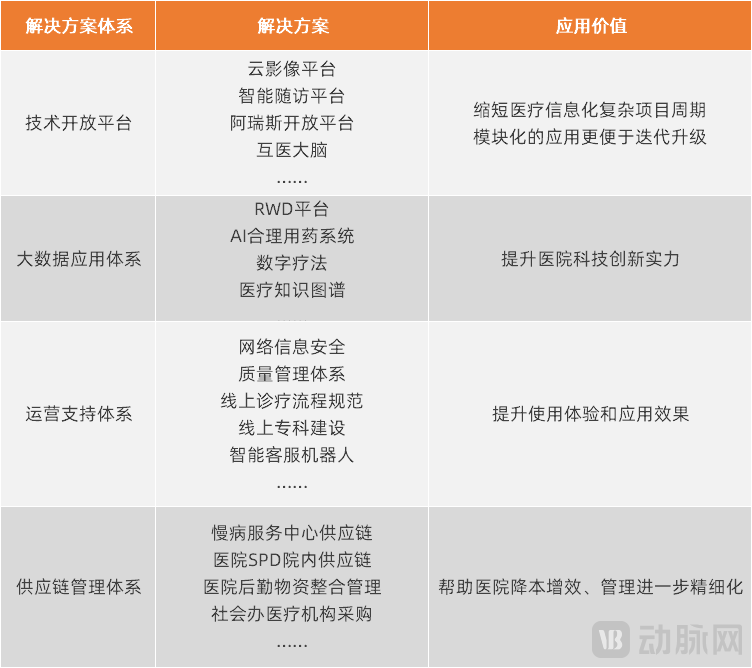
JD Health’s Four Major Solution Systems for “Digital-Intelligent Healthcare” and Their Application Value. Source: Compiled from public information.
The four major systems encompass a wide range of products, including cloud-based imaging, the Real-World Data (RWD) platform, online specialty department development, and supply chain services for chronic disease management centers. Tailoring its approach to different types of healthcare institutions, JD Health combines various products and service capabilities to deliver scenario-based solutions, such as comprehensive internet hospital solutions, integrated digital transformation solutions for traditional Chinese medicine hospitals, comprehensive digital and intelligent post-diagnosis care solutions, and integrated in-hospital supply chain solutions.
Systematically delivering solutions signifies that JD Health’s technical services are better aligned with the evolving trends of the healthcare service system, namely: the integration of online and offline services, the convergence of in-hospital and out-of-hospital care, and a shift from treatment-centric to health-centric models. This transformation necessitates support from digitalization and intelligent technologies to facilitate the integration of healthcare service scenarios and interoperability of data.
Meanwhile, digitalization and intelligentization refer not only to technologies such as AI, big data, and cloud computing, but also to the flexibility of system iteration and integration.
The “Survey on the Informatization Status of Chinese Hospitals (2019–2020),” released by the Information Professional Committee of the Chinese Hospital Association, indicates that issues in the hospital informatization application software market are primarily concentrated in the following areas: outdated product functionality that fails to keep pace with evolving demands; poor usability due to a lack of customer-centric design; obsolete technology that lags behind technological advancements; poor compliance with product standards, leading to integration difficulties; insufficient product stability, resulting in significant operational risks; and inadequate flexibility, making it difficult to meet customers’ personalized needs.
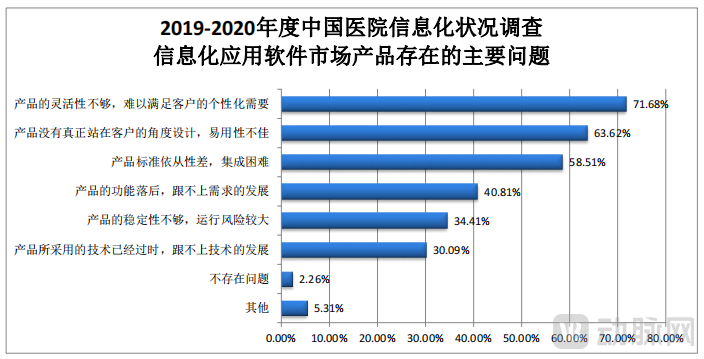
Major Issues with Products in the Healthcare IT Application Software Market. Image source: “Survey on Hospital Informatics Status in China (2019–2020)”
The aforementioned survey data profoundly reflects the many pain points of past healthcare informatization. A key principle in addressing these pain points is to implement systematic planning with a forward-looking perspective.
At the JD Health Digital Intelligence Healthcare Conference, Chen Jinxiong, Chairman of the Electronic Medical Record Committee of the China Medical Information Association, stated that planning for hospital digitalization must be based on development trends in the healthcare industry over the next 3–5 years, or even 5–10 years.
To address the longstanding challenges of traditional informatization, JD Health has transformed its four major solution systems for “Digital-Intelligent Healthcare.” By upgrading technologies with digital intelligence, it helps shorten the implementation cycle of complex informatization projects within healthcare service systems; modular applications facilitate iterative upgrades, while more efficient technologies promote the establishment of industry standards. Furthermore, through the practical application of big data, JD Health enables information interoperability, breaks down information silos, and supports hospitals in enhancing their technological innovation capabilities.
From JD Health’s perspective, digital-intelligent healthcare is a capability system that encompasses the entire informatization process of the healthcare service ecosystem. It represents the comprehensive integration of digitalization and intelligence in healthcare delivery across technology, operational models, and management. This implies that the current product portfolio will not only remain relevant but, thanks to its flexibility and ease of iteration, will also align with the future development needs of hospitals.
It is worth noting that JD Health’s four major “Digital-Intelligent Healthcare” solution frameworks are not merely technology exports; they also integrate service capabilities, particularly JD Health’s operational expertise and pharmaceutical supply chain capabilities.
Theoretically, hospitals (especially public hospitals) do not lack patients and thus have no need for operational management. However, in the process of digital transformation, hospitals have encountered several challenges related to operations. For example:
Internet hospitals have been established, offering comprehensive basic functions such as online follow-up consultations, e-prescriptions, online medication purchases, and even medical insurance reimbursement. However, patient uptake remains minimal. This is largely because patients have not yet fully developed the habit of using internet-based medical services. Apart from a few top-tier hospitals, most healthcare institutions struggle to attract more patients without active management and promotion of their internet hospital platforms.
The general public typically visits hospitals only when they are ill, and hospitals primarily treat patients in most cases. The concepts of out-of-hospital prevention and rehabilitation have not yet taken root among either healthcare institutions or patients. While digitalization has played a role in enhancing connectivity, how can we shift from a “treatment-centered” model to a “health-centered” one?
Even though hospitals have established services that extend to prevention and rehabilitation, as well as beyond the hospital walls, they struggle with high costs and insufficient manpower, requiring an efficient operational system to ensure the sustainability of these services.
For JD Health, platform operations and user engagement are core strengths. Over the past few years, JD Health has experienced rapid growth in both its user base and service volume. As of the first half of 2022, annual active users had reached 131 million, with an average of 250,000 online medical consultations per day.
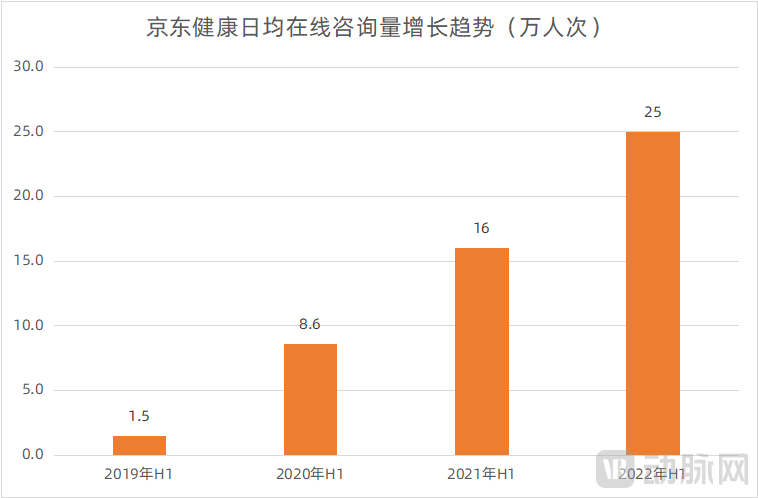
JD Health’s Daily Average Online Consultation Volume Growth; Data Source: JD Health Performance Report
Behind the high-growth operational data lies a mature platform operations system, and JD Health has also integrated its operational capabilities into digital-intelligent solutions.
Taking the comprehensive solution for internet hospitals as an example, JD Health leverages offline medical service scenarios to provide technical and operational support that optimizes healthcare processes, enhances consultation efficiency, and improves satisfaction among all stakeholders.
From a technical perspective, the overall business is decomposed using a microservices architecture to facilitate compatibility upgrades. Based on offline medical service scenarios, the objectives are to optimize healthcare processes, improve consultation efficiency, and enhance satisfaction among all stakeholders. From an operational perspective, modules such as the operational support middle platform, cloud pharmacy operation center, medical consortium operation center, and visualization platform help hospitals expand their service scope, create diversified services, improve patient satisfaction, and strengthen inter-institutional collaboration.
In March 2020, the JD Internet Hospital affiliated with the First Affiliated Hospital of Henan University of Chinese Medicine (hereinafter referred to as “the First Affiliated Hospital of Henan TCM”) was launched, becoming the first internet hospital specializing in traditional Chinese medicine (TCM) in Henan Province. Leveraging the distinctive advantages of TCM, JD Health has jointly operated the platform with the First Affiliated Hospital of Henan TCM. To date, the internet hospital has registered nearly 300,000 patients and processed over 200,000 consultation orders.
In April 2020, Tianjin Nankai Hospital partnered with JD Health to launch the Nankai-JD Internet Hospital. In addition to routine online follow-up consultations and prescription renewals, the Nankai-JD Internet Hospital has introduced services such as follow-up management and at-home nursing care, extending hospital services beyond the facility.
In its comprehensive internet hospital solution, JD Health integrates the offline service capabilities of medical institutions to expand the scope of services, extending healthcare from treatment to prevention, wellness, diagnosis, therapy, and rehabilitation. It also broadens the target population from patients to individuals in sub-health and healthy states, thereby enhancing patient experience and helping hospitals better serve and retain patients.
JD Health’s integrated digital-intelligent post-diagnosis service solution can also be co-developed with hospitals to provide operational support.
“For patients, in-hospital diagnosis and treatment account for less than 10% of the entire disease course, while 60%–90% of healthcare expenditures occur outside the hospital. In particular, some patients require long-term medication and continuous management, necessitating comprehensive post-discharge services—including out-of-hospital diagnosis and treatment, follow-up visits, and monitoring data support,” said Jin Fangyi, General Manager of the Hospital Cooperation Division at JD Health.
However, patients face challenges in the post-consultation phase, including inconvenient access to care and poor adherence to follow-up visits or self-management. Hospitals and physicians must devote substantial effort to post-consultation patient management, yet this does not necessarily guarantee favorable outcomes.
In response, JD Health has developed a comprehensive digital and intelligent post-diagnosis service solution tailored for hospitals, departments, and physicians.
To address the challenges of post-consultation patient management, JD Health has established a library of post-consultation follow-up content and collaborated with physicians to develop physician-tailored follow-up services across various disease areas. It has also implemented an effective task-based incentive mechanism to enhance patient adherence, thereby improving physicians’ follow-up efficiency. Furthermore, JD Health has partnered with providers of home-based smart monitoring devices to enable continuous monitoring and tracking of post-consultation health data.
In 2020, JD Health entered into a strategic partnership with the Hubei Provincial Health Commission to advance projects focused on the rehabilitation and psychological counseling of patients in Hubei Province who had recovered from COVID-19. As part of this initiative, JD Health established an online “workbench” for community family doctors, enabling them to enter into one-on-one contracts with recovered COVID-19 patients to provide psychological intervention and counseling. Meanwhile, JD Health provided operational support, including wearable devices, assessment scales, and online consultation services.
Over the two years since implementation, continuous follow-up has been conducted with 5,000 patients, generating multidimensional, high-value follow-up data that more precisely supports clinical research and patient services. The patient incentive system based on JD shopping benefits, combined with a patient engagement framework powered by AI-driven follow-up technologies, has resulted in a lower loss-to-follow-up rate. Throughout this two-year cohort follow-up, the loss-to-follow-up rate was maintained at approximately 58%.
Thus, it is evident that advancing the digital and intelligent transformation of healthcare does not merely involve providing a single system or platform, but rather entails an integrated approach combining technical services with multi-dimensional operations.
Chen Jinxiong, Chairman of the Electronic Medical Record Committee under the Chinese Medical Information Association, also believes that hospitals urgently need to upgrade and transform their information systems. The focus should shift from merely delivering functional features to generating tangible value. This requires a deep understanding of clinical operations, integrating products seamlessly with business workflows. By focusing on innovation across functionality, user experience, processes, efficiency, cost, and quality, hospitals can achieve high-frequency, efficient, and superior user experiences.
Since the onset of the pandemic, physical medical institutions have experienced a decline in service volume and revenue, making cost control increasingly urgent. Meanwhile, with the implementation of policies such as healthcare payment method reforms and centralized drug procurement in recent years, improving operational efficiency and reducing expenditures have become a consensus in hospital management. The National Health Commission has also issued the "Graded Evaluation Standard System for Smart Hospital Management (Trial)" to promote the development of smart management in medical institutions.
However, in the process of building a "trinity" smart hospital, the development of smart management has lagged behind that of smart medical care and smart services.
An overview of JD Health’s business layout reveals that, by leveraging the supply chain resources of JD Group and JD Health’s own pharmaceutical supply chain capabilities, it can support hospitals in building their supply chains.
Data shows that as of June 2022, JD Health utilized 20 pharmaceutical warehouses and over 450 non-pharmaceutical warehouses across China through JD Logistics. The “self-operated cold chain” capability for JD Pharmacy’s pharmaceutical products has covered more than 240 cities nationwide, and JD Pharmacy’s offline DTP (Direct-to-Patient) pharmacies have expanded to 26 provincial-level administrative regions across China.
JD Health’s omnichannel service, “JD Medicine Express,” has partnered with over 60,000 merchants by co-building a grid-based operational ecosystem and offering multiple fulfillment options, providing round-the-clock omnichannel services to users in more than 400 cities.
The supply chain for pharmaceuticals and health products is JD Health’s primary source of revenue and its core competitive advantage. While ultimately serving end users, this model is underpinned by JD Health’s ability—leveraging the supply chain capabilities of JD.com—to connect healthcare providers, patients, and pharmaceuticals, supported by a digitalized and intelligent management system that reduces costs and enhances efficiency.
Building on its accumulated experience in pharmaceutical supply chain management, JD Health has launched an integrated in-hospital supply chain solution, providing healthcare institutions at all levels with a comprehensive suite of services encompassing digitalized and intelligent centralized procurement, supply chain transformation, and the development and operation of refined management systems.
Zhou Xinyuan, Vice President of JD Group and General Manager of the Yaojingcai Business Unit at JD Health, stated that in response to the characteristics of hospital procurement—such as a wide variety of items and high frequency—JD Health has been continuously building an integrated B2B and B2C supply chain service capability for hospitals. Its product portfolio covers pharmaceuticals, medical consumables, medical equipment, medical textiles, office supplies, computer consumables, and more.
Leveraging these capabilities, JD Health effectively connects in-hospital scenarios—including outpatient buildings, inpatient wards, outpatient and emergency pharmacies, hospital information centers, and general logistics warehouses—to create a comprehensive management platform for pharmaceuticals, medical devices, and consumables, thereby meeting the full-category supply demands of various in-hospital settings. Outside hospitals, JD Health also utilizes service formats and models such as its self-operated JD Pharmacy stores and the O2O medication delivery service “JD Express Medicine Delivery” to address a broader range of patient needs.
Building on its two core pillars of supply chain infrastructure and operational services, JD Health has also developed integrated in-hospital supply chain solutions, including supply chain solutions for chronic disease management centers, hospital SPD (Supply, Processing, and Distribution) in-hospital supply chain solutions, integrated solutions for hospital logistical supplies, and integrated supply chain solutions for private hospitals.
VCBeat learned at the JD Health Digital Intelligence Medical Conference that, in the future, JD Health will continue to leverage its open strategy and technological innovation to enhance supply chain efficiency and promote the deep integration and innovative application of technology and medical services through a componentized, productized, platform-based, and ecosystem-driven approach.
As previously mentioned, JD Health’s “Digital-Intelligent Healthcare” solution ecosystem is underpinned by its operational advantages and supply chain capabilities, while also responding to robust industry demand. From a business perspective, why is the company making such significant investments and efforts in this area? It is important to recognize that the integrated application of new technologies requires long-term development cycles and substantial capital investment, yet it is difficult to achieve considerable returns in the short term. In particular, meeting the technical and operational needs of public medical institutions during collaborations poses a significant test of an enterprise’s comprehensive capabilities.
An analysis of the latest interim performance report alongside historical data reveals that product sales account for over 80% of JD Health’s revenue structure, while service revenue constitutes less than 15%. VCBeat has previously highlighted JD Health’s increasing emphasis on its service capabilities. On one hand, service revenue offers higher gross margins; on the other, as the entire pharmaceutical retail industry explores a transition from “product providers” to “service providers,” strengthening medically oriented service capabilities will provide JD Health with more sustainable growth momentum.
In China’s healthcare service system, physical medical institutions (especially public hospitals) occupy a dominant position. It can be said that it is difficult for service providers within the healthcare system to sustain development if they are completely detached from the public sector.
Overall, JD Health’s vigorous promotion of “digital-intelligent healthcare” is both a challenging path and an inevitable route for long-term development. Looking ahead, by leveraging its own advantages and collaborating with more high-quality public medical resources, JD Health’s core competitiveness will reach new heights.