

Tapping into a Billion-Dollar Market: Will Internet-Enabled Post-Diagnosis Disease Management Explode?
In 2022, internet healthcare, as an important component of the medical service system, entered a new decade.
In this new phase, internet healthcare is no longer confined to online services; it is extending its reach offline, with the integration of online and offline services becoming increasingly deep. Services that were once limited to single stages are being rapidly combined to form continuous care pathways targeted at specific diseases or patient populations. Against this backdrop, “Internet+” post-diagnosis disease management has emerged as an inevitable model in the industry’s evolution.
“Internet +” Post-Consultation Disease Management comprehensively leverages internet, AI, and IoT technologies, along with smart hardware, to provide patients with continuous management services following diagnosis and treatment. These services include intelligent follow-ups, medication guidance, disease education, and vital signs monitoring, aiming to enhance patient adherence to post-consultation management protocols, thereby better promoting and maintaining health status. This approach plays a pivotal role in healthcare delivery.
Two Major Models of Internet-Plus Post-Diagnosis Disease Management:
Complementary Advantages, Accelerating Market Penetration
“Internet Plus” post-diagnosis disease management is a systematic endeavor. Given the existing scarcity of medical resources, it is impractical to rely solely on in-hospital medical staff to assume additional workloads; therefore, social forces must participate. Currently, numerous companies in the industry are engaging in innovative explorations, gradually giving rise to two distinct models.
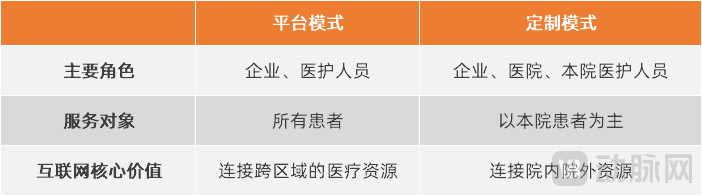
Key Features of the Two Models of “Internet+” Post-Diagnosis Disease Management, Chart by VCBeat
Platform Model Achieves Extensive Coverage, Promoting the Widespread Adoption of New Service Models
Platform Model: Enterprises establish internet platforms or build platform-based internet hospitals to attract healthcare professionals to join, integrate resources such as pharmaceuticals, medical devices, and laboratory tests required for disease management, with the platform operator and healthcare professionals jointly serving patients.
Early internet healthcare platforms largely incorporated such services. For instance, Medlinker has partnered with pharmaceutical companies and third-party medical testing institutions to jointly provide out-of-hospital disease management for users. Ark Health has extended medical services, doctor-patient education, and medication services from hospitals to patients’ homes, enabling home-based disease management. In specialized disease areas, Shi Doctor has built a surgical disease management platform, while Fangcun Doctor focuses on post-diagnosis management of attention-deficit/hyperactivity disorder (ADHD).
Key features of the platform model include extensive coverage of physicians and patients, allowing patients to choose doctors nationwide. Doctor-patient communication and interaction primarily occur online, but the model also facilitates cross-regional offline medical consultations. This is particularly beneficial for patients with complex or critical conditions who often seek care from renowned specialists; they can communicate their condition in advance online to prepare for offline visits and receive timely post-discharge management.
In the platform model, physicians practice online in their individual capacity. Research indicates that at least 16.51% of physicians across China have registered on internet platforms to provide services. Although this model exhibits limited integration with physical hospitals, it has facilitated the widespread adoption, utilization, and promotion of “Internet+” post-diagnosis disease management services by a large number of physicians.
Customized Model: Tailored to Local Conditions and Deeply Integrated into Hospital Service Workflows
The customized model involves enterprises and hospitals jointly establishing internet hospitals and co-building “Internet+” post-diagnosis disease management platforms, with in-house medical staff and enterprise operations personnel collaboratively serving patients.
For example, Hangzhou Jianhai Science and Technology Co., Ltd. has co-established “Post-Consultation Disease Management Centers” with hospitals. Leveraging patient-centric “Health Coaching Technology” and evidence-based medicine-driven digital therapeutics as its two core management tools, the company integrates online and offline resources as well as in-hospital and out-of-hospital services to provide multi-scenario, multi-level, comprehensive, and full-cycle post-consultation disease management services for patients in need. Currently, this model has been successfully implemented and operated in nearly 100 hospitals across provinces such as Zhejiang and Shandong, meeting the post-consultation management needs of various departments and multiple disease types, with notable achievements. In hospitals where the model has been deployed, key indicators—including patients’ timely follow-up visit rates, medication adherence, and lifestyle modifications—have improved, while hospital management costs have decreased.
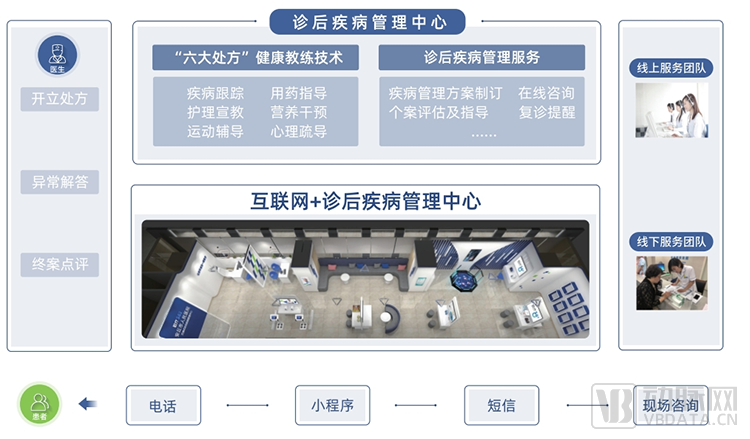
Jianhai Technology’s Post-Consultation Disease Management Center Co-established with Hospitals. Image source: Public information
Furthermore, Yi Suizhen has partnered with cancer hospitals to launch management services for patients, including follow-up consultations, reminders for return visits, patient education, and physician Q&A. The disease data accumulated on the platform can also support real-world studies. Beisheng Medical, on the other hand, focuses its services on the maternal and infant sector. By collaborating with pediatric hospitals as well as women’s and children’s hospitals, it conducts joint hospital-to-home follow-ups and integrates home-based terminal device monitoring into its services, thereby enabling more precise and timely disease management.
Given the significant variations among hospitals in terms of clinical care quality, health informatics capabilities, departmental structures, and areas of disease specialization, companies must clearly define their positioning in either comprehensive management or specialized disease management. Simultaneously, they need to determine specific service offerings in collaboration with hospitals based on actual circumstances, thereby giving rise to a customized model.
Compared with the platform model, the customization model features a higher degree of association between enterprises and hospitals. Empowering hospitals is one of the key tasks for enterprises, which involves helping hospitals build technical platforms and optimize service processes, or even directly participating in patient services to improve the work efficiency of medical staff.
The smooth operation of the customized model benefits both physicians and patients. For hospitals, refined internet-based management of post-consultation care amplifies the efficacy of high-quality medical resources, extending advantages such as specialized departments and distinctive techniques beyond hospital walls. Most services under this customized model are provided to the hospital’s own patients, meaning that patient “traffic” is sourced from and reinvested into the hospital, even enhancing its reputation and attracting more patients with relevant conditions.
For patients, the customized model leverages hospitals’ offline capabilities in diagnosis, treatment, and laboratory/imaging tests, while integrating technical platforms and online services to establish an integrated online-offline service workflow, thereby delivering a superior healthcare experience.
It is precisely because hospitals are deeply involved in the customized model that it not only enhances patients’ adherence to post-diagnosis management, but also improves hospital operational efficiency and reduces costs for payers.
It is worth noting that there is also an overlap between the two models. Some platform-based enterprises collaborate with hospitals to carry out disease management in response to hospital needs, such as the chronic disease management centers or specialized disease management centers jointly established by WeDoctor and JD Health with hospitals. Meanwhile, customized-service enterprises, after forming partnerships with multiple hospitals, have to some extent created platforms that enable the coordination of various resources on these platforms.
Overall, the two models complement each other’s strengths and are accelerating the penetration of “Internet+” post-diagnosis disease management among all stakeholders. Enterprises can not only provide solutions to address the practical needs of patients, hospitals, and payers, but also pursue corresponding commercial value.
"Internet Plus" Post-Consultation Disease Management connects hospitals, physicians, and patients, while also influencing payers to a certain extent; from the perspective of any stakeholder, "Internet Plus" post-consultation disease management holds critical significance.
From the patient’s perspective, “Internet Plus” post-diagnosis disease management can effectively improve disease prognosis.
The COVID-19 pandemic, which persisted for nearly three years, repeatedly disrupted the connection between patients and hospitals. During large-scale outbreaks in certain cities, internet-based healthcare played a significant role by addressing the need for prescription refills for patients with chronic diseases. Furthermore, in routine care, a substantial number of patients require continuous interventions, such as long-term follow-up guidance and data monitoring, particularly among oncology patients and postoperative populations.
Currently, a substantial body of research has validated the positive impact of “Internet Plus” post-diagnosis disease management. For instance, the use of mobile health (mHealth) solutions to manage patients with chronic obstructive pulmonary disease (COPD), asthma, and other conditions can reduce the risk of hospitalization. For patients with HIV, tuberculosis, cardiovascular diseases, and other conditions, mHealth also holds promise as an effective management tool. Meanwhile, postoperative management for various diseases conducted via internet-based platforms can significantly improve patients’ quality of life, alleviate anxiety and depression, enhance medication adherence, and reduce the incidence of adverse events.
For patients, Internet-plus post-consultation disease management during the pandemic can address urgent needs, while routine Internet-plus post-consultation disease management can enhance efficiency and adherence, thereby improving disease prognosis.
From the hospital’s perspective, “Internet+” post-consultation disease management is a crucial means of enhancing operational efficiency.
Currently, internet hospitals have become a standard component of healthcare services, with public internet hospitals accounting for as high as 70% of the total. Although some large tertiary Grade A hospitals have achieved notable operational success, many public internet hospitals remain built but unused, resulting in resource waste.
A 2021 survey conducted by VCBeat’s Eggshell Research Institute revealed that among internet hospitals primarily established by physical hospitals, those offering continuous care services recorded higher average daily patient visits than those not providing such services.
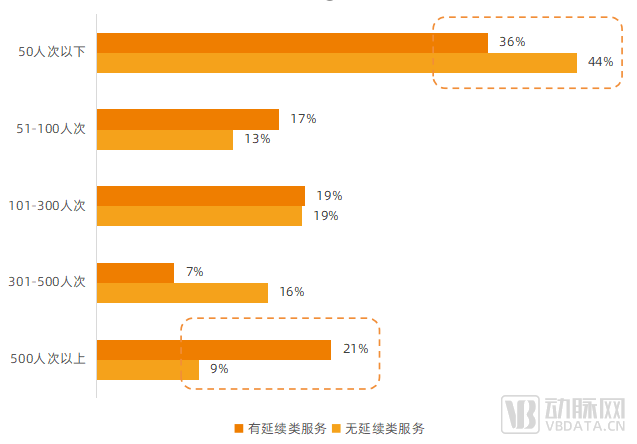
Whether Internet hospitals provide continuous care services impacts daily consultation volume. Image source: VCBeat’s “2021 Internet Hospital Report”
Consultation data, represented by patient visit volumes, largely reflects the operational effectiveness and value of internet hospitals. Therefore, leveraging continuous services such as “Internet+” post-diagnosis disease management can activate the high-quality resources of public internet hospitals, enabling their truly effective operation.
From the payer’s perspective, under the trend of healthcare payment method reforms, “Internet+” post-diagnosis disease management helps reduce cost expenditures.
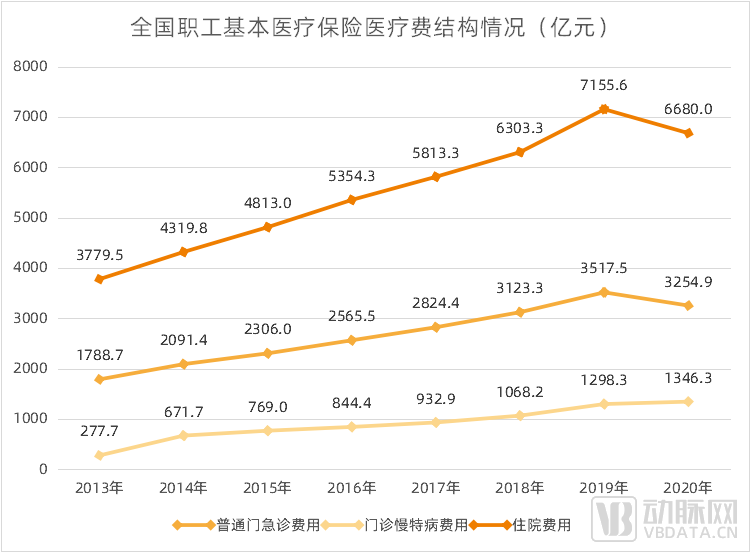
Structure and Growth of Medical Expenses under the National Basic Medical Insurance for Employees in Recent Years, Data Source: "China Healthcare Security Statistical Yearbook 2021"
As shown in the figure above, data from the 2021 China Medical Security Statistical Yearbook indicate that, excluding the exceptional circumstances caused by the pandemic in 2020, medical expenses under the national employee basic medical insurance have continued to rise in recent years. Structurally, inpatient costs account for the largest proportion; in terms of growth trends, the rate of increase in inpatient costs is significantly higher than that of general outpatient and emergency care costs and costs for chronic and special diseases treated on an outpatient basis. Given their high proportion and rapid growth, controlling inpatient expenses is clearly a top priority in medical insurance cost containment efforts.
At this point, the value of "Internet Plus" post-discharge disease management becomes evident: by transferring necessary postoperative and rehabilitation management to out-of-hospital settings for patients who meet discharge criteria, hospital length of stay can be shortened, thereby reducing medical costs.
In summary, when considering the demands of patients, hospitals, and payers, Internet-plus post-diagnosis disease management holds specific significance.
Overall, the whole-course disease management service built on "Internet+" post-diagnosis disease management can link up key stages—including initial diagnosis, follow-up visits, home-based rehabilitation, online follow-up consultations, and readmission—to form a continuous, closed-loop service. This approach helps address longstanding issues in healthcare delivery, such as insufficient emphasis on prevention and rehabilitation and fragmented care processes, and is poised to become an indispensable component of the future healthcare service system.
From a macro perspective, the pandemic has heightened public health awareness, while the healthcare service system is shifting from a “disease-centered” to a “health-centered” model. As such, Internet-plus post-diagnosis disease management, as an efficient means of promoting and maintaining health, demonstrates considerable promise.
On one hand, policies are vigorously promoting the “transformation” of medical services. For a considerable period in the future, high-quality development will be the central theme of public hospital operations, requiring hospitals to shift from extensive management to refined management and establish a new model of integrated medical and preventive care. This creates a favorable policy environment for Internet-plus post-diagnosis disease management.
On the other hand, the market ecosystem is maturing. The accelerated digital transformation of healthcare institutions and pharmaceutical and medical device companies, coupled with the burgeoning internet healthcare sector and the nascent stage of digital therapeutics, will create a more favorable environment for the development of “Internet+” post-diagnosis disease management, given their close interconnections.
Digital therapeutics, in particular, have achieved rapid breakthroughs since 2021, spanning from industry innovation to policy support. Essentially representing the digitization of healthcare services, digital therapeutics offer advantages over traditional services, including scalability, accumulative value, lower costs, and more convenient accessibility. These characteristics align closely with the tools required for post-diagnosis disease management, positioning digital therapeutics as a powerful instrument for “Internet+” post-diagnosis disease management.
According to iResearch’s “White Paper on China’s Post-Consultation Internet Healthcare Industry,” the overall market size on the demand side of China’s post-consultation internet healthcare industry was approximately RMB 441.35 billion in 2022, with a compound annual growth rate (CAGR) of 30.5% from 2015 to 2022, indicating that the industry is in a phase of rapid expansion. According to Frost & Sullivan, the market size of China’s digital chronic disease management reached RMB 361.3 billion in 2022 and is projected to grow rapidly to RMB 800.1 billion by 2025.
“Internet + Post-diagnosis Disease Management” shares significant overlap with post-consultation internet healthcare and digital chronic disease management. In comparison, post-consultation internet healthcare is a broader concept, whereas “Internet + Post-diagnosis Disease Management” and digital chronic disease management typically target specific diseases and integrate service resources around these conditions. Meanwhile, “Internet + Post-diagnosis Disease Management” encompasses both chronic disease management and out-of-hospital post-surgical care. Consequently, the market for “Internet + Post-diagnosis Disease Management” has entered the hundreds of billions of yuan range.
Certainly, "Internet + Post-Consultation Disease Management" also faces challenges such as low acceptance among hospital physicians and patients, and an immature business model. Moving forward, the industry needs to continuously explore technological and model iterations. By leveraging leadership from exemplary enterprises and fostering collaboration across the industrial chain, a value network should be established involving patients, medical institutions, healthcare professionals, and supply chain partners, enabling mutual empowerment among all stakeholders. This will help integrate "Internet + Post-Consultation Disease Management" as an indispensable component of the healthcare service system, thereby driving industry growth.