

Tripartite Models of Scientific and Technological Achievement Transformation: How Universities and Research Institutes Evaluate and Choose
Data reflect trends. According to the “2021 Annual Report on the Transformation of Scientific and Technological Achievements in China (Higher Education Institutions and Research Institutes),” in 2020, universities and research institutesTransferThe number of contracts for the commercialization of scientific and technological achievements exceeded 10,000 for the first time, reaching 14,346; withLicenseA total of 6,126 contracts were signed for the commercialization of scientific and technological achievements; whereasCapital Contribution by ValuationThe number of contracts for the transformation of scientific and technological achievements was the lowest, with a total of 487.
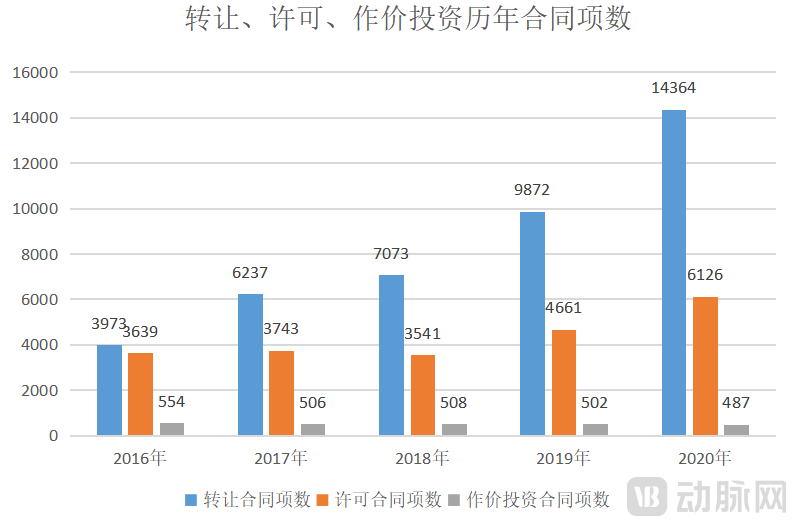
Moreover, by analyzing the number of contracts for three technology transfer modalities from 2016 to 2020, VBInsight further found that among assignment, licensing, and equity investment based on valuation, assignment and licensing accounted for a larger number of contracts and both demonstrated growth momentum. In 2020, the number of contracts for assignment and licensing increased by 44.6% and 34.5%, respectively, compared with the previous year. In contrast, the number of contracts for equity investment based on valuation was not only smaller but also declined to some extent, decreasing by 4.5% in 2020 compared with the prior year.
It is worth considering why such disparities exist among the three technology transfer models. What do these differences indicate? How do universities and research institutions evaluate these transfer mechanisms? What other viable transfer pathways are available? Next,VCBeat Orange BureauLet’s take a closer look.
Two Major Causes of the Disparity
“The emergence, development, and demise of anything are always the result of the combined effects of internal and external factors.” Therefore, when examining disparities, we should still seek causes from both internal and external perspectives.
1Internal Factors: From the perspective of the commercialization model itself, assignment and licensing are more attractive to industry players.
Specifically, the transfer of scientific and technological achievements involves the owner transferring ownership to the party responsible for commercializing such achievements, with the subject matter of the transaction being the intellectual property rights (IPR) embedded in these achievements. Licensing of scientific and technological achievements refers to a scenario where the licensee obtains the right to exploit the IPR associated with such achievements by entering into a contract with the owner and paying certain licensing fees, without the need to transfer ownership of the achievements. Equity contribution through valuation, on the other hand, refers to the process whereby the owner contributes the IPR of the scientific and technological achievements as capital investment into an enterprise, thereby acquiring equity interests in that enterprise and participating in its operation and management. Subsequently, the investee enterprise acquires ownership of the scientific and technological achievements and incorporates them into its intangible assets for operational and managerial purposes.
After defining the terms, we then examine the characteristics of each approach, which is also a key reason why assignment and licensing are chosen by most people.
Let's first look atAssignment, whose most distinctive feature is the transaction of intellectual property rights,Fully transfer benefits and risks to the transferee. In fact, once the transfer of intellectual property rights is completed, the boundaries between the two parties to the transaction become clearly defined, which facilitates the transferee’s subsequent financing plans, particularly by avoiding the cumbersome procedures associated with state-owned asset transactions;
Let's take another lookLicensing, which should be the simplest and lowest-transaction-cost method of commercialization.. The licensee’s objective is to implement scientific and technological achievements, enabling it to enjoy the benefits of such achievements within a specified term by paying only usage fees to the owners of the achievements.
For industry players, financing, management, and profitability are top priorities. Assignment maximizes the freedom of industry players, with all decisions led by them, enabling more precise control over the financing process. In contrast, licensing is simpler, requiring only the accurate commercialization of results to generate profits for the company.
In contrast, withEquity Investment Characterized by Tying Interests to Operational Performance and Close University-Enterprise CollaborationStill struggling within the “state system.” Most universities and research institutes are state-owned, meaning that state-owned equity obtained through capital contribution via asset valuation must be brought under the supervision of state-owned assets. Once state-owned asset transactions are involved, a series of procedures—including asset appraisal, public notice periods, and investment approval for establishing new companies—are extremely time-consuming, which may cause companies to miss critical opportunities for development.
Industry insiders have complained, “After a university takes an equity stake in a company, the financing timeline must account for the university’s approval process, forcing the company to allocate an additional five months during its early-stage preparations to accommodate institutional procedures. Furthermore, if the company seeks an initial public offering (IPO) in the future, the China Securities Regulatory Commission (CSRC) will not grant approval without the university’s signed consent.” Consequently, the protracted approval process has deterred many investors, prompting them to shift toward acquiring technological achievements through technology transfer or licensing arrangements instead.
2External Factors: An analysis of the characteristics of university professors reveals a stronger emphasis on technology transfer and licensing in the research sector.
As key players in the commercialization of scientific and technological achievements, university professors constitute a critical link; their choices can significantly influence the entire translation process. After summarizing their own characteristics, this distinct group appears to show a stronger preference for assignment and licensing.
Shen Juan, Deputy Director of the Industry Management Office at Peking University Health Science Center, has publicly stated that the translational projects at Peking University Health Science Center are relatively early-stage, and it remains uncommon for university professors to actually operate companies.The vast majority of university professors commercialize their technologies through technology transfer and licensing.
This is because for university professors to become entrepreneurs, they must not only incur substantial costs in terms of time and energy but also appropriately balance their own research and teaching responsibilities, a challenge that many professors have reported as difficult to manage.
Furthermore, for university professors, effectively bridging the gap between research and industry remains an inevitable challenge. As parties lacking commercial resources, they often do not have the funding, energy, or platforms to gather market intelligence, which easily leads to a disconnect between technological developments and market demands.
Therefore, a university professor told VCBeat that technology transfer and licensing are more favorable to researchers, as most of them should focus their primary efforts on the research, development, and iterative improvement of technologies.
Overall,The assignment and licensing model not only frees universities and research institutes from approval constraints, making it easier for industry players to secure financing, but also features a relatively straightforward commercialization process. It involves minimal subsequent engagement in corporate management, thereby being more favorable to university professors and allowing them to focus on their scientific research.
How to Choose the Right Path for Commercializing Scientific Research Achievements?
“A good start is half the battle.” When it comes to choosing an approach, university professors naturally take into account and weigh multiple factors, which can be specifically categorized into three dimensions:
At the individual level, the choice of commercialization pathway needs to take into account two factors: the university professor’s personal preferences/experience and team composition. If it isWhen personal willingness is high and the team structure is reasonable, valuation-based investment is preferred; conversely, when personal willingness is low and the team structure is inadequate, assignment and licensing are more appropriate options.
As the saying goes, “Interest is the best teacher.” University professors without entrepreneurial intentions tend to prefer technology transfer and licensing. In contrast, those with prior entrepreneurial experience usually draw on and refine their past experiences to launch new ventures and participate in corporate management.
From one perspective, team composition can reflect a university professor’s ability to commercialize research. A multidisciplinary team comprising R&D, business, and legal professionals is better positioned to navigate the commercialization process and is more suited to equity investment as a mode of technology transfer. Conversely, a team composed solely of R&D personnel that lacks the awareness to seek business expertise will struggle with effective company management; in such cases, assignment and licensing are, to a certain extent, the preferred options for achieving technology transfer.
Take Professor Lu Yang Tao of Soochow University as an example. Nearing sixty, with his educational responsibilities largely fulfilled, he now seeks to venture into the entrepreneurial arena. It is understood that Professor Tao plans to recruit students with a business orientation to join his team, co-found a company, and further advance the commercialization of research achievements. Additionally, drawing on his prior entrepreneurial experience, Professor Jun Tan from Chongqing Normal University (formerly Chongqing Second Normal University) has become more determined to embark on entrepreneurial endeavors in the field of non-alcoholic steatohepatitis (NASH).
At the technical level, factors such as the degree of technological innovation, technological maturity, and market maturity are taken into consideration. Prior to selecting a technology for commercialization, it is essential to assess its potential for industrialization, understand what value it can bring to the industry, and identify the problems it can solve. This necessitates a thorough examination of the technology itself.
Simply put, the higher a technology’s market fit, the more precisely defined its application scenarios, the greater the market demand, and the higher the likelihood of its successful industrialization.
Once a technology qualifies for industrialization, university professors must also comprehensively evaluate its technological innovativeness, technological maturity, and market maturity. In terms of innovativeness, a higher level of innovation indicates greater technological barriers and reduced susceptibility to imitation. Regarding technological maturity, a higher level signifies a faster R&D progression, ensuring both the quality and quantity of the product. Finally, concerning market maturity, a more mature market symbolizes intensifying competition.
Starting with the degree of technological innovation, thoseFor technological achievements with limited innovation, unclear market prospects, or an auxiliary nature, priority should be given to commercialization through transfer or licensing., thus enabling all rights holders to quickly realize cash income and achieve the so-called "locking in gains."
RegardingFor scientific and technological achievements characterized by strong originality, breakthrough nature, and significant market application prospects, it is recommended to adopt a long-term perspective and consider equity investment as a means of commercialization.. The owners of the intellectual property became shareholders in the enterprise. Although they cannot realize immediate cash income in the short term, once the company achieves successful industrialization based on the valued equity contribution, the economic returns generated for shareholders are often incomparable to those from a simple technology transfer fee.
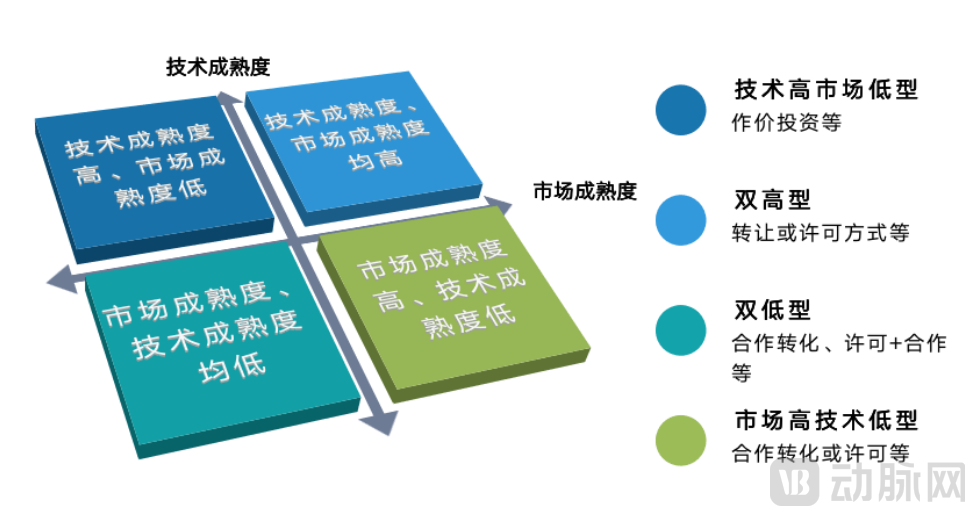
Furthermore, considering the maturity levels of both technology and market: if the technology is relatively mature but the market remains underdeveloped, requiring market cultivation and disruption of the existing market landscape, it is advisable to adopt equity investment as the valuation method and collaborate with relevant enterprises to jointly commercialize scientific and technological achievements.
When the technology is mature and the market is well-developed, subsequent R&D is no longer necessary, and the technology can be transferred to relevant enterprises through assignment. If further R&D is required, the achievement may be licensed to relevant enterprises through licensing.
If both technological and market maturity are relatively low, requiring further research and development as well as market cultivation—such as conducting corporate trials and pilot production, obtaining production approval documents, or gaining consumer recognition—it is advisable to pursue collaboration with enterprises or exclusive licensing. Conversely, if market maturity is high and the technology can be directly applied to service offerings or product manufacturing, licensing may be selected as the mode of commercialization.
In fact, the commercialization of scientific and technological achievements involves numerous steps, rather than being a mere registration of ownership transfer. University professors must also consider what resources various commercialization pathways will subsequently bring, including but not limited to financial support, technical support, and industry support.
First, regarding financial support, the average contract value for equity-based investments was the highest among the three models—assignment, licensing, and equity-based investment. In 2020, it reached RMB 13.35 million, creating a substantial gap compared to the other two models. This also indicates, to some extent, that equity-based investments can provide robust financial support for the commercialization of scientific and technological achievements.
Next is technical support. In technology transfer and licensing arrangements, university professors are primarily responsible for providing technical training and guidance. In contrast, with equity investment based on technology valuation, university professors may still choose to serve as Chief Technology Officer (CTO) in the enterprise, thereby deeply engaging in research and development and technology commercialization efforts.
Finally, industry support primarily involves the business and legal sectors. In practice, technology transfer through assignment or licensing entails a permanent or temporary separation of the technology from the scientists. Consequently, subsequent technological development is unlikely to require further business or legal support for the scientists. However, equity investment based on technology valuation involves multiple aspects, including business registration, taxation, and intellectual property rights, necessitating coordinated efforts across various departments.
Therefore,If university professors require follow-up funding, technological support, and industry backing for commercialization, equity investment based on valuation is better suited to meet these needs; in contrast, assignment and licensing offer relatively weaker resource support.
Revisiting Translational Pathways in the Medical Field
It is well known that the healthcare industry is characterized by high capital intensity, significant technological barriers, and elevated risks, imposing stringent requirements on both manufacturing technologies and R&D innovation.
Specifically, the high investment is reflected in the long R&D and commercialization cycles and substantial capital requirements, typically necessitating over five years and millions in R&D funding. The high technical barriers are manifested in the highly specialized nature of R&D, with fine-grained division of labor throughout the R&D and commercialization processes, requiring a dedicated team of researchers to conduct continuous development. Meanwhile, the high risk is evident in the significant uncertainties and risks associated with scientific research and commercialization.
Therefore, in addition to adopting mainstream methods for technology transfer, universities and research institutes are also exploring alternative pathways for commercialization.
First, self-funded investment for implementation and commercializationUniversities and research institutes generally do not require the participation of external enterprises when applying their technological achievements to their own scientific research and production activities, as these tasks are completed independently. A common approach is to establish university-affiliated enterprises, such as Tsinghua Tongfang, Peking University Founder, and Fudan Guanghua.
Self-investment integrates the source of achievements with the absorber, eliminating intermediate links and significantly reducing transaction costs in the commercialization of scientific and technological achievements, while achieving high conversion efficiency. However, this approach is only suitable for market entities with mature project technologies, substantial strength, and well-developed R&D and production chains. For most universities and research institutes, it is still difficult to meet these standards.
Next is to carry out the “Four Technical Services”, From the definition in the “Law on Promoting the Transformation of Scientific and Technological Achievements,” only technical development, technical consulting, and technical services conducted for the purpose of transforming scientific and technological achievements that subsequently facilitate activities such as experimentation, development, application, and promotion qualify as activities for the transformation of scientific and technological achievements. However, in the healthcare sector, due to excessively high technical barriers, only “four technical services” can be employed to carry out auxiliary tasks supporting the transformation of scientific research outcomes.
Finally, Collaborative Translation and Other Agreements to be Determined, using scientific and technological achievements as a condition for cooperation to jointly implement their commercialization, thereby providing a certain buffer period for the translation of research outcomes. This approach is widely adopted in developed countries and includes two models: commissioned development and collaborative development. In the former, enterprises commission capable universities and research institutes to conduct project research and development based on their developmental needs; in the latter, enterprises collaborate with universities and research institutes to carry out R&D activities for new technologies.
“It is often said in the industry that ‘the commercialization of scientific and technological achievements represents the “last mile” of the entire innovation process, and the success or failure of technological innovation largely hinges on how smoothly this commercialization proceeds.’” In light of the aforementioned commercialization pathways, university professors should select the approach best suited to their specific circumstances and the nature of their technologies.
Regardless of the form in which achievement transformation is implemented, it is essential to address the interests and incentives of university professors to motivate their participation in commercialization. Therefore, different transformation models should be paired with tailored incentive mechanisms, while effectively leveraging policy benefits to maximize returns for university professors, thereby truly stimulating their enthusiasm for innovation and technology transfer.