

Scientists as Entrepreneurs and Investors: Achieving Synergy and Mutual Success
As the “low-hanging fruit” in the sci-tech innovation sector is exhausted, investors are turning their attention to scientist-entrepreneurs.
Indeed, empowered by both knowledge and technology, scientist-entrepreneurs have become a major trend in the commercialization of scientific research. However, this does not necessarily mean that they will always attract the favor of capital.
For scientist-entrepreneurs, the goal is to leverage capital to commercialize their technologies; for investors, the primary consideration is profitability, aiming to achieve long-term returns by investing in early-stage technologies.
Although scientist entrepreneurs and investors share a mutually beneficial, two-way relationship, they each have their own considerations when faced with different objectives. Whether they can dance in step and how they can achieve win-win outcomes still require in-depth exploration.
To comprehensively discuss this issue from the perspectives of scientists, scientist-entrepreneurs, and investors, VCBeat Chengguo Bureau, in collaboration with the Office of Science and Technology Innovation at Fudan University’s School of Management, hosted an online panel titled “Scientist Entrepreneurship and Capital” on August 23. The event featured distinguished guests including Associate Professor Zhu Qi from the Department of Finance and Financial Accounting at Fudan University’s School of Management; Bao Ji, Associate Researcher and Doctoral Supervisor at West China Hospital; Zhang Yi, Vice President of Kemeixin; Su Xiaodi, Executive Director at Lilly Asia Ventures; and Zhang Xiaoyu, Certified International Technology Transfer Manager. They engaged in discussions centered around“Scientists as Entrepreneurs: Dancing with Capital”A roundtable discussion on this topic.
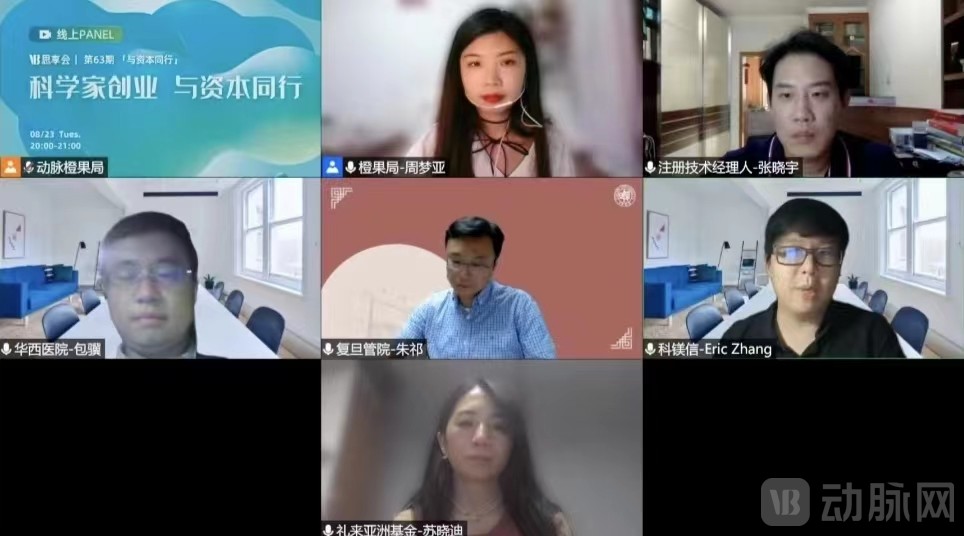
From left to right in the first row: Zhou Mengya, Senior Research Fellow at VBInsight; Zhang Xiaoyu, Certified International Technology Transfer Manager.
Second row, from left to right: Bao Ji, Associate Research Fellow and Doctoral Supervisor at West China Hospital; Zhu Qi, Associate Professor in the Department of Finance and Financial Accounting at Fudan University School of Management; Zhang Yi, Vice President of Kemeixin.
Third row: Su Xiaodi, Executive Director of Lilly Asia Ventures
The following is a transcript of the speech. To facilitate reading, VCBeat Orange Bureau has made editorial adjustments to the text without altering its original meaning:
Resources or Capital: How Should You Choose Your "First Pot of Gold"?
VCBeat Orange Fruit Bureau: Apart from funding, what other support is needed to translate a scientific achievement from the laboratory to industry?
Bao Ji:The commercialization of scientific and technological achievements requires a multitude of resources. However, in light of the debate over whether to prioritize capital or resources when securing one’s “first pot of gold,” it is evident thatResources Are More Important Than Capital。
Because whether for those who have just returned to China or for those working in research institutions or medical schools after returning, their scope of contact is very limited, and there is still a significant gap before they can establish a company. Therefore, they need to access more resources, especially those that can connect them with downstream partners.
Jokingly speaking, if you lack experience in translating scientific research into practical applications, you may find yourself in the awkward position of receiving funding but not knowing how to use it wisely when trying to turn laboratory results into products during the research phase.
VBInsight Orange Bureau: What experiences have been gained in the journey from a technology to a candidate product? What is essential, and what is secondary?
Zhang Yi:First, resources are more important than capital; second, in terms of resources,The Most Critical Factor Is Team Building, this is also the first step of the "entrepreneurial Long March."
Translating scientific achievements into practical applications and managing company operations is a massive undertaking that no individual can accomplish alone; therefore, a strong team is the guarantee of success. As for how to build or find a team of like-minded individuals, the first step is to clearly understandSelfWhat Can and Cannot Be Done. A successful startup team requires many indispensable puzzle pieces:Highly skilled scientists, CTOs with extensive industry experience, and CEOs with excellent execution and leadership capabilities...and only by finding all the puzzle pieces can a grand blueprint be formed.
VBInsight Orange Bureau: From an investment perspective, what are the functions of a professional early-stage investment firm? And in what aspects should it help a project grow?
Su Xiaodi:The first aspect is, of course, to provideFunding. This refers not only to the “first pot of gold” but also to subsequent funding. Research and development is a stepwise process, with additional capital required upon reaching each milestone; therefore, follow-on financing is also a critical factor in ensuring a product’s successful market entry.
Therefore, when selecting capital or partners, scientist entrepreneurs must consider both the other party'sCurrently Available Funding, it is also necessary to consider the other partyFuture Funding Potential. For the latter, it comprises two aspects: one isCapital itself will continuously support the company., to provide funding for the company; secondly,Capital leverages its appeal and influence within the venture capital community to attract peer investment firms to jointly “inject capital” into the company.。
The second aspect isTalentFor scientist entrepreneurs, talent may be the most critical missing link in their transition from scientists to business leaders; for investment firms, they place significant emphasis on whether a startup has a full-time CEO with extensive industry experience at the helm.
The third aspect isInformation. Scientist-entrepreneurs possess core technologies, butTechnology ≠ Product, scientist-entrepreneurs may lack a thorough understanding of market conditions, such as the potential indications or target populations for a product, prospective competitors, and existing marketed products; fortunately, investors or partners can help scientist-entrepreneurs address these challenges.
The fourth aspect isCorporate GovernanceIn fact, there is a significant difference between the operation of a company and that of a laboratory. Moreover, since most scientist-entrepreneurs are first-time founders lacking relevant experience in corporate governance, they require assistance from investment institutions in areas such as designing equity incentive plans and identifying reliable downstream suppliers or partners.
VCBeat Orange Bureau: From a management perspective, what considerations should startups take into account when securing their first round of funding? How should equity structures be established?
Zhu Qi:For a startup, many factors are worth considering when bringing in the first round of funding, such as timing, amount, and term sheet, butThe Most Important Thing Is to Find the Right InvestorsInvestors should be the first partners of entrepreneurial teams, not merely providers of capital. Our “Sci-Tech Entrepreneurship Camp” offers dedicated courses on this topic.
Here, I would like to discuss how sci-tech entrepreneurs canGoMatch InvestorsThree Key Takeaways for Reference: First, Joining the Board of DirectorsWhether investors are willing and able to dedicate time and resources to personally engage in the operations of startups, which is particularly important for startups; second,The brand recognition of investment firms cannot substitute for the assessment of investors’ qualifications, experience, capabilities, and fit.; thirdly,Whether the investor has prior successful fundraising experience, direct involvement in the relevant industry, sufficient understanding of the related technologies, and the ability to engage in in-depth discussions with scientist entrepreneurs.。
InEquity IssuesIn this regard, this is actually a specialized course in our training camp. I will briefly offer three suggestions: the first isScientist-entrepreneurs must accept the inevitable and objective consequence of their equity being diluted after each round of financing., which is also the price that startups must pay to achieve success. The second point isDilution of SharesAlthough it implies a loss for scientist-entrepreneurs in terms of profit distribution,There are many optional institutional arrangements to prevent founders from losing control of their companies.. The third point is that startups must be sure to when raising their first round of financing,Reserve Necessary Equity Incentive Shares for the Founding Team, otherwise it may affect the company's future development.
VCBeat: You have many years of experience in technology transfer overseas. What aspects could Chinese universities learn from?
Zhang Xiaoyu:First, it is necessary to make a judgment before transformation.Whether a Technology Is Worth Commercializing. In this regard, China’s approach differs from that of the United Kingdom and the United States. China has delegated this decision-making authority toFaculty Members of the Research Team, as research teams often require a dedicated budget for patent applications, which is typically borne by the faculty members leading the research groups, with the university providing only partial subsidies.
In contrast, the United Kingdom leaves the decision of whether to apply for a patent toTechnology Transfer Office. During this process, the Technology Transfer Office willAssess the commercial viability of researchers' technical proposals and conduct thorough market research and analysis., if the answer is affirmative, the university will use its funds to support the patent application and official fees for the next three years, and the university's Technology Transfer Office will lead the technology transfer and commercialization of the patented technology.
Secondly, it is toSelect the Right Direction for Commercialization. Foundational technologies differ from application-level technologies; the original R&D direction may not represent the optimal commercial scenario for industrializing such technologies. Instead, cross-sector applications often yield surprising opportunities, such as military-to-civilian conversion projects.
The third point isProfessors should strive to avoid becoming “lone warriors”; do not assume that launching a startup is the only path to commercializing research outcomes.In fact, having professors engage in fundraising and entrepreneurship is the least efficient and riskiest model for technology transfer, as they are largely unfamiliar with the industrial landscape. Moreover, while capital seeks to connect with top-tier technologies, such technologies reside in the minds of leading expert professors. If a top-tier expert has already reached the level of a candidate Academician, a Changjiang Scholar, or a recipient of the Young Thousand Talents Program, how could they rashly abandon their scientific career to start a business? Under China’s current system, once a professor leaves the university, it is difficult for them to return. Even if institutional policies permit re-entry, the professor’s own research capabilities would likely struggle to keep pace with the first tier.
Take the technology transfer and commercialization of MRI (Magnetic Resonance Imaging), which won the 2003 Nobel Prize in Physiology or Medicine, as an example. Initially, when this research project concluded, it was nearly abandoned because its market and investment potential were not recognized. However, with the assistance of the University of Nottingham’s Technology Transfer Office and British Technology Group (BTG)—where my UK supervisor once served as President—the MRI project underwent licensing negotiations with various companies seven to eight times before finally producing the first commercially viable prototype. The product solution was then continuously refined through practical testing, ultimately leading to the current situation where GPS (GE, Philips, and Siemens) dominate the global $32 billion MRI market.
The fourth point isSome researchers lack sufficient experience in drafting patentsThis has resulted in deficiencies in patent strategy and the layout of protection scopes. Many research groups rely on their own doctoral and master’s students to draft patents. However, as these researchers often lack expertise in maximizing claim scope while ensuring compliance, balancing the stability of patent families, and employing deliberate ambiguity in drafting, the resulting patents frequently resemble academic papers. Consequently, they fail to provide genuine legal protection.
The fifth point isScientists Are Not Necessarily Capable of Fulfilling All Roles in the Translation Process, such as business negotiations, sales management, production management, and financial and tax management, are areas that scientists have never been exposed to. It is unrealistic to expect a STEM expert to master all aspects of corporate management and operations.
Therefore,Team Building and Direction SelectionIt may be the driving force behind the translation of achievements, with funding ranking last.
Dancing with Capital: How Scientists Communicate with Investors
VBInsight Orange Bureau: When facing an innovative project, what do investment institutions pay more attention to?
Su Xiaodi:Conventional wisdom holds that communication barriers exist between scientists and investment firms, as scientists tend to speak in academic terms while investors are primarily interested in profit-driven narratives. However, this landscape is gradually changing. Many venture capital (VC) firms in China are highly professional and possess a profound understanding of scientific issues. Furthermore, these investors place significant trust in the innovativeness and value of research teams’ achievements. Consequently, their primary concern and key question revolve around whether the technology can be commercialized. This issue can be analyzed from three perspectives.
First,Clarifying Scientists' Objectives, that is, why this project or company should be undertaken. On the one hand, scientists often have a propensity for scientific research or decades of focused experience in a particular field, which sufficiently demonstrates their professional expertise; on the other hand, it is also essential for scientists to clearly understand the market potential of a technology within the entire industry and its future application directions.
Second,Assess whether the assembled team is suitable for undertaking this project.。
Third,Focus on Scientist-Entrepreneurs’ Control over Product Roadmaps. Scientists often do not evaluate the progress of a venture based on phased achievements during the ideation phase. However, corporate growth unfolds in distinct stages. Therefore, by understanding how much financing scientist-entrepreneurs require and to what operational stage such funding can sustain the company, one can assess their strategic planning for the startup.
Artery Orange Bureau: What are the differences in communication and focus between industry and academia?
Zhang Yi:The industry focuses on products, while academia focuses on publications.。
After I entered the industry, the most important criterion for judging scientific research achievements is: this workCan it be developed into a drug, or has the potential to eventually become one?. For example, whether a compound can be produced at scale, and whether the purification method can facilitate mass production of the drug. In academia, research teams are more concerned with how their work compares to existing technologies and peer competition,What Are the Advantages of Our Proprietary Technology and Patents?。
Given the differing backgrounds and objectives of the two parties, such divergence in focus is, in fact, a normal phenomenon. From the perspective of technology transfer,From an initial idea to a tangible product, both upstream and downstream are equally important.。
In terms of communication, industry players should candidly disclose their key pain points, while research teams should focus on articulating how their technologies can address these specific challenges.
Bao Ji:First,Candor, enabling industry players and scientists to gain a thorough understanding of each other’s strengths and perspectives, thereby making subsequent collaborations more efficient. Secondly, emphasis should be placed onCommunication Across Every Link from Research Outcomes to Market. A complete process of technology transfer is as follows: First, scientists provide the results of their preliminary research; then, industry stakeholders select those achievements suitable for commercialization; next, the financial sector helps transform these technologies into products; and finally, the products enter the market. Each stage in this process is highly complex and critical, so communication at every step must be given due attention. Lastly,Bridging the Financial and Research Communities through Industry, to improve communication efficiency and increase actual conversion output.
VCBeat Orange Bureau: To enable effective and even efficient communication between scientists and investment institutions, how should both parties shift their mindsets in the early stages?
Zhu Qi:Regarding the question of how to characterize the interaction between scientists and investors, we are still constantly exploring it, but it is undeniable that both parties mustEstablishing a Relationship of Mutual Understanding。
However, generally speaking,Scientists are more deficient or weak in understanding investors., since most scientists have little entrepreneurial experience—often only once—it is very difficult for them to shift their mindset in a short period of time; whereas investors have extensive investment experience and many successful cases, so they can more easily understand the thinking of scientists.
To help sci-tech entrepreneurs better, faster, and more effectively complete this transition from scientists to entrepreneurs,The Necessary Relearning ProcessIt may be indispensable, which is also the original intention behind our establishment of the “Sci-Tech Innovation Entrepreneur Camp” training program.
Scientist-entrepreneurs and venture capitalists must always keep in mind that both parties areA Community of Stakeholders, to seek out incentive-compatible solutions through the ongoing process of collaborative adjustment.
VCBeat Orange Fruit Bureau: What roles can it play as an intermediary for the commercialization of technological achievements?
Zhang Xiaoyu:For physicians and researchers, their primary responsibilities are clinical practice and scientific research. Therefore, it is unrealistic to expect these individuals to engage in corporate management. In contrast, we believe thatThe More Suitable Role for Researchers in Enterprises Is CTO。
Returning to our role as technology transfer professionals, we frequently engage with researchers and also possess relevant research experience. ThereforeAt the communication level, technology transfer professionals are well-versed in the language of scientific research.. AndAt the service level, the role of technology transfer professionals is to address the challenges researchers encounter during commercialization, compensate for their deficiencies, and enable them to focus more on their areas of expertise.
Creating Value: How Can Scientists Leverage Capital for Mutual Benefit?
VCBeat Orange Bureau: Walking Hand in Hand with Capital—Should Scientific Research Follow the Focus of Capital, or Should Capital Learn and Pay Attention to the Language of Scientists? How Can Both Parties Achieve Mutual Engagement?
Su Xiaodi:For scientists, there should be more when starting a businessStarting from the science itself or one’s own technological advantages, then aligning with market demand to identify a common ground.. As for how to achieve a win-win outcome, it requires scientist-entrepreneurs and investors to work together toward shared goals.With a dynamic perspective and an open mindsetTo confront the challenges and obstacles encountered when starting a business.
Zhang Yi:Investors are the individuals who help scientist-entrepreneurs turn an idea into reality, serving as a crucial driving force behind entrepreneurship; therefore,Like-minded Investors Are a Crucial Foundation for Startup Success. From the perspective of scientist-entrepreneurs, when seeking investors,It is not only necessary to accept investors’ evaluation of the project, but also to assess investors’ perspectives, experience, and capabilities., ensuring the identification of investors who share mutual commitment.
Bao Ji:Based on the preceding discussion, two main points are summarized: First,Effective Communication Between the Scientific and Industrial Communities Can Foster Mutual Collaboration. Through efficient communication, the industry can understand what problems the scientific community can solve for them. Second,With the support of the financial sector, scientific discoveries and original technologies have been transformed into commercial products., this process can be transformed into an excellent system that serves society, which is highly beneficial for technology transfer.
Zhu Qi:Over the past two years of observation, we have identified certain patterns in how startups select their initial round of financing, among whichIndustry Fitis a critically important indicator. Money is not omnipotent; if it could solve all problems, venture capital (VC) firms would cease to exist. This also means that for scientist-entrepreneurs, when selecting capital,Greater emphasis should be placed on investors’ professional backgrounds, specifically whether they can provide strategic support for the company’s future development that other investors cannot offer., rather than focusing solely on the amount of funding.
Scientists are well-versed in their research achievements but lack understanding of the commercialization involved in translating these results into marketable products; therefore, scientists need toSeek investors with strong alignment in professional expertise and patent portfolios。
Zhang Xiaoyu:What everyone has discussed earlier is actually quite close to the level of post-investment management. At the level of technology transfer and commercialization, the first point that needs to be clarified is that,The commercialization of research outcomes does not necessarily require researchers to start their own ventures; it may also involve technology transfer or assignment.. Regardless of the approach, what researchers are more concerned about isCan the Counterparty Comply with Its Commitments After Signing the Agreement?, so at this point,Legal protection is crucial.。
Secondly, if it is a mutual effort, then the prerequisite must beIt must align with the researchers' own willingness.. On this basis, there is aProfessional and Trustworthy Team, they understand the market and business operations, and can help scientists handle matters beyond technical research.