

Tafier Breaks Through Small Molecule Drug Development Bottleneck with Differentiated Strategy: Osteoarthritis Drug X0002 in Phase III Trials in Both U.S. and China
After years of rapid development, small-molecule drug R&D appears to have reached a bottleneck, with an increasing number of companies shifting their focus to the development of large-molecule drugs.
“Some people cite the fact that seven of the top ten best-selling drugs worldwide are large-molecule therapeutics to argue that small-molecule drug development is on the decline,” Dr. Yu Chongxi, founder of Taifei'er, told VCBeat. “In reality, all of the top ten most-prescribed drugs globally are small-molecule agents, meaning small-molecule drugs remain the cornerstone of therapeutic treatment. The true criteria for evaluating a drug’s merit lie in its efficacy and safety, not its molecular size. Compared with large-molecule drugs, small-molecule drugs exhibit superior permeability, facilitating easier access to target sites. They can treat the vast majority of diseases, feature lower manufacturing costs and more controllable quality, and can be administered orally or topically, generally offering significantly better patient compliance than large-molecule drugs.”
This is indeed the case. There are over 3,000 small-molecule drugs on the market, compared to only more than 100 large-molecule drugs. Furthermore, due to pain points associated with large-molecule drugs—such as difficulty in penetrating tissues to reach targets and exert therapeutic effects, administration limited to injection, high manufacturing costs, and challenges in quality control—nearly all of the top 30 most prescribed drugs are small-molecule agents. In addition, small-molecule drugs have accounted for over 70% of new drugs approved by the FDA in the past five years. In other words, small-molecule drugs remain the mainstay of the innovative drug market.
However, an unavoidable fact is that the research and development of innovative small-molecule drugs also faces multiple challenges. First, there is already a rich variety of small-molecule drugs available, covering nearly all major disease areas such as diabetes and hypertension, and these have undergone long-term market validation; second, competition over drug pricing intensifies after patent protection expires.
In such scenarios, newly developed small-molecule drugs struggle to achieve market success even if they demonstrate comparable efficacy and safety to off-patent marketed drugs. This is due to two primary reasons: first, pricing new drugs at the level of off-patent generics makes it nearly impossible to recoup R&D costs; second, the limited duration of clinical trials cannot rule out potential adverse effects that may not manifest during this period. In recent years, most newly launched small-molecule drugs have been orphan drugs targeting niche markets. A key reason for this trend is the absence of competition from existing marketed drugs, resulting in relatively lower thresholds for regulatory approval and market acceptance. However, orphan drugs also face market challenges: recovering R&D costs often necessitates high pricing, which makes it difficult to establish viable orphan drug markets in developing countries such as China.
These factors have led to a widespread industry consensus that the development of new small-molecule drugs with promising market prospects is challenging, prompting many pharmaceutical companies to focus their efforts on the research and development of large-molecule therapeutics.
In the pharmaceutical industry, innovative drugs are generally understood as those developed from the ground up based on novel mechanisms of action, possessing independent patent rights and comprehensive, robust safety and efficacy data to support market approval, and being the first to receive regulatory authorization for launch. Typically, it takes more than ten years for a drug to progress from target identification to final regulatory approval and market entry. Given this consensus, industry professionals immediately associate new drug development with the challenges of discovering new active molecules, substantial capital investment, long payback periods, and significant uncertainty regarding successful market approval. Moreover, it is not enough for an innovative drug to be merely new; it must also offer superior therapeutic value.
Innovation begins with identifying problems and ends with solving them.
Years ago, Dr. Yu Chongxi noted that,XiangMany small-molecule drugs have actually failed to achieve their intended therapeutic efficacy.“Because these drugs are actually ‘difficult to effectively reach the target tissues,’ and the lower the rate of delivery to the target tissues, the poorer the therapeutic efficacy. Based on this, Dr. Yu Chongxi hypothesized that”Efficient delivery of a drug or its prodrug to the target tissue should significantly enhance therapeutic efficacy. This would allow for reduced dosages, thereby minimizing or even eliminating adverse effects.
After years of dedicated research, Dr. Yu identified a breakthrough for this “bottleneck issue” and successfully developed and createdHigh-Penetration Drug Innovation Platform.Leveraging this platform, newly developed drugs can enter the body in greater quantities, more rapidly, and with higher efficiency, thereby reaching the lesion site and achieving significant, even unexpected, improvements in therapeutic efficacy. Meanwhile, these drugs typically exhibit high penetrability, enabling transdermal administration and thus avoiding side effects associated with oral intake. Furthermore, when new drugs developed using this platform technology are structurally modified from already marketed drugs, their safety profiles can be predicted with relatively high accuracy since their side effects are already known; this essentially eliminates the medication risks posed by potential side effects that might go undetected during clinical trials.
Typically, orally administered or injected drugs reach the lesion site via systemic circulation. However, most drugs penetrate tissues very slowly and struggle to cross biological barriers such as the skin, blood-brain barrier, prostatic capsule, and cartilage. Consequently, a significant proportion of drug molecules remain in the bloodstream, making it difficult to achieve adequate concentrations at the target site, which limits therapeutic efficacy. Meanwhile, to ensure sufficient drug concentration at the target site, systemic blood drug levels must be increased, thereby imposing a burden on the liver and kidneys and leading to significant adverse effects. Furthermore, when a drug has a narrow therapeutic window, there can be substantial variability in both efficacy and side effects among patients with differing metabolic capacities.
Currently, Taifei'er has developed three drugs in clinical stages and eight preclinical drugs based on this platform. The pipeline candidate X0002 for osteoarthritis (OA) has demonstrated significantly better efficacy in Phase II clinical trials compared to existing marketed drugs. It is currently undergoing Phase III clinical studies in both the United States and China, with smooth progress.
As is well known, the critical determinant of success or failure in drug R&D lies in the invention and design of drug molecules, whereas the highly standardized development process can be outsourced to contract research organizations (CROs). To this end, Taifei'er has focused its efforts on drug design, having thus far built and refined a technologically leadingHigh-Penetration New Drug R&D Platform.
Transdermal Drug Delivery Systems (TDDS) refer to a novel dosage form that utilizes pharmaceutical, physical, and chemical methods to facilitate the penetration of drugs through the skin surface into the circulatory system at a constant or near-constant rate, thereby producing systemic or local therapeutic effects. From a technical perspective, transdermal drug delivery offers unique advantages such as non-invasiveness, avoidance of the first-pass effect, and improved patient compliance, enabling effective targeting, ensured efficacy, and reduced adverse reactions.
However, the skin is a highly “robust” biological barrier, and the vast majority of drugs cannot directly penetrate it to enter the systemic circulation, making it difficult to achieve bioavailability comparable to that of other formulations. For this very reason, nearly all small-molecule drugs cannot be administered via this route, and successfully marketed transdermal drug delivery systems are exceedingly rare.
Dr. Yu Chongxi holdsOver 20 years of global drug development experience,and to dateOver 15 Years of Expertise in Developing High-Penetration DrugsCurrently, by structurally modifying existing small-molecule drugs, Taifei'er has not only achieved efficient drug delivery but also breakthroughly addressed the biological barrier challenges associated with transdermal administration. The company’s high-penetration drug delivery platform links highly permeable transport units to active molecules, endowing drugs with autonomous penetration capabilities. This enables rapid traversal of biological barriers such as the skin, cartilage, and blood-brain barrier, facilitating the treatment of conditions like osteoarthritis and stroke that are difficult to manage with conventional oral or injectable therapies. It also simplifies the administration of drugs that are traditionally challenging to deliver, such as prostaglandins.
Meanwhile, this technology platform can significantly reduce systemic drug exposure, substantially improve therapeutic efficacy, and achieve ideal sustained-release effects. Drug concentrations in target tissues remain essentially stable over 24 hours, thereby avoiding irritation and burden on the gastrointestinal tract and liver. The reduced dosage lowers plasma drug concentrations, thus minimizing side effects.
Drugs developed based on high-permeability drug delivery platforms, compared with existing drugsAchieves a penetration efficiency of over 1,000-fold,enabling small-molecule drugs, including existing ones, to fully exert their therapeutic efficacy,Breaking Through the R&D Bottleneck of Small-Molecule Drugs by Forging a New Path.
Notably, there are generally several to dozens of commercially available small-molecule drugs for the treatment of major diseases, making it extremely difficult to develop products with clinical significance. However, once successfully developed, these products hold substantial market value. Taifei'er has strategically positioned itself in multiple high-capacity niche segments across key therapeutic areas, including the musculoskeletal, cardiovascular and cerebrovascular, immune, metabolic, and neuropsychiatric systems.The pipeline comprises 10 assets, including two novel drugs in clinical development.
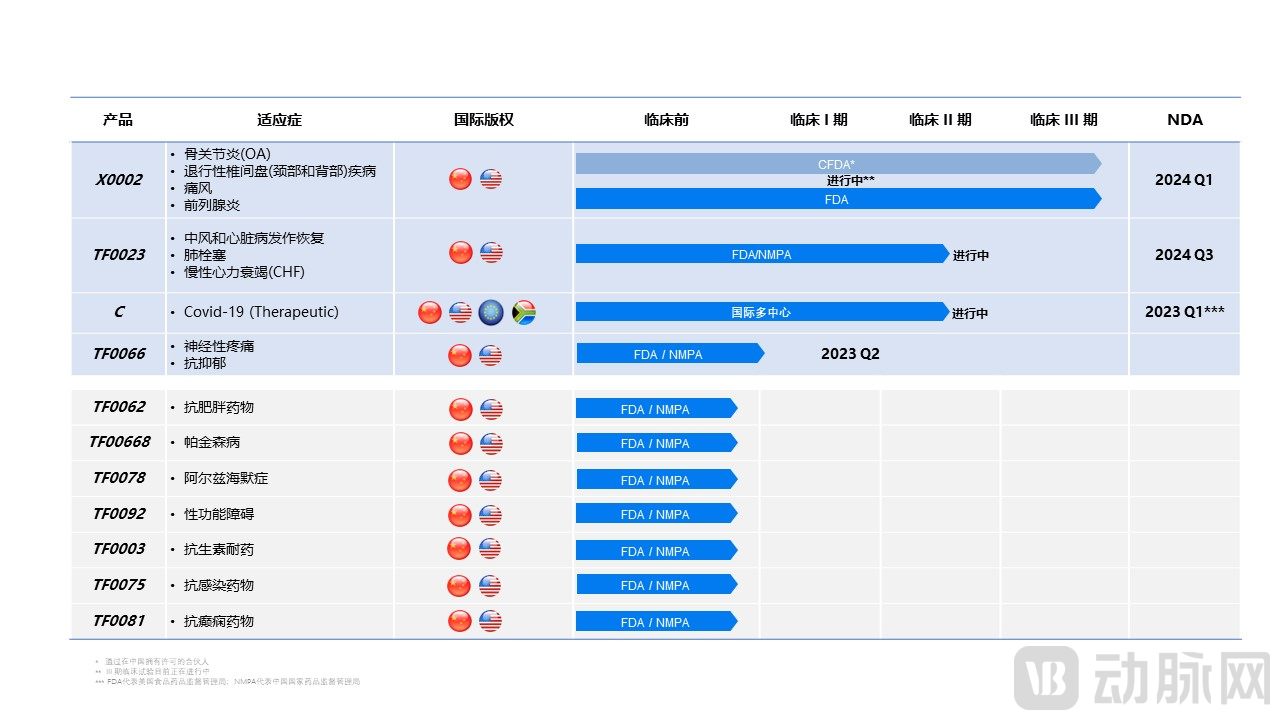
Taifei'er's Drug Pipeline Portfolio
Taifei'er's primary drug candidate, X0002, targets osteoarthritis. This specific disease area offers broad market prospects and addresses significant unmet clinical needs.
Due to the near absence of vascularization in cartilage tissue, conventional drugs cannot effectively reach the lesion site,Osteoarthritis has long remained an insurmountable challenge in the field of drug development,To date, there are no medications available for the long-term management of osteoarthritis pain, let alone any disease-modifying treatments for osteoarthritis. Currently, nonsteroidal anti-inflammatory drugs (NSAIDs), which are the most commonly used agents, provide only short-term relief of partial pain in patients with mild to moderate disease and are effective in only a subset of patients. Furthermore, long-term use of these drugs can lead to adverse effects such as gastrointestinal bleeding and perforation, and increase the risk of cardiovascular diseases.
Meanwhile, the osteoarthritis treatment market offers substantial growth potential. In 2003, total sales revenue from COX-2 inhibitors (Celebrex, Vioxx, and Valdecoxib) exceeded $9 billion. Although subsequent findings revealed that these COX-2 inhibitors increased the risk of cardiovascular disease, leading to restrictions on their use, such limitations did not hinder the continued growth in demand within the osteoarthritis treatment market. The market is projected to achieve a compound annual growth rate (CAGR) of 8.1%, with demand expected to reach $10.3 billion by 2025.
To this end, there is an urgent need in the osteoarthritis treatment market for an innovative drug capable of providing long-lasting pain relief, slowing disease progression, and improving or restoring joint function.
X0002 is a spray formulation capable of penetrating skin and cartilage,Indicated for pain relief and symptom management in osteoarthritis. In July 2020, the drug received FDA “Fast Track” designation. Clinical studies completed in China and the United States have demonstrated that X0002 exhibits significantly superior efficacy compared to first-line agents currently in clinical use.
Phase II clinical study results showed that X0002 not only effectively alleviated patients’ pain, but also improved stiffness and difficulties in daily activities. Pain did not recur one week after discontinuation of the drug. Meanwhile, it demonstrated a favorable safety profile and increased joint space width, i.e.,It has the potential to treat osteoarthritis and is expected to become a safe and effective medication for the long-term treatment of osteoarthritis.
X0002 is currently undergoing Phase III clinical trials in the United States and China, respectively, with marketing approval applications expected to be submitted by the end of 2023.
Notably, the Phase III clinical trial in China was designed as a randomized, double-blind study using Pfizer’s oral drug Celebrex (celecoxib) as the active control. In its first year on the market, Celebrex achieved sales exceeding $2 billion, a record that remained unbroken for nearly two decades. The U.S. Phase III clinical trial of X0002 is structured as a 22-week double-blind study followed by a 30-week open-label extension; currently, patients have already entered the open-label phase. Phase II clinical results for X0002 demonstrated significant improvement in patients’ pain indices, with pain becoming mild enough in the later stages of treatment to not interfere with daily life and work. More notably, concurrent improvements in joint symptoms and condition were observed, highlighting the superior efficacy of X0002. Furthermore, no drug-related adverse events have been identified to date; even common topical side effects such as skin irritation are rare and very mild when they do occur.
Dr. Yu Chongxi shared an interesting anecdote: After completing the first phase of a clinical study, one patient stated that she did not wish to participate in the next phase because her osteoarthritis had become virtually pain-free, allowing her to move freely and even hike mountains. She planned to spend the entire summer with friends and family in a remote mountainous area without electricity or mobile phone signal, thereby withdrawing from the study. The physician warned her that failing to complete the full course of treatment could lead to a rapid recurrence of joint pain. However, the patient responded that at 74 years of age, she was uncertain how many summers she had left. Having been housebound for many years due to arthritis, she felt that traveling alone to such a remote, high-altitude destination would pose safety concerns. Now that she had regained the ability to hike, she did not want to miss this opportunity to spend the entire summer in the mountains with her friends.
Dr. Yu Chongxi stated that while he feels a slight regret that she did not complete the entire clinical trial, he is predominantly filled with sincere gratification at the prospect of the patient being able to once again enjoy a fulfilling life.
“Leveraging our high-penetration innovative drug R&D platform, along with data derived from theoretical analysis, animal studies, and clinical trials, we are confident that our pipeline candidates demonstrate superior efficacy compared to existing market offerings. This confidence serves as the foundation for our continued deep engagement in the highly competitive innovative drug markets of Europe, the United States, and China,” stated Dr. Yu Chongxi.
In addition to X0002, the company is developingTF0023 is a novel antithrombotic drug, enabling it to reach myocardial and cerebral infarct sites lacking blood circulation due to thrombosis, thereby restoring function to the infarcted tissue. TF0023 has initiated Phase II clinical trials in the United States.
Taifei'er'sCOVID-19 Drug for Severe to Critically Ill Patients Has Entered Phase II Clinical Trials in the United States and Europe.For acute viral infections such as COVID-19, antiviral drugs and neutralizing antibodies are typically no longer effective once symptoms appear. Moreover, the use of antivirals, neutralizing antibody therapies, or antiviral vaccines may induce viral mutations; therefore, it is difficult to regard these approaches as favorable treatment strategies for either individuals or populations. Based on current clinical experience with COVID-19, mild cases of acute viral infection generally do not require treatment, while the cornerstone of management for severe cases is preventing an excessive response by the host’s immune system. Mechanistically, drugs that suppress the immune system by targeting the upstream components of the immune response cascade may trigger adverse reactions.
Taifei'er has adopted a fundamentally different approach from existing therapeutic strategies, effectively suppressing the excessive immune response triggered by the virus. The current clinical study focuses on hospitalized patients requiring oxygen support for respiratory assistance, and the trial is progressing smoothly. Preliminary clinical results reveal significant variability in treatment outcomes: half of the patients were able to discontinue oxygen therapy and be weaned off ventilators within 1–2 days, whereas the other half required at least 10 days or more to cease oxygen support, with some patients still unable to discontinue oxygen therapy even after one month of hospitalization.
In other words, although it is a double-blind randomized study, Taifei'er is confident in the prospects of its investigational drug for treating COVID-19, given the aforementioned clinical effects combined with the excellent results on organ protection demonstrated in animal model studies. The investigational drug holds promise for eliminating post-COVID-19 sequelae, commonly known as "Long COVID," and addressing the issue of SARS-CoV-2 variants.
Furthermore, TF0066, Taifei'er's investigational antidepressant drug, has completed preclinical studies and is ready for clinical trial application. Other pipeline candidates targeting Alzheimer’s disease, obesity, Parkinson’s disease, and epilepsy are in the preclinical stage, with partial CMC studies and animal experiments completed.
“An innovative product launches a market and guides an industry.”Going forward, Taifei'er will continue to focus on unmet clinical needs, overcome the limitations of small-molecule drugs, accelerate the global layout of its R&D centers, and advance its pipeline, thereby creating a wholly innovative market with innovative products that demonstrate significantly superior therapeutic efficacy compared to conventional drug treatments, and establishing a complete industry chain.