

Luca Healthcare Secures Tens of Millions in Pre-A Funding to Advance Digital Biomarker and Digital Medicine Innovation
VCBeat has learned that Luca Healthcare (hereinafter referred to as “Luca”), a developer of digital therapeutic targets, recently completed a Pre-A financing round worth tens of millions of RMB. The round was led by Lightspeed China Partners, with participation from Jinding Capital andPicus CapitalCo-investment. The proceeds from this round of financing will be allocated to the research and development and validation of Luca’s existing digital target pipeline, international scientific collaborations, and the upgrade of its digital target discovery platform.
Luca, founded in 2020, is a company specializing in the development of digital targets within the field of digital medicine. The primary application scenarios for digital targets include evaluating drug efficacy in clinical trials, serving as digital companion products paired with pharmaceuticals and medical devices, and enabling the development of standalone digital therapeutics.
To date, Luca has successfully developed more than 40 digital therapeutic targets, primarily focusing on the fields of respiratory health, neuromotor function, and cognition. Four of its related products are currently undergoing separate applications for Class II and Class III medical device registration certificates.
“With the development of digital targets as our core, we can strategically position our business to bridge digital targets with diverse application scenarios through a combination of business models,” said Chen Si, Founder and CEO of Luca. During the subsequent interview, Chen Si also provided VCBeat with a detailed overview of Luca’s business strategy and business model, as well as her vision for the future of digital medicine.
When it comes to drug targets, those with some understanding of drug development are certainly familiar with the concept. However, the term “digital targets” may strike many as both familiar and unfamiliar.
To truly understand digital targets, we must first clarify a closely related concept—digital phenotype—which refers to raw data characterized by individual and disease-specific features.
The so-called digital biomarker is a digital technology product composed of one or more digital phenotypes, validated by evidence-based medicine, and associated with diseases.
In short, digital targets are a combination of one or more digital phenotypes of a certain disease. The term “combination” may give the impression that it is an easy task, but in reality, it is not.
Gao Jiankai, Partner at Lightspeed China Partners, stated, “The innovation of digital technology will permeate every aspect of healthcare. Advances in digital health are inseparable from data analysis and insights, with the foundation and key technologies in this field centered on identifying digital targets associated with diseases. The Luca team possesses profound expertise and strong R&D capabilities in this area. We believe in and look forward to Luca achieving explosive and sustainable growth in the commercial application of digital targets and digital health.”
According to Chen Si, the development of digital targets involves high barriers and a long cycle, with R&D challenges permeating the entire process.
Medical research is the first hurdle in the development of digital endpoints. At this stage, “companies need to gain a deep understanding of disease background, intervention pathways, pathogenesis, and related symptoms, as well as which symptoms are common to which diseases.” In other words, companies must possess substantial medical expertise;
When advancing to the second step of digital target development—signal acquisition—issues regarding the feasibility, reliability, and accuracy of data collection come into play. “For example, while the information collected within a fixed space in a hospital is precise, enabling continuous or semi-continuous interventions often requires expanding data collection beyond the hospital setting to home environments. This poses significant challenges for enterprises: how to ensure the continuity and robustness of information acquisition while aligning with real-world application scenarios to guarantee practical technical feasibility.”
As companies navigate through these successive stages and reach the late phase of digital target development—data analysis—the construction and application of analytical models have emerged as a significant barrier.
Despite the challenges inherent in the entire digital target development process, Luca, founded in 2020, has firmly committed to this path and successfully completed the development of multiple digital targets.
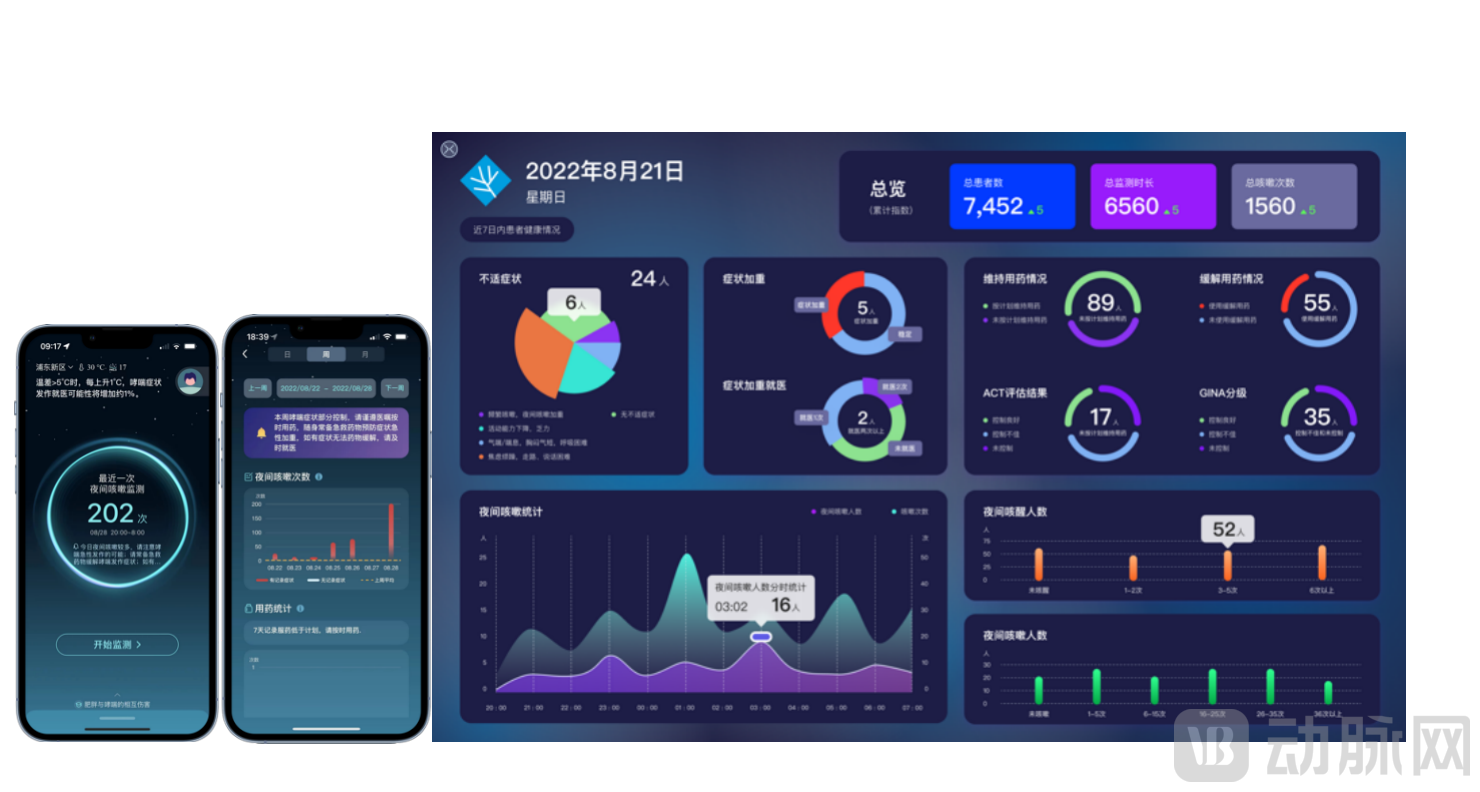
Luca’s Digital Companion (Drug + Digital) Asthma Management App “Cocoa Steward” Paired with Asthma Medications for Asthma Management
When asked why he is so committed to making digital target development the core business, Chen Si stated that this decision is primarily driven by the broad applicability of digital targets.
For example, prior to drug approval, digital endpoints can serve as clinical endpoints for drugs, enabling a more objective assessment of their clinical efficacy.
Moreover, from the perspective of healthcare services, digital endpoints can also be applied to disease screening and diagnosis, remote monitoring and management of patients, as well as prediction and early warning of acute events;
From the perspective of enhancing therapeutic outcomes, digital endpoints can serve as digital companion products to pharmaceuticals, improving overall treatment efficacy through methods such as adverse event (AE) management, dose adjustment, and medication management;
From an intervention perspective, digital endpoints can also serve as assessment endpoints for interventions, forming a closed-loop diagnostic and therapeutic system for digital therapeutics and enabling digital, personalized precision medicine.
“In traditional drug development, there are active pharmaceutical ingredients, or APIs. In fact, digital targets can be viewed as active digital ingredients,” said Chen Si.
Luca has achieved notable success in both digital clinical assessment and digital therapeutics. For instance, in the development and application of digital companions, diagnostic tools, and digital clinical endpoint assessment instruments, Luca has established collaborations with renowned multinational pharmaceutical companies such as Shanghai Pharmaceuticals and AstraZeneca, as well as Thermo Fisher Scientific, a global leader in healthcare services.

In its collaboration with Thermo Fisher Scientific, Luca primarily leverages digital endpoint combinations to assist in clinical trials by capturing and collecting subject data, thereby enabling objective assessment of clinical benefits. Furthermore, by integrating digital medication adherence solutions, Luca will support Thermo Fisher Scientific China’s Direct-to-Patient (DTP) clinical trial services, promoting the adoption and widespread application of digital endpoints in “patient-centric” clinical trial services.
Hann Pang, President of Thermo Fisher Scientific China, stated, “The combination of Luca’s digital endpoints and digital phenotyping modules provides strong support for our clients’ decentralized, innovative clinical studies. Leveraging digital endpoints to assist clinical trials also aligns with Thermo Fisher Scientific’s global strategy. We look forward to collaborating with Luca to integrate more precise digital solutions into our clinical services portfolio, thereby empowering our patient-centric clinical trial services.”
In terms of product development for digital therapeutics, Chen Si repeatedly emphasized during the interview: “Luca has chosen to focus on the domain of digital targets, rather than specific disease areas—that is, targeting digital phenotypes to discover new features from a data dimension.”
Luca is currently developing digital therapeutics products, either independently or in collaboration with industry stakeholders, covering multiple disease areas, with particularly in-depth exploration in respiratory and neurological disorders.
The reasons mainly stem from the following four aspects:
First, from the perspective of application scenarios, there is substantial demand for digital endpoints in the fields of respiratory and neurological diseases. Second, with advances in medicine, an increasing number of associations between symptoms and clinical manifestations are being discovered. Improvements in informatics capabilities, such as computing power and signal processing, not only facilitate the discovery of digital endpoints but also make their practical application feasible. Third, Luca believes that respiratory diseases are poised to become the next largest category of chronic diseases, following diabetes and hypertension. Fourth, compared with hypertension, the respiratory field lacks precise, high-sensitivity measurement strategies, and current data assessment suffers from low granularity. This leads to issues such as imprecise evaluation of drug efficacy and attrition in drug development. These challenges present a prime opportunity for the application of digital endpoints.
However, as previously mentioned, the development of digital targets is no easy feat. So how did Luca achieve it?
We may find the answer in Luca’s team composition.
According to Chen Si, Luca’s team members come from diverse fields such as biotechnology, medicine, artificial intelligence, internet technology, and algorithms, offering unique insights and advantages in integrating technology with medical practice.
Chen Si’s academic background in biosensors from the University of Cambridge, combined with her industry experience, is closely aligned with digital biomarkers and digital therapeutics. She previously served as the China General Manager at Huma, a UK-based digital health unicorn, where she was responsible for remote patient monitoring, as well as the development of digital biomarkers and digital therapeutics. She also held the position of Director of R&D and Business Development at DRW, an in vitro diagnostics technology company. Additionally, she played a leading role in the research and development of a POCT (Point-of-Care Testing) hardware and software platform for infectious disease detection, and contributed to the creation of digital biomarker and digital therapeutic products in areas such as pulmonary hypertension, neurology, and hip replacement.
The founders and core team’s profound insight into and understanding of the industry have enabled Luca to successfully pass the first stage of digital target development.
According to Chen Si, throughout the entire process of digital biomarker development, Luca adheres to the core principle of “Meeting patients where they are.” Grounded in rigorous medical logic, the team evaluates technical feasibility and accessibility, employing a comprehensive data processing and algorithm development pipeline to address challenges such as limited raw data volume and class imbalance. These measures enhance the prediction accuracy of deep learning models in complex scenarios. “These breakthroughs enable us to precisely capture evidence-based digital biomarkers for disease diagnosis and monitoring through streamlined approaches and scenario-tailored technical configurations, thereby achieving deep alignment between application scenarios and the most suitable technologies.”
Regarding digital targets, digital therapeutics (DTx), and even digital medicine, this founder indeed holds a rather ambitious vision. “Future digital therapeutics should be categorized into three segments: first, the currently mainstream DTx focused on digitizing Cognitive Behavioral Therapy (CBT) or clinical guideline pathways; second, DTx used in conjunction with pharmaceuticals or treatment protocols; and third, over-the-counter (OTC) DTx, which holds the greatest growth potential.” Chen Si stated that to truly gain recognition for digital therapeutics and realize their clinical benefits and health economic value, it is necessary to further regulate the evaluation, assessment, and certification systems for digital medicine, as well as to conduct deeper and more extensive market education.
Zou Lijun, Founding Partner of Jinding Capital, stated, “Digital health has evolved into a new phase characterized by AI- and technology-driven proactive disease diagnosis and management. We highly recognize the vision and R&D capabilities of Luca’s founding team. Leveraging our years of accumulated expertise and insights in branding and offline retail, we will continuously integrate premium resources to empower Luca’s market strategy. We remain steadfast in our philosophy of being ‘not just investors, but partners.’”
Alexander Kremer, Managing Partner of Picus Capital China, stated, “We are highly optimistic about the R&D direction pursued by Luca’s team. We believe that the digital endpoints developed by the company can be integrated into digital medicine applications worldwide. We will also provide full support for Luca’s expansion across Europe, the United States, and other regions.”