

ImmuOnco Biotech: Pioneering Immune Repertoire Sequencing in China and Advancing AI-Driven Precision Medicine
The human immune system is the body’s primary defense mechanism and a key factor in improving human health. Due to its vast scale and complexity, the human immunome is estimated to be billions of times larger than the human genome. To date, scientists have yet to fully unravel the underlying principles by which it adapts to and combats disease.
The convergence of next-generation sequencing (NGS) technology with major advancements in genomics, bioinformatics, and artificial intelligence (AI) has driven the development of immunogenomics, making it possible to decode the human immune system.
The immune system comprises the innate immune system and the adaptive immune system, with T cells and B cells being the two major cell populations of the adaptive immune system. Immune Repertoire (IR) refers to the circulatory system of an individual at a certain point in timeThe sum of all functionally diverse T cells and B cells, typically measured in blood. In healthy adults, each milliliter of blood contains approximately 50,000–440,000 B cells and 600,000–3,500,000 T cells.When the human body mounts an immune response, antibodies expressed on the surface of T/B cells bind to their specific antigens, thereby activating the T-cell receptor (TCR) or B-cell receptor (BCR) that recognizes disease-associated antigens on the cell surface. This activation triggers clonal proliferation of the T/B cells, ultimately generating the corresponding immune effector responses.
Each individual's immune repertoire comprises 1x10¹²-18different TCR/BCR, thisDiversityEnabling the individual’s immune system to recognize and respond to diverse antigens in vaccination, infection, autoimmunity, cancer, and other diseases. In theory,The greater the diversity of TCR/BCR repertoires in an individual, the broader the range of disease antigens that can be recognized, and consequently, the stronger the capacity to mount an immune response.。
When TCR/BCR are activated and produceClonal Proliferation,NGS technology can identify a large number of expanded identical TCR/BCR sequences, thereby inferring that the individual's T/B cells have activated functional pathways, produced corresponding antibodies, and initiated an immune response.。
That is to say,NGS-based assessment of TCR/BCR clonal expansion can be applied to clinical diagnosis and monitoring, as well as to the establishment of immune repertoire gene libraries., leveraging AI technology to identify the relationship between TCR/BCR and diseasesDecoding the human immunogenome represents the next frontier in genetic medicine, with the potential to reimagine and reshape the future of public health—from disease prevention and precision diagnosis to effective treatment.
Aimu'en Biotechnology(hereinafter referred to as "Aimuen"),China's FirstImplementationBiotechnology Company Specializing in Immunogenomics Sequencing, seven years of research accumulation in the Immunology Laboratory at the University of Chicago, incubated by the Nano Research Institute of Zhejiang University, and officially established in Hangzhou, Zhejiang Province in 2016,Filling the Domestic Gap in Immunogenomics Sequencing Technology。
Aimu'en byDr. Tao SunandDr. Liu XiaoCo-founded by two individuals who completed their biotechnology-related studies and research at the Illinois Institute of Technology and the University of Chicago in the United States, andHe began conducting related research at the University of Chicago’s Immunogenomics Laboratory in 2009. Dr. Tao Sun has focused on immunology and peptide vaccine research for over a decade and has published 34 academic papers., holding 11 patents related to immune repertoire sequencing, immunodiagnostics, and TCR-T cell immunotherapy;Dr. Liu XiaoSpecializes in research on T cell receptors, personalized cancer immunotherapy, neoantigens, and the tumor microenvironment, and authored the professional monograph *Immunopharmacogenomics* in the Springer academic series.
Your outstanding research achievements in immunogenomics will soonattracted the Zhejiang-California International Nanosystems Institute. Given the gap in immunogenomics research within China’s academic community and clinical applications, as well as the importance and potential of immunogenomics in precision medicine,Dr. Zhao Lingyun, Assistant to the Dean of the Nanotechnology Research InstituteProvided guidance and incubation for the initial implementation and operational setup of Aimu’en. Dr. Zhao holds a degree in Biomedical Engineering from Zhejiang University and possesses extensive experience in scientific research commercialization and enterprise incubation.
Furthermore, Aimu'en also brings togetherMr. Wei Bing, with 20 years of experience in marketing management at pharmaceutical companies, after graduating from the Third Military Medical University, he/she worked at Xinqiao Hospital, Sanofi, Green Cross, etc.; andTang Chenling, AI Bioinformatics Engineer at the University of Houston, USAand those who have recently joinedWang Ziyi, Ph.D. in Biochemistry from The Hong Kong University of Science and Technology, supporting Aimu'en in T-cell drug development.
Leveraging the profound and pioneering research in immunogenomics by Dr. Sun Tao and Dr. Liu Xiao, Aimu’en has launched its Immunology Platform, which translates immunogenomics into clinical products by decoding the genetic blueprint of the immune system.
Currently,AIMUEN leverages its proprietary AI machine learning algorithms and a curated database of tens of billions of immunogenomics data points, employing ImmuHub®Immune Repertoire Sequencing Technology, includingRNA 5′ RACE Single-Primer Library Preparation MethodwithDNA+ Multiplex PCR Primer Library Preparation Method, inClinical Diagnosis, Drug Development, Health Checkups, Research ServicesLaunched immune-driven products across four key areas.
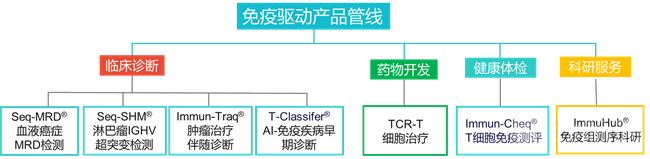
AIMUEN®Immuno-Driven Product Pipeline
In terms of clinical diagnostics, Aimu'en has launched testing products for hematologic cancers and solid tumors, as well as T-Classifier, an AI-driven early disease diagnostic tool based on TCR sequencing and artificial intelligence algorithm analysis.®. ItsSeq-MRD®Blood Cancer MRD Test: The First in China and the Second Worldwide Blood Cancer MRD Testing Product. It enables the assessment of patient prognosis, evaluation of treatment response, determination of transplant necessity, and guidance on treatment timing by detecting the number of residual cancer cells and specific clonal sequences. In 2020, Seq-MRD®Recommended by the China Cancer Foundation as the designated product for myeloma MRD testing. In 2021, Genetron Health signed a cooperation agreement with AmoyDx to commercialize this product, and its current sales revenueAccounted for half of total sales. 2022,Seq-MRD®CE Certified, and is concurrently pursuing registration for Class III medical devices. Currently, this technology has been applied toRelevant Clinical Trials by Johnson & Johnson and Other Pharmaceutical Companies in the United States。
In the field of companion diagnostics for solid tumor therapy, Aimu'en has launchedImmun-Traq®Used to guide cancer pharmacotherapy, evaluate immune system status, assess treatment efficacy, and predict patient prognosisThis technology has currently demonstrated significant efficacy in various tumor types, including breast cancer, head and neck cancer, cervical cancer, and colorectal cancer. Building on this success, Immun-Traq aims to expand the application of this technology through collaborations with pharmaceutical companies, catering to enterprises engaged in the research and development of diverse therapeutic agents.®It plays a role in all stages of drug development, clinical trials, and post-marketing.Currently, multiple pharmaceutical companies have established collaborations with Aimu'en through this technology.
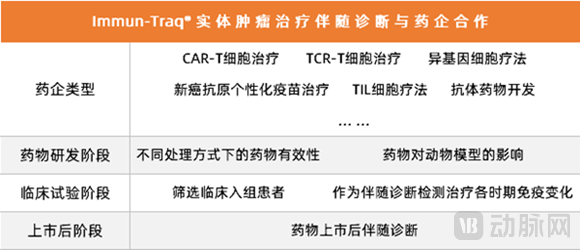
Immun-Traq®The Role Played in Collaboration with Pharmaceutical Companies at Various Stages
InBig Health MarketIn this regard, ImmuCure has now launched Immun-Cheq®T-cell Immunity Assessment. This technologyCurrently, it is mainly used for health check-ups., by assessing the subject's TCR diversity and the presence of extensive clonal T-cell proliferation in vivo, to determine the subject's immune age and whether an immune stress response is occurring. If clonal proliferation is detected, referral to the appropriate clinical department is recommended based on the patient’s health risk factors or symptoms.
of this technologyExtension is the T-Classifier®AI-Powered Early Disease Screening via Immune Diagnostics: Combining TCR Sequencing with AI Algorithms to Enable Comprehensive Early Screening and Diagnosis Using Only Peripheral Blood Samples. This technology integrates multiple AI algorithms to classify TCR clones, and by identifying the presence of disease-specific TCRs in the subject, it determines whether they are infected with the corresponding disease. By continuously expanding the database for machine learning, AI-TCR is currently able toThe detection accuracy for multiple diseases has increased to 86–95%.. When the database linking T cells to diseases is sufficiently large, it becomes possible to decode which specific T-cell receptors (TCRs) the immune system generates in response to particular disease antigens. This enables early screening and diagnosis of diseases by performing TCR sequencing on proliferating T-cell clones and leveraging TCR specificity.
TCR-T Drug DevelopmentThis is the technical platform that Aimu’en has established in recent years and will also be the direction for accelerated development in the future. Given the significant efficacy of TCR-T cell therapy in cancer-specific treatment, and leveraging its in-depth research on TCRs and market accumulation, Aimu’enScreening for Highly Specific TCRs to Combat Cancer. After obtaining tumor antigens, Aimu'en utilizes high-throughput methods to match antigenic peptides with activated T-cell receptors (TCRs) and performs paired alpha-beta chain assembly of the TCRs. It then validates and engineers the TCR-T cells in terms of antigen specificity, affinity, cytotoxicity, and safety, ultimately selecting the optimal TCR.The pipeline currently under development includes HPV, tumor neoantigens, and tumor shared antigens.
AIMUENCompleted immediately upon establishment.Angel Round Financing of Several Million Yuan, and obtainHangzhou Municipal Government Provides Millions in Funding Support. In 2018, partnered with the Shaw Precision Diagnosis Center to launch a pilot center for clinical testing services.2019, co-founded and invested in Hangzhou Chunxun Biotechnology, layout AimuenAI Single-Cell Sequencing Industry Chain。In 2020, secured tens of millions of yuan in investment from Genetron Health and Zhengfang Capital., and entered into a strategic partnership with Genetron Health, providing technical and product support through patent sharing, CRO business collaboration, and assistance with IVD regulatory approvals.
As the first company in China dedicated to immunogenomics, Aimu’en has demonstrated its technological breakthrough capabilities and market-expansion spirit across various dimensions, including technological maturity, platform comprehensiveness, and extensive collaborations. In an interview,Dr. Sun Tao, Founder of Aimuenstated: “Immunogenomics is a relatively young discipline, with a history of less than twenty years,”It is like a newborn baby, striving to explore and adapt to more application scenarios..” Due to its relatively short period of technical accumulation, the correlation between TCR/BCR and diseases remains ill-defined in certain scenarios, and its acceptance in the clinical stage is not yet prominent; however,The role of immune repertoire sequencing in disease diagnosis and treatment is unquestionable.。
What is needed now is a greater infusion of academic expertise, time, and capital into immunogenomics to establish this epoch-making pathway for precision medicine diagnostics.
As a market pioneer, Aimune will continue to advance the approval and commercialization of its existing partnerships, enhancing market acceptance of immune repertoire sequencing; as a technology leader, Aimune will continuously explore new clinical pipelines, collecting and enriching its immunogenomics database; as an industry driver, Aimune plans to vigorously promote its own drug development platform after accumulating extensive R&D and marketing experience.
ThisChina's First Immunogenomics Company, leveraging over a decade of technical expertise, has achievedThe Most Extensive Product Development in the Market, possessing the sense of responsibility and mission expected of an industry pioneer.
“Without accumulating small steps, one cannot reach a thousand li; without gathering tiny streams, one cannot form rivers and seas.”What immunogenomics needs is an increasing number of “ImmuEn” entities, diligently exploring technology, vigorously expanding the market, and uniting to drive development.