

Amid Market Downturn, This Medical AI Pioneer Secures Over RMB 100 Million in Funding: What Will Drive Its Success in the Next Phase of AI?

FUSUN AITROX
Developer of Intelligent Medical Imaging Devices
Influenced by multiple factors, investment and financing activity in the healthcare sector declined significantly in the first half of 2022 compared with the previous year. According to data from VCBeat, there were 1,598 financing deals globally in the healthcare industry during the first half of 2022, representing a year-on-year decrease of approximately 43% from the peak recorded in the first half of 2021, indicating an overall cooling trend. Among these, digital health experienced an even steeper decline.
In this challenging environment, FUSUN AITROX announced this month the completion of a new round of strategic investment exceeding RMB 100 million, jointly participated in by Fosun Pharma, Sinopharm Zhongjin, and Anting Industrial. Undoubtedly, this positions it one step ahead in the fiercely competitive second half of the medical AI race.
VCBeat has learned that, as Fosun Pharma’s first self-incubated project focused on medical artificial intelligence and integrating “software, hardware, operations, and medical services,” FUSUN AITROX has established a multi-product matrix framework and delved into various specialized segments, breaking the boundaries of medical technology and facilitating the practical implementation of AI-driven healthcare solutions. Meanwhile, its robust capabilities in “industry-academia-research-application” collaboration have enabled it to continuously secure approval for key national-level projects, including the Ministry of Science and Technology’s National Key R&D Program, the National Natural Science Foundation’s Key Projects, the Ministry of Industry and Information Technology’s “Open Competition Mechanism” Projects, and the 14th Five-Year Plan initiatives. With its flexible business model and synergy with Fosun’s ecosystem-wide resources, FUSUN AITROX has emerged as a rising star in the AI healthcare sector, garnering widespread attention from the industry.
How Did This Low-Profile AI Company Secure Major Funding Against Market Trends? What Lessons Can the Industry Learn? VCBeat (WeChat ID: Vcbeat) Investigated to Provide Industry Insights.
A review of the development of China’s AI medical imaging industry reveals that obtaining regulatory approval is merely the beginning of commercialization, not the sole measure of successful commercialization. Currently, mainstream AI imaging products have largely addressed the basic issue of whether AI can be deployed in practice; however, products that can deeply integrate into diagnostic and treatment workflows remain quite rare. This is partly because AI solutions, primarily delivered as software, are constrained by medical ethics and clinical workflows, posing significant challenges to commercialization. Additionally, most existing AI products focus on improving efficiency within individual departments, yielding limited impact on overall hospital performance and revenue growth, which hinders broad user acceptance.
This has resulted in poor commercialization progress and widespread difficulties in monetization for current medical AI. The industry is therefore experiencing an inversion of input and output—AI companies often raise billions in financing, yet only generate less-than-ideal revenues in the tens of millions. Although technological advancement indeed requires substantial resources and high valuations serve to reflect recognition of the technology, for the sake of sustainable industry development, it may be time for the entire sector to reflect on the deviations in existing business models and explore effective breakthrough strategies. In response, FUSUN AITROX has offered its own solutions.
Inheriting the DNA of Fosun Pharma, a pioneer in the healthcare industry ecosystem, and leveraging its deep expertise in big health and medical care, FUSUN AITROX has explored model innovation since its inception. By deploying a multi-product matrix that spans multiple departments and covers various diseases, along with an “AI+X” product format, the company aims to capture market share.
“AI+X” refers to leveraging the strong integrative nature of AI by combining it with various elements such as medical information, medical devices, consumables, pharmaceuticals, information systems, and healthcare services. This approach enables flexible and diverse implementations tailored to actual needs, thereby enhancing the value of the traditional healthcare industry, genuinely addressing the needs of patients, physicians, and hospitals, while also overcoming the challenges associated with monetizing AI solutions.
According to He Chuan, Global Partner of Fosun and Chairman of FUSUN AITROX, the company is currently in the phase of large-scale commercial implementation. Its hybrid business model, integrating hardware and software, SaaS, and software sales, has begun to yield results. Leveraging the Fosun ecosystem, FUSUN AITROX is expanding its reach and collaborating with local governments in multiple regions, achieving solutions that are “implementable, replicable, and effective.”
Compared with pure software application models, the integrated hardware-software and software-as-a-service (SaaS) models offer advantages such as high performance and strong adaptability, making them significantly more favored by healthcare institutions in practical applications. However, there is still considerable room for improvement across the industry in this regard. FUSUN AITROX has leveraged its “integrated hardware-software” solutions to align with the industry characteristic of “earning tangible revenue from hardware.”
FUSUN AITROX firmly believes in the trend of domestic substitution for medical devices and high-end equipment in the future. It has chosen to independently develop hardware, integrated with its self-developed AI-assisted diagnostic software and information management system, creating a trinity comprehensive solution. In 2021, the "Guidance Standards for Reviewing Government Procurement of Imported Products," jointly issued by relevant authorities, validated FUSUN AITROX’s foresight: The Standards clearly stipulate the required proportions for government agencies (public institutions) to procure domestically produced medical devices and instruments. Specifically, 100% domestic procurement is mandated for 137 types of medical devices; 75% for 12 types; 50% for 24 types; and 25% for 5 types.
In terms of market entry strategy, FUSUN AITROX has targeted the pathology sector. As the “gold standard” for tumor diagnosis, pathology offers substantial market potential: the global market exceeds USD 40 billion, while the market in China is valued at nearly RMB 40–50 billion. Taking the cervical cancer market as an example, approximately 100 million eligible women undergo screening annually in China. With screening fees around RMB 60 and outpatient service charges at hospitals approximately RMB 200, the estimated annual market capacity approaches RMB 10 billion.
Pathology imposes stringent standardization requirements on slide images, and instruments capable of ensuring stable slide preparation and consistent imaging standards form the foundation for developing AI pathology algorithms. Therefore, targeting its pathology product line, FUSUN AITROX has launched an integrated hardware-software solution—AITROX “Jingling.”
FUSUN AITROX’s “Jingling” is the industry’s first integrated hardware-software system for pathology departments. It includes digital microscopic image scanners and image management systems suitable for hospitals at all levels. Starting with single-disease applications, it brings together top Chinese pathologists and a global team of leading algorithm scientists to develop AI-powered products built on a digital foundation. The system ultimately meets multi-scenario needs—including slide management, digital diagnosis, research and teaching, quality control, departmental administration, and telepathology—empowering comprehensive transformation and upgrading of pathology departments.
It is reported that its pathology product portfolio now covers applications such as respiratory virus detection, lung cancer cytology testing, breast cancer FISH fluorescence analysis, and bladder cancer detection, thereby establishing a robust competitive barrier in the field of AI-powered pathology.
Professor Liu Dongge, Chairman of the Pathology Branch of the Chinese Medical Association and Director of the Department of Pathology at Beijing Hospital, spoke highly of Aitrox’s “Jingling” system. He noted that China faces a relative shortage of pathologists and significant disparities between urban and rural areas. Therefore, the development of digital pathology is of critical importance. This system can more effectively address current healthcare challenges, better serve the broad patient population, and improve medical standards, thereby contributing more effectively to the Healthy China initiative.
Amid the national push for domestic substitution, leading Chinese medical device manufacturers are poised to reap dual benefits from both rapid industry growth and the replacement of imported products. We have observed that United Imaging Healthcare, a leader in domestic medical imaging equipment, recently went public with strong market performance. FUSUN AITROX, with its independent R&D capabilities and internationally competitive products, may well become the next “United Imaging” in the field of digital pathology.
SaaS has become a mature model in many industries. However, transforming SaaS into a product that integrates with medical AI and achieves practical implementation has long been a challenge for the industry. FUSUN AITROX’s SaaS model is an innovative solution that combines medical AI, hardware, services, and operations. Currently, this model has helped hospitals improve operational efficiency and generate sustainable revenue growth in implemented projects.
FUSUN AITROX’s SaaS model originated from its collaboration with Foshan Fosun Chancheng Hospital (hereinafter referred to as “Foshan Chancheng Hospital”), which has ranked first among non-public medical institutions for four consecutive years. This partnership integrates medical AI technology with the hospital’s clinical service capabilities, creating a new model for specialized department operations. In addition to significantly improving internal departmental efficiency, the model extends its expertise to other hospitals through remote services, providing value-added support to medical institutions subscribed to FUSUN AITROX’s SaaS platform. These services include remote image interpretation, talent pipeline development, quality control management, and implementation of new technologies. Centered on Foshan Chancheng Hospital, this model has reached nearly 100 primary care medical institutions in the Greater Bay Area, enhancing the accessibility of medical services across the region. Meanwhile, FUSUN AITROX has obtained the Trusted Cloud National Standard Service Certification, ensuring robust data security capabilities.
Building on its experience in achieving regional coverage within the private hospital system in the Greater Bay Area, FUSUN AITROX has taken a significant step forward by successfully expanding this model into the public hospital system through government partnerships. Centered on high-tier hospitals within the region and extending its reach to primary care institutions, this “large hospitals supporting smaller ones” approach addresses the critical challenge of “having equipment but lacking physicians” at the grassroots level. This strategy has substantially increased the rate of patients seeking care nearby, aligning closely with China’s overarching policy of expanding and decentralizing high-quality provincial medical resources and strengthening county-level medical consortia.
Since 2019, the Chinese government has prioritized enhancing the service capacity of primary healthcare institutions as a key national strategy. Guided by this strategy, regions across China have made strengthening county-level medical services a critical task to address gaps in basic public services. Explicit policies have been introduced to establish medical consortia within counties, progressively achieve shared medical resources within these regions, further bolster primary care capabilities, and promote a tiered diagnosis and treatment model characterized by initial consultations at the primary level, two-way referrals, separate management of acute and chronic conditions, and coordinated care between upper- and lower-level facilities.
Chen Qiyu, Executive Director and Co-CEO of Fosun International, stated that amid the current trend of population aging, structural imbalances between the supply and demand of healthcare services—particularly the uneven distribution between urban and rural areas—will become increasingly pronounced. Addressing this imbalance is a challenge that requires collaborative discussion and joint efforts from government departments, the medical community, the industry, and the investment sector. AI technology serves as an effective auxiliary tool; it not only assists physicians but also acts as an aide for healthcare institutions, their administrators, and patients’ self-management systems, thereby enhancing the accessibility of high-quality medical resources and maximizing equity in healthcare service delivery.
FUSUN AITROX, leveraging its proprietary digital-intelligence specialized department operational services, has successfully partnered with the Xuzhou Tongshan Health Commission to interconnect 31 medical institutions across the district, establishing a regional imaging medical consortium. By adopting the model of “primary hospital scanning + AI-assisted diagnosis + central hospital diagnosis + core hospital quality control,” it has addressed the shortage of physicians despite adequate equipment in primary hospitals, accelerated the implementation of tiered diagnosis and treatment, and realized the goal of “minor illnesses treated within towns, major illnesses managed within the district.”
This project helped establish unified quality control standards for medical institutions across the district, promoting resource sharing and reducing duplicate examinations. During the implementation period, the volume of scanned images at pilot hospitals doubled, with an estimated savings of nearly RMB 10 million in fiscal expenditures and a reduction of approximately RMB 80 million in out-of-pocket costs for patients.
Professor Liu Shiyuan, Chairman of the Chinese Society of Radiology under the Chinese Medical Association, has maintained a long-standing collaboration with FUSUN AITROX and witnessed its development. He shared his insights: “China’s annual volume of radiological imaging scans is growing by approximately 30%, while the number of radiologists is increasing by only 4.1%. Additionally, many primary-care hospitals have radiologic technologists but no radiologists in their radiology departments, resulting in significant underutilization of medical equipment. The launch of AITROX’s artificial intelligence products, such as the ‘CT Imaging Assistant Detection Software for Pulmonary Nodules,’ along with information technology solutions based on medical consortia and integrated healthcare delivery systems, has substantially improved work efficiency in hospital radiology departments. These innovations also empower primary care institutions to make full use of medical resources, thereby supporting the national goal of tiered diagnosis and treatment.”
In the realm of 5G-enabled telemedicine, to promote the standardized application of ultrasound at the primary care level, FUSUN AITROX, in collaboration with China Unicom and Ruijin Hospital, has launched the “Rui Sheng Zhi Yuan—5G-Based Smart Ultrasound Remote Diagnosis Empowerment Platform.” This platform leverages AI and remote ultrasound technologies to enhance the diagnostic capabilities of primary care hospitals, enabling residents in remote areas to access ultrasound imaging and diagnostics from tertiary Grade A hospitals without leaving their villages or townships. This initiative also represents a significant practice in its AI+X differentiated competitive strategy.
Professor Zhou Jianqiao from the Department of Ultrasound at Ruijin Hospital stated that while ultrasound equipment is widely distributed across China, there is a severe shortage of ultrasound physicians. Unlike radiological imaging, ultrasound imaging relies entirely on the scanning techniques of ultrasound physicians. Ruijin Hospital has partnered with FUSUN AITROX to leverage AI-enhanced ultrasound as an entry point, focusing on independent innovation at the intersection of medicine and engineering. The collaboration aims to build a 5G-enabled smart healthcare empowerment system centered on “5G remote transmission, intelligent diagnostic and therapeutic devices, medical informatization, and AI-assisted diagnosis.” The initiative strives to establish a National Medical Ultrasound Imaging Smart Center and develop a 5G-enabled smart healthcare service platform, thereby implementing an integrated development strategy to enhance the quality of smart ultrasound services in the Yangtze River Delta region. In the future, it aims to achieve a demonstration effect for standardized and intelligent nationwide integrated construction. Through horizontal and vertical expansion via the “5G + Smart Diagnosis + Specialty Medical Consortium” model, the project will provide comprehensive support covering medical care, education, research, management, and services.
The successful implementation of FUSUN AITROX’s diverse business models is attributed not only to the support of the Fosun ecosystem and accurate assessments of market demand but also significantly to its multi-product matrix. While most AI products are limited to enhancing efficiency within a single department, FUSUN AITROX has completed a comprehensive “horizontal and vertical” R&D and product layout across its three major AI-assisted product lines: radiology imaging, pathology imaging, and ultrasound imaging. The “horizontal” dimension refers to the cross-departmental integration spanning radiology, pathology, ultrasound, respiratory medicine, cardiology, and oncology. The “vertical” dimension covers the entire disease diagnosis and treatment workflow, including early screening, early diagnosis, early treatment, and follow-up. This approach truly realizes the practical application of medical AI technologies across both medical technology departments and clinical specialties.
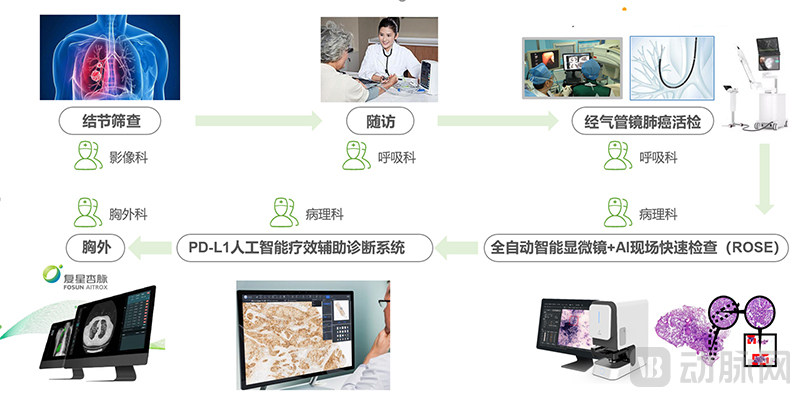
Taking one of FUSUN AITROX’s flagship products—the Intelligent Multi-Disease Lung Detection System—as an example, the system provides end-to-end diagnostic and therapeutic support for lung tumors, covering early screening, follow-up management, rapid on-site biopsy evaluation, and treatment efficacy assessment. This is achieved through AI-assisted pulmonary imaging diagnosis, AI-driven intelligent pulmonary follow-up, an all-in-one artificial intelligence microscope, the world’s first AI-ROSE intelligent auxiliary analysis system for bronchoscopy, and an AI-based PD-L1 evaluation system. By enabling comprehensive coverage from technical diagnostics to clinical treatment, the system offers physicians holistic clinical information and decision-making references.
This integrated solution has been widely welcomed by users, meeting the needs of multidisciplinary team (MDT) consultations. It provides efficient digital tools for MDT diagnosis and treatment across multiple departments, including radiology, pathology, and pulmonology, thereby optimizing departmental workflows and enhancing operational efficiency.
FUSUN AITROX: One-Stop Intelligent Pulmonary Diagnosis and Treatment Solution from Clinical to Medical Technology Departments
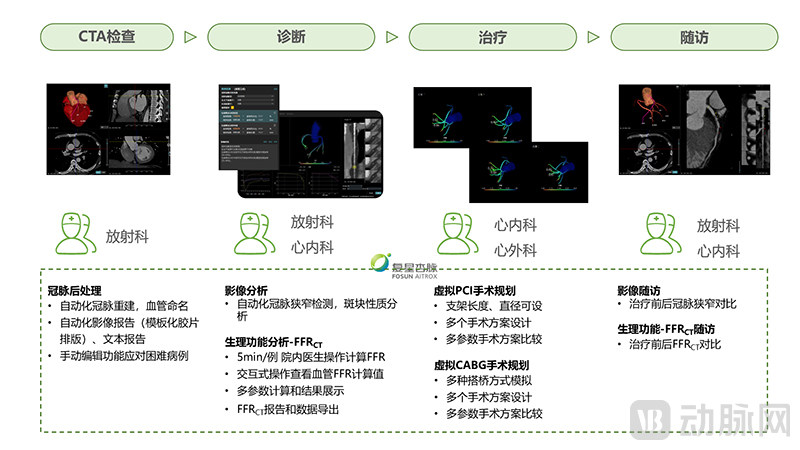
FUSUN AITROX’s “CardioVision” is another flagship product line from FUSUN AITROX, horizontally integrating the departments of radiology, cardiology, cardiac surgery, and rehabilitation to provide an integrated multidisciplinary team (MDT) solution for the diagnosis and treatment of cardiovascular diseases. CardioVision first assists the radiology department in the intelligent processing of coronary CT images, automatically annotating anatomical information such as the location, nature, and severity of stenosis in coronary atherosclerotic lesions. It then reconstructs and calculates CT-derived fractional flow reserve (CT-FFR), a critical physiological parameter, using computational fluid dynamics powered by artificial intelligence. By leveraging both anatomical and physiological data, it precisely supports cardiologists and cardiac surgeons in formulating treatment plans. The proprietary virtual stenting and virtual bypass grafting technologies of CardioVision further enable preoperative surgical rehearsal through collaboration between radiology and cardiology/cardiac surgery departments, accurately predicting outcomes based on different surgical strategies to achieve precise treatment of major cardiovascular diseases. Additionally, during postoperative cardiac rehabilitation, CardioVision provides continuous assessment of cardiovascular patients’ health status.
Meanwhile, FUSUN AITROX’s “Cardiac Imaging” solution can be fully operated by in-house medical staff without engineer intervention, enabling rapid deployment across tertiary Grade-A hospitals and primary healthcare institutions, thereby ensuring greater professionalism in computational results and surgical planning. Furthermore, all data computation and processing are performed locally within the hospital, eliminating the need for external data transfer and ensuring robust data security.
FUSUN AITROX: One-Stop Intelligent Cardiovascular Diagnosis and Treatment Products from Clinical to Medical Technology Departments
This system has played a positive role in the implementation of health-focused poverty alleviation and tiered diagnosis and treatment in remote areas of Guizhou Province. In 2020, FUSUN AITROX partnered with Guizhou Provincial People’s Hospital to enable AI-assisted multidisciplinary team (MDT) consultations across 15 district- and county-level hospitals within the medical consortium. This collaboration helped these hospitals establish rapid, standardized AI-based imaging auxiliary diagnosis, fractional flow reserve (FFR) analysis, and surgical planning, thereby maximizing the integration of medical resources and advantages in underdeveloped regions. Within a few months, the AI system assisted in diagnosing over 1,000 patients with coronary heart disease, while MDT remote consultations based on FFR analysis and surgical planning successfully diagnosed more than 100 complex cases of coronary heart disease.
Dr. Zhang Jiayin, Director of the Department of Radiology at Shanghai General Hospital, stated that there are approximately 11 million patients with coronary heart disease in China. The application of AITROX “CardioVision,” an AI-powered comprehensive cardiovascular solution based on coronary CTA, can provide robust evidence to guide clinical decision-making between medical and surgical interventions for patients with cardiovascular diseases. This technology has the potential to reduce the number of patients undergoing invasive catheterization procedures by 10–20% annually, thereby avoiding the waste of medical resources.
As a leading AI-driven enterprise in China that integrates “software, hardware, operations, and medical services,” FUSUN AITROX has achieved genuine implementation of products that span multiple domains, combine software and hardware, and integrate diagnosis with treatment—a feat accomplished by very few players in the industry. Its unique “AI+X” model, bolstered by Fosun’s ecosystem resources, has enabled it to develop distinct product competitiveness and commercialization capabilities. Meanwhile, Fosun’s extensive experience in industrial operations has led FUSUN AITROX to place particular emphasis on capital efficiency. Since its founding in 2018, the company has achieved its current commercial success with an investment of just over RMB 200 million, demonstrating exceptionally high operational efficiency compared to the billions of yuan commonly invested by others in the sector. This may well be the key reason behind its ability to secure substantial financing even amid market headwinds.
With the strategic support from industry and capital partners such as Sinopharm CICC and Anting Industrial, FUSUN AITROX will have stronger resource aggregation capabilities after this round of financing. In the future, it will provide higher-quality integrated solutions to industrial partners and medical institutions through broader channels.
“Running a business is a long-distance race, requiring diligence and constant vigilance. We will always persist in doing the right things, the difficult things, and the things that require time to accumulate. We will continue to maintain our entrepreneurial passion, create value for shareholders and society, and realize our vision of using AI to bring healthy, happy, and fulfilling lives to one billion households,” said He Chuan.
As the industry shifts from “concept demonstration” in the first half to “capability demonstration” in the second, medical imaging AI itself will undergo rapid iteration and upgrading, with its development being leapfrog rather than linear. Which medical imaging AI companies will ultimately prevail in this AI race? Time will tell.
Why Did Investors Decide to Invest in FUSUN AITROX? What Do They See as Its Unique Edge in the AI Medical Imaging Sector? Click to View
Note:
1. The content of this article is intended solely for academic exchange among professionals.
2. For contraindications or precautions mentioned in this article, please refer to the product instructions for details.