

Fosun Health and WinHealth Launch Next-Gen Smart Healthcare Cloud Platform, Fully Deployed at Foshan Chancheng Hospital
On the evening of August 26, the inpatient department of Foshan Fosun Chancheng Hospital’s main campus (hereinafter referred to as “Foshan Chanyi”) ushered in a significant milestone—the official launch of the new-generation smart healthcare cloud platform (hereinafter referred to as “Cloud HIS”), jointly developed by Fosun Health and Winning Health.
Dr. Wang, who was on duty that night, spoke highly of the new system: “The single-screen display feature, in particular, integrates all the routine functions we need in our daily work and presents key diagnostic and treatment information for patients. We no longer have to frequently switch back and forth between different interfaces! Moreover, the embedded professional medical data within the new system assists in diagnosing common diseases, significantly improving the efficiency of writing medical orders and clinical records.”
In addition to the inpatient department, outpatient clinics, fever clinics, emergency departments, and health examination centers are also systematically migrating to the cloud-based Hospital Information System (HIS) and the SaaS-based Internet Hospital mini-program. As a result, starting from August 27, six hospitals—including Foshan Chancheng Central Hospital’s main campus and its Chengnan Branch—will uniformly adopt the new-generation cloud HIS. Leveraging a dual-SaaS architecture (HIS-SaaS and Internet-SaaS), this initiative further strengthens the regional medical consortium centered on Foshan Chancheng Central Hospital, achieving an integrated model of healthcare services that spans online and offline channels, within and outside hospital settings, and across pre-diagnosis, intra-diagnosis, and post-diagnosis stages.
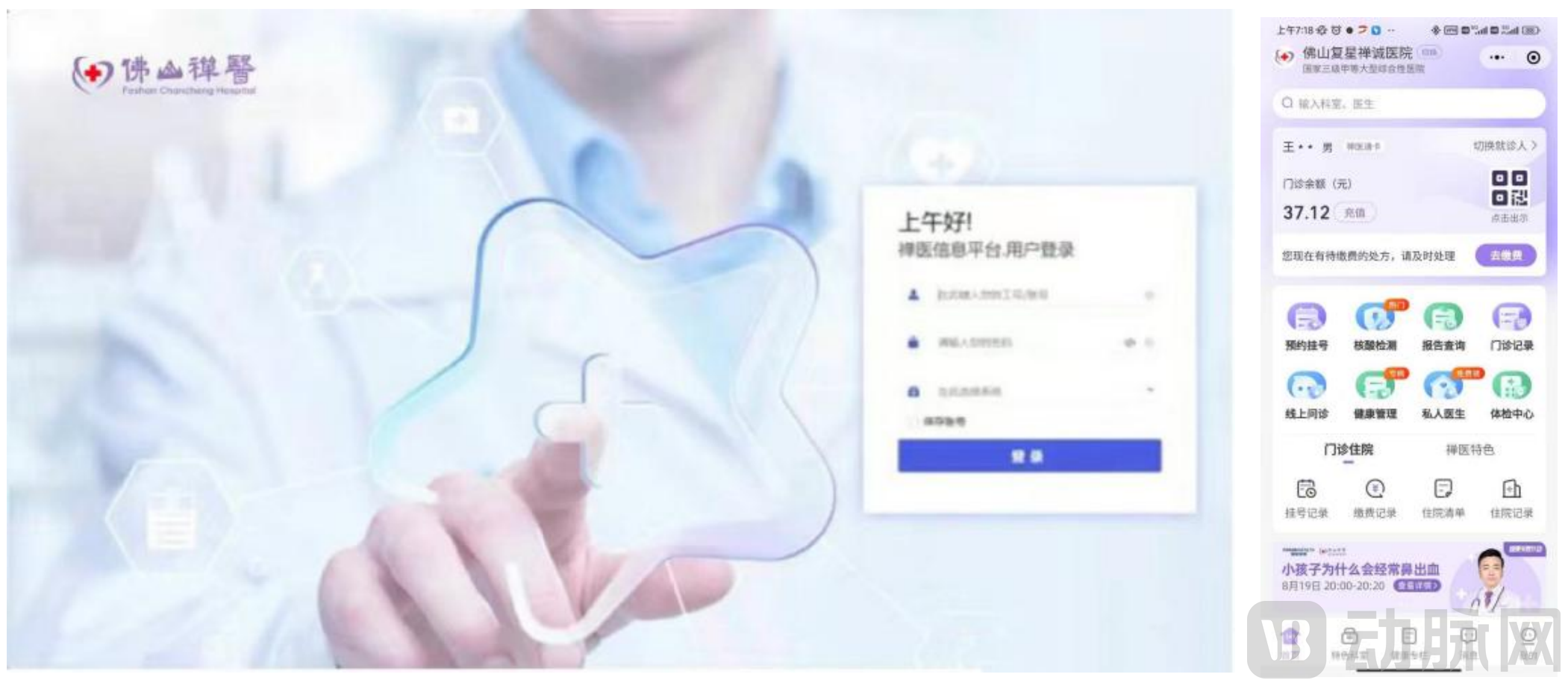
Next-Generation Cloud HIS System: Hospital-Side Interface & Mini Program Interface
Li Shengli, CEO of Fosun Health, stated that the new-generation cloud-based Hospital Information System (HIS), jointly developed by Fosun Health and Winning Health, has integrated various medical and health resources both within and outside the system. This integration facilitates the comprehensive flow of medical resources, helping to significantly enhance user experience and provide convenient, effective tools for patients, their families, doctors, nurses, and hospital administrators. “The initial implementation of the cloud HIS at Foshan Chancheng Central Hospital has played a ‘leading goose’ role in Fosun Health’s comprehensive digital hospital construction.”
Industry experts believe that with the establishment of the connotation of smart hospitals, the vigorous development of medical consortia, and the acceleration of internet healthcare, the medical industry is undergoing profound changes and has inevitably entered a stage of digital transformation. As a model for non-public medical institutions, Fosun Health actively leverages the advantages of group-based medical operations to implement digital development, having already become an important innovative force in China’s internet healthcare services sector. The smart healthcare cloud platform built by Fosun Health relies on a dual SaaS system to effectively migrate various data and business processes to the cloud, thoroughly transforming traditional medical architectures. “This positions Fosun Health at the forefront nationwide in terms of medical management philosophy and operational practices, and the advantages of group-based medical operations will become even more pronounced in the future.”
According to reports, the Cloud HIS jointly developed by Fosun Health and Winning Health is a knowledge-driven innovative medical information system built upon a “middle-platform” architecture to support digital transformation in healthcare. Based on comprehensive preliminary research into the diverse needs of Foshan Chancheng Hospital and an in-depth understanding of the pain points associated with its legacy system, the joint team redefined the hospital’s internal informational interaction modules according to different clinical scenarios. With a hospital-business-oriented approach and service capability development as the cornerstone, and by delivering all modules via a SaaS model, the solution has fully integrated in-hospital diagnostic and treatment services with out-of-hospital health management services.
“Hospital administrative departments can fully leverage internal systems for medical care, nursing, patient services, and operational management to carry out refined hospital management tasks, including business processing, data verification, and workflow management,” explained Hu Hang, President of Fosun Health and Director of Foshan Chancheng Hospital. In terms of data management, the cloud-based Hospital Information System (HIS) enables comprehensive management and interoperability of all hospital data, including electronic medical records (EMR), medical imaging, and laboratory test results. Frontline clinical staff can browse, query, collect, and transmit patient-related information anytime and anywhere through the system. Newly generated data can also be synchronized in real time to the data middle platform via the network. “Efficient co-creation and sharing of data break down information silos, significantly improving healthcare professionals’ work efficiency, responsiveness in clinical decision-making, and communication efficiency, while also effectively helping to prevent clinical errors.”
Notably, leveraging the dual SaaS platform, member hospitals under Fosun Health have transcended the limitations of traditional operational models. By breaking down hospital “walls” and crossing departmental boundaries, high-quality medical resources have been further unlocked. This enables top-tier physicians to move beyond single-hospital systems and empower more same-specialty hospitals within the medical group, ultimately facilitating digital and intelligent department construction and comprehensive patient management for a broader range of hospitals.
On the other hand, for patients and their families, issues such as complex medical procedures, cumbersome administrative formalities, and difficulties in seeking cross-regional and cross-hospital care have severely impacted the healthcare experience. The intelligent services of the new-generation cloud Hospital Information System (HIS) streamline the entire diagnostic and treatment process—pre-hospital, in-hospital, and post-hospital—creating a closed-loop smart healthcare service ecosystem. This effectively provides patients with an "invisible patient escort." Ms. Wu (a pseudonym), a patient, stated, "With this mini-program, I no longer need to endure long queues for appointment registration, waiting, payment, or retrieving test reports; everything can be handled online via my smartphone. Moreover, when I feel unwell, I can use the platform to perform preliminary self-assessments based on my symptoms." This solution not only addresses patient confusion but also significantly reduces the time and financial burdens associated with travel for out-of-town patients. With improved information flow and the implementation of cross-hospital sharing of electronic medical records, patients across different regions can now access convenient, high-quality, and efficient healthcare services right at their doorstep.
Hu Hang, President of Fosun Health and Director of Foshan Chancheng Hospital, further added that to enhance the convenience and continuity of patients’ online and offline medical care, the hospital’s WeChat mini-program not only features standard service modules but also specially integrates specialized department services unique to Chancheng Hospital. These include home nursing services under “Chanyi at Home,” family doctor services through “Chanyi Private Doctor,” and whole-course disease management for patients with specific conditions.
With the accumulation and management of more patient information data, personalized medicine will gradually be improved and implemented. Through the establishment of patient health records, medical staff can efficiently and comprehensively track patients' health conditions, especially for integrated health management of chronic disease patients.
As planned, Fosun Health will deploy cloud-based Hospital Information System (HIS) platforms for its member hospitals in the Pearl River Delta Greater Bay Area by the end of 2022. Currently, Foshan Xinglian Nursing Home, Guangzhou Xinshi Hospital, and Shenzhen Hengsheng Hospital have completed their requirements assessment. Foshan Xinglian Nursing Home has entered the phase of data preparation and interface integration development. Moving forward, each hospital will comprehensively consider its own operational strengths and regional user needs, leveraging the cloud HIS platform to implement customized service modules.
Driven by the “wild goose formation effect” generated through the comprehensive deployment of Fosun Health’s integrated online-to-offline diagnostic and treatment solution in the Greater Bay Area, the Fosun Health Smart Medical Cloud Platform will extend its reach to and stimulate multiple hospitals under Fosun Health in other economic zones, including the Yangtze River Delta, the Huaihai Economic Zone, the Chengdu-Chongqing Economic Belt, and the Central China Economic Belt, thereby promoting coordinated development of healthcare across these regions. In due course, all member hospitals under Fosun Health are expected to achieve cross-regional interoperability and mutual recognition of information, as well as interconnectivity and sharing of medical and health resources across different locations, thus fostering balanced improvement in clinical care standards among hospitals.
Chen Yuqing, Co-Chairman of Fosun Health, stated that as an internet diagnosis and treatment platform with strong medical attributes, Fosun Health is continuously deepening its layout in the healthcare industry while exploring innovative and optimized pathways. “Guided by benevolence, grounded in healthcare, and empowered by technology, Fosun Health will continue to deepen and upgrade its online-to-offline integrated solutions for private healthcare groups, thereby facilitating high-quality development in the private healthcare sector. We aim to accelerate the realization of our vision to ‘provide family users with a medical-grade, all-scenario, one-stop health ecosystem,’ ensuring that every family user can access precise and customized services for disease treatment and health management.”