

Pulmonary Artery Denervation (PADN) Featured in 2022 ESC/ERS Guidelines and PADN-CFDA Pivotal Trial Results to Be Unveiled at TCT 2022

Pulnovo Medical
Developer of Medical Devices in the Field of Pulmonary Hypertension Treatment
From August 26 to 29, 2022, the 70th European Society of Cardiology Congress (ESC Congress 2022) was grandly held in Barcelona, Spain. At the congress, the European Society of Cardiology (ESC), in collaboration with the European Respiratory Society (ERS), prominently released the “2022 ESC/ERS Guidelines for the Diagnosis and Treatment of Pulmonary Hypertension” (hereinafter referred to as the “Guidelines”), providing optimal treatment recommendations and the latest evidence support for the diagnosis and management of pulmonary hypertension worldwide, for reference by medical experts and patient families. Notably, in the section on treatment strategies for pulmonary arterial hypertension (PAH), the new edition of the “Guidelines” specifically adds information regardingPulmonary Artery Denervation (PADN Technique)The introduction and analysis affirm the significant academic value and clinical potential that PADN technology has already demonstrated in the field of pulmonary hypertension treatment, while also reflecting its positive implications for disease cure and health management in patients with pulmonary hypertension. Furthermore, PADN technology continues to garner increasing attention in the international arena of pulmonary hypertension treatment. Notably, at the upcoming Transcatheter Cardiovascular Therapeutics (TCT 2022) conference scheduled for September this year, Pulnovo Medical will globally unveil the results of the first-ever PADN-CFDA registered clinical study. Stay tuned!
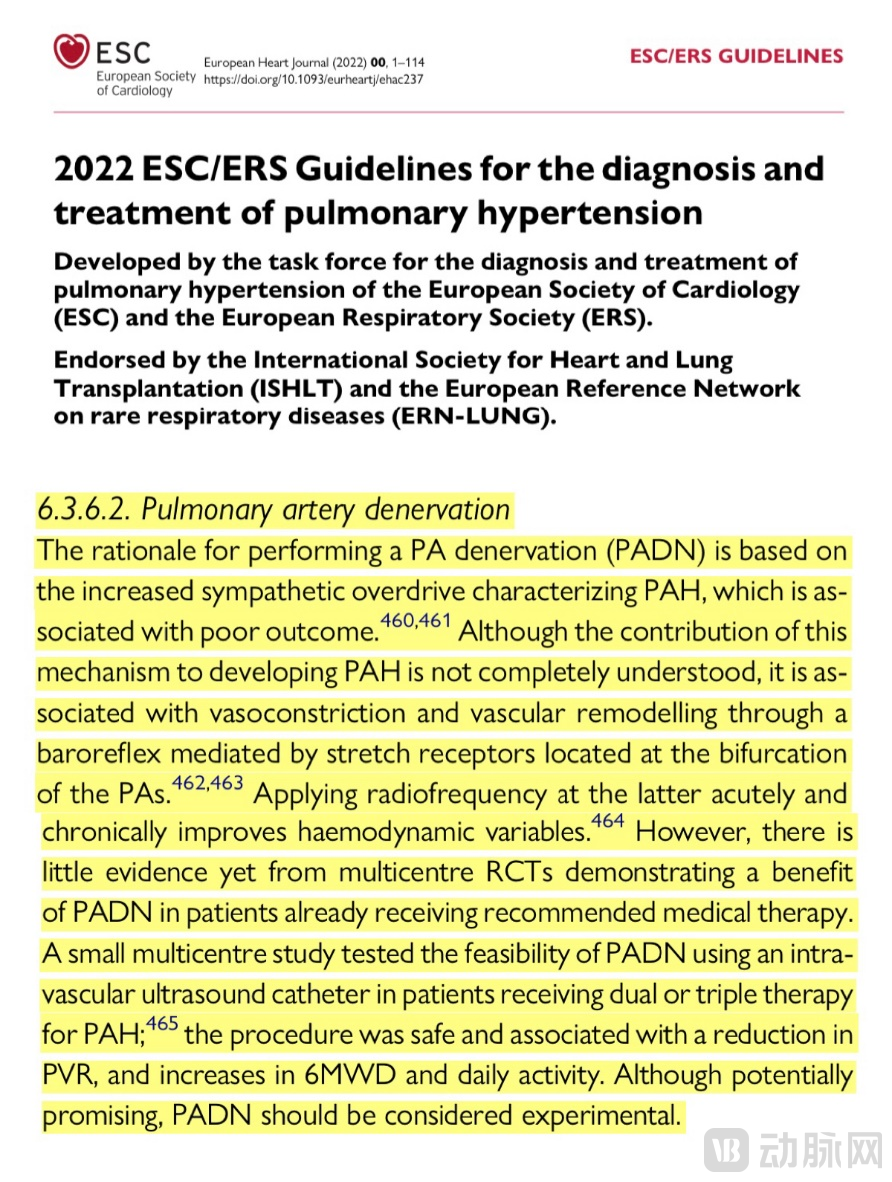
"Guidelines"The section on interventional therapy for pulmonary arterial hypertension (PAH) points out that stretch receptors are distributed at the bifurcation of the pulmonary artery in healthy individuals. These receptors regulate pulmonary arterial pressure through a negative feedback mechanism, leading to vasoconstriction and vascular remodeling. Sympathetic excitation, which promotes the development of PAH, is associated with pulmonary vasoconstriction and vascular remodeling. Animal studies have demonstrated that local injury or intervention affecting the integrity and function of the pulmonary sympathetic nerves can significantly alter pulmonary arterial pressure in mammals. In human trials, small multicenter clinical studies have confirmed the safety of PADN treatment in patients with pulmonary arterial hypertension. This treatment has been shown to significantly improve patients' exercise tolerance, as evidenced by reduced pulmonary vascular resistance and increased 6-minute walk distance.
PADN Holds Great Potential for Treating Pulmonary Hypertension!
In 1980, a clinical study published in CHEST investigated the mechanisms underlying pulmonary hypertension induced by pulmonary artery balloon dilation. The results indicated that pulmonary artery balloon dilation stimulates stretch receptors and/or sympathetic nerve fibers at or near the pulmonary artery bifurcation, leading to elevated pulmonary artery pressure via adrenergic neural mediation. Subsequently, a study published in Circulation in 2004 further substantiated the hypothesis of increased sympathetic nervous activity in patients with pulmonary hypertension. It reported, for the first time, direct evidence of heightened sympathetic activity in patients with advanced pulmonary hypertension and proposed that sympathetic overactivation may correlate with disease severity. In 2010, a study published in the American Journal of Respiratory and Critical Care Medicine (AJRCCM) explored the prognostic significance of muscle sympathetic nerve activity (MSNA) in patients with pulmonary hypertension, suggesting that sympathetic nervous system activation is an independent predictor of clinical deterioration in pulmonary hypertension.
Building on the aforementioned clinical studies, it can be further clarified that human pulmonary arteries are primarily regulated by the sympathetic nervous system, with sympathetic nerve density gradually decreasing from the proximal to the distal segments. Stretch stimulation of the pulmonary arteries activates pulmonary sympathetic nerves, thereby increasing pulmonary arterial pressure and pulmonary vascular resistance. Based on this mechanism,President Chen Shaoliang formally proposed the PADN technique in 2012., and the first PADN animal experiment was conducted on 20 experimental dogs. The study results showed that after PADN treatment, the mean pulmonary artery pressure (mPAP), systolic PAP, and diastolic PAP all returned to baseline levels. There were no adverse consequences or complications, such as acute thrombosis, PA perforation, or death. This initial animal experiment indicated that the afferent and efferent nerve fibers of the reflex are located at the bifurcation of the main PA. Although the study lacked histological components to assess the feasibility of PADN treatment in ablating nerve fibers, this animal experiment demonstrated the effectiveness and safety of PADN treatment for PAH.
After obtaining the expected results in animal experiments, President Chen ShaoliangThe team has successively conducted a series of PADN clinical studies, including PADN1-Phase 1, PADN1-Phase 2, and PADN5, to explore the safety and efficacy of PADN in patients with WHO Group 1, Group 2, and Group 4 pulmonary hypertension (PH). The PADN-1 Phase 1 study investigated the safety and efficacy of the PADN procedure in patients with idiopathic pulmonary arterial hypertension (IPAH) who were non-responsive to pharmacological therapy. A total of 21 PAH patients were enrolled in the study; 13 patients underwent the PADN procedure (surgical group), while 8 patients did not receive surgical intervention (control group). Follow-up results at three months showed that in the surgical group, the mean pulmonary artery pressure (PAP) decreased from 55±5 mmHg to 36±5 mmHg (P<0.01); the six-minute walk distance (6MWD) increased from 324±21 m to 491±38 m (P<0.006); and the Tei index decreased from 0.7±0.04 to 0.50±0.04 (P<0.001). This study was the first to report the positive effects of PADN on cardiac function and hemodynamic status in IPAH patients refractory to medical therapy.
The PADN-1 Phase 2 study aimed to analyze the effects of Pulmonary Artery Denervation (PADN) on hemodynamics, cardiac function, and clinical symptoms in patients with pulmonary hypertension (PH) of various etiologies. This prospective study consecutively enrolled 66 patients who underwent PADN and had a resting mean pulmonary arterial pressure (mPAP) ≥ 25 mmHg between April 2012 and April 2014. The results indicated that PADN is a safe and feasible treatment for PH. The procedure significantly improved patients’ hemodynamic status, cardiac function, and exercise capacity, while reducing PH-related events and mortality rates within one year post-treatment. Further clinical studies are warranted to definitively establish the efficacy of PADN in patients with PH.
The PADN-5 study, the first global randomized controlled trial to confirm the efficacy of pulmonary artery denervation (PADN) in patients with heart failure, used the improvement in 6-minute walk distance at 6 months post-operation as its primary efficacy endpoint. A total of 98 patients diagnosed with combined pre- and post-capillary pulmonary hypertension (Cpc-PH) via right heart catheterization were enrolled. Of these, 50 patients in the sham procedure group received sham PADN on top of standard heart failure medication and sildenafil therapy, while 48 patients in the PADN treatment group received PADN combined with anti-heart failure pharmacotherapy. The results showed that, except for right atrial diameter which demonstrated no statistically significant difference between the two groups, all other indicators in the PADN group improved significantly compared to the sildenafil group. This confirms that patients with Cpc-PH can benefit from PADN therapy, with such benefits observed in both patients with reduced ejection fraction and those with preserved ejection fraction.
Long-term Follow-up Study of PADN Treatment in Patients with Pulmonary Arterial HypertensionThis long-term follow-up study included 120 patients with pulmonary arterial hypertension (PAH) who underwent Pulmonary Artery Denervation (PADN) between March 2012 and October 2018. Based on etiology, the patients were divided into 68 with idiopathic PAH (IPAH) and 52 with connective tissue disease-associated PAH (CTD-PAH). Over a mean follow-up period of 6.6 years, 23 patients died, including 15 with IPAH and 8 with CTD-PAH, yielding a hazard ratio for mortality of 0.675. The median net increase in the 6-minute walk distance (6MWD) after PADN was 43 meters. Hemodynamic parameters showed significant improvement in patients undergoing PADN. A REVEAL score ≥7 and baseline WHO functional class were identified as independent predictors of long-term mortality. Long-term follow-up data indicate that PADN significantly improves long-term survival in patients with both IPAH and CTD-PAH.
Based on the results of multiple clinical studies, the safety and efficacy of Pulmonary Artery Denervation (PADN) in the treatment of patients with pulmonary hypertension have been preliminarily confirmed, making it imperative to conduct further multicenter randomized controlled trial (RCT) studies. The PADN-CFDA study, led by Professor Chen Shaoliang’s team, has now been fully completed. The clinical findings are scheduled to be announced at the main venue during TCT 2022. As a single-blind, randomized, sham-controlled clinical trial, this study aims to evaluate the safety and efficacy of PADN surgery for pulmonary arterial hypertension (PAH). The preliminary clinical data disclosed so far have been highly positive, indicating that PADN offers a novel and effective therapeutic option for the clinical management of pulmonary hypertension. It is anticipated that the release of the final results from the PADN-CFDA study will bring significant insights to interventionalists and fill the gap in RCT evidence for PADN technology.
Furthermore, the international multicenter clinical trial of PADN, with Professor Gregg W. Stone, a leading authority in global cardiovascular medicine, serving as the Principal Investigator (PI), is poised to launch. This initiative aims to provide further evidence-based medical support for PADN technology and offer new therapeutic solutions for pulmonary hypertension.
Pulnovo Medical is committed to providing patients with breakthrough therapies driven by clinical value, focusing on hardcore innovation and advocating for domestically developed innovative medical devices. The inclusion of PADN, an original achievement of Pulnovo Medical, in the ESC Guidelines not only affirms the company’s mission but also further underscores its contributions and value to the industry.
September 1, 2022, 19:00–20:40
CDQI Guidelines Tour for Pulmonary Vascular Disease Centers:
Part I of the ESC/ERS Guidelines for the Diagnosis and Treatment of Pulmonary Hypertension
