

Shu Yao Intelligence Files IPO Prospectus: Multi-Indication Digital Therapeutics in Neuroscience Poised for Launch

SDODT
Developer of Digital Therapeutics for Neurological Diseases
In July 2022, China’s “Brain Health Initiative” was officially launched. The initiative has clear objectives: “By 2025, orderly advance the work for key populationsBrain Health Screening, Brain Health Check-ups, and Brain Health Monitoring; vigorously promote the development of foundational knowledge in brain health, and research and validate brain health screening methods and biomarkers,Digital Therapeuticsand preventive and therapeutic drugs, etc.”
To address these challenges, companies are racing to develop various methods for the detection, prevention, intervention, and rehabilitation of brain disorders.Shiji Huatong’s ecosystem includes SDODT as one of its members.。
SDODT integrates biosensing applications with artificial intelligence analysis, leveraging cutting-edge research in neural networks to provide digital therapeutic solutions for the diagnosis and treatment of neurological disorders. The company is dedicated to developing technologies, products, and platforms tailored for digital therapeutics, pioneering efficient, convenient, and universally accessible digital therapies. Meanwhile, it continuously explores effective applications of digital health across various fields, thereby advancing frontier research in neuroscience.
According to CB Insights data, the global market size for brain science was $6.2 billion in 2020 and is projected to surpass $10 billion by 2024, with a compound annual growth rate (CAGR) of 17% expected from 2020 to 2024. It can be said thatBrain science has the potential to become the next industry to bring disruptive impact to human society.
Meanwhile, the 14th Five-Year Plan period represents a critical “strategic window” for proactively addressing population aging. Over the next decade,It also represents a critical "window of opportunity" for China to proactively address brain diseases.。
However, brain disorders affect individuals across all age groups, including children, adults, and the elderly. Currently, the prevalence of these conditions is continuously rising, imposing an increasingly heavy disease burden. This spectrum ranges from pediatric psychiatric disorders such as attention-deficit/hyperactivity disorder (ADHD) and autism spectrum disorder (ASD), to psychological issues and depression among adolescents and adults, and further to neuropsychiatric conditions such as cognitive impairment and Alzheimer’s disease. Particularly for certain major neuropsychiatric disorders, effective treatments have not yet been identified.Proactive prevention and intervention measures are crucial.。
Furthermore, the clinical management of many psychiatric and neurological disorders still relies primarily on pharmacotherapy and psychotherapy; however, these conventional treatments are limited by low efficacy and poor adherence. Although favorable prognoses can be achieved through cognitive behavioral training,Plagued by the lack of suitable therapeutic tools.
The emergence of digital therapeutics has revealed the potential to transcend traditional treatment modalities. Digital therapeutics, a novel therapeutic approach grounded in evidence-based medicine and digital technologies for disease treatment or health improvement, are being actively integrated into the diagnosis and management of various mental disorders, including attention-deficit/hyperactivity disorder (ADHD), autism spectrum disorder (ASD), insomnia, substance use disorders, anxiety, and depression.
For a company to achieve success, it must possess comprehensive strengths across multiple dimensions, with the primary factor beingSeize the opportunities presented by rapid market growth.
According to data from VBInsight, the total funding for digital therapeutics exceeded RMB 9 billion between 2017 and July 31, 2022. The year 2021 saw the highest number of financing events and is also referred to as the “Year One of Digital Therapeutics.”SDODT immediately seized the momentum by entering on the right side to establish the company.
The core of a startup lies inDevelop competitive products and establish a product portfolio., SDODT is well aware of the importance of this. Since its inception, SDODT has leveraged its resource advantages to enter the field of brain disorders through gamified digital therapeutics, aiming to gain a deeper understanding of the human brain through the research and development of digital therapeutics in the field of brain science.
As Li Wenyu, CEO of SDODT, stated, “Our core product strategy focuses on games that significantly impact human mental health. We are the most medically proficient among game developers, and the most gaming-savvy among medical providers.” Driven by this vision, SDODT has achieved remarkable progress in just one year since its establishment in 2021.Successfully developed and launched multiple digital therapeutics products for Attention-Deficit/Hyperactivity Disorder (ADHD), Autism Spectrum Disorder (ASD), and sleep disorders with high efficiency.
In China, the overall prevalence of attention-deficit/hyperactivity disorder (ADHD) among children and adolescents is as high as 6%, with more than 23 million affected individuals. Although traditional pharmacological treatments act rapidly, they are associated with poor adherence, often belong to the class of central nervous system stimulants or inhibitors, and tend to cause varying degrees of adverse effects, resulting in low acceptance among parents. Furthermore, non-pharmacological manual interventions for ADHD are inefficient, highlighting an urgent need for more effective therapeutic approaches.
To address these pain points, SDODT has developed its solutions based onFrontier Theories of Neural Networks and the Dual-Task ParadigmThe game developer has launched a digital therapeutic, the “Attention Enhancement Training System,” to provide more treatment options for children aged 6–12 with ADHD in China. This project was jointly developed with the Brain Science Academy of Zhejiang University and the Children’s Hospital School of Medicine at Zhejiang University, incorporating design recommendations from researchers and physicians, and was brought to fruition by SDODT’s intelligent product development team.
 SDODT's ADHD Digital Therapeutic Product — "Attention Enhancement Training Software System"
This digital therapeutic can reactivate the attentional neural network, induce physiological changes in the brain, and improve attention function in pediatric patients. Meanwhile, the product incorporates an adaptive algorithm that automatically adjusts difficulty and intensity based on individual needs, enabling personalized treatment and supporting physicians and caregivers in continuously monitoring and evaluating therapeutic efficacy.
It is reported that SDODT has collaborated with the Department of Psychology at Zhejiang University Children's Hospital on clinical trials. The results indicated that the intervention training using SDODT’s “Attention Enhancement Training Software” produced no significant side effects and significantly improved ADHD symptoms.
CDC survey data indicate that there are approximately 75 million individuals with autism spectrum disorder (ASD) worldwide, a figure exceeding the combined total of cancer and AIDS patients globally. In China, the prevalence of ASD has reached as high as 1%. However, due to the unclear etiology and lack of curative pharmacological treatments, the common intervention approach is behavioral therapy. This therapy primarily focuses on systematically training patients to relearn self-care, language, and social skills, emphasizing the use of reward systems to reinforce acceptable behaviors and discourage stereotyped and repetitive behaviors.
This treatment protocol is typically designed by Board Certified Behavior Analysts (BCBAs) and implemented by other healthcare professionals, such as speech-language pathologists, physical therapists, psychologists, and occupational therapists. However, this intervention demands a high level of professional expertise from practitioners. Due to a shortage of qualified staff in many rehabilitation institutions, intervention efficiency is often compromised, resulting in missed opportunities for optimal early intervention in children with autism.
On the other hand, intervention aids are mostly consumables that require regular procurement. To improve intervention efficiency and even expand to home-based intervention scenarios, the best solution is to rely on online digital health products.
 SDODT ASD Digital Therapeutics Product — "VR Assessment and Intervention System for Children with Autism"
In response, SDODT has developed an autism screening and intervention system based on virtual reality technology. The system comprises three major modules: the Assessment and Training Module, the Rehabilitation Platform Module, and the Family Companion Module. It can record and analyze behavioral data of individuals with autism, providingCondition Assessment and Rehabilitation Intervention, Inclusive Education, and Parent Training Services, to help children integrate into group settings.
Among these, the VR training module conducts targeted training through simulated interaction, utilizing mainstream ultra-high-definition VR devices to emphasize an immersive and realistic training experience. It can record measurement metrics such as pediatric patients’ eye movements (including character eyes, facial features, and background), behaviors, electroencephalogram (EEG) signals, respiration, and micro-expressions. The system was first unveiled on October 20, 2021, at the Century Huatong booth during the World VR Industry Conference.
Digital therapeutics for intervention and training in ADHD and autism spectrum disorder fall under the category of digital drugs targeting neurodevelopmental disorders in children. Another product development direction of SDODT is “ShuMian,” a brainwave-monitoring digital therapeutic for sleep aid, which expands its target user base to China’s 400 million people suffering from sleep disorders.
“Shuimian” consists of an EEG monitoring device worn on the forehead and a Bluetooth-enabled mobile app, which willPrecise Acquisition of User Prefrontal EEG Data, with a sampling rate of up to 15,000 times per minute. Subsequently, by integrating AI-powered algorithms, it provides users withAutomated Sleep Staging, detect abnormalities in sleep architecture andTargeted Intervention, such as by using naturally soothing music to relax the mind, alleviate anxiety, facilitate rapid sleep onset, and stabilize sleep cycles.
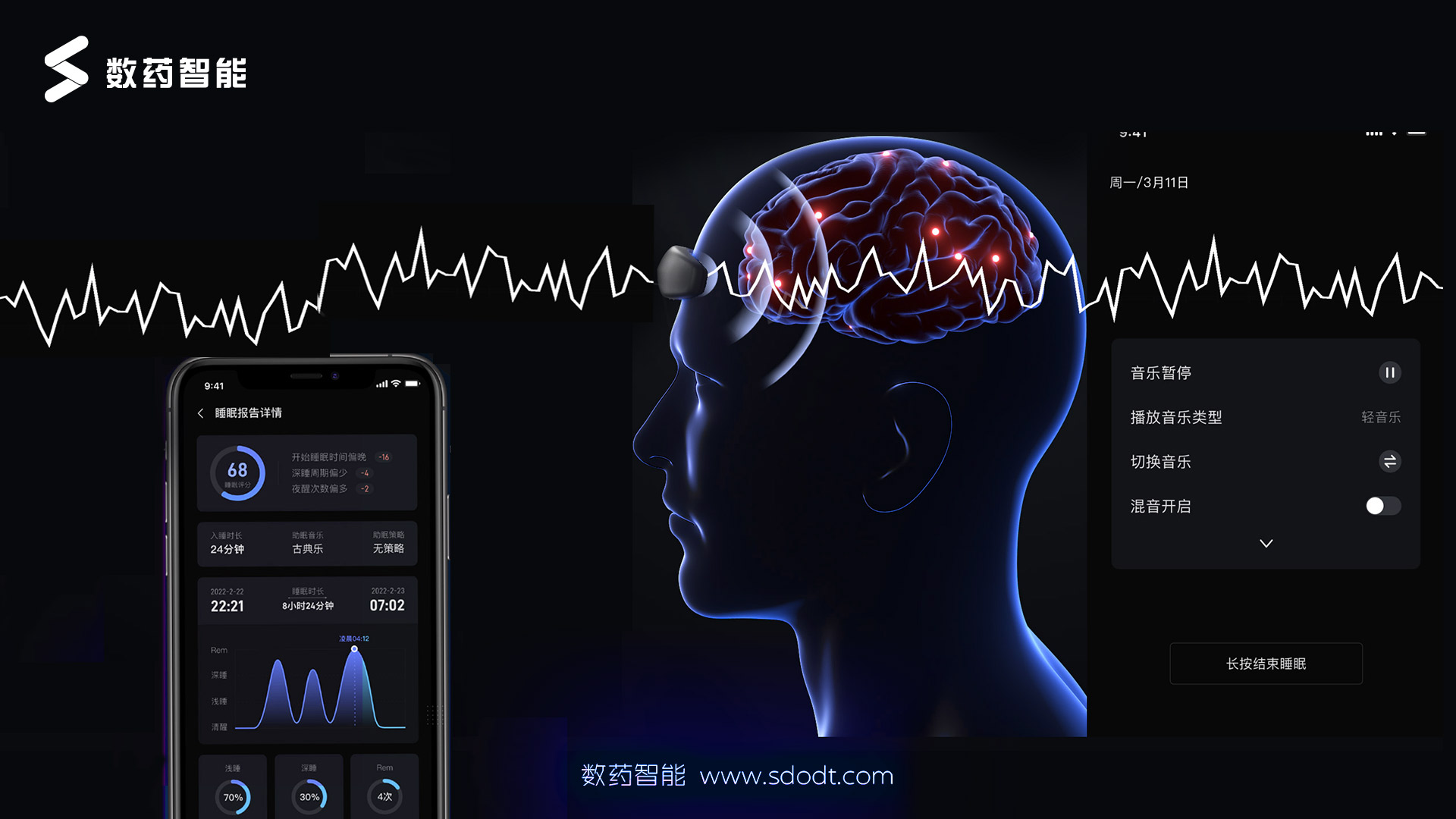
SDODT’s Digital Therapeutic Product for Sleep Aid via EEG Monitoring—“ShuMian”
“Shuimian” offers two forms of brainwave monitoring devices—a headband and a forehead patch—to maximize the accuracy of data collection during sleep. Highly portable and unrestricted by space, the device can be used in various scenarios such as at home or while traveling. Meanwhile, the system provides personalized sleep-aid strategies tailored to each individual’s actual sleep conditions. Currently, the product is in discussions with the Shanghai Mental Health Center and Shanghai General Hospital to conduct clinical research.
The rapid expansion of the product pipeline is undoubtedly underpinned by robust R&D capabilities. It is understood that the R&D team at SDODT consists of three parts,First, a research team closely collaborating with Zhejiang University, with a team of senior professors, PhDs, and physicians, collaborating with SDODT on scientific research and development as well as product commercialization;Second is the product R&D team, primarily composed of product designers, software engineers, and artistic engineers, accounting for approximately 65% of the company's workforce;Third is SDODT's internal research team, primarily composed of experts in neurology, psychology, pharmacy, and medicine, accounting for approximately 20% of the company’s workforce. PhDs, professors, and high-end R&D talent constitute about 5%, a proportion that continues to grow.
Li Wenyu, CEO of SDODT, stated that over the next three years, the company’s product development will remain focused on the field of brain science, positioning hospitals as the “main battlefield” for R&D. By closely aligning with clinical needs, SDODT aims to help doctors and patients achieve instrumentalization and enhanced efficacy of its products. The company’s long-term goal is to further improve the intervention effectiveness of digital therapeutics through brain-computer interface (BCI) and neurofeedback technologies.
Meanwhile, SDODT's R&D products can also be functionally integrated.For instance, 30%–80% of patients with autism spectrum disorder (ASD) have comorbid attention-deficit/hyperactivity disorder (ADHD), while approximately 13% of patients with ADHD have comorbid ASD. The two products can be used in a complementary manner. Currently, such products are grounded in the underlying theories of cognitive function training or psychological training. Future advancements will focus on integrating these approaches with electroencephalographic (EEG) activity, thereby improving symptoms while simultaneously modulating the functional activity of brain regions implicated in the underlying causes. The emergence of ShuMian lays the technological foundation for such future integration, enabling deep combination with a broader range of digital therapeutic products.
In terms of commercialization channels, as a member of the Century Huatong ecosystem, SDODT can also share a wealth of high-quality resources within the group, including scientific research, public welfare initiatives, universities, and medical institutions. Meanwhile, to better promote the marketing and service of future products, SDODT has initiated a financing process to support its R&D team in continuously exploring more brain disorders suitable for diagnosis, treatment, and rehabilitation via digital therapeutics, such as Alzheimer’s disease, Parkinson’s disease, addiction, and other central nervous system disorders.