

Crown Bioscience Accelerates Entry into Organoid-Based Drug Discovery Through Strategic HUB Collaboration and OcellO Acquisition

OcellO
Contract Research Organization (CRO)
Crown Bio
Biologics R&D Outsourcing Service Provider
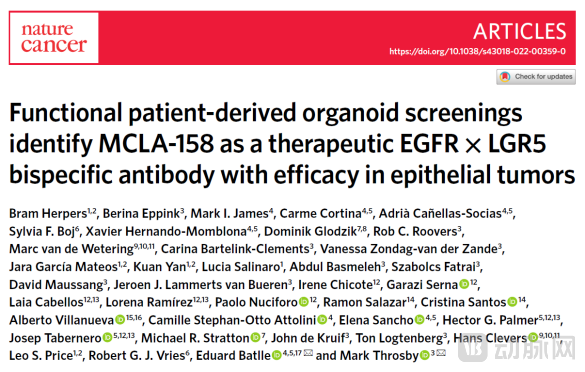
Several months ago, researchers from Crown Bio, Merus, and the Barcelona Institute of Science and Technology collaborated to identify a clinical candidate drug through screening in solid tumor organoids for the first time, demonstrating the efficacy of organoids as a novel tool in drug development.
The team published a research paper in the Nature portfolio journal Nature Cancer, titled: “Functional patient-derived organoid screenings identify MCLA-158 as a therapeutic EGFR × LGR5 bispecific antibody with efficacy in epithelial tumors.”
In this study, researchers from Hubrecht Organoid Technology (HUB), a partner of Crown Bio, established a large organoid biobank comprising organoids derived from colorectal cancer patients, colorectal cancer liver metastases, and normal non-cancerous tissues. Scientists from OcellO (acquired by Crown Bio) conducted high-throughput screening of this organoid library, ultimately identifying MCLA-158, a bispecific antibody with favorable therapeutic properties, from among more than 500 candidates.
The commercial applications of organoids primarily focus on new drug development and indication expansion, creating a natural synergy between CRO companies and organoid technology.—As specialized institutions providing services such as clinical or preclinical research for new drugs to pharmaceutical companies, leveraging organoids to optimize these services is a natural progression.
Although limited information has been publicly disclosed, CRO companies such as WuXi AppTec have already begun to establish a presence in the organoid sector.
Crown Bio is one of the CROs that has made significant strides in organoid technology. Through extensive collaborations and acquisitions, this CRO has integrated organoid technology into its portfolio of oncology drug development services.
Crown Bio excels at identifying professional partners across multiple fronts, securing outstanding collaborators for every stage from organoid bank construction to drug screening.
When reviewing Crown Bio’s strategic layout in the organoid field, one milestone cannot be overlooked.
In April 2019, Crown Bio established a strategic partnership with HUB, founded by Hans Clevers, the pioneer of organoid technology. Crown Bio can leverage HUB’s organoid technology to provide preclinical oncology drug development and validation services, including access to HUB’s comprehensive library of well-characterized tumor and corresponding normal tissue organoids. In multiple interviews, Crown Bio has stated that among CRO companies worldwide, it is the only one authorized to utilize HUB’s technology and organoid models for preclinical drug screening.
Collaboration with HUB has benefited Crown Bio in at least three areas: talent development, team building, and research progress.
Crown Bio RepresentativeA delegation visited the HUB Institute for study. Leveraging Crown Bio’s expertise in preclinical drug screening, Dr. Xu Xiaoxi, Head of In Vitro R&D and Head of the Organoid Platform at Crown Bio, focused on tumor organoid culture and technologies for in vitro efficacy testing using organoids, thereby advancing Crown Bio’s capabilities in organoid-based drug screening.Technology.
Marrit Putker, a postdoctoral researcher from the Hans Clevers laboratory, joined Crown Bio in October 2020, becoming the first scientist at Crown Bio’s new entity in Utrecht, the Netherlands. Dr. Putker led the establishment of Crown Bio’s new laboratory in Utrecht from the ground up. In addition to contributing extensive expertise, she was responsible for expanding the research team, overseeing research projects, and leading model development.
In April this year, researchers from Crown Bioscience, Merus, and the Barcelona Institute of Science and Technology collaborated to publish a paper in Nature Cancer, a subsidiary journal of Nature, detailing their findings on drug screening for colorectal cancer using MCLA-158. This project utilized HUB technology to establish a large-scale organoid biobank, comprising organoids derived from colorectal cancer patients, organoids from colorectal cancer liver metastases, and organoids from normal non-cancerous tissues.
In addition to the services provided by HUB, scientists from Crown Bio’s CBNL platform also played a significant role in this study.
CBNL, formerly known as the Dutch company OcellO B.V., was acquired by Crown Bioscience on May 5, 2021.Through this acquisition, Crown Bio has expanded its in vitro service platform by integrating OcellO’s high-content imaging technology with Crown Bio’s in vitro and in vivo screening platforms and immuno-oncology efficacy assessment services.
Headquartered at the Leiden Bio Science Park in the Netherlands, OcellO is a CRO that provides compound screening and analysis using cultured human tissues. The company offers in vitro compound testing services, with its screening platform built on technology from Leiden University. Its core technology involves generating human microtissues and organoids via three-dimensional (3D) cell culture in a high-throughput format. Additionally, it provides high-content screening (HCS) services. By combining cultured tissues with automated imaging and analysis, OcellO can detect the effects of drug targets and therapeutic molecules within complex biological systems, thereby facilitating drug screening.
Under the terms of the agreement, Dr. Leo Price, CEO and Chief Scientific Officer of OcellO, will join Crown Bio as Senior Vice President of In Vitro Sciences to lead the research and development of Crown Bio’s in vitro platform in the United States and Europe.
Through this series of collaborations and acquisitions, Crown Bio has established the world’s largest biobank of patient-derived organoids (PDOs) and patient-derived xenografts (PDXs) for translational oncology research.
Crown Bio now offers services in biomarker discovery, efficacy testing, screening, DMPK, pharmacology and bioanalysis, and toxicology studies. It features four in vitro biological platform models: 2D cell line panels, 2D HuCell™, organoids, and in vitro imaging technologies.
They offer two types of organoid services: one is large-scale screening for evaluating efficacy, selecting models, and assessing combination strategies; the other is immunotherapy evaluation using a proprietary immuno-oncology platform that incorporates patient-derived 3D in vitro models co-cultured with non-autologous immune cells.
Its organoid database, OrganoidBase, compiles data encompassing optical microscopy, genomics, transcriptomics, and pharmacology, enabling users to access, search, and select from an ever-expanding variety of organoids. Its OmniScreen platform features over 500 tumor cell lines covering various cancer types, including lung, breast, hematologic, prostate, liver, and gastric cancers, with each screening run evaluating at least 50 cell lines.
So, how does Crown Bio apply its organoid biobank to oncology drug research services?
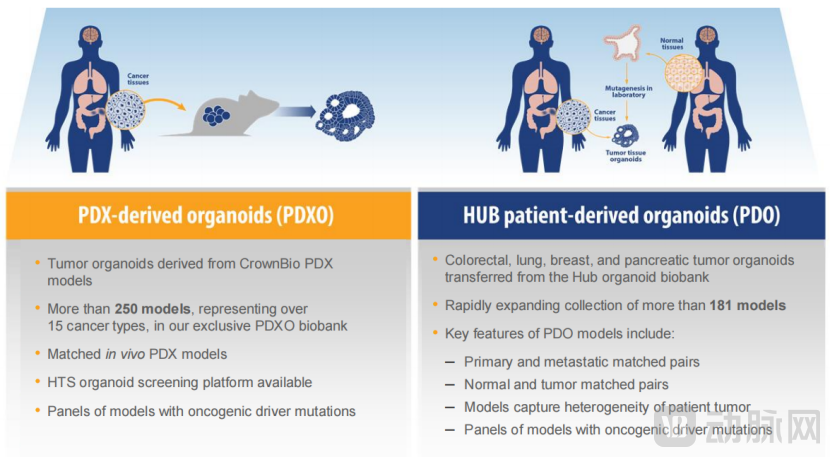
Leveraging its existing organoid library, Crown Bio has further optimized its services, including guidance on selecting in vivo and in vitro research models, high-throughput screening (HTS) analysis, high-content imaging analysis, biomarker discovery and analysis, bioinformatics, and applied genomics research.
Crown Bio has established a relatively comprehensive process for developing a 3D in vitro platform based on tumor patients for drug development.: First, continuous observation of organoid size, stability, expansion capacity, and density under an optical microscope is required to establish a primary biobank. Then, histopathological validation is performed by confirming the concordance between PDXOs and their corresponding PDXs through pathological analysis across different cancer types. This is followed by molecular characterization and pharmacological analysis, and finally, the tumorigenicity data of PDXOs are evaluated against those of the original PDXs.
The strategic deployment of tumor organoids is a microcosm of Crown Bio’s overall approach as a CRO company.Crown Bio has always demonstrated strong “agility” and “integrative capacity,” excelling in self-adjusting its business operations and integrating resources.
On the one hand, Crown Bio proactively streamlines its operations by establishing subsidiaries and divesting business units, enabling each smaller team to focus on a specific area of business. On the other hand, it excels at resource integration, expanding business depth and maintaining cash flow through mergers and acquisitions.
Around 2013, Crown Bio was described as a “sinking ship.” As a CRO company, it primarily provided in vivo and in vitro drug screening, efficacy, and metabolism research services in the fields of oncology, cardiovascular diseases, and metabolic disorders, incurring annual losses of over $10 million.
At that time, Crown Bio reached a significant turning point—the company clarified its positioning and restructured its organization. Dr. Yu Guoliang, Co-founder, Chairman, and CEO of Crown Bio, believed that the core issue lay in insufficient business segmentation, unclear positioning, and a lack of synergistic force. He sought to transform Crown Bio,“Continuously subdivide your area of focus, aligning the mindsets and capabilities of all participants toward a single objective, and strive to become the leader in that niche within a defined timeframe.“Ultimately, he decided to focus on oncology drug efficacy research. The team, originally comprising over 200 members, was reduced to single digits, with talent recruitment to follow the restructuring.”
Crown Bio announced in July 2013 that it had acquired a stake in Preclinical Oncology Services Limited (PRECOS), a leading preclinical R&D service provider specializing in oncology. This acquisition established Crown Bio as the world’s largest oncology services provider, with operations spanning North America, Europe, and Asia-Pacific.
Three years later, Crown Bio emerged as a leader in the field of anti-tumor drug efficacy, turning around from annual losses to achieving profits exceeding $10 million. After initially witnessing the effectiveness of its focused strategy, Crown Bio recognized that, as a CRO company, its business model constraints might prevent it from going further in new drug development. Consequently, the company decided to adjust its business operations once again to keep its core business focused, spinning off its new drug development activities into a new entity, CBT Pharmaceuticals, for continued operation.
Subsequently, in December 2017, JSR Corporation acquired Crown Bioscience for NT$12 billion. Following the merger, Crown Bioscience continued to operate as an independent subsidiary; however, the acquisition provided Crown Bioscience with significant economic resources and facilitated a smoother commercialization process.
Following the establishment of a strategic partnership with HUB, Crown Bio experienced continuous growth in business demand, leading to another organizational restructuring in 2019—the establishment of the Beijing Screening Center, which is exclusively responsible for all drug screening activities.
Today, measured by employee headcount, model portfolio size, and business revenue, Crown Bio has become one of the world’s largest preclinical oncology platforms.This CRO company not only applies organoid technology to optimize its own oncology drug research service workflows, but also continues to leverage emerging technologies—such as AI, big data, and machine learning—to deepen its business capabilities.
It can be said that continuous self-adjustment has made Crown Bio’s development path increasingly clear, while extensive collaborations have injected fresh talent with greater professional expertise into the company.
References
1. https://www.businesswire.com/news/home/20210505005619/en/CrownBio-Acquires-OcellO-B.V.-to-Expand-Its-Preclinical-In-Vitro-Drug-Development-Service-Offerings
2. https://www.clinicalleader.com/doc/crown-bioscience-oncology-expertise-acquisition-precos-ltd-0001
3. https://www.rolfaulinger.com/bioprocess-insider/jsr-announces-acquisition-crown-biosciences-international/
4. https://www.crownbio.cn/press/crownbio-acquires-ocello/
5. https://www.lifesciencesatwork.nl/startups/ocello
6. https://www.crownbio.cn/service-type/screens/omniscreen/
7. https://mp.weixin.qq.com/s/Kyl2Jrpbcn1fy-mTt-tRkQ
8. Crown Bio Organoid Platform Information