

How TU/e Deeply Binds Scientific Research with Industry through Open Labs, Joint Research, and Innovation Labs
“University-Enterprise Cooperation"Greatly promotedEindhoven University of Technology(Eindhoven University of Technology, hereinafter referred to as TU/e) development.
At the time of its founding, TU/e’s primary mission wasTo address the local enterprises' demand for technological talent, i.e., to cultivate engineers for the industrial sector。
Later, to promote the translation of research outcomes, TU/e further deepened its collaboration with enterprises. It is reported that in terms of publishing academic papers and translating technological achievements into practical applications,TU/e was among the top 25 universities worldwide with the closest innovation partnerships in 2017.。
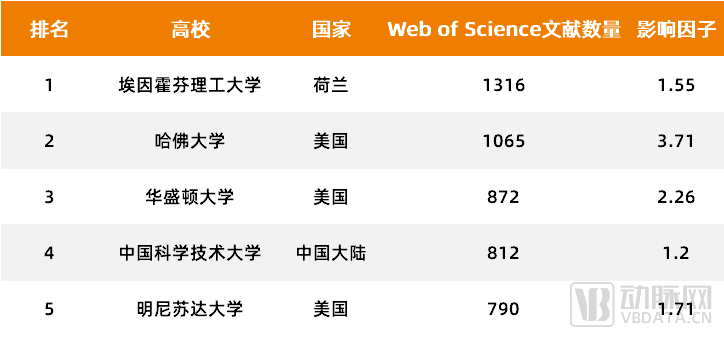
Note: Top 5 universities with the most research publications in collaboration with innovative enterprises
This is not without reason, as TU/e views itself and enterprises as “complementary angles” in the translation of scientific research achievements. Starting with TU/e, as a university, it possessesInnovative and mature academic and research achievements, but lacking the core capabilities to commercialize them; whereas enterprises are exactly the opposite, theyProficient in market operations, but lacking innovative technology and unable to bear the R&D costs derived from a large number of innovative achievements.。
So, what exactly is TU/e’s industry-university collaboration model for translating scientific research achievements? What constructive insights can it offer to Chinese universities in this regard? To address these questions, VCBeat’s Orange Fruit Bureau has conducted an in-depth analysis of TU/e’s industry-university collaboration model.
01. Open Laboratory: “Deeply Binding” with Startup Projects
In the realm of scientific research, TU/e faces the same challenges as most universities worldwide:Where Do Good Research Ideas Actually Come From?
Undoubtedly, the impetus comes from researchers; however, these researchers face specific challenges, namely the lack of advanced research platforms and early-stage funding support during the R&D process.
To address this pain point for researchers, TU/e has come up with a solution: enabling on-campus54 large and small research laboratoriesBoth have launched external collaborations and are open to the public.Call for Innovative Projects, with Paid Technical Services Provided。
Specifically, TU/e has established for each laboratoryDedicated External Cooperation Liaison and Technology Transfer Officer, when individuals or enterprises stationed in the laboratory encounter technical difficulties, the laboratory director will mobilize on-campus resources to the fullest extent to coordinate and resolve the issues.
Throughout this process, TU/e will pay special attention to early-stage projects featuring original innovative technologies and significant market potential. In other words, TU/e will give priority support to high-quality projects with substantial commercialization value.
How exactly should we “care for” them?
On the one hand, it provides technical support by either supplying professional R&D talent or facilitating collaboration between enterprises and TU/e, based on the actual needs of early-stage projects.
On the other hand, in terms of funding, although TU/e does not provide direct financial support to early-stage project teams during the R&D phase, it grants them free access to all university laboratories and assigns relevant professional personnel at no cost. This approach alleviates, to some extent, the financial constraints faced by these early-stage teams.
In fact, the concept of “open laboratories” is not novel; many research institutions, industrial parks, and incubators in China have established them. Their objective is straightforward: to identify promising early-stage targets. However, in practice, their impact has been limited.
This is primarily because these so-called “development laboratories” merely serve as a vehicle, essentially providing free office space for early-stage project teams, without offering tailored services based on the actual needs of the projects, as TU/e does.
Therefore, the “shallow binding” model of open laboratories in China not only fails to support early-stage project teams in moving forward but also results in insufficient linkage and a lack of established trust between the laboratories and these early-stage projects. In contrast, TU/e has effectively achieved “deep binding” with early-stage project teams at this stage, thereby facilitating smoother subsequent collaboration.
02. Joint Research: Differentiated Collaboration Based on Corporate Needs
Globally, the rate of technology transfer remains low. This is partly because the transfer process itself is inherently challenging, and partly because many research outputs lack any real-world commercial viability, meaning they are disconnected from market demands.
Therefore, at this critical juncture, a key issue is to provide direction for early-stage project teams, ensuring that their scientific research outcomes possess translational value.
TU/e recognized this early on, and its proposed solution is that,Aligning Laboratory Research Achievements with Corporate R&D Needs, strive to achieve a "one-to-one correspondence."
However, the needs of enterprises vary across different stages. Therefore, TU/e also proposes distinctly different collaboration models tailored to companies of varying sizes and developmental stages.
First, large-scale enterprises possess robust capital chains and mature product portfolios but often lack innovation awareness. In other words, they prefer to leverage their “experience” and “resources” to incubate existing innovation projects. This approach not only increases the success rate of R&D but also significantly reduces R&D costs.
In response to such corporate demands, the solution proposed by TU/e is to establish “Joint Research Center for Industry-University Collaboration”. At this center, the two parties have established a collaboration whereby the enterprise provides R&D funding and TU/e conducts fundamental research directly (including technology or product development, technical diagnostics, breakthroughs in core technologies, etc.). The resulting technological achievements may be shared by both parties, or the patent ownership may be transferred to the enterprise; however, the enterprise is responsible for the process of translating these achievements into practical applications.
Currently, TU/e has established “Joint University-Enterprise Research Centers” with globally renowned companies such as TNO Automotive, ASML, Shell, Philips, NXP, DAF, and TomTom, all of which have achieved remarkable results.
For relatively small-scale enterprises, they are the source of innovation and hold many innovative projects awaiting commercialization; however, they lack R&D experience and resources, with the latter primarily referring to funding.
Based on this, the collaboration proposal put forward by TU/e is to establish “Joint Research Mechanism”, whereby TU/e and enterprises each leverage their respective strengths to jointly promote the translation of research findings.
Specifically, TU/e leverages its advantages in scientific research infrastructure and talent, along with market-oriented resources, to provide enterprises with services such as contract research, technical consulting, support for research facilities, and training for technical personnel. This approach maximizes the reduction of companies’ R&D burdens, enabling them to fully devote themselves to technology-based research and development.
Currently, TU/e has established “joint research mechanisms” with globally renowned companies such as IMEC, Solliance, and Toyota.
03. Innovation Labs: The Struggle with “Maturity” and “Funding”
With R&D achievements in hand, the next step is to consider how to commercialize them—that is, how to bring these innovations to market, which is often the most challenging phase.
Based on this, TU/e established its ownTechnology Transfer Company – Innovation Lab(Innovation Lab), whose team members consist of professionalTechnology Manager、Researcher、Corporate PersonnelandStudentComposition.
However, the Innovation Lab faces concrete and thorny challenges in promoting the translation of research outcomes, which can be broadly categorized into two dimensions: first,Significant Gap Between the Maturity Level of Scientific Research Achievements and Industry Needs, secondlyLack of Sustained Financial Support。
By further breaking down these two issues, we can uncover more details. Let us first address the “disconnect” between scientific research outcomes and the market. Although collaborative research with various enterprises enables early-stage projects to gain a thorough understanding of market demands, whether the resulting technologies can truly meet the requirements for practical application hinges on the core competencies of researchers. In reality, however, the vast majority of researchers exhibit significant weaknesses in this area.
Furthermore, many scientific and technological achievements from universities have not undergone pilot-scale trials or market validation; consequently, their maturity levels fail to meet industry standards, thereby hindering collaboration with enterprises.
Returning to the issue of funding. Although TU/e provides early-stage project teams with free laboratory space, offers substantial pro bono support, and regularly provides “sponsorship” to projects, such financial backing is inherently short-term. To sustain their development, early-stage project teams require funding sources across multiple dimensions.
In addressing these two issues, the solutions proposed by the TU/e Innovation Lab still prioritize enterprises.
Building on its solid foundation of prior joint research with small and medium-sized enterprises (SMEs), the Innovation Lab immediately recognized that deep collaboration with SMEs would become a key approach to refining scientific achievements and securing funding. Therefore, it established a dedicatedLiving Lab。
To Enhance the Maturity Level of University Research Outcomes,Living LabUsing campuses as venues for R&D, small-scale pilot trials, and medium-scale pilot trials, through repeated experiments to test and improve technical capabilities, while simultaneously developing solutions and products. By identifying and promptly resolving issues on campus, a closed-loop process is formed, which helps ensure that the products are market-driven.
Regarding funding, Living Lab launchedCo-funded and Co-builtCooperation Model: InResearch Fundingabove, by TU/e and enterprisesJoint Capital Contribution; inDivision of LaborIn this arrangement, TU/e is responsible for research and development, while the enterprise provides labor and necessary materials. Meanwhile, TU/e grants the enterprise intellectual property rights to the research outcomes, and the enterprise can also leverage the university’s platform for other innovations.
It is reported that,Each Living Lab project will establish an expert panel., composed of a consortium of companies participating in the project, will also invite researchers from other universities or retired entrepreneurs to jointly discuss technical issues. Once the project matures, the expert panel will seek a professional management team to establish aStartup, proceed with mass production and market operations.
To date, the TU/e Innovation Lab launches approximately 100 startup projects annually, spanning across nine faculties, and engaging with more than 50 emerging student teams and startups, while the Living Lab has also taken shape.Energy, Health, Smart Mobility, Data Science, and High-Tech Systems5 Major Strategic Themes.
04. Where Is the Path for “School-Enterprise Collaboration”?
As the commercialization of research outcomes increasingly becomes an imperative for universities, collaboration with enterprises appears to be a promising option; however, in practice, it has proven more challenging than anticipated.
The core issue lies in the fact that both universities and enterprises “hold back” during their collaboration, meaning they are unwilling to engage deeply. This stems from their differing positions: universities tend to prioritize amplifying the clinical value of research outcomes, whereas enterprises focus more on maximizing their market value.
However, beyond differing perspectives, universities and enterprises operate under distinct models with their own respective mechanisms; therefore, achieving close integration requires both parties to make certain compromises.
So, what new insights can we gain from TU/e’s “university-industry collaboration model”?
It is not difficult to observe that, in the process of translating research outcomes into practical applications, TU/e demonstrates considerable “respect” for enterprises by striving to adopt their perspective when designing collaboration models. For instance, regarding jointly developed research outcomes, TU/e tailors cooperation schemes to meet the specific needs of different enterprises and ensures that these enterprises receive their due benefits from the commercialization of such outcomes.
This collaborative model makes companies feel valued while also recognizing the significant responsibilities they bear. As a result, they demonstrate greater initiative throughout the R&D and commercialization process, thereby increasing the likelihood that the resulting innovations will successfully reach the market.