

Nearly Half of AI+Drug Discovery Founders Stem from Academia, With Tsinghua and Peking University Dominating the Landscape
In the second half of 2021, global pharmaceutical investment entered its darkest hour. The stock prices of the vast majority of domestically listed biotech companies corrected by more than 50%, ushering in what industry insiders refer to as a “capital winter.”
AI + New Drugs inRarely “Resilient” Amid the Capital Winter, “Bucking the Trend” Has Even Boosted the Overall Performance of the Current Pharmaceutical Sector.
According to incomplete statistics from VBInsight,In 2021, global financing in the field of AI-driven new drug development reached a new high, with 83 financing events totaling $4.613 billion.In the first half of 2022, the global AI-driven new drug financing market continued its robust growth momentum.—According to incomplete statistics from VBInsight, there were a total of 75 financing events in the global AI-driven new drug market in the first half of 2022, with the total amount approaching $4 billion. In terms of both the number of financing events and the total amount raised, the market performance of the global AI-driven new drug sector in the first half of the year has already approached that of the entire year of 2021.
During this critical period of development in the AI-driven new drug industry, VBInsight has continued to conduct in-depth research in this field. By conducting intensive interviews with nearly 20 senior experts in the AI-driven new drug industry and carrying out extensive desk research, VBInsight has produced the “2022 Industry Research Report on AI-Driven New Drug R&D,” aiming to more accurately depict the current state of development in the AI-driven new drug R&D industry.
In reviewing the research and technology transfer outcomes of 47 research groups across 16 Chinese universities and research institutions, we found that:
▶Research groups entering the field of AI-driven new drug development are predominantly from disciplines related to pharmaceutical R&D, such as pharmacy, chemistry, biology, and life sciences, while those originating from artificial intelligence backgrounds remain relatively few.
▶ Nearly half of the AI-driven new drug development teams in China have backgrounds in universities or research institutions. The conversion rate of scientific research achievements in China’s AI-driven new drug sector has reached 25.5%, significantly exceeding the overall national average conversion rate of 15%.
▶Among AI-driven new drug development founding teams with backgrounds in Chinese universities and research institutions, those affiliated with just two universities—Tsinghua University and Peking University—account for half of the total.
Why do research groups entering the AI-driven new drug discovery field predominantly have a background in pharmaceutical R&D, while relatively few artificial intelligence-focused teams have ventured into this space? Why is the proportion of startup teams with academic or research institution backgrounds so high in the AI-driven new drug discovery sector? What accounts for the higher success rate of translating scientific achievements into commercial applications in this field compared to others? Why have Tsinghua University and Peking University demonstrated the most outstanding performance in the commercialization of scientific achievements in AI-driven new drug discovery? Which other institutions have also delivered noteworthy and instructive results?
VBInsight discussed the above topics with multiple industry experts, forming the basis of this article.
01
Industry insiders believe that there are two main reasons for this phenomenon.
On one hand, artificial intelligence has gone through the phases of “technology-driven” and “data-driven,” and has now entered the phase of “scenario-driven,” beginning to be deeply implemented across various industries to address problems in different scenarios.
In terms of application maturity, artificial intelligence has reached a very high level of maturity in fields such as security, retail, the Internet of Things (IoT), and finance. In terms of popularity, AI is experiencing rapid growth in scenarios including protecting humans from cybersecurity threats, creating the metaverse, and enabling autonomous driving.
For AI talent, the healthcare sector is just one of many scenarios with enormous market potential.“There are far too many areas where AI can be applied and developed from an artificial intelligence perspective; it’s not necessary to focus exclusively on the healthcare sector,” said a recent PhD graduate in AI visual algorithms.
Additionally,The high professional barriers in the pharmaceutical industry have become another factor limiting the entry of AI talent.—The pharmaceutical industry faces the well-known “three major hurdles”: high investment costs, long development cycles, and high investment risks. Developing a new drug typically takes 10–15 years, costs up to $2.8 billion, and has an 80–90% clinical failure rate.
“Life phenomena are exceedingly complex, the underlying mechanisms in the life sciences remain unclear, and numerous unresolved challenges persist,” said Hao Tianlong, Director of Medicinal Chemistry at Inpharmatics. He noted that few researchers venture into interdisciplinary life science research unless driven by strong interest.“Compared with fields where related mechanisms have been thoroughly studied and industry standards are relatively clear, the application of AI in life sciences is fraught with greater uncertainty.”
For pharmaceutical professionals in the field, AI-driven new drug development represents the inevitable future trend of the industry. Embarking on research into AI-driven new drug development is a timely and strategic move.
This is primarily attributable to the “Eroom’s Law” dilemma currently facing the pharmaceutical industry: since 1950, the number of new drugs approved per $1 billion in R&D spending has halved approximately every nine years. This trend, which has remained remarkably stable over the past six decades, is known as Eroom’s Law in the pharmaceutical sector.
Furthermore, with the rapid advancement of digitalization and informatization across society, coupled with upgrades to drug R&D equipment and long-term data accumulation, the volume of available drug development data has grown so substantially that it can no longer be fully analyzed and processed using conventional methods and software tools within a given timeframe.Pharmaceutical companies are undergoing digital transformation, generating vast amounts of data continuously, while traditional statistics is increasingly proving inadequate in the face of massive big data.
Thus,AI is regarded as the key weapon to break the pharmaceutical industry’s Eroom’s Law, and AI, which is essentially data-driven for induction, learning, and creation, has become a potential solution to overcome the data dilemma.
02
According to incomplete statistics from VCBeat,Among the 71 AI-driven new drug companies in China, teams with backgrounds in universities or research institutions account for 49.3% of all AI-driven new drug teams in the country.Among them, there are 13 AI-driven new drug discovery teams with backgrounds in overseas universities/research institutions, and 22 such teams with backgrounds in domestic universities/research institutions.
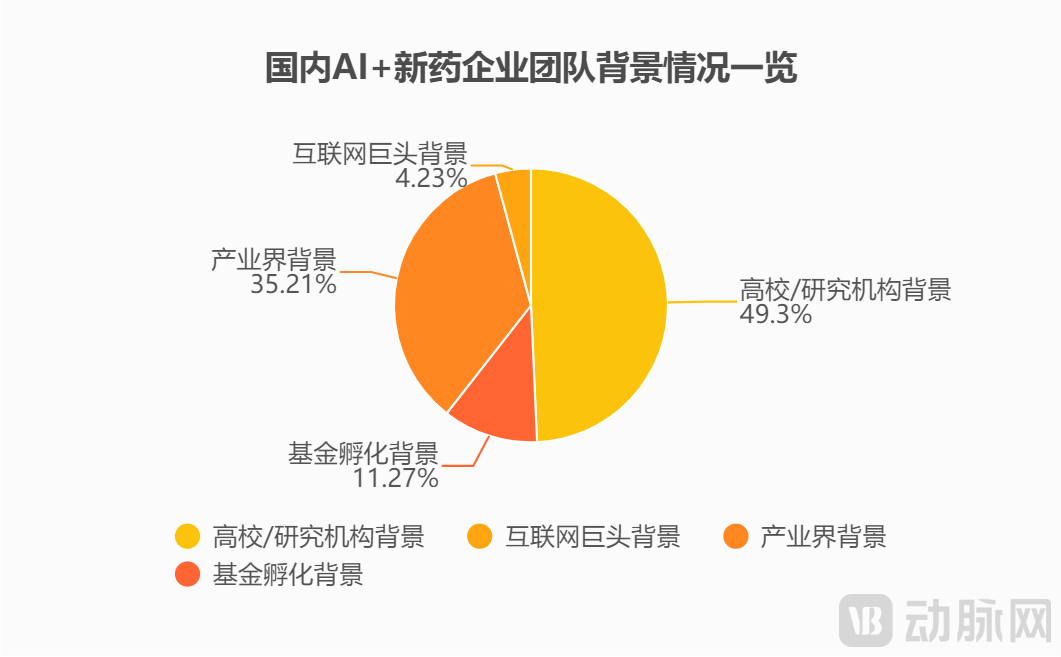
Among AI-driven new drug development teams in China with backgrounds in universities or research institutions, 12 are outcomes of technology transfer from these institutions; therefore, the conversion rate of scientific research achievements in China’s AI-driven new drug sector is approximately25.5%, is the current average rate of conversion of scientific research achievements in China (15%) of1.7times.
Numerous professors from Chinese universities, including Zeng Jianyang, Xu Jinbo, Peng Jian, Xie Zhengwei, Pei Jianfeng, Ma Lijia, Guo Tiannan, Yang Shengyong, Zhang Chunming, Hong Liang, and Yun Caihong, have successfully commercialized their scientific achievements through independent entrepreneurship or intellectual property licensing. These efforts have led to the establishment of AI-driven new drug development companies such as Suikun Intelligence, Molecule Mind, Huashen Zhiyao, Yiyao Technology, Yingfei Zhiyao, Yungu Zhiyao, Westlake Omics, Aorui Pharmaceutical, Zheyuan Technology, Tianwu Technology, and Hongyun Biology.
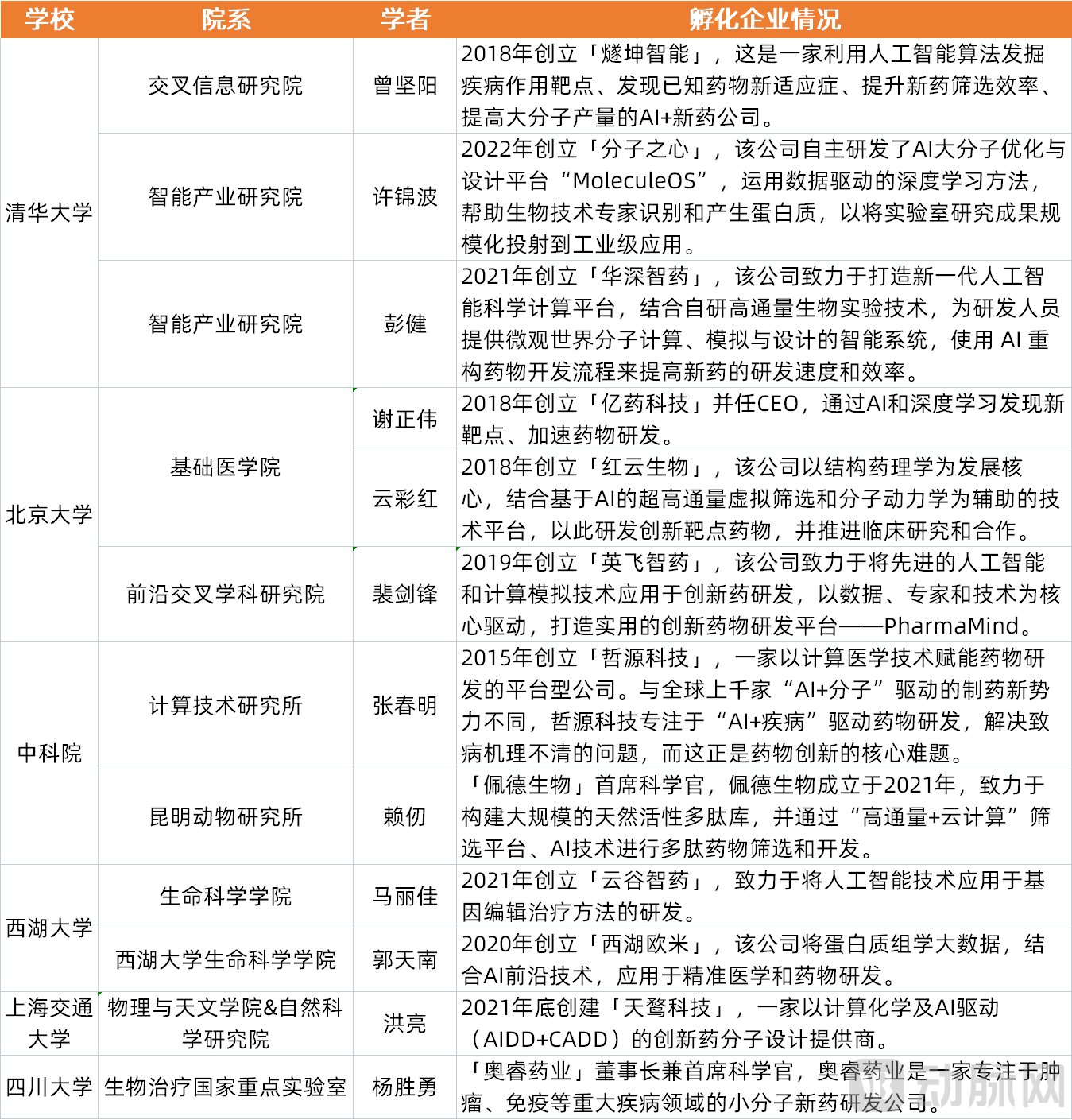
Behind the high conversion rate of scientific research achievements in the AI + new drug field, is itIs the AI + new drug sector outperforming other fields in terms of technology transfer and commercialization?Some industry insiders do not agree with this statement.
An anonymous industry insider told VCBeat New Medicine, “The high conversion rate in the ‘AI + new drug’ talent sector is merely a superficial phenomenon; the deeper reason lies in the fact that this field is still immature.”
This industry insider believes that,Similar to the field of synthetic biology, the AI-driven new drug development industry has a relatively short history, and there is a scarcity of directly relevant talent in the industrial sector; therefore, it is necessary to cultivate such talent from the source (the scientific research community).“Besides the talent originally engaged in CADD who have joined the AIDD ranks, few professionals from other sectors of the industry are converging toward AIDD."Instead, due to policy support, universities have accumulated a substantial body of fundamental research in this area."
The immaturity of the industry and the scarcity of relevant talent have led to a greater number of startup teams being incubated within universities, creating the illusion of a high rate of translation of scientific research achievements in the AI-driven new drug development sector.
Some industry insiders hold slightly different views. An anonymous investor believes that AI-driven new drug development is the inevitable trend in the pharmaceutical industry’s future, with both industry and academia vigorously cultivating talent and promoting the commercialization of research outcomes to accelerate industry growth. “Precisely because the field of AI-driven new drug development is emerging, offers broad prospects, and harbors substantial scientific research opportunities, it will, for the academic community, first stimulate researchers to actively pursue studies in this area and facilitate the translation of findings into practical applications; second, some universities will provide greater support in this domain. These factors are all driving the translation of scientific achievements in AI-driven new drug development.”
VCBeat has observed that the founding or participation of professors from Chinese universities and research institutions in AI-driven new drug startups has been heavily concentrated around three key periods: 2018, 2020, and 2021. These years represent highly significant milestones in the development of China’s AI-driven drug discovery industry. In 2018, the sector entered its initial proof-of-concept phase, with the earliest batch of AI-driven drug companies beginning to achieve validating results such as preclinical candidate drugs, thereby stimulating industry growth. In 2020 and 2021, numerous AI-driven drug companies, including Exscientia, Relay Therapeutics, Recursion Pharmaceuticals, and Insilico Medicine, announced that their AI-discovered drugs had entered clinical trials. Several AI-driven drug companies, such as Schrödinger and Exscientia, successfully went public on secondary markets. Meanwhile, tech giants including Google, Tencent, and Baidu sequentially announced their entry into the AI-driven drug discovery space. This trend underscores, to some extent, how the industry’s robust growth itself has spurred the translation of research into tangible outcomes.
03
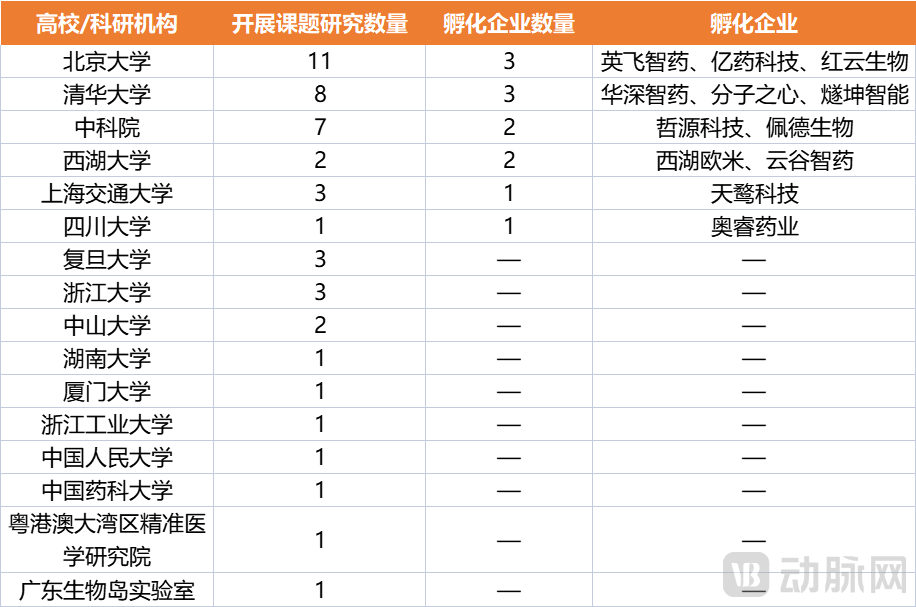
An analysis of 47 related research projects and enterprise incubation initiatives across 16 Chinese universities and research institutions reveals that Peking University and Tsinghua University have demonstrated the most outstanding performance, each having incubated three AI-driven new drug startups.
Among them, Peking University conducted 11 research projects related to AI-driven new drug development and incubated three AI-driven new drug companies, including InfiDrug, Hongyun Biotech, and Yiyao Tech; Tsinghua University conducted 8 research projects related to AI-driven new drug development and incubated three AI-driven new drug companies, including Huashen Zhiyao, Molecule Mind, and Suikun Intelligence.
In addition, universities and research institutions, including the Chinese Academy of Sciences and Westlake University, have also performed remarkably well, each incubating two AI-driven new drug startups.
Beyond the macro-level industry influences mentioned above, what is the secret behind the outstanding performance of these universities and research institutions in translating AI-driven new drug discoveries into tangible outcomes?
Industry insiders pointed out,Closely tied to the translation of scientific and technological achievements are the underlying systems for commercializing such achievements and the associated organizational policies.Institutions and research organizations, including Tsinghua University, Peking University, the Chinese Academy of Sciences, and Westlake University, have evidently established relatively comprehensive systems and organizational policies for the translation of scientific and technological achievements, serving as typical examples of such institutions in China.
In November 2020, to vigorously support and drive frontier original innovation, high-end “hard technology” innovation, and guide the incubation of high-level scientific research achievements,Peking UniversityThe Technology Transfer Fund announced its establishment. In January 2021, the “Yuanpei Fund” was also successfully established. To further strengthen the informatization of intellectual property (IP) management, Peking University, in addition to establishing a comprehensive IP management system, has actively explored the introduction of information technology solutions and developed the “Scientific and Technological Achievement Evaluation and Management System.” This system enables efficient, end-to-end management covering the entire process of IP protection and technology transfer activities at Peking University.
As is well known,Tsinghua UniversityResearch funding at Tsinghua University has consistently ranked first among Chinese universities for many years. The university has introduced nearly 11 policies to promote the commercialization of research achievements, establishing a comprehensive policy framework. Furthermore, Tsinghua University actively collaborates with industry partners and local governments at all levels to advance the deep integration of industry, academia, and research. It has established numerous research institutes that facilitate technology transfer through secondary development and enterprise incubation.
Chinese Academy of SciencesIn recent years, continuous efforts have been made to explore new models for the commercialization of scientific and technological achievements. As early as September 2017, the Chinese Academy of Sciences (CAS) launched its Master Fund for Technology Transfer and Commercialization, aiming to guide social resources toward addressing the challenges in translating CAS’s research outcomes into practical applications. Westlake University, needless to say, has appointed Professor Tian Xu, a renowned expert in the commercialization of scientific research, as its Vice President, thereby bringing to the institution over two decades of distinguished experience in global scientific research and technology transfer.
In general, we believe thatA clear intellectual property allocation system, a flexible mechanism for the commercialization of research findings, and a supportive attitude toward development are the three most critical factors in driving the translation of scientific achievements.
For scientists seeking to commercialize their research findings, a clear, documented pathway for translation—specifying the pricing, modality, and timeline for rapidly licensing out technologies or establishing startups—is of paramount importance.
Although relevant domestic legislation mentions the allocation of rights and interests between universities and patent inventors (i.e., those who complete scientific and technological achievements or project leaders), it does not specify the exact proportion of revenue from scientific research outcomes to be distributed between them. Consequently, implementation varies significantly across individual institutions.
A flexible mechanism for translating research outcomes and a supportive attitude toward development are two factors highly valued by researchers who are keen on commercializing their scientific achievements.
Take the Chinese Academy of Sciences (CAS) as an example. The Institute of Computing Technology (ICT) under CAS has a mature mechanism for translating scientific and technological achievements into practical applications, granting researchers full autonomy in choosing how to commercialize their work. Whether they resign to launch startups in the industry or engage in technology transfer through part-time arrangements, the institute provides strong support and maintains an open attitude. Thanks to this supportive and open environment for commercializing research outcomes, ICT-CAS has successfully incubated a series of listed companies over the years, including Lenovo, Sugon, Cambricon, and Loongson.
However, the approach adopted by the Chinese Academy of Sciences is not universal; in fact,Many researchers at colleges, universities, and scientific research institutes who wish to start businesses or establish companies may be required to make a one-way choice between retaining their status as employees of public institutions and assuming the status of enterprise personnel.
Of course,The successful translation of scientific research achievements also represents the research accumulation of relevant universities/research institutions in the field of AI + new drugs.It is evident that there is a strong positive correlation between the commercialization of scientific research achievements and the conduct of AI-driven new drug research projects by universities and research institutions.
“Whether from the perspective of enterprises or investors, research translation efforts backed by strong theoretical foundations and a track record of successful cases are more likely to succeed, thereby bolstering confidence,” said Hao Tianlong of Infinitus Pharmaceuticals. For instance, the core team members at Infinitus Pharmaceuticals were among the first interdisciplinary academic groups in China to engage in AI-driven drug design, boasting over 25 years of accumulated expertise in CADD (Computer-Aided Drug Design) and AIDD (AI-Driven Drug Discovery). Prior to founding the company, the core team had already gained successful experience in licensing out First-in-Class drug candidates.
“Given the high research barriers in the interdisciplinary field of AI-driven new drug development, founders who transition from academia to entrepreneurship are typically leading figures or highly influential, experienced experts in the domain. The capabilities of their teams are unquestionable, generally achieving complementary skills among members and strong working synergy. If such a founding team can partner with an industry team that complements their scientific research capabilities, the path to success becomes significantly easier.”
Zhao Yu, Co-founder of Zheyuan Technology, pointed out that Zheyuan Technology is a typical team led by an industry thought leader with complementary core member capabilities, forming an interdisciplinary “Chief Architect” structure—a rarity globally. Professor Zhang Chunming, Founder of Zheyuan Technology and Associate Researcher at the Institute of Computing Technology, Chinese Academy of Sciences, has over ten years of cross-disciplinary experience in information technology and life sciences. Dr. Niu Gang, Co-founder of the company and Director of the Turing-Darwin Laboratory, previously led the analysis of the world’s largest patient-derived cell (PDC) dataset for liver cancer. Zhao Yu serves as Chief Operating Officer (COO); he formerly served as Vice President of Market and Strategy at WeDoctor, where he cultivated extensive expertise in the “Internet + Healthcare” sector, gaining broad industry insights and rich industrial experience.
Talent shortage is one of the core challenges currently facing the AI-driven new drug discovery sector. As a multidisciplinary field, the scarcity of professionals with cross-disciplinary expertise has, to some extent, constrained the industry’s development. Although both industry and academia are actively seeking various solutions, the high professional barriers between artificial intelligence and pharmaceutical R&D, coupled with the difficulties in cultivating such hybrid talent, mean that the integration of AI specialists and drug discovery experts will take time. Consequently, the shortage of cross-disciplinary talent is not an issue that can be fully resolved in the short term.
Therefore, for the AI-driven new drug industry to accelerate the resolution of talent shortages, it is not enough merely for companies to intensify recruitment efforts and for the scientific research community to strengthen talent training. More importantly, enterprises must explore innovations in their talent management and development systems. This includes understanding how to cultivate interdisciplinary professionals through standardized frameworks, identifying which roles genuinely require such multidisciplinary expertise, and determining how to fully leverage the value of these scarce interdisciplinary talents in those positions.