

Alibaba's Damo Academy Launches First AI-Powered Alzheimers Screening Mini Program in China
On August 31, the Alzheimer’s Disease Committee (ADC) of the China Association for Geriatric Healthcare, in collaboration with Alibaba DAMO Academy, launched China’s first AI-powered screening mini-program for Alzheimer’s disease. The tool has been medically validated and enables users to complete self-screening on their mobile phones in approximately ten minutes. Experts expressed hope that this initiative will help address the shortage of primary healthcare resources and promote large-scale public welfare screening for Alzheimer’s disease.
Alzheimer’s Disease Has Become a Major Health Threat to the Elderly in ChinaA 2020 study published in The Lancet, a leading international medical journal, reported that there were as many as 9.83 million individuals aged 60 and older with Alzheimer’s disease in China. Due to the irreversible nature of brain damage, Alzheimer’s disease currently remains incurable; however, early detection enables interventions that can slow its progression. Large-scale screening demands substantial medical resources, and many regions—particularly grassroots and remote areas—face limited capacity, falling far short of the 80% screening rate for the elderly advocated by the National Health Commission.
As World Alzheimer’s Month (September) approaches, the Alzheimer’s Disease Center (ADC), in collaboration with Alibaba DAMO Academy, has launched an AI-powered screening mini-program to lower the barriers to screening through technological innovation. A reporter’s trial revealed that users can simply open the Alipay app on their mobile phones, search for “ADC Dementia Screening,” and complete a brief profile to begin the assessment. The screening process, which takes approximately ten minutes, involves tasks such as voice-based responses and clock-drawing tests. The AI system automatically analyzes the results, which are then manually reviewed by experts, with reports issued within five business days. If the screening indicates a high risk, the system will advise the user to seek further clinical diagnosis at a hospital.
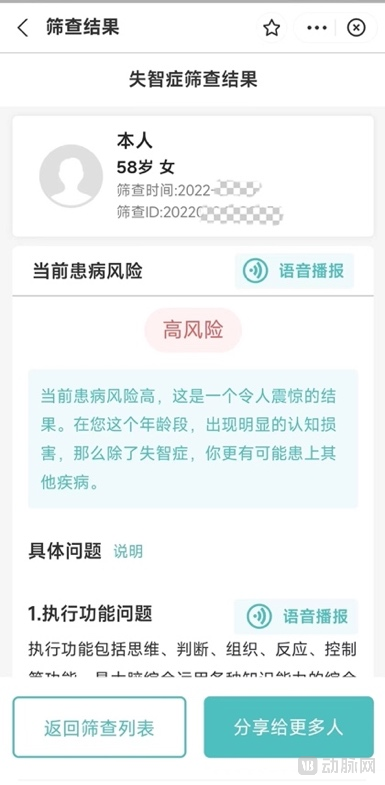
Screening Result Examples
“This is China’s first AI-based screening mini-program for Alzheimer’s disease. We have conducted over a thousand preliminary tests, which have passed medical validation, with both sensitivity and specificity exceeding 80%,” introduced Sun Yongan, Deputy Chairman and Secretary-General of the Alzheimer’s Disease Committee (ADC) and Chief Physician at Peking University First Hospital. The AI screening integrates classic clinical cognitive assessment scales with cutting-edge artificial intelligence technology to rapidly and effectively evaluate the risk of Alzheimer’s disease. Taking the classic Clock Drawing Test as an example, while it appears simple, it actually poses a significant challenge to elderly individuals’ cognitive abilities, particularly their spatial orientation skills.
Sun Yong’an stated that offline screening is time-consuming and labor-intensive, requiring the elderly to visit hospitals in person or rely on assistance from healthcare professionals. In contrast, mobile phone-based operations are now simple and convenient. He expressed hope that this tool would be prioritized for deployment in grassroots and remote areas with scarce medical resources, thereby addressing the challenge of large-scale screening.
Xu Guohai, a senior algorithm engineer at Alibaba DAMO Academy, introduced that the AI-based screening application for Alzheimer’s disease employs cutting-edge multimodal AI technology. It utilizes joint modeling of speech and semantics to evaluate elderly users’ verbal responses, thereby mitigating biases caused by accents. The team also focused on overcoming the challenge of AI recognition of hand-drawn clocks by the elderly. Due to the high variability in elderly individuals’ drawings, which involve complex spatial relationships among contours, numbers, and hands, accurate assessment typically requires experienced experts. DAMO Academy’s AI not only learns from experts’ assessment outcomes but also captures the underlying rationale and knowledge behind their judgments. This approach has led to the development of explainable AI that understands both “what” is correct and “why” it is correct, successfully transforming expert knowledge into AI capabilities.
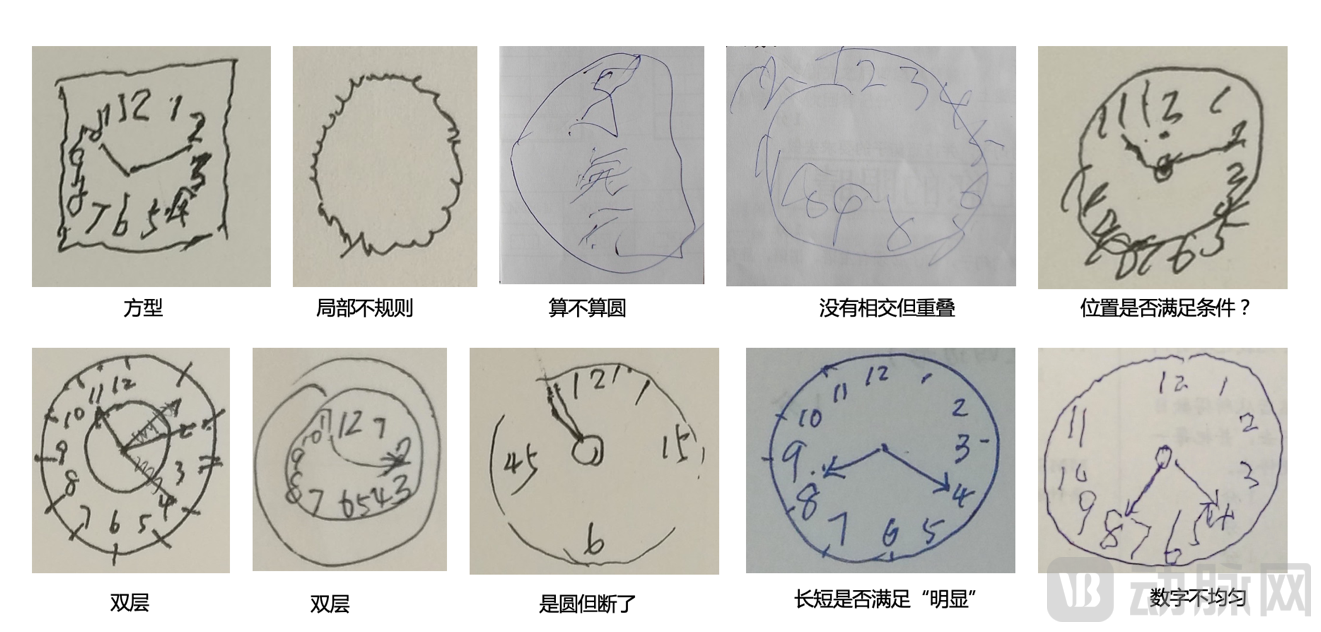 Various Hand-Drawn Clocks
According to reports, since 2021, the DAMO Academy has been researching AI-based screening for Alzheimer’s disease. In collaboration with a team from the School of Public Health at Zhejiang University, it conducted offline screening in Hangzhou, and the research findings were published in the international medical journal *Frontiers in Psychiatry* after undergoing professional medical evaluation. This year marks further progress, as the DAMO Academy and ADC have jointly developed an AI-based screening mini-program, shifting from offline, staff-assisted screening to online self-service screening.
Expert Reminder: Screening is not equivalent to clinical diagnosis; please seek medical attention promptly if needed.
Access Portal: Open Alipay on your mobile phone and search“ADC Dementia Screening”。