

WeDoctor Showcases China's Digital Healthcare Reform Solutions at 2022 China International Fair for Trade in Services
On August 31, the 2022 China International Fair for Trade in Services (CIFTIS) kicked off in Beijing. This year’s CIFTIS continued to adopt a “online + offline” hybrid model, aiming to enhance its international influence through digitalization while closely aligning with the latest trends in the development of the digital economy. Focusing on topics such as digital technologies and digital industries, the fair actively promoted international cooperation in the field of digital trade and commerce.
The China International Fair for Trade in Services (CIFTIS) is the world’s only national-level, international, and comprehensive platform for trade in services. Co-hosted by the Ministry of Commerce of the People’s Republic of China and the Beijing Municipal People’s Government, and jointly supported by international organizations such as the World Trade Organization (WTO), the United Nations Conference on Trade and Development (UNCTAD), and the Organisation for Economic Co-operation and Development (OECD), CIFTIS is the only global comprehensive fair covering all 12 major sectors of trade in services. This year’s edition saw participation from 65 countries and international organizations, with more than 400 Fortune Global 500 companies and leading international enterprises exhibiting in person.
At this year’s China International Fair for Trade in Services (CIFTIS), globally leading medical innovations were showcased, with companies such as WeDoctor, Merck & Co., Mindray Medical, and Sinopharm Group making appearances. As a representative of the digital healthcare industry, WeDoctor prominently featured three innovative solutions it has explored and implemented to address reform challenges in healthcare delivery, pharmaceuticals, and health insurance: Internet hospitals, a pharmaceutical and medical device trading platform, and a Digital Health Community. WeDoctor was also the largest digital healthcare platform enterprise exhibited at this year’s CIFTIS.

According to reports, in response to the three major pain points in China’s healthcare sector—difficulty in accessing medical care due to “uneven” distribution of medical resources, high costs driven by “asymmetric” information in the pharmaceutical market, and overtreatment resulting from “ineffective” health insurance payment methods—WeDoctor has achieved three breakthrough innovations over the past decade. This has established a digital healthcare development pathway aligned with China’s comprehensive reforms promoting the coordinated integration of healthcare services, pharmaceuticals, and health insurance (“Three-Medical Linkage”).
In 2015, WeDoctor established China’s first internet hospital—the Wuzhen Internet Hospital—breaking down the traditional walls of hospitals. In 2017, Haixi Pharmaceutical Exchange Center, a subsidiary of WeDoctor, built the National Healthcare Security Administration’s national platform for drug and medical consumable procurement and management, and was exclusively commissioned by the Sanming Procurement Alliance (National) to carry out cross-regional joint procurement of drugs and consumables, continuously guiding drug prices back to reasonable levels. In 2019, WeDoctor pioneered and implemented the Chinese-style Health Maintenance Organization—the Digital Health Community—promoting value-based payment in health insurance.
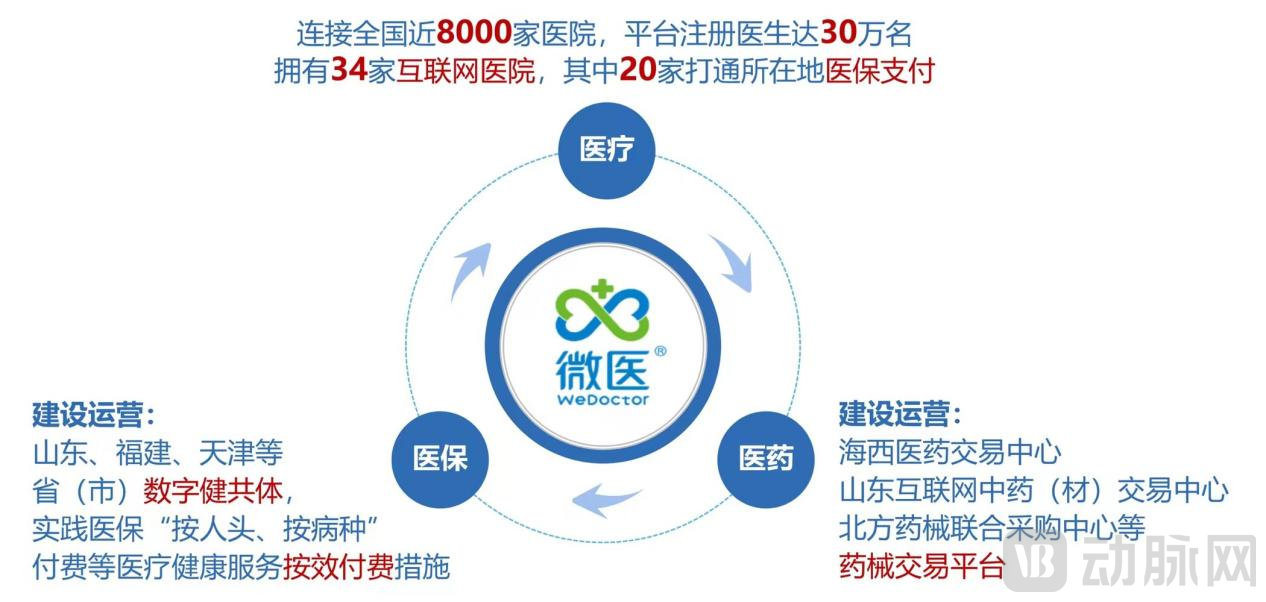
Exhibition displays indicate that, to date, WeDoctor has connected with nearly 8,000 hospitals across China, with 300,000 registered physicians on its platform. The company operates 34 internet hospitals, 20 of which have integrated local medical insurance payment systems. Meanwhile, WeDoctor is responsible for the construction and operation of pharmaceutical and medical device trading platforms, including the Haixi Pharmaceutical Trading Center, the Shandong Internet Traditional Chinese Medicine (Materials) Trading Center, and the Northern Pharmaceutical and Medical Device Joint Procurement Center. Currently, WeDoctor’s Digital Health Community has achieved routine operations in provinces and municipalities such as Shandong, Fujian, and Tianjin.
To better showcase the development achievements of WeDoctor and China’s digital healthcare industry online, WeDoctor has established virtual exhibition halls centered on three innovative practices: internet hospitals, pharmaceutical and medical device trading platforms, and digital health communities. These exhibitions feature content such as the Internet-based Medical Consortium for Chronic Diseases, the Shandong Internet Traditional Chinese Medicine (Herbal Materials) Trading Center, the Tianjin Primary Care Digital Health Community, and the WeDoctor International Digital Health Center, promoting to a global audience the “Chinese Solution” that leverages digital healthcare to address worldwide challenges in healthcare reform.
For example, the WeDoctor Tianjin Digital Health Community was launched in early 2020. Led by the Tianjin WeDoctor Internet Hospital, it deployed a unified “cloud platform” across 266 primary healthcare institutions in Tianjin, leveraging chronic disease management as an entry point to achieve digitalized, intensive, and standardized medical service delivery. Meanwhile, through the WeDoctor Northern Pharmaceutical and Medical Device Joint Procurement Platform, it implemented disease-specific joint drug procurement and adopted performance-based payment measures for healthcare services, such as capitation and diagnosis-related group (DRG) payments. To date, the standardized management rate for diabetic patients in pilot primary healthcare institutions within the Tianjin Health Community has reached 76.68%. The blood glucose control rate among patients enrolled in demonstration-level chronic disease management for more than three months is 13.5 percentage points higher than that of unmanaged patients. Furthermore, primary healthcare institutions implementing capitation-based payment have achieved medical insurance surplus rates ranging from 16% to 31%.
The Digital Health Community has further validated the pioneering value of digitalization in driving the upgrading of healthcare service systems. In April this year, policy documents jointly issued by five ministries and commissions, including the Cyberspace Administration of China, the Ministry of Agriculture and Rural Affairs, and the National Development and Reform Commission, explicitly proposed “guiding localities to explore the development of grassroots Digital Health Communities.”
With the annual theme of “Promoting Development through Service Cooperation, Embracing the Future with Green Innovation,” this year’s China International Fair for Trade in Services (CIFTIS) also effectively sets the tone for the annual development agenda of China’s digital healthcare industry. In the next phase of development, WeDoctor will continue to deepen its collaboration with all stakeholders in healthcare delivery, working jointly with local governments to steadily advance healthcare reform, provide high-quality and efficient medical and health services to the public, and promote the clustered and green development of the digital health industry across various regions.