

U-Protech Secures Angel and Angel+ Funding to Advance Next-Generation Protein Degradation Therapeutics

Zheshang Venture Capital
Investment Institutions in Advanced Manufacturing, Life and Health, Next-Generation Information Technology, New Energy, and New Materials

UProtech
Developer of Novel Targeted Protein Degradation Platforms and Innovative Drugs
VCBeat has learned that U-Ji Universal Medical Technology (Hangzhou) Co., Ltd. (hereinafter referred to as “U-Ji Universal”) recently announced the completion of a financing round amounting to tens of millions of RMB. The Shanghai Biopharmaceutical Innovation Transformation Fund served as the sole investor in the angel round, while Zheshang Venture Capital Co., Ltd. acted as the sole investor in the angel+ round.
Uji Puxi was established in November 2021. The company is dedicated to overcoming the bottlenecks and limitations of current protein degrader drug development, focusing on the development of next-generation protein degraders. The founding team has extensive experience in the fields of protein degradation, cell signaling, and chemical biology. Co-founder Professor Jin Jianping has long been engaged in research on ubiquitination signaling pathways and protein degradation, achieving pioneering results such as the discovery of Uba6, the second human ubiquitin-activating enzyme (E1) (only two E1 enzymes have been identified in humans to date), and its specific ubiquitin-conjugating enzyme (E2) Use1. Co-founder Dr. Lin Shixian is an outstanding young scientist with extensive exploration and accumulation in PROTAC chemical design, synthesis, and chemical biology. The company has assembled a core scientific team specializing in tumor and inflammation signaling pathways, ubiquitin-mediated protein degradation, and chemical design and synthesis.
In 2019, as the first PROTAC pipeline entered clinical trials, industrial enthusiasm for the translation of PROTACs and protein-degrading drugs continued to surge. However, the vast majority of existing PROTAC drugs are designed using small-molecule ligands that target only a few E3 ubiquitin ligases, such as CRBN and VHL. Although more than 600 E3 ubiquitin ligases have been identified in humans, the potential of most of these ligases remains unexplored in PROTAC drug design. Developing small-molecule ligands for novel E3 ubiquitin ligases poses significant challenges, requiring careful consideration of factors such as tissue and cellular distribution, abundance, activity, and biological function, as well as the establishment of efficient ligand screening systems tailored to these new E3 ubiquitin ligases.
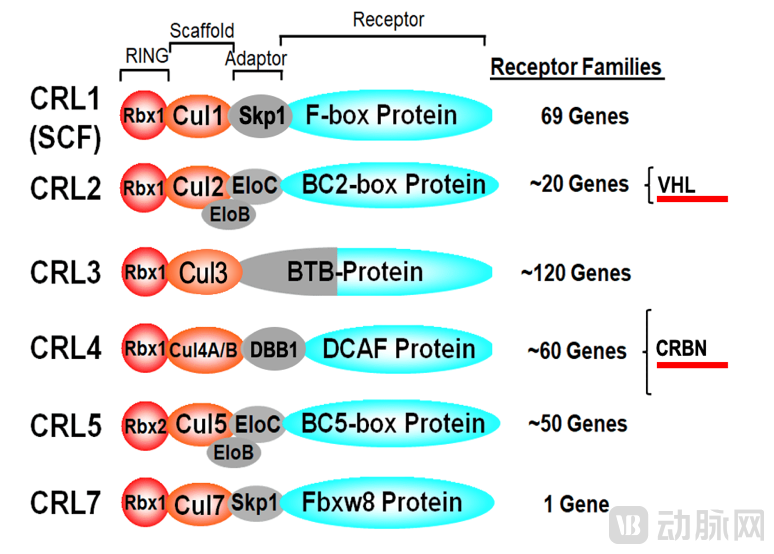
CRL ubiquitin ligases account for nearly 50% of all E3 ligases, making them the largest E3 family. The two most widely utilized E3 ligases in PROTACs, VHL and CRBN, also belong to the CRL family. The majority of E3 ligases remain poorly characterized, with no corresponding ligands currently available. Image sourced from a monograph published by the founding team.
YouJi PuShi is dedicated to the development of small-molecule ligands for novel ubiquitin ligases, expanding PROTAC drug development into new indications and targets, and carving out new patent spaces. The company’s in-house protein degradation pipeline includes PROTACs and molecular glues for autoimmune diseases and cancer. This round of financing will be used for the construction of experimental centers, the establishment of a custom compound screening library, the strategic layout of R&D pipelines, and team expansion.
Professor Jin Jianping, Co-founder of Youji PushiIt was stated that the development of protein-degrading drugs is an emerging industry, poised to overcome the limitations of traditional small-molecule inhibitors in targeting the vast majority of non-enzymatic proteins. Currently, the design and screening of protein-degrading drugs, primarily PROTACs and molecular glues, rely heavily on the limited number of existing ubiquitin ligase ligands. Without expanding the toolkit in this area, the development of the entire field will be severely constrained. Our team has been deeply engaged in the field of ubiquitin-mediated protein degradation for many years, achieving multiple original discoveries and gaining profound insights into the tissue and cellular distribution, activity regulation, functions, and disease associations of ubiquitin ligases. With strong support from investors, we are committed to forging a new path in the development of novel ubiquitin ligase ligands and protein-degrading drugs targeting undruggable disease-related proteins, ultimately realizing our vision of alleviating suffering and benefiting humanity.
Guo Qiushan, President of the Shanghai Biopharmaceutical Innovation and Commercialization FundIt is noted that protein-degrading drugs, as a drug modality developed in recent years, have garnered significant attention due to their distinct advantages over other types of therapeutics in targeting undruggable or mutated targets, achieving catalytic efficacy, and overcoming drug resistance. With the increasing number of PROTAC pipelines and companies leveraging the ubiquitin-proteasome system (UPS) mechanism, lysosome-based degradation technologies have recently achieved translational progress, leading to a flourishing landscape in the field of protein degradation. Nevertheless, the development and expansion of novel E3 ubiquitin ligase ligands are still regarded as a critical opportunity for major breakthroughs in the industry. We believe that the founding team of UbiQure Therapeutics, with its strong expertise and accumulation in ubiquitination and protein degradation research, can successfully develop novel E3 ubiquitin ligase ligands, thereby significantly expanding the application potential of PROTACs and molecular glues, and continuously unleashing innovative R&D capabilities.
You Xiangdong, Managing Partner and Executive President of Zheshang Venture Capital, and Executive Partner of the Qizhen Medical Innovation FundProtein degraders represent a cutting-edge technology garnering significant attention in the innovative drug industry, with their development poised to overcome many limitations inherent to traditional small-molecule drugs. Key breakthroughs in protein degrader development primarily hinge on the discovery of novel E3 ubiquitin ligase ligands and the exploration of new therapeutic targets. The core team at UJi Global comprises top interdisciplinary scientists from Zhejiang University. The team has conducted in-depth research on the ubiquitin-proteasome system, with related findings recognized by leading international journals. We are confident that UJi Global will achieve major breakthroughs in the field of protein degradation.
The Shanghai Biomedical Innovation and Commercialization Fund is an early-stage fund under the Shanghai Biomedical Fund, focusing on investment opportunities in the “0 to 1” phase of the biomedical industry. It was jointly established by Shanghai Industrial Holdings (SIH), Shanghai Pharmaceuticals, Guofang Capital, and the Shanghai Angel Investment Guidance Fund. The fund prioritizes the successful translation and application of original scientific research achievements and cutting-edge innovative technologies. Aiming to build an innovation and commercialization platform that is “focused on Shanghai, linked with the Yangtze River Delta and the Greater Bay Area, and oriented toward the global market,” it invests in and supports original technologies with international leading standards. By connecting various types of innovation and service entities within the innovation ecosystem, the fund seeks to create a “Innovation + Industry + Capital” platform with distinct Shanghai characteristics.
In March 2020, the Qizhen Future Medicine Fund was initiated under the personal advocacy of Academician Wu Zhaohui, President of Zhejiang University, and launched and managed by Zheshang Venture Capital Co., Ltd. The fund is dedicated to investing in early- to mid-stage innovative medical technologies, while guiding and attracting more social capital to invest in innovative projects such as the public service platform of Zhejiang University Medical Center, biopharmaceuticals, and medical devices, thereby gradually forming an innovation ecosystem where capital follows the sources of knowledge and technology. Focusing primarily on early-stage investments, the fund aims to identify next-generation innovative technologies and strategically position itself in specialized medical service endpoints or platforms. Fifty percent of the fund’s returns will be donated to Zhejiang University to establish funds for introducing innovative talent and supporting non-profit medical research.