

China Releases New Regulations on Online Prescription Drug Sales: Key Changes in the 'Measures for the Supervision and Administration of Online Drug Sales'

AliHealth
Medical and Health Services Network Service Provider

Meituan
E-commerce Platform Service Provider
After much anticipation, it has finally been unveiled.
Yesterday, the “Measures for the Supervision and Administration of Online Drug Sales” (hereinafter referred to as the “Measures”) was finally released! Prior to this, the “Measures” had undergone multiple rounds of public consultation over a period of several years.
Online sales of prescription drugs have consistently been one of the most closely watched aspects of the new regulations. In 2019, the newly revised Drug Administration Law of the People’s Republic of China (hereinafter referred to as the Drug Administration Law) was promulgated, removing prescription drugs from the list of products prohibited from online sale, thereby formally liberalizing their online distribution. However, online sales of prescription drugs were subsequently included in the Negative List for Market Access. In June 2022, relevant provisions of the Implementation Regulations of the Drug Administration Law of the People’s Republic of China (Revised Draft for Comment) were taken out of context, leading some individuals to misinterpret them as a ban on third-party platforms selling pharmaceuticals.
How Should the Online Sale of Prescription Drugs Be Conducted in Compliance with Regulations? A More Definitive Answer Is Urgently Needed. Throughout the text, the Measures devote considerable space to regulating the sale of prescription drugs, which not only further affirms the regulatory compliance of online prescription drug sales but also provides the industry with detailed implementation standards through more comprehensive rules.
The Measures mention prescriptions and prescription drugs 31 times, devoting more space to detailing the requirements for online sales of prescription drugs compared to previous draft versions for public comment. Specifically, Articles 9 and 13 of the Measures provide clear stipulations on key aspects such as prescription sources, display of prescription drug information and risk warnings, and sales processes, representing notable changes in the new regulations.
How to Ensure the Authenticity and Reliability of Prescription Sources?
The authenticity and reliability of prescription sources were mentioned in the 2020 “Measures for the Supervision and Administration of Online Drug Sales (Draft for Comments)” (hereinafter referred to as the “2020 Draft”). The current Measures provide more specific clarifications. For instance, online drug retail enterprises shall enter into agreements with entities providing electronic prescriptions and strictly conduct prescription review and dispensing in accordance with relevant regulations. Where a third-party platform accepts electronic prescriptions, it shall verify the credentials of the entities providing such prescriptions and enter into agreements with them.
The formulation of this regulation stems from the previously reported issue of “successful purchase of medication using fake prescriptions.” Major media outlets once reported that consumers were able to successfully purchase prescription drugs online without providing a valid prescription or even by uploading a photo of a dog. Over the past two years, e-commerce platforms have tightened their management, and such practices have been largely curbed. However, some media outlets have pointed out that it is still possible to purchase prescription drugs by creating a fake prescription that mimics the format of a legitimate one.
In other words, even with stringent prescription review protocols in place, e-commerce platforms may still fail to detect counterfeit prescriptions that mimic the format of legitimate ones. As stipulated in the Measures, the authenticity of prescriptions must be addressed at the source.
Currently, pharmaceutical e-commerce companies generally address the issue of ensuring authentic and reliable prescription sources by either establishing their own internet hospitals or collaborating with existing ones. For instance, AliHealth combines self-built and collaborative models, utilizing both its proprietary internet hospital and prescriptions issued by partner internet hospitals. Meituan primarily relies on collaborations but is currently in the process of building its own internet hospital. Against this backdrop, e-commerce platforms are exercising greater caution regarding external prescriptions.
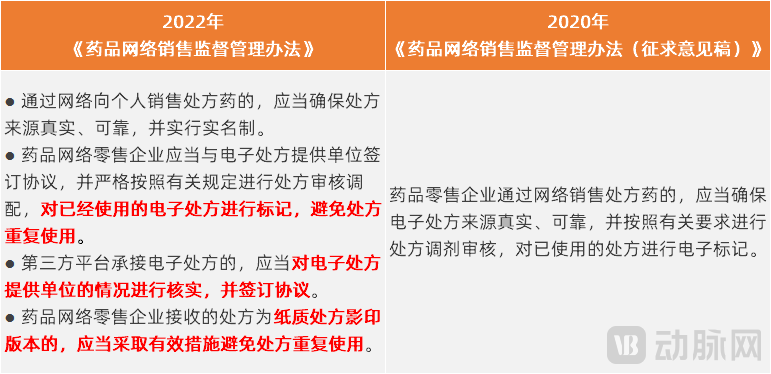
Regulations on the Source of Prescriptions for Online Sales of Prescription Drugs, Data Source: National Medical Products Administration
With authentic prescriptions in hand, how can we prevent patients from using a single prescription multiple times? This has been a heavily debated issue within the industry, drawing particular attention from regulatory authorities. Both versions of the documents propose implementing electronic marking for prescriptions that have already been used.
VCBeat has learned that prescription review and labeling have already been implemented on major e-commerce platforms and internet healthcare platforms. For instance, JD Health has established an intelligent control platform for prescription review. By leveraging an electronic prescription review system for rational medication decision support and an OCR-based intelligent keyword image recognition system, the platform provides auxiliary review of electronic prescriptions from online consultations and paper prescriptions uploaded by users, thereby assisting licensed pharmacists in conducting prescription reviews.
Based on prescription audits, the platform can flag both dispensed prescriptions and those that have exceeded their validity period (typically three days), thereby preventing patients from reusing prescriptions or purchasing excessive quantities of medication.
How to Fully Provide Information Disclosure and Risk Notification?
Patients purchase prescription drugs online primarily for convenience, yet most are unaware of the reasons behind the strict regulation of these medications and the consequences of non-adherence to prescribed regimens. Therefore, it is critically important for pharmaceutical e-commerce platforms to provide necessary information disclosure and risk warnings to patients.
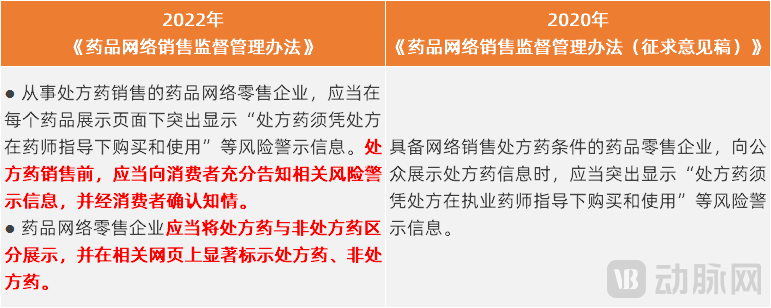
Regulations on the Display of Prescription Drug Information and Risk Warnings; Source: National Medical Products Administration
The 2020 draft for public comment already emphasized that e-commerce platforms, when displaying prescription drug information to the public, should prominently display risk warnings such as “Prescription drugs must be purchased and used under the guidance of a licensed pharmacist with a valid prescription.”
The newly issued Measures further supplement these provisions by requiring that, prior to the sale of prescription drugs, consumers be fully informed of relevant risk warnings and confirm their acknowledgment of such information. In other words, patients should not only see the relevant warnings when browsing prescription drugs but also receive reminders again at the time of purchase.
In line with common practices on internet platforms, prompts for prescription medications during the purchase process may appear as pop-up windows, checkboxes, or buttons, and patients can proceed with the purchase only after clicking to confirm.
Furthermore, the Measures also require e-commerce platforms to display prescription drugs and over-the-counter (OTC) drugs separately. This practice aligns with the zoning requirements for offline pharmacies and serves as a reminder to patients regarding prescription medications.
How to Implement the “Prescription First, Medication Sales Second” Model?
However, displaying more prescription drug information is not necessarily better. In accordance with the requirements of the Measures, information such as packaging and labels of prescription drugs must not be directly displayed on the main sales pages or homepages. A manager from a pharmaceutical e-commerce platform told VCBeat that this measure is primarily intended to prevent patients from selecting and purchasing medications based solely on webpage information, thereby overlooking professional medical diagnosis and prescription requirements.
These regulations address the “prescription after medication” practice, which regulatory authorities have repeatedly prohibited but for which no uniform avoidance procedures have yet been established.
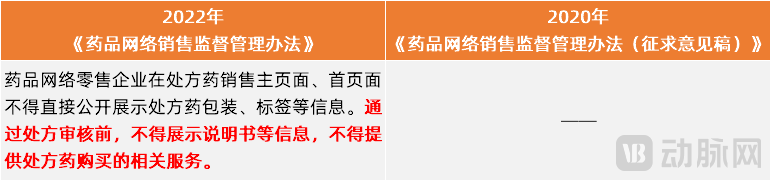
Regulations on the Sales Process of Prescription Drugs, Source: National Medical Products Administration
During online shopping, users are accustomed to directly searching for products based on their needs or browsing by category. This habit naturally extends to the online purchase of pharmaceuticals. For prescription drugs, users are highly likely to search by drug name or disease name and make selections according to their perceived needs. If the displayed information for prescription drugs is overly detailed, patients, seeking convenience or urgency in obtaining a specific medication, may engage in “self-diagnosis” based on such information and report symptoms to online physicians that align with the indications of a particular prescription drug. In such scenarios, even if e-commerce platforms do not intentionally “match drugs to fabricated symptoms” for sales purposes, they may still be misled by patients’ self-reported symptoms into issuing risky prescriptions.
Therefore, the Measures also stipulate that prior to prescription verification, product information such as package inserts shall not be displayed, and services related to the purchase of prescription drugs shall not be provided. In other words, patients can access more comprehensive information about prescription drugs and place actual orders only after obtaining a prescription through online consultation or by uploading an existing prescription, and having it verified by a pharmacist.
Overall, this provision reflects both the prevention of the “medication before prescription” practice on platforms and the approach of guiding patients toward rational medical consultations and medication purchases through these platforms. This aligns closely with the Detailed Rules for the Supervision of Internet-based Diagnosis and Treatment (Trial), issued in 2022. Together, these two documents clearly define each stage and the overall process of online consultations, prescription issuance, prescription review, and drug sales, thereby promoting a healthier ecosystem for internet-based healthcare and pharmaceutical services.
However, managers from the aforementioned e-commerce platforms stated that specific definitions regarding “the main sales page and homepage for prescription drugs” and “provision of services related to drug purchases” still need to be clarified. Before the formal implementation of the Measures, the industry must strengthen communication with regulatory authorities to confirm and adhere to these details. Meanwhile, given that online users’ shopping habits have been established over many years, e-commerce platforms need to devote greater effort to refining their service processes and technical functionalities. This is essential to ensure a positive user experience while maintaining compliance, thereby enabling patients to purchase prescription drugs efficiently and safely.
Strengthening penalty measures is a prerequisite for ensuring the effective implementation of rules and regulations. Compared with previous drafts for public comment, particularly the 2020 draft which was the most recent, the Measures have intensified the penalties.
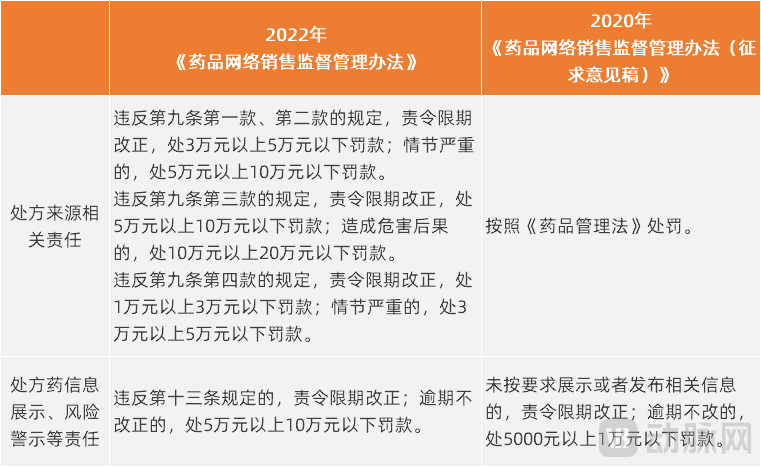
Legal Liabilities Related to the Online Sale of Prescription Drugs, Source: National Medical Products Administration
In the 2020 draft for public comment, violations of regulations concerning the authentic source of prescriptions were to be penalized in accordance with the Drug Administration Law. However, the Drug Administration Law does not specify detailed requirements regarding prescription sources. The current Measures clarify various scenarios involving non-compliance with prescription source requirements and establish corresponding penalties. For instance, violation of Article 9, Paragraph 3—which stipulates that third-party platforms accepting electronic prescriptions must verify the credentials of the entities providing such prescriptions and enter into agreements—shall result in an order to rectify within a specified time limit and a fine of not less than RMB 50,000 but not more than RMB 100,000; if harmful consequences ensue, a fine of not less than RMB 100,000 but not more than RMB 200,000 shall be imposed.
Regarding the display of prescription drug information and risk warnings, if enterprises violate relevant regulations and fail to make corrections within the specified period, the Measures stipulate a fine of not less than 50,000 yuan but not more than 100,000 yuan, which is higher than the maximum cap of 10,000 yuan set forth in the draft for public comment.
Not only does it target prescription drug sales, but overall, the penalty measures in the "Measures" are stricter than those in the draft for comments. The fines under the "Measures" range from 10,000 to 200,000 yuan, whereas the draft for comments proposed fines ranging from several thousand to 30,000 yuan. This means that once pharmaceutical e-commerce platforms cross regulatory red lines, they will face higher costs for non-compliance.
“More stringent requirements and harsher penalties under the new regulations are fine with us, as long as sales aren’t banned,” remarked a professional in the pharmaceutical e-commerce sector.
Indeed, the imposition of stringent penalties is fundamentally rooted in considerations of patient medication safety, which serves as the basic prerequisite for the survival of the pharmaceutical e-commerce industry.
JD Health also believes that the Measures fully reflect a regulatory approach to online drug sales that prioritizes “guidance” over “restriction,” and embody the integration of government oversight with industry self-discipline, as well as the combination of ex-ante, in-process, and ex-post supervision, thereby creating a more standardized and orderly environment for the implementation of online prescription drug sales.
The “Measures” will come into effect on December 1, 2022. Their formulation was not easy, involving prolonged periods of public consultation and discussion, as well as a setback shortly before their official release.
In 2021, a draft for review of the “Administrative Measures for the Supervision and Regulation of Online Drug Sales” (hereinafter referred to as the “Draft for Review”) circulated online. The Draft for Review established a broader scope of prohibited drugs for online sale; in addition to special-controlled substances such as psychotropic and narcotic drugs, it also included high-risk medications such as oncology drugs. Furthermore, it imposed stringent requirements on the display of prescription drug information and the drug purchasing process.
Prescription drugs, represented by oncology medications, have become a key category for vigorous expansion by pharmaceutical e-commerce platforms in recent years. Statistical data from a certain e-commerce platform shows that among all prescription drug categories, oncology medications experienced the fastest growth in 2021.
If implemented as drafted, online platforms may lose some market share and suffer a decline in user experience. Meanwhile, offline retail channels would absorb this portion of the market.
Fortunately, following discussions among various stakeholders, the draft version circulated online did not become the final version. The final version of the Measures restricts the prohibition on drug sales solely to the scope stipulated by the Drug Administration Law, without any expansion; furthermore, the requirements for the display of prescription drug information and the purchasing process are more moderate.
An industry practitioner who has participated in multiple discussions on the Measures revealed that a major reason why the formulation of the new regulations became a “protracted battle” was the difficulty in balancing the interests and dynamics between online and offline sectors.
According to industry statistics, the sales volume of online pharmacies has been growing day by day, exceeding 200 billion yuan in 2021. With the opening of online sales policies and the rapid development of internet hospitals, the scale of online prescription drug sales has also grown rapidly. At the same time, under the impact of the pandemic, the demand for purchasing medicines online has increased, and consumer habits have further developed.
The online sale of pharmaceuticals and prescription drugs has become an irreversible major trend.
From a holistic perspective, the online and offline channels should not be viewed solely through the lens of competition and rivalry. On one hand, online platforms require a vast number of widely distributed offline pharmacies to ensure a more comprehensive product assortment and timelier delivery. On the other hand, offline pharmacies need online platforms with greater traffic and higher efficiency to expand their service radius and enhance service quality.
From the perspective of 1YaoWang, although the online sale of prescription drugs has been permitted, the long-standing absence of specific regulations for online drug sales has not only posed challenges for regulatory oversight but also hindered the robust collaboration between internet platforms and the traditional pharmaceutical industry. The implementation of the Measures imposes stringent compliance requirements on pharmaceutical e-commerce operators, thereby facilitating the sector’s sustainable growth and expansion within a healthy regulatory environment.
Zhou Kai, Deputy General Manager of Yaofangwang Mall, stated that the company will continue to monitor policy developments and market changes, and actively expand related businesses by comprehensively considering factors such as market opportunities and development strategies.
The industry has long foreseen this trend: pharmaceutical e-commerce players opening physical pharmacies, and brick-and-mortar chains launching online platforms, with increasing integration between online and offline channels.
The Measures also embody the principle of consistency between online and offline operations in multiple provisions, thereby promoting the integrated development of the industry. Notably, the Measures set forth separate requirements for pharmaceutical e-commerce enterprises and third-party platforms regarding drug sales, which further confirms that the industry’s interpretation several months ago—that “third-party platforms are prohibited from selling drugs”—was a misreading. The formation of an industry ecosystem featuring both self-operated and platform-based models in pharmaceutical e-commerce is itself a manifestation of online-offline integration.
It is foreseeable that in the future, there will be more mutual benefits and less competition between online and offline pharmaceutical retail.