

Agibot™ Robotic-Assisted Laparoscopic System Successfully Completes Comprehensive Urological Animal Trials, Agile Medical Advances Toward Pivotal Clinical Studies

Agibot
Surgical Robot Developer
In recent years, with the gradual iteration of laparoscopic surgical robot products, their key clinical value has become increasingly prominent. For example, they enable precise manipulation under the surgeon’s control, eliminate involuntary hand tremors or shaking, facilitate anatomical dissection in confined spaces, enhance visualization of the surgical field, reduce operative time, minimize complications and patient suffering, and shorten the learning curve for surgeons mastering new surgical techniques.
Technological advancements have further heated up the domestic market for laparoscopic surgical robots. Today, laparoscopic surgical robot systems have become an integral part of routine surgeries, scientific research and teaching, as well as standardized physician training in fields such as urology, gynecology, general surgery, and thoracic surgery. These systems are widely used in clinical practice, with their adoption in disease treatment significantly increasing.
Recently, this sector has seen new progress,Agibot Medtech (Suzhou) Co., Ltd. (hereinafter referred to as “Agibot”) has independently developed the Agibot™ laparoscopic surgical robot. Since launching preclinical studies in June, it has successively conducted animal experiments on typical urological procedures, including nephrectomy, bladder repair and suturing, cystectomy, and radical prostatectomy.
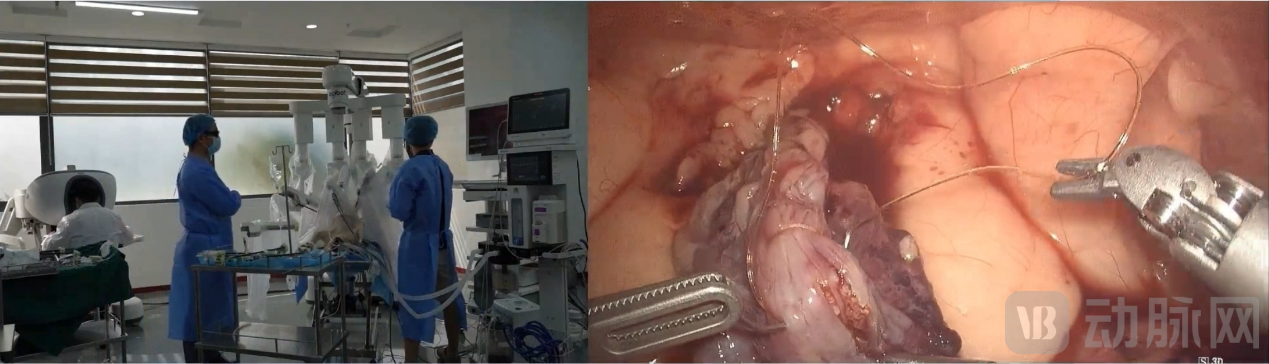
Figure 1 Agibot™ Laparoscopic Surgical Robot Performing Bladder Repair and Suturing
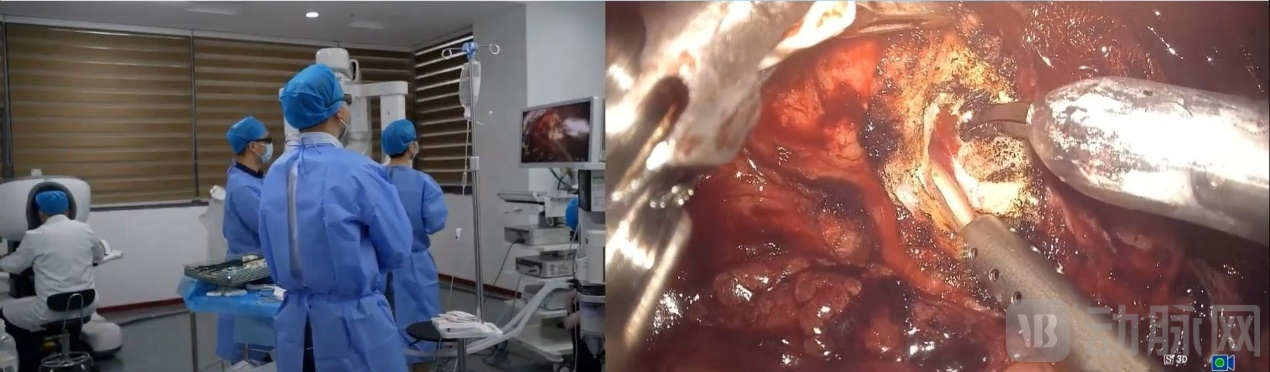
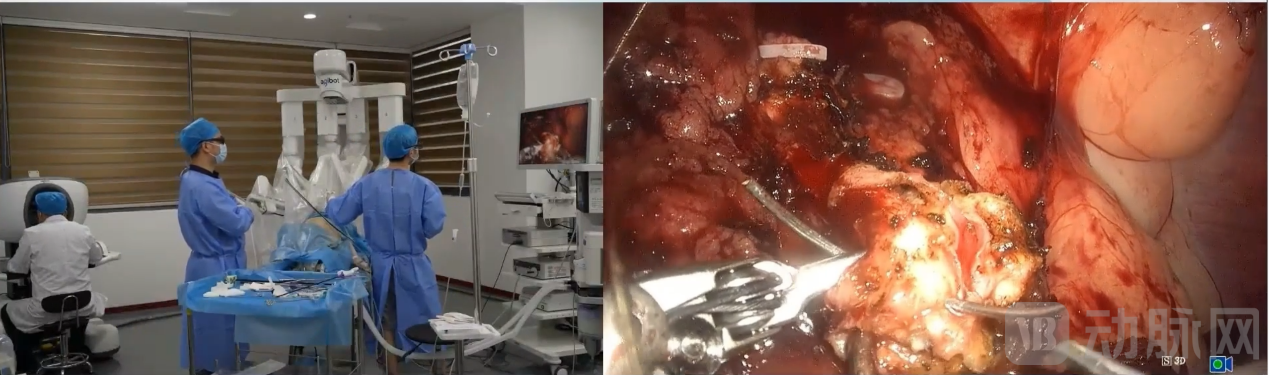
Figures 2 and 3: Agibot™ Laparoscopic Surgical Robot Performing Radical Prostatectomy
It is reported that the animal experiments were performed by urology experts from the First Affiliated Hospital of Soochow University, with the surgical procedure proceeding smoothly and all steps completed as expected. This fully validated the product’s capability to perform delicate maneuvers—including dissection, hemostasis, ligation, and suturing—within the confined spaces of the abdominal and pelvic cavities, thereby demonstrating its ability to support a full range of urological surgical procedures. By conducting preclinical research validation and iteratively refining product functionality in a stepwise manner, this work has laid the foundation for the Agibot™ laparoscopic surgical robot system to enter the registrational clinical trial phase.
Agibot possesses end-to-end independent technological development capabilities for laparoscopic surgical robots, spanning from underlying technology development to complete system R&D.
Since its inception, the company has adhered to independent innovation, advancing the research and development of laparoscopic surgical robots through a model integrating medicine and engineering. It has achieved original technological breakthroughs across multiple dimensions—including multi-degree-of-freedom instruments, visual imaging, electronic hardware, software algorithms, main body design, and system integration—thereby establishing a comprehensive technology development platform for surgical robots.
It is reported that Agibot expects to have over 100 patent applications accepted by the end of the year, with nearly 30 patents already granted.Achieved significant breakthroughs in motor servo drive, telecentric fixed-point control, development of fully active multi-degree-of-freedom robotic arms, third-party-compatible 3D imaging, and high-precision real-time master-slave control.By developing key underlying components in-house, we have broken the constraints imposed by imported parts on the development and iteration of robotic products. This has simultaneously shortened iteration cycles, reduced product costs, and enhanced product competitiveness.
Based on Differentiated Product Technology Roadmaps and Breakthroughs in Core Technologies, the Agibot™ laparoscopic surgical robot is expected to be used in specialties such as urology, gynecology, general surgery, and thoracic surgery.In various robotic surgeries, it shortens preoperative preparation time, simplifies surgical procedures, and improves surgical efficiency, assisting doctors in better performing complex surgeries.
Xu Min, founder of Agibot, believes“Clinical needs-driven” is a consensus in the research and development of surgical robots. However, it is easier said than done, and achieving this poses significant challenges.
Therefore, from its inception, Agibot established a development direction driven by clinical needs to guide technological R&D, ensuring that technology serves product development. It adopted a development strategy focused on building product differentiation and continuously enhancing product competitiveness. By creating a “need-driven surgical robot innovation platform” from scratch, Agibot further addresses this challenge.
Xu Min explained to VCBeat thatAgibot“Demand-Driven Innovation Platform for Surgical Robots”: Conceptual Framework and Implementation Steps:
First, we systematically reviewed application scenarios and usage workflows based on first principles to identify pain points, extract requirements, refine product definition, and subsequently build the technical framework and establish the technical roadmap. Throughout this process, the team continuously deliberated on and cultivated differentiated competitive advantages for the product, seeking opportunities to outperform competitors.
Second, undertake breakthroughs in key technologies to develop product prototypes with minimal personnel, the shortest cycle, and the lowest cost. Establish a development strategy for full-state products based on the principle prototype and initiate modular development. Advance the development of core and major functions according to plan and priority, conduct phased engineering and biological validations, and continuously drive forward the R&D of the innovative laparoscopic robot.
Third, leveraging the foundational technologies developed for endoscopic surgical robots and integrating advanced capabilities such as intelligent sensing and image processing algorithms to foster the convergence of more innovative technologies. We will continuously iterate our products and build a pipeline of intelligent surgical solutions to address unmet clinical needs.
Fourth, establish an industrial collaboration platform that includes innovative enterprises, research institutes, clinical hospitals, and investment institutions. Form an organically coordinated industrial innovation network, create a healthy ecosystem, and enhance corporate innovation capabilities.
In the future, Agibot will follow this path by continuously exploring the application of more innovative technologies in various robotic products, thereby expanding the clinical application scenarios of surgical robots and promoting the widespread adoption of robotic procedures in clinical practice.
Laparoscopic surgical robots represent one of the largest and most commercially successful segments within the surgical robotics market. According to Frost & Sullivan, the global market size for laparoscopic surgical robots grew from USD 2.71 billion in 2016 to USD 5.25 billion in 2020, achieving a compound annual growth rate (CAGR) of 18.0%.
Although China’s surgical robot market is still in its early stages of development, the widespread clinical acceptance of laparoscopic surgical robots, the gradual inclusion of robot-assisted surgeries in domestic medical insurance coverage, and the trend toward domestic substitution of laparoscopic surgical robots are expected to drive a steady increase in the installed base of laparoscopic surgical robot systems in China, as well as sustained growth in the volume of robot-assisted laparoscopic procedures performed domestically.
Data shows that from 2015 to 2020, the annual number of robot-assisted laparoscopic surgeries performed in China increased from 11,000 to 47,000 cases.
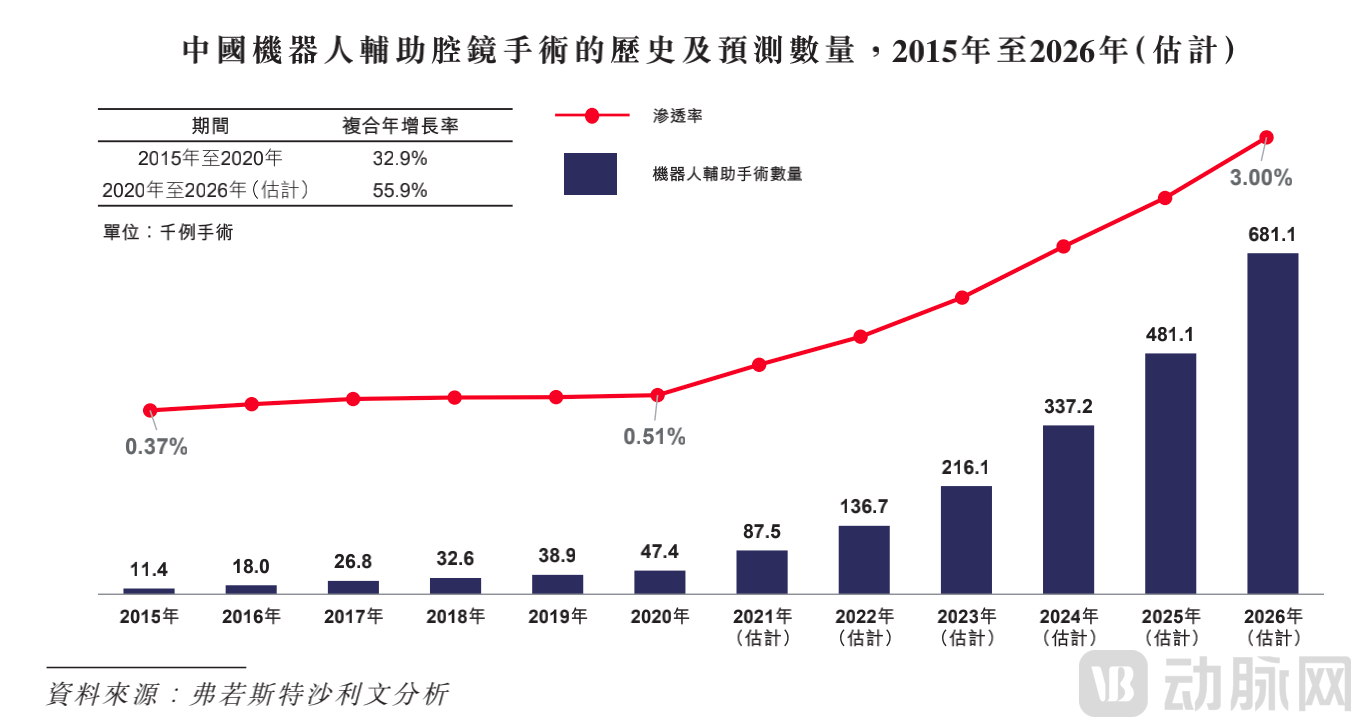
History and Projected Volume of Robot-Assisted Laparoscopic Surgery in China (2015–2026 Estimates)
Data Source: MicroPort MedBot Prospectus
Agibot began assembling a multidisciplinary team of professionals in medicine, mechanics, optics, electronics, electrical engineering, algorithms, and software in 2020 to develop and manage operations for its surgical robot products, aiming to advance technological R&D, clinical translation, mass production, and commercialization.
As core technologies of surgical robots are gradually mastered and favorable industry policies are introduced, Agibot is poised to leverage its robust R&D capabilities and differentiated product strategy. By offering innovative, accessible products that meet clinical needs, the company aims to fill market gaps in the surgical robotics sector.