

TissUse: Pioneering Multi-Organ-on-a-Chip Technology for Transformative Drug Development and Personalized Medicine

TissUse
Organ Chip Developer
Around 2010, organoid and organ-on-a-chip technologies gradually garnered attention from the pharmaceutical industry. After more than a decade of development, researchers have progressively developed models with greater functional completeness, complexity, and higher fidelity. Early single-organ chips, such as those for the lung, intestine, and liver, are now evolving toward multi-organ linked chip systems, while a wider variety of organoid-based chip types, including tissue chips and tumor-on-a-chip platforms, have begun to emerge.
In the field of multi-organ serial chips, biotechnology company TissUse absolutely has a say. In 2010,TissUse, founded in Berlin, Germany, has developed a unique “multi-organ chip” platform. This platform offers a novel approach to predicting drug toxicity, pharmacokinetics, and in vitro efficacy, thereby reducing and replacing animal testing while simplifying human clinical trials.
Focus on Multi-Organ Serial Chips, Launching Tissue Chips for the First Time
Compared with small animal models or single-organ chips used for drug screening, multi-organ linked chips can integrate multiple organoids into a common circulating medium environment, thereby supporting more complex and physiologically relevant drug screening. By linking the target organ of a drug with organ-on-a-chip systems containing liver and kidney organoids, it is possible to evaluate drug efficacy while simultaneously detecting hepatotoxic and nephrotoxic side effects at clinically relevant doses. This enables accurate monitoring of unsafe drugs before they reach clinical application, ensuring medication safety for patients. Consequently, multi-organ linked chips have become one of the more reliable and cost-effective research tools in the pharmaceutical industry.
TissUse was originally co-founded by Reyk Horland and Uwe Marx. Uwe Marx served as Chief Executive Officer from 2010 to 2020; prior to founding TissUse, he led the multi-organ chip development project at the Technical University of Berlin. After serving as Head of Business Development for eight years, Reyk Horland was appointed Chief Executive Officer of TissUse in October 2020, having previously led the HUMIMIC project in 2014.®The Emergence of the Technology.
Another core executive of the company is Silke Hoffmann, who serves as Vice President of Intellectual Property and Innovation. Previously, Ms. Hoffmann worked as an Intellectual Property Manager at ProBioGen AG, a German CDMO, where she was responsible for patent management and operational research. She brings extensive expertise in biochemistry and intellectual property.

When organ-on-a-chip technology first garnered attention, despite its convenience, certain challenges were inevitable. In vitro culture of human cells is relatively simplistic and lacks systematic integration, while model animals, although capable of mimicking human physiological mechanisms, pose challenges in terms of humanization. These limitations hinder accurate prediction of drug efficacy during drug screening.
Addressing these limitations, TissUse has focused not on single-organ organ-on-a-chip systems, but on human tissue chips with multi-organ serial culture capabilities. The company has developed a “Human-on-a-Chip” technology platform to accelerate the development of pharmaceuticals, chemicals, cosmetics, and personalized medical products.This technology marks the first time in history that human tissues have been used on a chip to facilitate preclinical research and predict the effects of chemicals and their metabolites on models that closely resemble real-life physiological conditions.
TissUse has developed a proprietary commercial Multi-Organ-Chip (MOC) technology platform, a microfluidic microphysiological system capable of maintaining and culturing miniature organ equivalents to longitudinally simulate the biological functions of their respective counterparts. This technology simulates the activities of multiple human organs in a realistic physiological environment at the smallest possible biological scale. By incorporating key biological features, MOC supports repeated-dose toxicity testing and various efficacy studies for long-term disease treatment. The technology enables flexible customization and combination of different tissue structures or organs based on a single-use chip microphysiological system.
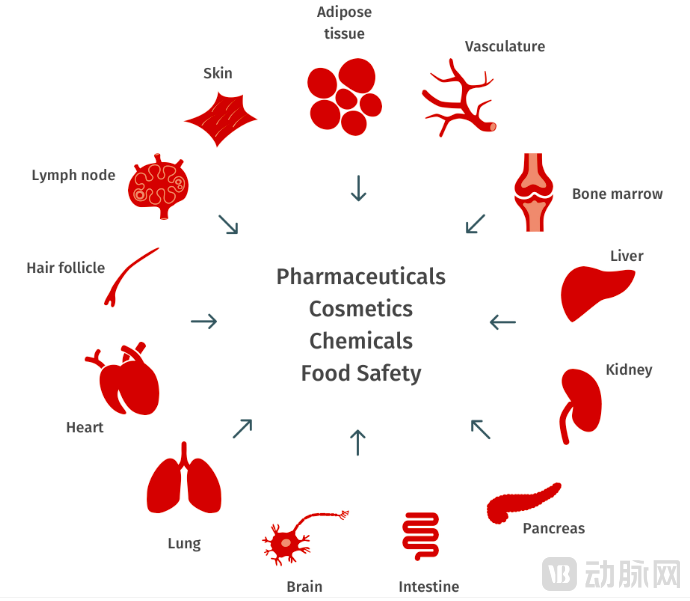
Currently, TissUse’s MOC platform supports culture ranging from single organs to complex multi-organ systems, and has even achieved four-organ culture.The provided organ models cover the liver, intestine, skin, vascular system, neuronal tissue, cardiac tissue, cartilage, pancreas, kidneys, thyroid, hair follicles, lung tissue, adipose tissue, tumor models, and bone marrow, with additional organ models currently under development.
HUMIMIC Is Maturing, Paving the Way for Commercialization
Based on the MOC technology platform, TissUse launched its organoid culture system, HUMIMIC, in 2014.
HUMIMIC’s systematic service solution encompasses hardware, software, specific cell lines, chip systems, and technical services, enabling disease testing without the need for human patients. To achieve higher relevance and accuracy in test results, HUMIMIC features automated chip-based testing of human organ models, equipped with organ-on-a-chip models that indicate physiological relevance, as well as patient-specific diseased organ subunits integrated into the chips. This comprehensive product suite lays the foundation for assessing safety and efficacy prior to in vivo exposure, as well as evaluating overall personalized therapeutic outcomes.

HUMIMIC features a compact chip design capable of simulating a realistic human physiological environment, including temperature, humidity, airflow, pressure, and fluid flow. The base of the chip incorporates isolated microfluidic channels, allowing for independent configuration of culture conditions tailored to specific organs, thereby providing a precise environment for culture and differentiation. This enables the efficient and uniform generation of organoids for research or drug screening purposes, with high reproducibility.
Automated integrated systems for cell culture and differentiation can improve the success rate of directed organoid differentiation. The HUMIMIC system can simultaneously culture four different types of organoids and link them via microfluidic technology to enable research on multi-organ serial culture.
With the MOC technology platform and the HUMIMIC system, TissUse has established a robust commercialization pathway.
Previously,TissUse Has Collaborated with Multiple Companies. TissUse collaborates with AstraZeneca to establish relevant microphysiological systems (MPS) models based on its MOC technology, for studying insulin- and glucose-regulated islet-liver crosstalk and constructing a comprehensive model of type 2 diabetes.
TissUse has also established a new partnership with Roche to develop assays for evaluating lineage-specific hematopoietic toxicity and assessing the pharmacokinetics of therapeutic antibodies. TissUse leverages its MOC technology as a highly versatile tool to develop in vitro assays, thereby enhancing the prediction of early-stage drug candidate safety.
Furthermore, TissUse has collaborated with Bayer to establish a liver-endocrine multi-organ model. In its recent partnership with PMI (Philip Morris International), the companies jointly developed a human aerosol testing platform to simulate the entire human respiratory tract.
Collaboration with large enterprises enabled TissUse to launch HUMIMIC in 2014®Since its market launch, the technology has achieved a substantial annual sales growth rate.
Currently, organ-on-a-chip technologies still face challenges such as the lack of vascularized structures and low levels of organ system integration. TissUse is also working toward technical breakthroughs in whole-blood supply and innervation of organ models, alongside the ongoing maturation of personalized immune systems on its HUMIMIC platform. TissUse will address these subsequent challenges to establish complex systems-level human biology on microchips.