

Mental Health Sector Surges with Over $2.1 Billion in Funding Amid Pandemic-Driven Demand

Beijing Zhujian Technology
Mental Health Service Platform
Upon receiving the notice that the lifting of lockdown measures in his residential community would be postponed once again, Xiao Zhou stared blankly at his mobile phone in silence. He was well aware that he should immediately go online to stock up on essential daily supplies, yet he felt unable to do anything. At that moment, he was overcome with a sense of helplessness, as if he were the only person left in the world.
Over the three years of the pandemic, mental internal friction among young people like Xiao Zhou has seemingly become a defining sentiment of our times. The pandemic has exerted varying degrees of psychological impact on individuals; some have experienced heightened fear and anxiety, while others have seen their work and daily lives disrupted by insomnia and emotional volatility.
The psychological issues among the public caused by the pandemic have been a key driver behind the rapid development of the mental health industry over the past two years.
From an industry perspective, major social events invariably drive the popularization and development of the mental health sector. In the face of a global event such as the COVID-19 pandemic, what has the mental health industry accomplished over the past three years?
In the past, patients with mental disorders not only endured the torment of their illnesses but also suffered from the stress and hardships caused by social stigma. This led to an avoidance of medical care and a reluctance to seek professional help, thereby preventing them from receiving timely and effective treatment. Today, with heightened health awareness and the recognition that mental disorders are legitimate medical conditions, people are beginning to prioritize and actively engage in treatment.
If this trajectory continues, the mental health industry will undergo a long-term accumulation process, similar to other sectors. However, the black swan event of the pandemic has triggered explosive growth in an industry that was previously experiencing slow expansion.
According to a survey of the mental health status of nearly 15,000 members of the general public in China conducted during the outbreak and published in the Chinese Journal of Psychiatry, the positive detection rate for depressive symptoms was 53.5%, comprising 29.3% with mild depression, 14.0% with moderate depression, and 10.1% with severe depression. The positive detection rate for anxiety symptoms was 44.6%, comprising 27.8% with mild anxiety, 10.2% with moderate anxiety, and 6.6% with severe anxiety.
The emergence of the pandemic has exacerbated pre-existing mental health issues, while extensive media coverage has simultaneously fostered a more accurate public understanding of these conditions. There has been a substantial increase in the demand for mental health support, driven by anxiety, loneliness, and depression stemming from isolation and illness.
According to the 2020 report “Defining the Mental Health Economy” by the Global Health Institute, the global mental health market has reached a scale of $121 billion. Industry insiders estimate that the market size of China’s mental health sector is approximately RMB 300 billion.
Against this backdrop, mental health-related services have sprung up like bamboo shoots after rain. Investors from various sectors have also recognized the opportunities inherent in this market and begun to enter the fray.
From an industry-wide perspective, financing activity has been exceptionally robust. Platforms such as Haoxinqing (Fine Hin), Jiandan Xinli (Beijing Zhujian Technology), Zhaoyang Doctor, Damai and Xiaomi, and Yidianling have secured multiple rounds of funding in recent years, characterized by substantial amounts and late-stage investment rounds. This demonstrates venture capital firms' confidence in these enterprises and their respective market sectors.
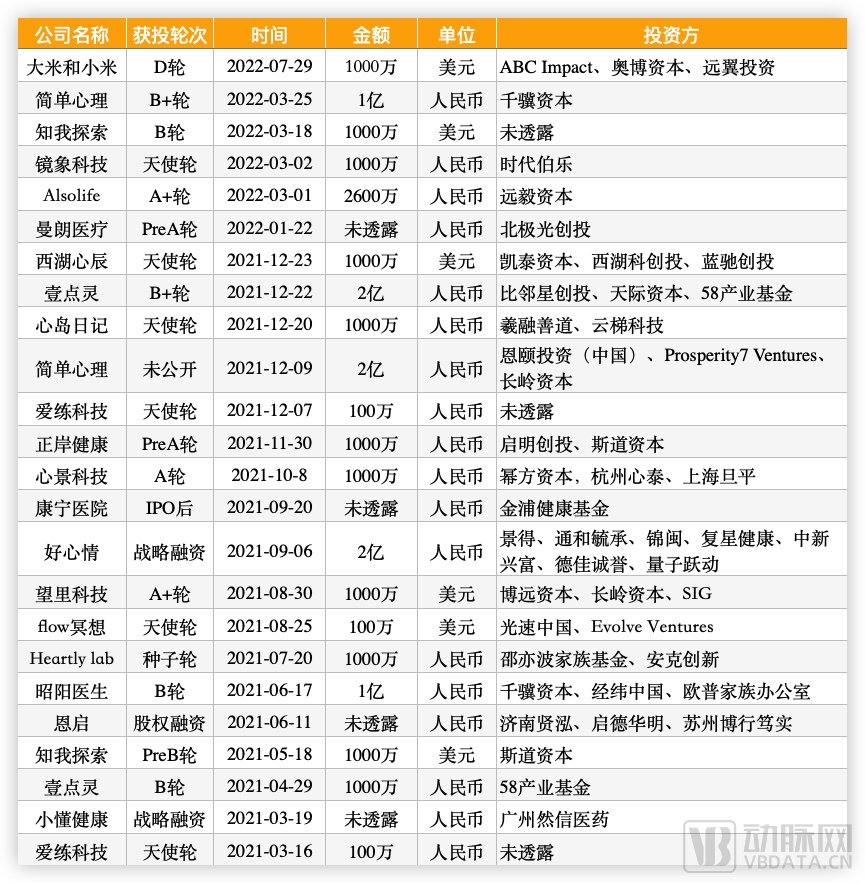
Mental Health Industry Financing Statistics (2021–Present), Data Source: VCBeat Orange
According to data from Artery Orange, there have been 24 financing and investment transactions in the mental health sector from 2021 to the present, with a total cumulative amount exceeding RMB 1.5 billion. Internet giants are also prominent among the investors: in September 2021, ByteDance led a RMB 200 million Series C financing round for Hao Xinqing, a digital mental health service platform, setting a new record for the largest single financing transaction in China’s mental health sector at that time.
Moreover, Westlake MindPal, an AI-driven mental health services technology company, raised nearly $10 million in its angel round alone—a rarity in the mental health sector.
Overseas, the mental health market is also favored by capital. According to statistics from Fierce Healthcare, startups in the mental health sector raised a total of $5.5 billion in 2021 alone, representing a year-on-year increase of 139%. Unicorn companies such as LifeStance and Talkspace completed their IPOs on U.S. stock exchanges last year.
As can be seen from this list of financing deals, the funded projects cover multiple segments of the mental health industry, including services, software platforms, technology R&D, and specialized vertical niches, reflecting a broad distribution of investment. So, what explorations have companies in the industry undertaken over the nearly three years since the pandemic that have continued to attract institutional investors?
Unlike common physiological diseases, mental health issues can be diagnosed without reliance on instrumental examinations or biochemical tests. Instead, diagnosis is based on clinician-patient communication, the physician’s observation of the patient’s behavior and verbal expressions, and the application of professional theoretical knowledge and clinical experience.
This characteristic gives digital health a unique advantage in the field of mental health.
In the “Expert Recommendations on Internet-Based Psychiatric Diagnosis and Treatment during Major Public Health Emergencies (COVID-19),” jointly formulated by the Chinese Society of Psychiatry of the Chinese Medical Association, the Psychiatric Physicians Branch of the Chinese Medical Doctor Association, and the National Center for Mental Health of the Chinese Center for Disease Control and Prevention, it is explicitly stated that, compared with diseases managed in departments such as internal medicine, surgery, obstetrics and gynecology, and pediatrics, mental and psychological disorders often require long-term pharmacotherapy and continuous psychological counseling and psychotherapy, making them more suitable for the internet-based diagnosis and treatment model.
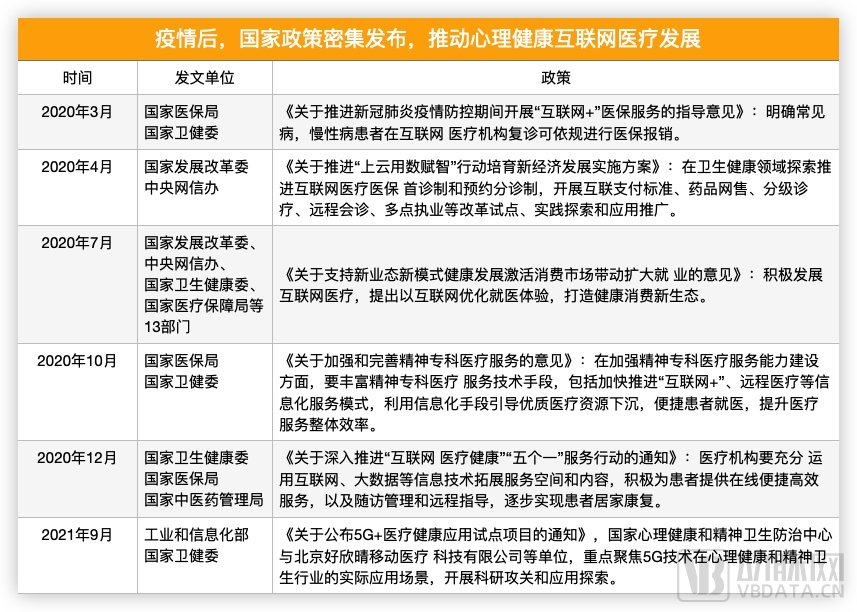
Post-Pandemic Policies Boost the Development of Internet-Based Mental Healthcare
From the perspective of demand, the development trajectory of the internet-based model has enabled mental health services to align with user needs.
For consumer-end users, there are several concerns regarding mental health services—namely, price, efficacy, and social stigma. Internet-based models can educate clients and popularize mental health knowledge through various formats. Once users recognize the value of these services, they will naturally accept the paid model, while the inherent nature of the internet helps ensure privacy protection.
The digitalization of mental health services has met user demands, and the convergence of these forces has triggered an explosion in the trillion-yuan mental health market, while also driving growth across multiple industry sub-sectors.
Based on the urgency and severity of demand, the mental health industry can be segmented into four primary tracks: psychiatric and psychological care for serious medical conditions, moderate social-psychological support, mild emotional management, and others. Companies participating in the mental health industry adopt varying strategies; some focus deeply on vertical niche segments, while others pursue a multi-point layout.

Major Subsectors in the Mental Health Industry
01. Psychological Counseling Model
Psychological counseling remains the most representative business model in the mental health sector.
Particularly, there is a large number of online psychological counseling platforms that use the internet as their medium. Admittedly, entering this sector is not difficult; it merely involves moving offline psychological counseling services online and designing products delivered via video, audio, or text. However, establishing a virtuous cycle between counselor supply and user demand to enable continuous business expansion presents a high barrier to entry.
Currently, the leading online psychological counseling platforms include Yi Dian Ling, Simple Psychology (Beijing Zhujian Technology), and Yi Xinli.
Taking Beijing Zhujian Technology as an example, a data-driven, evidence-based mental health service system has been established. By integrating digital interventions and products, the supply of services has been enhanced and expanded. Previously, users could only receive services from individual psychological counselors; now, a comprehensive professional mental health service system provides users with precise and effective intervention support.
On the other hand, Beijing Zhujian Technology leverages its front-line service experience to enhance the training and education of mental health professionals, continuously iterating its educational system to cultivate future talent with professional competence and the ability to utilize technology and digital interventions.
In addition to traditional consumer-centric services, B2B Employee Assistance Programs (EAPs) are emerging as a key growth trend. Beijing Zhujian Technology has sequentially established strategic partnerships with major health management companies such as iKang Group and Lejian Group, as well as insurance groups like Aixuan Technology and ZhongAn Insurance, to deliver scalable B2B services to large enterprises and internet companies.
Due to the unique nature of psychological counseling, it is challenging to build trust among individual consumers, who tend to place greater confidence in established brands and word-of-mouth reputation. Market leaders benefit from a halo effect that attracts more clients. The resulting influx of user data further strengthens their digital operations and creates a competitive moat.
In March 2022, Jiandan Xinli (Beijing Zhujian Technology) completed its Series B+ financing round, securing RMB 100 million in exclusive investment from Qianji Capital. What attracted institutional investors was the digital potential of mental health care, as well as Jiandan Xinli’s capacity, as a digital mental health management platform, to continuously provide users with long-term, evidence-based digital mental health management services.
02. Online Hospital Model
Vertical internet healthcare services focused on mental health are also a hotspot attracting capital attention. As mentioned earlier, Haoxinqing, which was invested in by ByteDance, is a typical player in this sector.
Fine Hin has independently developed an intelligent diagnosis and treatment system based on big data, with targeted functional designs for various types of mental and psychological disorders, enabling rapid assessment of the risk and classification of mental health conditions.
Through modular and standardized electronic medical records, a medication knowledge base, and clinical diagnostic systems—utilizing clinical psychological scale assessments and follow-up systems—the Haixinqing Platform matches users with appropriate specialists upon receipt of results. Users can then independently select services to obtain authoritative and comprehensive rehabilitation solutions.
The Haoxinqing Intelligent Assistant System spans the entire business workflow, covering patient follow-up visits, medication purchases, consultations, psychological assessments, medical quality audits, and psychological relaxation and counseling, thereby forming coherent disease progression data and user profiles.
Leveraging the patient base accumulated through the rapid online growth of Haoxinqing Internet Hospital, the Haoxinqing Intelligent Diagnosis and Treatment System possesses unique data advantages in terms of volume and sustainability that are not available to typical AI companies. The platform’s rapid annual patient growth rate also provides continuous data and technical validation for the system’s ongoing learning.
In October 2021, Oriental Pearl Fund invested RMB 100 million in Fine Hin’s Series C+ round. Leveraging its robust resources from a major media industry group, the investment will help extend Fine Hin’s mental health science popularization and education initiatives, as well as its remote psychological healthcare services, from smartphones to large-screen home televisions, thereby bringing Fine Hin’s services into more households.
Furthermore, there is another platform in this sector called Zhaoyang Doctor. In June 2021, it completed a Series B financing round worth hundreds of millions of yuan, jointly led by Matrix Partners China and Qianji Capital, with follow-on investment from the Oupu Family Office. As a platform covering the entire spectrum of online and offline, in-hospital and out-of-hospital diagnostic and treatment services in the field of mental health management, Zhaoyang Doctor not only provides SaaS tools connecting patients and doctors but also operates physical psychiatric specialty clinics and pharmacies, addressing patient needs across all stages of diagnosis, medication, and psychological counseling.
03. Emotional Management Models
Mild emotional management is an effective means to help users navigate through low periods and prevent the escalation of emotional issues.
In the segment for mild emotional management, mindfulness meditation is the hottest field. Self-help mindfulness meditation products have not only overcome the common challenges of standardization and insufficient supply in the mental health sector but also incorporate the logic of “consumption upgrading” into their brand and product design. Currently, U.S. mindfulness meditation companies Headspace and Calm have both reached unicorn valuation levels.
Several domestic companies have also made strategic moves in this space, including the pop-psychology firm KnowYourself, Heartly Lab, and Flow Meditation, all of which secured financing last year.
Positive psychological socialization represents another solution. Its core philosophy is akin to that of support groups, fostering emotional connections between users who share similar emotional upheavals and the app, thereby enhancing user retention. However, as the barrier to entry for such products is relatively low, it remains to be seen whether the user base size and activity levels will enable early-entering companies to gain a competitive advantage.
For instance, Xin Dao Ri Ji (Mind Island Diary), which secured its angel round of financing after December 2021, addresses users’ emotional issues through two channels. First, it guides users to write emotional diaries to express their feelings, generates emotional reports, and pushes relevant content for emotional counseling. Second, it facilitates peer emotional support by using algorithms to recommend users to anonymous communities within the platform where they can communicate and confide in others with similar moods and circumstances.
04. Digital Therapeutics + AI Model
Digital therapeutics, which have already been proven highly effective in the field of mental health abroad, represent a currently trending pathway for psychological well-being development.
Currently, digital therapeutics in the field of mental health in China cover neurological conditions such as attention-deficit/hyperactivity disorder (ADHD) and autism spectrum disorder (ASD), addiction issues including substance dependence, and psychiatric and psychological disorders such as post-traumatic stress disorder (PTSD), depression, and anxiety.
Digital therapeutics must meet the standards of evidence-based medicine, which requires extensive data analysis to design effective intervention and treatment strategies. In this process, AI serves as an indispensable digital aid. Furthermore, the integration of AI technology into the field of psychology has created numerous new application scenarios, such as AI-powered psychological service robots.
For consumer-facing users, an AI bot may be more likely to earn their trust than a human being—when they wish to express their innermost thoughts but worry about others’ opinions and fear judgment; when they suffer from insomnia late at night and desire someone to talk to but hesitate to reach out to friends or family for fear of disturbing their rest; and when they harbor unique secrets that prevent them from speaking their hearts openly.
Currently, Wangli Technology’s mobile-based “Cognitive Impairment Treatment Software” has obtained a medical device registration certificate. This digital therapeutic product from Wangli Technology is the first mobile app in China’s psychiatry and neurology sector to receive approval from medical regulatory authorities. In the AI mental health sector, companies including Lingxin Intelligence, Miyou Intelligence, and Westlake Xincen have also established their presence.
In addition to players in individual niche segments, Yidianling, established in 2015 to build a digital “Healthcare + Psychology” service platform, has completed its layout across the entire industry chain and constructed a comprehensive mental health diagnosis and treatment service system. From user-oriented science popularization and education, to hotlines for venting mild psychological distress, to psychological counseling for emotional struggles, and further to psychiatric diagnosis and treatment for mental disorders, the platform ensures that users receive professional services for any mental or psychological issues they may encounter.
All of this is inseparable from the development of digital diagnostic and treatment solutions. Yi Dian Ling has gradually achieved digital and intelligent assessment of users' mental health status through the application of technologies such as AI and big data.
In recent years, digital technologies have undergone continuous iteration and development, with increasingly diverse application scenarios. However, achieving comprehensive integration in the field of mental health services remains a significant challenge, as both psychological research and development and technological research and development require substantial investment, resulting in relatively high barriers to entry.
With the rapid development of the industry, mental health issues have garnered significant social attention, and individuals are increasingly prioritizing their own mental health needs. In the future, the mental health sector may witness the following trends.
01. Sustained Growth in Talent Demand Spurs Training Services
Psychology professionals have long been primarily engaged in psychotherapy. In the post-pandemic era, the scenarios demanding psychological expertise are expanding. Psychologists are playing more significant roles than ever before in government, media, tech startups, and many other sectors. A growing number of people recognize that psychologists are capable of making substantial contributions across various industries.
Taking the psychological counseling industry as an example, there is currently no authoritative vocational training system or related infrastructure in place. Relevant training efforts are primarily conducted independently by leading psychological counseling platform enterprises and specialized training institutions. For aspiring practitioners, training entails not only theoretical study and the transmission of experience but, more importantly, hands-on practical participation.
Consequently, leading internet mental health platforms with greater resources are more competitive. However, companies specializing in professional qualification and skills training, such as Yujian and Boruisi Education, are also participating in the market. In the future, as demand continues to grow on the consumer side, the need for talent will intensify, making an authoritative professional training system increasingly indispensable.
02. Opportunities Emerge in Vertical Niche Sectors
The outbreak of the pandemic has driven both the incidence of psychological issues and the demand for psychotherapy services to historic highs, particularly among children. According to survey data from the U.S. Centers for Disease Control and Prevention (CDC), between March and October 2020, following the onset of the pandemic, emergency department visits related to mental health conditions increased by 24% among children aged 5 to 11 years and by 31% among those aged 12 to 17 years, compared with the same period in 2019.
Vertical, niche segments of the mental health market, exemplified by childhood autism, are poised for rapid growth.
Among children diagnosed with autism spectrum disorder (ASD), a significant proportion present with pseudo-autism. With timely intervention, these children have a promising prognosis for recovery. Consequently, driven by the convergence of clearly defined treatment protocols, strong unmet demand from parents, and a relative scarcity of rehabilitation institutions, this niche sector has emerged as a hotbed for investment.
Currently, Dami and Xiaomi, which focuses on autism in children, has secured multiple rounds of financing. Other participating enterprises include Peking University Medical Brain Health, Enqi, Star Hope, and Yibaikang.
03. Smart Hardware “Heart” Scenarios
Mental health and emotional management both involve delivering positive information to users during the service process, and such content will spark new innovations through its integration with smart hardware in the future.
Taking VR technology as an example, it not only mimics the sensations of the physical world through a virtual environment but also transcends the constraints of time and space, enabling experiences unattainable in the real world. Currently, it has been applied to the assessment and treatment of mental and psychological disorders such as depression, anxiety, insomnia, and autism spectrum disorder. For instance, Xinjing Technology in China is utilizing VR technology for psychotherapeutic interventions.
Wearable devices, such as smart bands and watches, can capture physiological metrics via sensors. By integrating these data with simple and convenient emotional assessments, the system generates emotional reports to guide self-administered stress reduction training. The data are simultaneously uploaded to a cloud platform, enabling remote psychological intervention and crisis early warning functions.
Furthermore, quality sleep helps alleviate stress and promote emotional stability. Wearable devices also play a role in sleep monitoring, precisely quantifying sleep patterns, assessing sleep quality, and improving sleep outcomes.
04. The Digital Mental Health Industry Explodes
According to statistics from VCBeat, in 2021, the year following the outbreak of the pandemic, domestic funding for digital mental health reached $186 million, a six-fold increase from $29 million in 2020. This sufficiently illustrates the booming trend in the digital mental health sector.
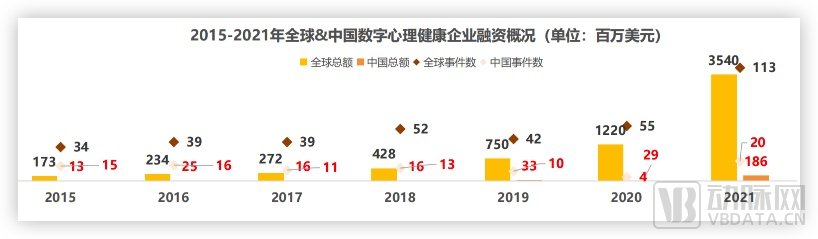
Overview of Digital Mental Health Financing from 2015 to 2021, Data Sourced from VCBeat
These companies’ business portfolios cover mental disorders (such as depression, anxiety, schizophrenia, and panic disorder), behavioral and cognitive impairments (including smoking cessation and alcohol use disorder), as well as areas such as meditation, chronic pain, and psychogenic insomnia. They participate in industry development by offering digital therapeutics, telemedicine/online consultations, smart hardware, and online communities.
In 2021, three U.S. digital mental health companies—LifeStance, Talkspace, and Pear Therapeutics—successfully completed their initial public offerings (IPOs), serving as a testament to the sector’s booming momentum. Influenced by these developments, the global digital mental health landscape has begun shifting toward game-based digital therapeutics and online platforms for mild mental health support.
For example, from 2015 to 2021, there were a total of 26 financing events globally related to game-based therapy, with 12 of them occurring in 2021 alone, amounting to nearly $300 million in total funding. This surge was driven by the FDA approval of the world’s first video game-based therapeutic product during the pandemic, which demonstrated the viability of this business model and prompted emerging companies centered on technological innovation to accelerate their development.
Compared with the overseas remote mental health sector, which has already achieved a certain level of market maturity, domestic market education in China is developing more slowly due to factors such as public awareness and a later start. However, “lightweight,” consumer-oriented mental health platforms, often based on social media, are emerging.
The spread of the epidemic has exacerbated public mental health issues. Although the integration of mental health and digital technology has yielded many novel therapeutic approaches, alleviating to some extent the challenges of limited mental health resources, low prevalence of mental health literacy, and poor clinical treatment adherence, the healthcare sector is evolving toward comprehensive health management, with a shifting focus from treatment to prevention—a trend equally applicable to the mental health industry. The digitalization of the mental health field will increasingly intervene in the behaviors of both healthy and sub-healthy populations to reduce the incidence of psychological problems.
The current fervor is just the beginning; in the coming years, we will usher in a golden age of development for this sector.