

DeeCamp 2022 Concludes with AI Tackling Key Challenges in Life Sciences
In the history of AI-driven life sciences, AlphaFold2 solved the 50-year-old challenge of predicting protein spatial structures that had long plagued the biological community, marking a milestone in the field of AI plus life sciences.
Amid the rapid global advancement of AI-enabled life science technologies, more than 30 drug candidates developed with the assistance of AI have entered clinical trials. This progress has gained recognition in capital markets, with over 10 companies worldwide successfully going public.
What other possibilities lie ahead for AI plus life sciences? At the DeeCamp AI Training Camp, co-hosted by Sinovation Ventures and the Institute for Intelligent Industry of Tsinghua University, numerous university students from interdisciplinary fields spanning AI and life sciences offered their perspectives.
Over the past two intense months, more than 150 participants from top universities and research institutions worldwide—including Tsinghua University, Peking University, Nanyang Technological University, Fudan University, the Institute of Computing Technology of the Chinese Academy of Sciences, and The Chinese University of Hong Kong—spontaneously formed 30 teams. Majoring in computer science, life sciences, and related fields, these 30 teams from leading academic institutions focused on the theme of “Exploring New Frontiers in Life Sciences with AI.”
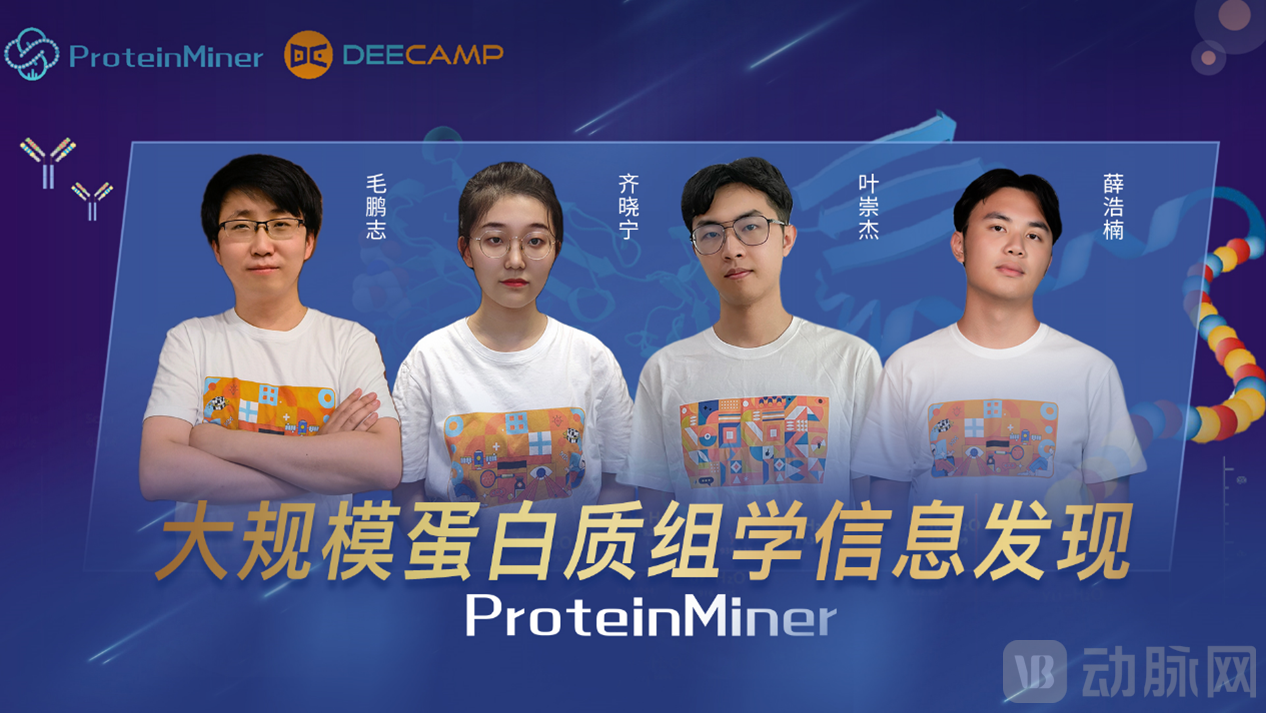
The six teams shortlisted for the final debate attempted to leverage artificial intelligence technologies to address challenges in life sciences, including PROTAC drug development, large-scale proteomics data discovery, drug molecule discovery, whole-genome expression prediction, prediction of protein phase separation capacity, and prediction of enzyme activity based on protein structure. Ultimately, Team ProteinMiner, which tackled the challenge of large-scale proteomics data discovery, was awarded the Grand Champion title at DeeCamp 2022.
At this competition, many participating teams focused on issues that are also hot topics in the industry. What new ideas can emerge from the collision between the fresh perspectives of students and those of multiple seasoned industry professionals?
DeeCamp AI Training Camp is a public welfare initiative launched by Sinovation Ventures, targeting college students worldwide and dedicated to cultivating applied AI talent. To date, it has held six sessions.
This year, DeeCamp is focusing its AI applications on the life sciences sector, a period that marks the transition of AI + life sciences from early-stage technological accumulation to the phase of value validation.
Historically, the pharmaceutical industry has remained one of the least efficient sectors and has proven resistant to disruption by information technology. Nevertheless, the transformative impact of AI on biotechnology remains unstoppable. AI has begun to permeate every stage of drug R&D, including virtual screening, molecular generation, target discovery, ADMET prediction, drug repurposing, and compound synthesis during the drug discovery phase.
Many experts believe that AI will usher in a new revolution in the healthcare industry. Participants of DeeCamp have brought fresh perspectives to this transformative movement.
Among them, ProteinMiner, the grand prize winner, tackles proteomic information discovery.
Protein sequencing is one of the most critical steps for humans to understand and regulate life activities. Although gene sequencing has become increasingly mature, protein sequencing still lacks high-throughput technologies. Meanwhile, traditional analytical methods rely on existing protein sequence databases and are unable to analyze novel proteins or antibodies, giving rise to the demand for de novo protein sequencing.
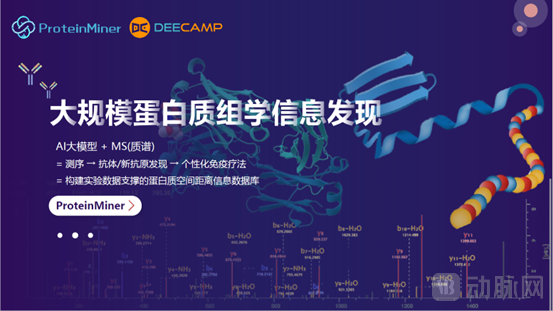
ProteinMiner is built upon AI- and big data-driven mass spectrometry-based protein sequencing technology, dedicated to enhancing the capability for large-scale discovery of unknown protein sequences and structural information. ProteinMiner introduces a pre-trained AI spectral language large model to improve the accuracy of de novo mass spectrometry sequencing, accelerate the discovery of immune-related neoantigens and antibodies, and thereby advance the progress of personalized immunotherapy. Furthermore, ProteinMiner proposes a deep learning model for spectrum classification, enabling rapid identification of cross-linking mass spectrometry data and constructing an omics-scale database of protein spatial distance information supported by experimental data.
For complex challenges that remain unresolved in the industry, DeeCamp participants leverage AI technologies to explore breakthroughs; from another perspective, they also envision using AI to reduce costs and enhance efficiency for existing solutions.
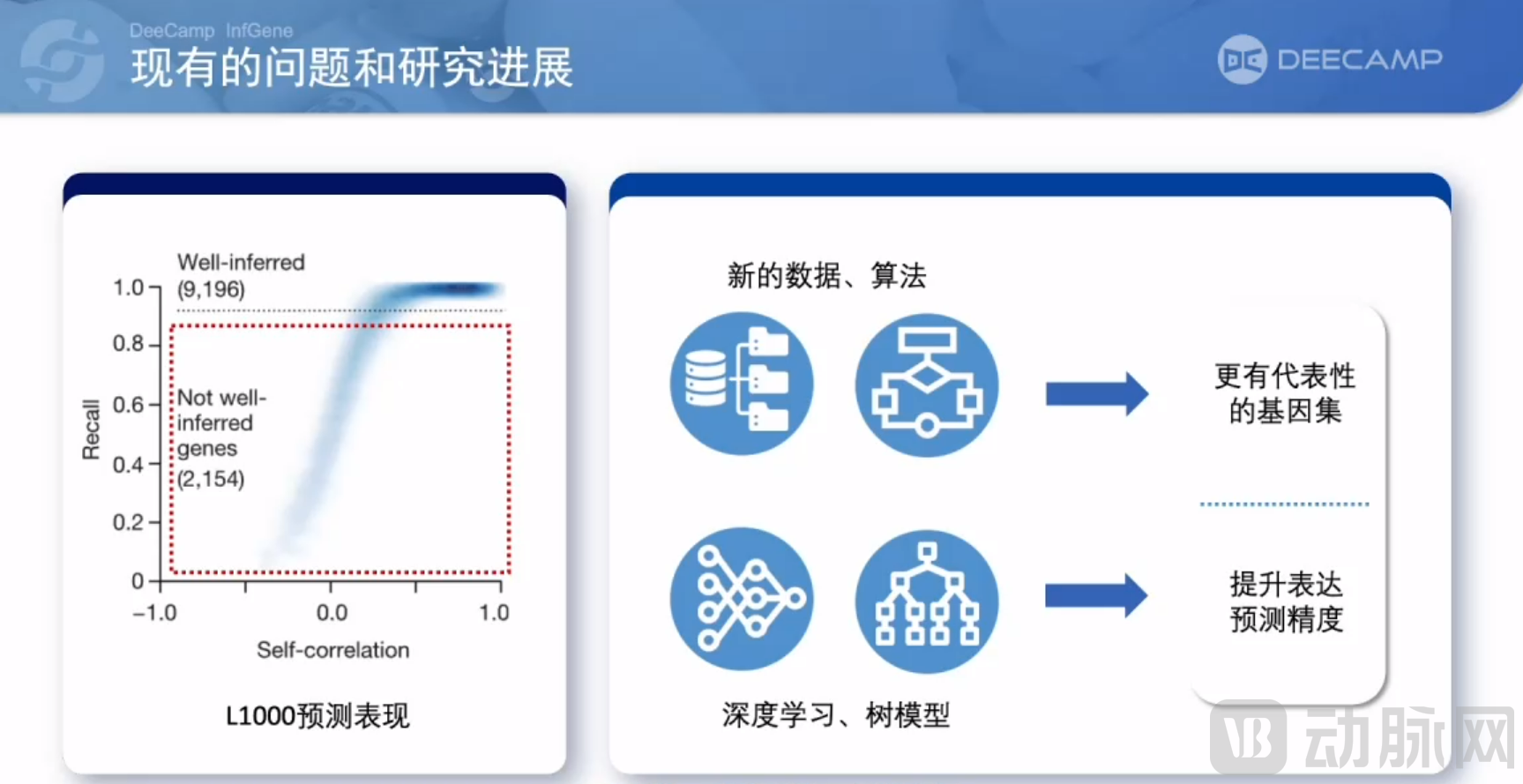
Taking the InfGene team, with Megga Technology as its industry mentor, as an example, InfGene is exploring whole-genome expression prediction technology based on representative gene sets. This interdisciplinary team, composed of members from universities both in China and abroad, leverages algorithmic computations to reduce the number of required genomic tests.
This technology aims to reduce the cost of ultra-high-throughput measurements. Whole-genome expression profiling requires measuring the transcriptional expression levels of more than 20,000 human genes, and ultra-high-throughput detection incurs high costs. In fact, there is a high degree of correlation among human gene expressions, making it possible to infer the expression levels of different genes from one another.
Building on this theoretical foundation, the U.S. National Institutes of Health (NIH) launched the LINCS program and introduced L1000, a low-cost transcriptomic profiling technology.
The L1000 technology leverages correlations in gene expression and, through large-scale statistical analysis, identifies 978 genes as genome-wide landmark genes. By measuring the expression levels of these landmark genes, the expression levels of the remaining more than 20,000 genes can be inferred.
The InfGene team discovered that the Fractal Autoencoder (FAE) can select a more streamlined set of representative genes as features compared to the L1000 Panel, achieving superior whole-genome expression prediction performance in XGBoost models. This approach holds promise for further reducing large-scale measurement costs, establishing patentable new panels, and expanding applications to the development of tissue-specific panels, thereby advancing precision medicine.
What role will the explorations by these trainees play in future industry exploration?
Dr. Wu Qiong, Director of the Biological Computing Platform at MegaRobo Technologies, stated, “This competition has yielded a wealth of creative ideas and inspiration. The InfGene team members possess interdisciplinary backgrounds in biology and computer science. Within just one month, they boldly explored various gene set selection methods, compared deep learning with traditional data processing algorithms, and successfully identified an optimal solution. Although the results require further validation in practical applications, they hold potential commercialization value and patentability in the context of large-scale drug screening. Furthermore, this approach can be extended to address other significant scientific challenges in the future, such as identifying core regulatory genes in diseases and predicting expression across multi-omics modalities, thereby providing methodological references for enterprises and research institutions.”
In the field of AI plus life sciences, a major bottleneck hindering the industry's rapid development is the significant difficulty in cultivating interdisciplinary talent.
DeeCamp was launched by Sinovation Ventures in 2017. From its origins as a small-scale experimental training camp, it has grown to train hundreds of AI+ talents from universities each year. The program aims to provide students with a comprehensive experience encompassing technical learning, engineering practice, product commercialization, and business thinking, thereby promoting deep integration among industry, academia, and research.
Over the past six years, DeeCamp has established a pilot program for cultivating application-oriented AI talent in China. Instruction from industry leaders, investors, and top-tier experts has provided fertile ground for students’ ideas to flourish, thereby injecting fresh blood into the industry. Many graduates have joined leading technology companies or research institutions, where they put their acquired skills into practical use.
Over the past six years, DeeCamp has garnered support from numerous top-tier scholars and experts. Distinguished mentors—including Kai-Fu Lee, Yaqin Zhang, Runsheng Chen, Andrew Ng, Hongjiang Zhang, Ming Zhou, Zhi-Hua Zhou, Yaoqi Zhou, Weiying Ma, and Xin Gao—have personally delivered lectures on current hotspots in global AI research, as well as the future opportunities and challenges of “AI+.” The program also covers practical considerations for commercializing AI technologies, including the deployment of AI products and investment and entrepreneurship in the era of AI empowerment.
Over the six years since its inception, DeeCamp has received applications from more than 20,000 undergraduate students, admitting and training over 1,500 participants. It is currently the largest, longest-running, and most distinctive AI public welfare training program. Among AI students both in China and abroad, DeeCamp has established a strong reputation.
Behind the six consecutive editions of DeeCamp lies Sinovation Ventures’ sustained commitment to nurturing talent in the AI field. As a leading technology-focused venture capital firm in China, Sinovation Ventures not only provides financial “ammunition” to companies but also empowers high-tech entrepreneurs through its “VC + AI” deep-tech enablement model, supporting their growth and expansion.
As the life sciences industry continues to upgrade, cross-disciplinary technologies such as AI, digitalization, and automation are continually reshaping its development landscape. There is a growing need for versatile investors with genuine expertise in both interdisciplinary technologies and cross-sector industries to patiently support entrepreneurs throughout their growth journey.
In the AI plus life sciences sector, Sinovation Ventures closely connects industry, academia, and capital. Targeting unresolved challenges in life sciences, it cultivates and incubates innovative teams from the ground up that can address technical hurdles and industry pain points. It provides entrepreneurs with critical resources within its ecosystem across multiple dimensions, ranging from technology productization to commercialization, and from corporate financing to the enhancement of high-level professional networks.
DeeCamp has also built a bridge for talent communication and cultivation between the industry and universities, with dozens of top enterprises and institutions participating by providing valuable project resources, case studies, and mentorship.
As a strategic partner of this year’s DeeCamp, MEGA Robotics is a leader in the field of intelligent automation for life sciences, committed to enhancing the efficiency of research, development, and production in the life sciences sector. Since its inception, MEGA Robotics has strategically positioned itself in the life sciences domain, leveraging artificial intelligence and robotic automation technologies to build a closed-loop capability integrating “automation + AI + biology.” The company continuously pushes the boundaries in life sciences, accelerating frontier breakthroughs and technological innovation in related fields, thereby contributing to the improvement of human health and well-being.
In this collaboration, MegaRobo provided abundant research topics and mentorship resources. Mr. Huang Yuqing, Founder and CEO of MegaRobo, stated, “We are delighted that MegaRobo could participate in DeeCamp 2022 as a strategic partner, joining hands with global elites in the fields of AI and life sciences to explore the possibilities offered by cutting-edge technologies in advancing human health. As is well known, life sciences have evolved into a data-driven discipline, and artificial intelligence is changing the ‘rules of the game’ in this field. MegaRobo has always regarded data as a core asset, designing experiments for algorithmic data collection and generating data through its large-scale automated experimental platforms. For DeeCamp 2022, leveraging its years of technical expertise and data advantages in intelligent automation for life sciences, MegaRobo invited senior scientists from relevant fields to engage in in-depth exchanges and intellectual brainstorming with the students. Looking ahead, we hope that students will take their experience at DeeCamp 2022 as a starting point to contribute greater strength to advancing China’s AI-plus-life-sciences sector!”
Enhancing the reproducibility and predictability of biological experiments is key to boosting R&D productivity in the industry. The convergence of artificial intelligence (AI) with the life sciences sector is ushering in a new transformation for biotechnology. The imagination and ingenuity demonstrated by participants in DeeCamp 2022 have highlighted the vitality of the AI-plus-life-sciences industry. Although there is still a long road ahead in using AI for drug design, it is believed that, with concerted efforts from all sectors, algorithms will become more refined, and AI will play an increasingly significant role in the field of life sciences.
Dr. Kai-Fu Lee, Chairman and CEO of Sinovation Ventures and Honorary Dean of HICOOL Business School, stated that the intersection of AI and science is a new paradigm for innovative growth that Sinovation Ventures predicts will explode in the next 5 to 10 years. He emphasized that AI plus life sciences is a golden track with profound implications for benefiting humanity. This underscores the deeper significance of DeeCamp’s first focus on the theme of “AI + Life Sciences,” aligning with its consistent advocacy over the past six years for “applying learning to practice.” The six teams shortlisted for the finals were composed of outstanding students specializing in AI and life sciences. Under the guidance of top-tier research and industry mentors, they explored various scenarios, including protein structure prediction and whole-genome expression prediction, tackling multiple real-world challenges. I am delighted to see the finalists stand out in this competition and look forward to them becoming innovation pioneers in China’s “AI + Life Sciences” sector in the near future. I encourage DeeCamp participants aspiring to entrepreneurship to view this project practice as an initial exploration of industrial value, while also leveraging the abundant resources offered by the Beijing HICOOL Global Entrepreneurship Competition and HICOOL Business School, which are dedicated to supporting high-tech entrepreneurs.