

VB Share Session: The Substantive Role of AI in Drug Discovery
Since 2020, with the continuous maturation of AI technologies, the frequency and scope of collaborations between artificial intelligence enterprises and biopharmaceutical companies have expanded and deepened. The AI-driven new drug industry has entered a period of rapid development. The earliest cohort of AI-driven new drug companies has made leapfrog progress to provide end-to-end solutions, initiating clinical validation of their AI-powered drug pipelines.
Methodologies underpinned by the rigorous disciplines of mathematics and physics have sparked a new convergence between artificial intelligence (AI) and traditional chemistry in drug development. As these two fields collaborate closely, a widely debated topic among industry insiders is which party plays the decisive role in key stages of drug development. Furthermore, in the wake of AlphaFold’s breakthrough in solving the 50-year-old challenge of predicting protein spatial structures, how are Chinese AI-driven novel drug companies developing their own algorithms and enhancing computational power to propel the growth of the innovative drug industry?
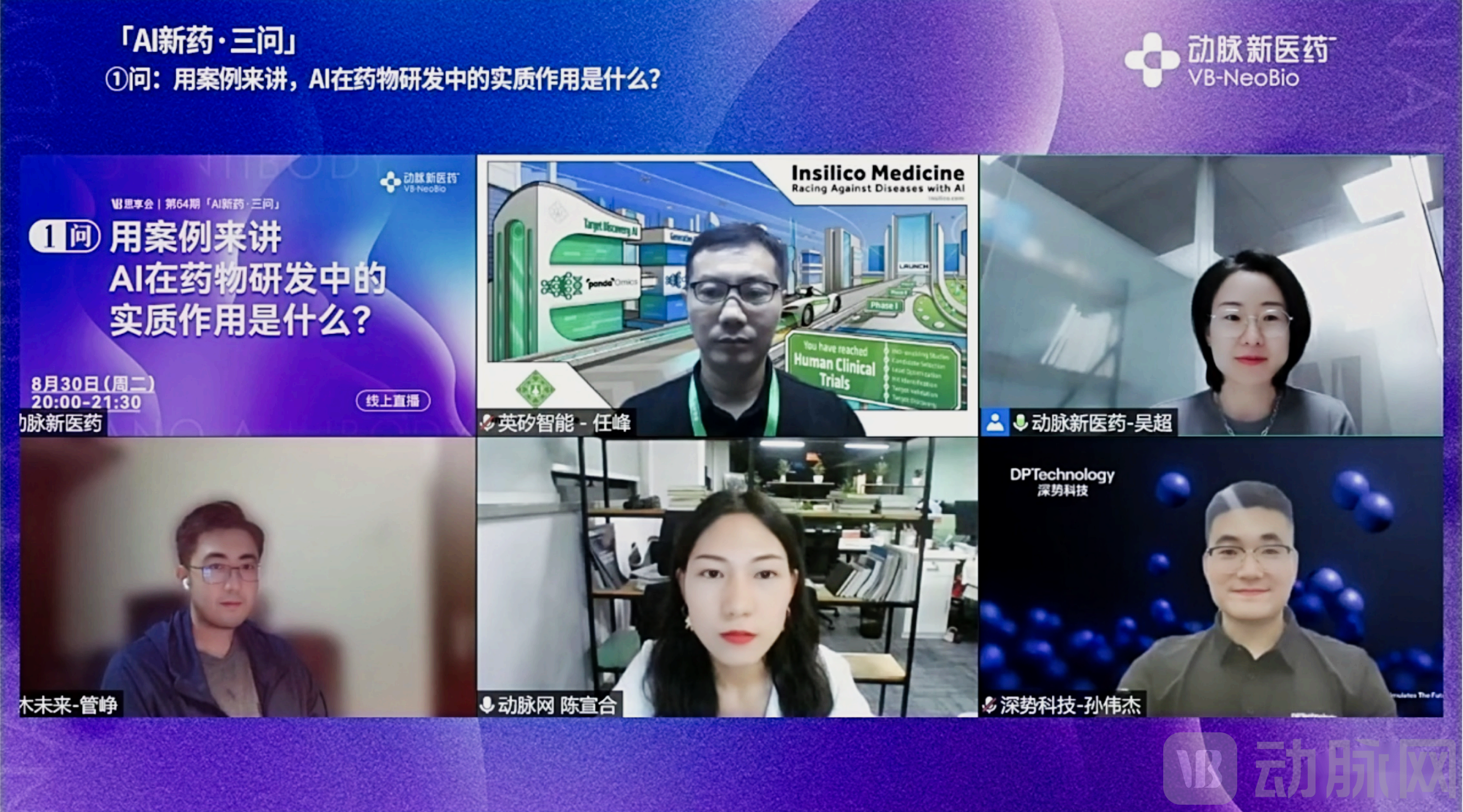
On August 30, Artery New Medicine, in collaboration with Mr. Ren Feng, CEO, Chief Scientific Officer, and Head of Drug R&D at Insilico Medicine; Mr. Guan Zheng, Vice President of Shuimu Future; and Mr. Sun Weijie, Founder & CEO of DeepModeling, delivered comprehensive and in-depth insights into the development of the AI-driven new drug industry through case-based presentations, aiming to accelerate the release of innovative potential.
At the outset of the Think Tank Session, Chen Xuanhe, an industry researcher at VCBeat, provided a brief overview of the report “2022 Industry Research on AI-Enabled New Drug Development,” published by VCBeat Institute. Based on in-depth interviews with nearly 20 senior experts in the AI-driven new drug development sector, the report offers a detailed and accurate portrayal of the industry’s evolution. Furthermore, from a macro perspective of the AI-powered pharmaceutical industry, Researcher Chen conducted a multidimensional discussion covering the developmental stages, current status, and challenges faced by AI-enabled drug discovery.
From the Exploratory Phase to the Developmental Phase, AI Has Gradually Become a Standardized Tool for Pharmaceutical Companies
Since 2020, the industry has entered a period of rapid development. As technologies continue to mature, the frequency, scope, and depth of collaboration between AI-driven drug discovery companies and pharmaceutical firms have continuously expanded and deepened. The first wave of AI-driven drug discovery companies has further strengthened their end-to-end solution capabilities and has successively initiated clinical validation of their AI-discovered drug pipelines. In addition, multiple technology and internet giants, including Google, Tencent, Baidu, Huawei, Alibaba, and ByteDance, have entered the AI drug discovery space. Notably, DeepMind, a subsidiary of Google, developed two generations of the AlphaFold algorithm, which solved the 50-year-old challenge in biology of predicting protein spatial structures. This breakthrough has not only attracted greater attention to the field of AI-driven drug discovery but also brought additional resources and talent to the sector.
From CADD to AIDD: Improving Model Accuracy
With the rapid development and widespread adoption of AI technology, “AI+” has permeated every segment of the healthcare sector. Initially, AI was extensively applied in medical imaging, and later gradually extended into drug discovery and development, bringing about a series of transformations to traditional drug development models: from random screening to rational design, from empiricism to data-driven approaches, and from fully manual processes to assistance using traditional Computer-Aided Drug Design (CADD), ultimately culminating in the transition from traditional CADD methods to an integration of AI with conventional CADD. Today, AI technology is increasingly involved in various stages of drug R&D, with both academia and industry exploring the use of AI to assist drug discovery and development, thereby seeking new impetus for the identification and development of novel therapeutics.
Evolution of Application Scenarios: From Early-Stage Drug Discovery to Covering the Entire New Drug R&D Process
The service chain of AI-driven new drug companies is extending vertically: from providing technical services for specific stages to offering end-to-end solutions, and gradually covering the entire drug discovery process. According to incomplete statistics by VCBeat Research Institute, among the 52 AI-driven new drug companies currently developing chemical drugs, 39 (75%) have the capability to provide end-to-end services (from target identification to lead compound delivery). Currently, the layout of domestic AI-driven new drug companies is mainly concentrated in the drug discovery stage, with virtual screening, molecular generation, target discovery, and ADMET prediction being the four most commonly addressed scenarios.
Dr. Feng Ren, Co-CEO, Chief Scientific Officer, and Head of Drug Discovery at Insilico Medicine, stated:
The traditional approach to developing a new drug, from early target discovery through clinical trials to market launch, takes an average of 10 to 15 years. This process involves extensive trial-and-error-based screening, optimization, and evaluation, making it time-consuming and costly. It relies heavily on the expertise and experience of R&D personnel and is characterized by significant uncertainty. Furthermore, traditional drug development faces persistent challenges, including difficulties in identifying and validating targets, complexities in generating small-molecule compounds, and the high costs associated with conducting clinical trials.
Building on this foundation, Insilico Medicine has leveraged artificial intelligence technologies—including generative adversarial networks, reinforcement learning, and pre-trained models—to develop three software platforms: PandaOmics, Chemistry42, and InClinico. These platforms are designed to efficiently identify drug targets, perform de novo generation and design of compounds, and predict clinical trial outcomes, respectively. By integrating biology and chemistry, these tools enable the development of customized drugs or therapies for specific diseases.
Taking idiopathic pulmonary fibrosis (IPF), a rare disease with an extremely high mortality rate, as an example, there are over 700,000 IPF patients worldwide, whose forced vital capacity (FVC) is declining at an annual rate of 7%. Currently, only two drugs—pirfenidone and nintedanib—are available on the global market to provide therapeutic benefits for these patients. Unfortunately, these two medications have certain limitations; for instance, 10% to 40% of patients are forced to discontinue treatment or experience compromised efficacy due to intolerance to adverse drug reactions.
Insilico Medicine’s PandaOmics software integrates 23 artificial intelligence algorithms to compare and analyze genomic differences between patients with idiopathic pulmonary fibrosis (IPF) and healthy individuals, while mining clues from literature and patent data. This process initially identified more than 20 novel targets. Following further selection and evaluation based on specific attributes such as innovativeness, druggability, and safety, the platform ultimately pinpointed one entirely new target. Currently, no drug targeting this molecule has been developed or entered clinical trials globally, making it a true first-in-class candidate.
Following target identification, we leveraged the Chemistry42 compound design and generation platform to perform de novo small-molecule generation against this novel target. We synthesized and evaluated 78 compounds, several of which demonstrated superior in vitro and in vivo activity as well as drug-like properties compared with existing clinical agents. For instance, validation in murine models revealed that the candidate drug significantly improved lung function; notably, it achieved efficacy comparable to that of current clinical therapies at one-tenth of their dose.
This project, spanning from target discovery to compound generation and preclinical testing, had a development timeline of 18 months with R&D expenditures of approximately $2.6 million. In contrast, traditional small-molecule drug development—from target validation to compound design and the identification of preclinical candidate compounds—typically requires about four and a half years and incurs R&D costs exceeding tens of millions of dollars. Leveraging AI significantly shortens the new drug development cycle, enhances R&D efficiency, and reduces costs.
Dr. Guan Zheng, Shuimu Future:
I will share case studies on accelerating new drug development by leveraging the convergence of two related technologies: structural biology and AI.The fundamental question—what is the essence of AI in the field of AI-driven new drug development?—is undoubtedly to accelerate the process. Those of us engaged in new drug R&D are acutely aware that we are currently in a capital market winter, with signs of weakness emerging in certain sectors of the healthcare industry. The root cause lies in insufficient innovation capacity, or more precisely, growing impatience among investors regarding the output efficiency of pharmaceutical innovation, prompting them to seek other new growth engines. In this context, leveraging AI-computation-driven approaches for new drug R&D represents the most rational direction for innovation at present.
Cryo-electron microscopy is an ultra-low-temperature sample preparation and transfer technique for electron microscopy (Cryo-SEM) that enables direct observation of liquids, semi-liquids, and electron-beam-sensitive samples through high-resolution images generated by electron beams. By analyzing cryo-EM images, researchers can elucidate the structures of biological macromolecules and their changes during various physiological processes, thereby gaining insights into the fundamental principles of life phenomena. Based on this understanding, researchers can specifically modulate molecules directly associated with particular diseases or physiological processes, or induce functional changes in these molecules using small-molecule or protein-based therapeutics, ultimately achieving therapeutic or preventive effects against diseases. After years of development, cryo-EM has become one of the most powerful techniques in structural biology. It offers unique advantages in resolving high-resolution structures of membrane proteins and biological macromolecular complexes in near-native states, opening up new avenues for structure-based drug discovery.
Sun Weijie, Founder and CEO of DP Technology, stated:
AI for Science and AI for Industry differ significantly. Historically, the predominant paradigm has been AI for Industry. Its development logic is rooted in the rapid growth of many sectors, particularly the internet industry, which has accumulated massive volumes of data. These large-scale datasets are used to train AI models that extract high-value patterns, which are then applied to solve practical problems. Typical applications include image processing, natural language processing, and even the Human Genome Project in the life sciences sector—all of which rely on the AI for Industry model driven by extensive data training.
One of the greatest challenges facing physical industries such as pharmaceuticals and materials design is that, relative to the complexity of the problems to be solved, available data are extremely limited and highly non-standardized. In such cases, we can adopt AI for Science approaches. For instance, although these industries have not accumulated large volumes of data, scientists can first abstract the underlying operational mechanisms and distill the fundamental scientific principles. AI can then learn these scientific principles, knowledge, and even physical models to develop a generalizable model, which is subsequently applied to solve practical problems. Typical application scenarios include industrial simulation, molecular simulation, and the design and simulation of new materials.
Leveraging these new AI for Science paradigms, DP Technology has developed a suite of novel tools for drug discovery and materials research. With the introduction of systematic computational simulation tools into a field, the R&D workflow evolves to prioritize computational design and simulation, followed by experimental validation. Consequently, in the realm of drug design, this facilitates an intelligent transformation: from random screening to rational design, from experience-driven to data- and model-driven approaches, and from labor-intensive to computation-intensive processes. This shift empowers pharmaceutical R&D enterprises to achieve leapfrog development in the new era.
AI-Driven New Drug Technology: Not a Replacement for Traditional R&D, but a Catalyst for InnovationAI-driven new drug technology does not replace traditional pharmaceutical R&D; rather, it liberates human productivity from conventional, inefficient tasks, enabling researchers to focus on work requiring greater intelligence and creativity, and to develop novel methodologies for life sciences research. In the future, with advancements in algorithms, breakthroughs in computing power, and the growth of big data, AI technology will be deeply integrated into every stage of new drug development, playing an increasingly critical role in compound synthesis, efficacy prediction, and automated R&D. Furthermore, to fully leverage the empowering potential of AI, it is essential to achieve deep integration between foundational pharmaceutical R&D sciences and core AI technologies. Only by closely aligning core technologies with industry needs and gaining a profound understanding of the sector can the intelligent transformation of drug development be truly realized.