AOC Breakthroughs, China's Innovation Goes Global, and Accelerated International Clinical Progress in the Oligonucleotide Therapeutics Sector

SANEGENEBIO
Small Nucleic Acid Drug Developer

February to March 2026: The small nucleic acid drug field is in full bloom.Among whichAOC Field IndustryFastImplementation,New platforms continue to emerge,siRNA is rapidly emerging with its long-lasting advantages, while ASO continues to advance in the fields of rare diseases and the central nervous system. The industry is gradually shifting from validation in rare diseases to larger chronic disease markets such as cardiovascular and metabolic disorders. As indications continue to expand, the neuro/muscular system has become the most active ground for innovative trials, and the focus of competition has shifted from "Is it effective?"Turn to"Whose delivery is superior, dosing less frequent, and safety margin better". At the same time, government regulation is presentedSupport New ModelAndStrictly Control SafetyThe Dual-Track Model。
Against this backdrop, the industry saw frequent dynamics in February to March 2026, presentingChina's Innovation Overseas Expansion Boom、International Clinical Acceleration、Indications Continue to ExpandThree Major Core Trends.

SANEGENEBIOAndGenentech (Roche)Sign Global Cooperation and Licensing Agreement
According to the agreement, Genentech will obtain the exclusive global development and commercialization rights for an RNAi drug from SANEGENEBIO. Through this collaboration, SANEGENEBIO will not only receive an upfront payment of $200 million but also has the potential to earn up to $1.5 billion in development and sales milestone payments.
HLB Panagene Officially Launches AOC Drug Development Project, with the First Indication Focused on Duchenne Muscular Dystrophy (DMD)
HLB Panagene, relying on its self-developed Peptide Nucleic Acid (PNA) artificial nucleic acid platform, is actively advancing the research and development of AOC. By integrating PNA core technology with antibody conjugation and delivery platforms, it achieves a differentiated competitive edge for AOC products. Following "spatial proteomics," it further expands its business layout with novel AO therapies.
Madrigal and Suzhou Ribo Reach Global Licensing Agreement for 6 MASH siRNA Projects
Madrigal Obtains Global Development, Manufacturing, and Commercialization Rights for 6 Preclinical siRNA Programs, Upfront Payment$60 million`, with the highest total transaction volume`$4.4 billion; The company saidIND enablingThe work will be launched in 2026. This event marks a significant升温 in the layout of siRNA in the direction of metabolic liver diseases.
First Patient Dosed with STK-002 in Stoke Study
Stoke Announces First Dosing Completed in the Phase 1/2 OSPREY Study of ASO Program STK-002 for Autosomal Dominant Optic Atrophy (ADOA), Following the "Protein Upregulation" ASO Approach, Rather Than the Traditional Silencing Type of Small Nucleic Acids.
The New England Journal of Medicine Publishes Phase I/II Clinical Trial Results of del-desiran (AOC 1001) for the Treatment of DM1
In the Phase 1/2 MARINA clinical trial (NCT05027269), the investigational antibody-oligonucleotide conjugate (AOC) delpacibart etedesiran (AOC 1001; deldesiran) achieved skeletal muscle delivery of small interfering RNA (siRNA) and reduced mutant DMPK messenger RNA (mRNA) levels in adult patients with Type 1 myotonic dystrophy (DM1). The findings were published in The New England Journal of Medicine.
Avidity’s Del-Desiran (DM1) Phase 1/2 Final Results Published in The New England Journal of Medicine
Avidity's final results of the MARINA study will be published in the NEJM on February 19, followed by PubMed indexing the paper "An Antibody-Oligonucleotide Conjugate for Myotonic Dystrophy Type 1." This further increases industry attention on AOC (Antibody-Oligonucleotide Conjugate) as a muscle delivery route.
Frontier Biotechnologies Partners with GSK on Two Kidney Disease siRNA Assets
GSK Obtains Global Rights to 2 siRNA Assets, One of Which Has Entered the IND Stage, with an Upfront Payment of $40 Million and a Total Amount Up to $963 Million. Reuters Also Explicitly Stated That GSK Had Acquired the Global Development Rights for Two siRNA Therapies Targeting Kidney Diseases.
Vico Announces VO659 Expansion Cohort Initiation with Semi-Annual Dosing,FDA Has Approved U.S. Research
Vico Announces Initiation of Twice-Yearly Dosing Regimen in European Phase 1/2a Expansion Cohort for ASO Program VO659, Targeting Huntington’s Disease, SCA1, and SCA3; FDA Approves IND, with U.S. Study Expected to Launch Later in 2026.
GSK's bepirovirsen submits for marketing approval in Japan and is accepted
Accepted by Japan's Ministry of Health, Labour and WelfarebepirovirsenNDA for chronic hepatitis B, GSK claims this is the drugWorld's First Regulatory Submission, and included in JapanSENKUAccelerated review system, this drug is an ASO introduced from Ionis.
Novartis Completes Acquisition of Avidity
Novartis Announces Completion of Acquisition of Avidity, Which Becomes Its Wholly Owned Subsidiary. Novartis Gains Access to the Muscle-Tissue-Oriented AOC Platform and 3 Late-Stage Projects, Demonstrating Big Pharma’s Continued Strong Interest in “Extra-Hepatic Delivery” Platforms.
PepGen's DM1 Phase 2 Study Partially Clinically Held by FDA
FDA on PepGen'sFREEDOM2-DM1Phase 2 Trial Initiatedpartial clinical hold(Partial Clinical Hold), The reason is related to preclinical pharmacology/toxicology issues; however, existing research in the UK, Canada, and other places can continue. This event serves as a reminder to the market: although extrahepatic delivery of small nucleic acids is gaining popularity, the safety threshold has not been lowered.
China's Obesity siRNA Project Receives Clinical Approval
CMS-D008, a project under China Biologic Products, has been approved by the NMPA to conduct clinical trials for overweight/obesity. The company describes it as a small nucleic acid drug targeting INHBE, indicating that small nucleic acids are beginning to actively enter the obesity treatment field.
Alnylam Establishes Cardiovascular Collaboration with Tenaya
The two parties announced a research collaboration focused on the identification and validation of new targets for cardiovascular diseases, combining Tenaya's target biology capabilities with Alnylam's RNAi delivery and development expertise, reflecting that RNAi is expanding from traditional liver targeting to a broader cardiovascular pipeline layout.
SANEGENEBIO and AstraZeneca Collaboration Project Undergoes Adjustment
Silence Discloses That AstraZeneca Will Not Proceed with Phase 1 Follow-up Development of SLN312; Global Rights Return to Silence. For the Industry, This Represents One of the Few Headwinds Amid a "Cooling of Collaboration."
Dyne Launches DM1 Phase 3 HARMONIA
DyneOfficially launch the HARMONIA Phase III clinical trial of zeleciment basivarsen (z-basivarsen, research and development code DYNE-101) for Type 1 myotonic dystrophy (DM1), planning to enroll approximately 150 participants. DM1 thus becomes one of the most crowded neuromuscular tracks for small nucleic acid/oligonucleotide conjugates competition in the first quarter of 2026.
HARMONIA SANEGENEBIO Announces New Data for Salanersen and Initiates Global Phase 3
Biogen Updates at MDA Conferencesalanersen(SMA ASO) Phase 1b Data, and Global Phase 3 STELLAR-1、STELLAR-2 AndSOLARLaunching; This project focuses onOnce a yearDrug administration.
Porton Advanced Solutions Attends BIOCHINA 2026
Porton highlighted its one-stop R&D and production solutions in fields such as ADC, AOC, and small nucleic acids at the exhibition. It also shared insights on "Challenges in the Development and Industrialization of Small Nucleic Acid Drugs" at the Small Nucleic Acid Innovation and Development Forum. Practical solutions for AOC conjugation processes, quality control, and large-scale production were provided to advance AOC from laboratory to industrialization.
Argo's HAE siRNA Program Receives FDA Fast Track Designation
Argo Biopharma AnnouncesBW-20805FDA Approval ObtainedFast Track, Global Phase 2 is ongoing, expected inThe Second Half of 2026Completed, with plans to enter Phase 3 next.
Ionis's Zilganersen Receives FDA Priority Review
FDA AcceptancezilganersenNDA for Alexander Disease and GrantPriority Review, PDUFA date isSeptember 22, 2026If approved, it is expected to become the first treatment to alter the course of the disease.
Sarepta Announces First Batch of siRNA Clinical Results
Sarepta Discloses ItsSRP-1001(FSHD1)andSRP-1003(DM1)The first batch of clinical results, highlighting exposure in muscles, dose-related distribution, early biomarker changes, and tolerability, indicate that its self-developed extrahepatic siRNA platform has begun the human proof-of-concept stage.
GSK's bepirovirsen accepted by EMA
Following Japan, EMA Acceptancebepirovirsen's listing application. GSK stated that the submission is based on two Phase 3B-Well 1/2Positive results, achieving a statistically significant and clinically meaningful "functional cure" rate.
Arrowhead Presents Long-Term Data of Plozasiran at ACC
Arrowhead Reports in Patients with Severe Hypertriglyceridemia,plozasiranAchieve83% Median Reduction in Triglycerides, and96%Patients with TG below 500 mg/dL demonstrate the ongoing commercial potential of the cardiometabolic RNAi program.
1)AOC (Antibody-Oligonucleotide Conjugates) Becomes the Core Track for Small Nucleic Acid Drugs to Break Through the Extrahepatic Delivery Bottleneck
February–In March, the AOC field has entered the stage of clinical value establishment and industrial acceleration. Its breakthrough in overcoming the bottleneck of small nucleic acid delivery outside the liver has been authoritatively validated and recognized by leading pharmaceutical companies. New platforms are constantly emerging, and pipelines along with CDMO capabilities in and outside China are being upgraded simultaneously. The field is rapidly moving from clinical to commercialization, becoming an important growth direction for small nucleic acid drugs in the next phase.
2) Regulatory milestones have accelerated significantly, especially as mature ASO assets begin to enter a genuine market launch window.
February–March,The most important regulatory developments have focused onbepirovirsenandzilganersen: The former inJapan, EuropeContinuously accepted, the latter was approved in the United StatesPriority ReviewThis indicates that small nucleic acids are moving from the proof-of-concept stage to a more stable period of regulatory approval on the path of "a few validated platforms + clear clinical endpoints."
3) The nervous/muscular system remains the most densely innovative testing ground, but the focus of competition has shifted from "whether it works" to "who has better delivery, less frequent dosing, and a better safety margin."
Avidity, Dyne, Biogen, Sarepta, Stoke, Vico, PepGen all provided clinical, registration, or regulatory updates around February to March, coveringDM1、DMD、SMA、FSHD、ADOA、HD/SCA...and many other types of diseases. Meanwhile, AOC, peptide delivery, and CNS/muscle-targeted platforms are advancing in parallel, proving...Extrahepatic DeliveryIt remains the most core technology competition point in the entire industry.
4) China's RNAi asset out-licensing was very active in the first quarter, shifting from single projects to "platform-based, multi-project package licensing."
February–In March, there were at leastSanegeneBio–Genentech、Frontier–GSK、Suzhou Ribo–MadrigalThree high-profile deals, ranging from hundreds of millions to billions of dollars, cover indications such as kidney disease and MASH. For the global small nucleic acid industry, this means multinational pharmaceutical companies are increasingly treating early-stage RNAi research in China as a source of external innovation.
5) Indications continue to expand, and small nucleic acids are no longer just about "rare disease stories."
In the new developments of March, we can already seeObesity (CMS-D008)、MASH(Madrigal/Ribo)、Kidney Disease (Frontier/GSK)、Cardiovascular (Alnylam/Tenaya, Arrowhead)... and other directions are advancing simultaneously. The focus of funding and collaboration in the sector is gradually shifting from "only betting on orphan diseases" to "also considering the commercial potential of major disease categories."
6) The regulatory attitude shows a "dual track": supporting new models on one hand, while maintaining strict requirements on safety on the other.
FDA/HHS Releases Guidance on Ultra-Rare Diseases in FebruaryPersonalized TreatmentThe draft guidelines explicitly mention ASO and RNA-based therapies; however, almost simultaneously, PepGen’s project faced a partial hold due to preclinical issues. This indicates that regulatory authorities are not "relaxing" but rather...More willing to give access, but the premise is that the non-clinical and CMC foundation must be solid.。

With the continuous expansion of targets, increasing complexity of modifications, and rising delivery requirements, traditional R&D models face common challenges in efficiency, stability, and cost control:
How to Quickly Validate Candidate Molecules in High-Throughput Screening?
How to Achieve Stability and Scale-Up of the Synthetic Process Under Complex Modifications?
How to Maintain Delivery Efficiency in Multi-Organ Targeted Design?
SANEGENEBIO builds an industry-leading self-developed full-industry-chain ecosystem based on five major platforms as its technological foundation: "raw materials, equipment, design, synthesis processes, AI, and digitalization." Relying on self-developed key reagents, consumables, and synthesis equipment, and deeply integrating "AI + molecular intelligence manufacturing" technology, the company has created an "AI + high-throughput small nucleic acid screening intelligent manufacturing platform," providing efficient, stable, and scalable foundational support for the aforementioned challenges in small nucleic acid drug development.
✅ AI-Driven Sequence Design: Integrating multi-dimensional predictions such as activity, stability, and off-target effects to enhance the success rate of candidate molecule development;
✅ Full-chain autonomous supply: Complete control over key reagents and consumables, synthesizers, and purification processes, with dual verification through MS and HPLC to ensure supply chain security and process consistency;
✅ Complex Modifications and Mature Processes: Covering over 200 chemical modifications including 2'-F, 2'-OMe, PS, LNA, EVP, and supporting personalized modification design;
✅ Multiple Delivery System Support: Offering various delivery solutions such as GalNAc and 2-O-C16 modifications, adaptable to different target tissues and development stages;
✅ High-throughput Synthesis and Validation: Delivery in as fast as 3 natural days, with scale-up synthesis services ranging from μg-level research samples to kg-level commercial API, covering the full-cycle needs from basic research to IND submission.
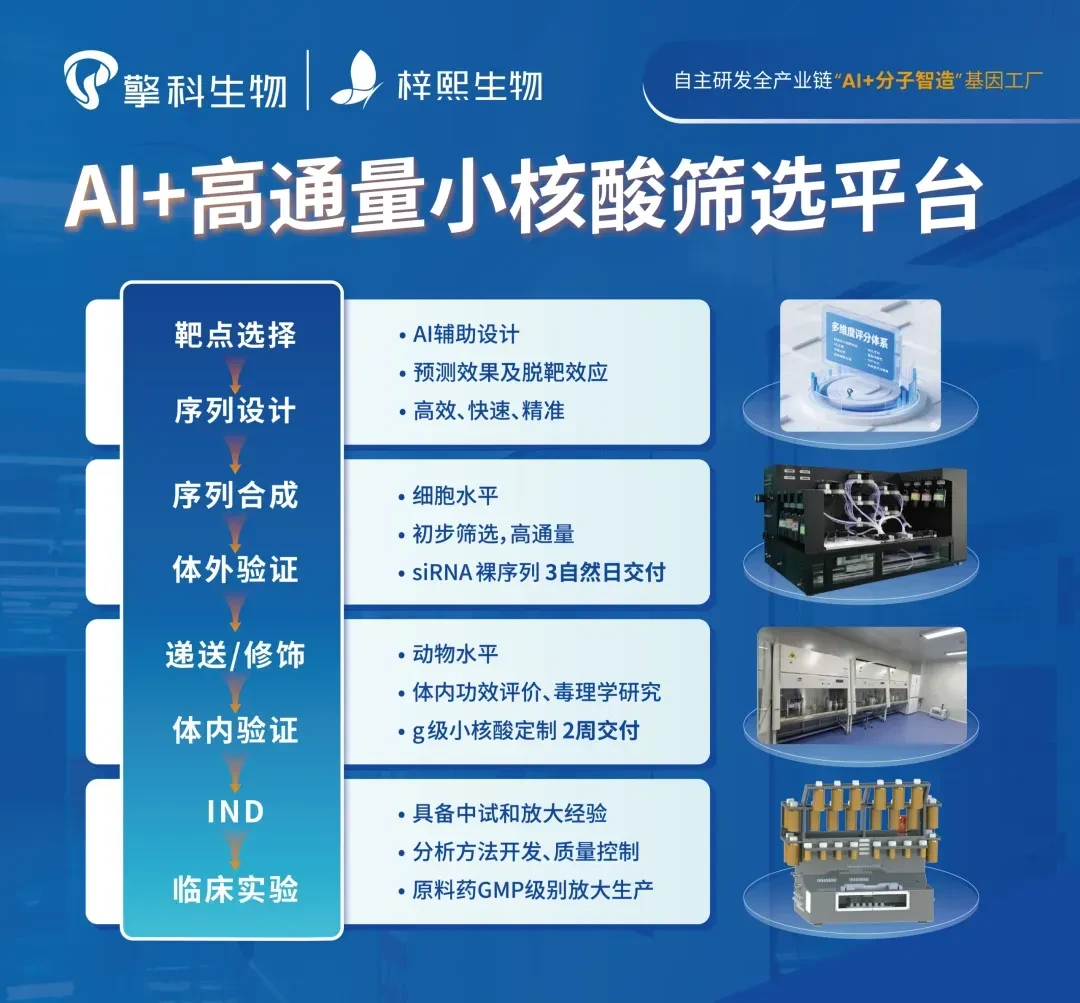
Overview of Small Nucleic Acid-related Synthesis Services
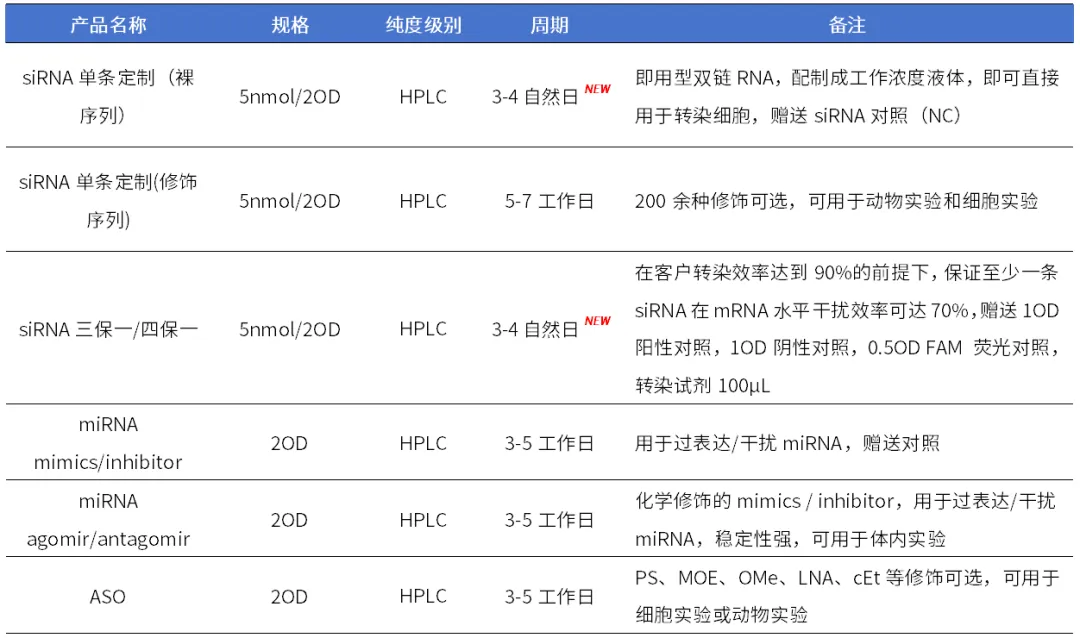
Qingke BioExample of GalNAc-siRNA Synthesis
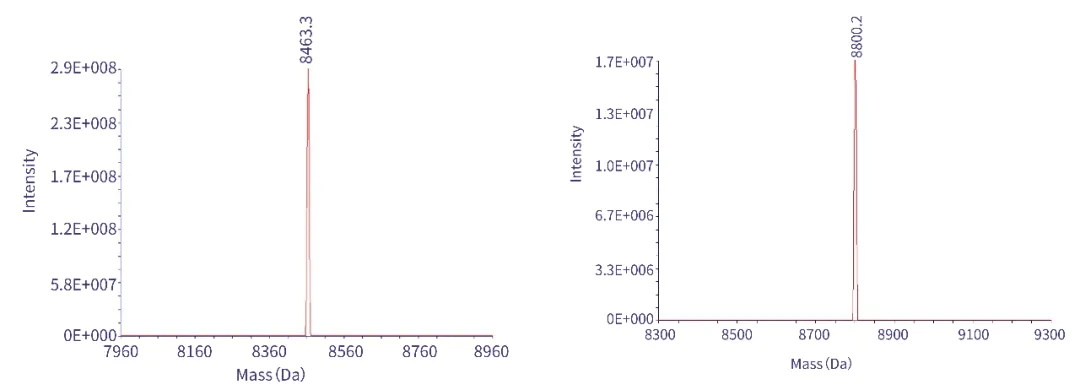
MS Detection
Tsingke Biotech siRNA Synthesis Application Cases
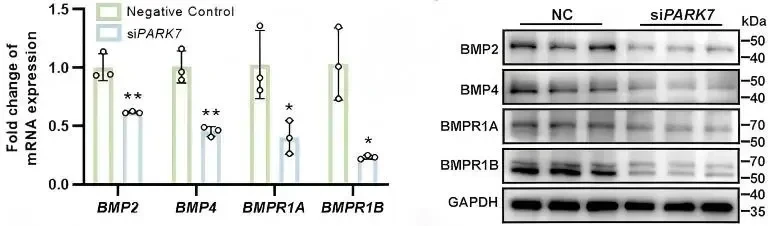
qPCR and WB Results
We believe that the next few years will be a critical stage for small nucleic acid drugs to move from "innovation" to "industrialization." Tsingke is committed to accompanying more pharmaceutical companies and researchers with its autonomous, intelligent, and scalable "AI-driven gene factory" model, accelerating the clinical translation and industrial implementation of RNAi therapies.
Welcome to contact us via the backstage message to obtain a one-stop customized solution and technical support for small nucleic acid drugs!