

K2 Oncolog Advances Commercialization of Organoid Technology Amid Industry Tailwinds
As an emerging in vitro evaluation platform, organoids offer advantages in throughput and cost. They have been continuously validated in research and clinical projects in recent years. With various favorable policies, stakeholders are painting a broad and promising future for the application of organoid technology.
However, for organoid companies themselves, the biggest challenge remains how to achieve commercialization.Even in regions such as Europe and North America, where organoid research began earlier, the commercialization pathway has not been fully validated. Domestic companies lack comparable benchmarks, and many investors have candidly admitted that they remain in a “wait-and-see” stage regarding the organoid sector.
Setting aside labels like “cutting-edge” and “state-of-the-art,” how can the practical value of organoids be realized? With this question in mind, VCBeat New Medicine interviewed Sun Zhijian, General Manager of K2 Oncology.
Sun Zhijian established K2 Oncology in 2016, focusing on the research and development and commercialization of functional testing technologies for tumor organoids to shorten the drug development cycle for new oncology therapies. Its technology service platform has gained recognition and adoption from numerous leading pharmaceutical companies and hospitals.
Prior to launching his startup, Sun Zhijian worked in the pharmaceutical industry for many years. He was involved in liver disease drug R&D at Novartis’ Shanghai R&D Center and later witnessed the entire journey of BeiGene from its inception to its public listing, accumulating extensive industry experience.
Not long ago, K2 Oncology completed a new round of financing worth tens of millions of yuan.It also became the first organoid company in China to secure Series B financing.
Organoids Carrying Hope: High Standards Are Key to Practical Implementation
Since the true breakthrough in organoid technology in 2009, organoid models have been held in high esteem, making it crucial to develop methods for cultivating high-standard organoids and conducting their analysis. Meanwhile, organoid technology is continually being compared with traditional in vitro cell lines and animal models.
K2 Oncology is one of the earliest companies in China to enter the field of organoids, having developed nearly 30 types of organoid models. Although there are currently no mature standards for organoids, Sun Zhijian believes that the level of model quality control will directly impact the effectiveness of their practical applications.
VCBeat New Medicine:Can animal models be completely replaced? And how should we view the technological pathway of organ-on-a-chip?
Sun Zhijian:De-animalization is undoubtedly the trend, driven on one hand by ethical concerns and on the other by the significant efficiency gains offered by organoid models. However, it is unlikely that animal models will be completely replaced in the short term, as they provide holistic systems that continue to offer substantial value. In the long run, advancements in technologies such as organ-on-a-chip and automation will help accelerate preclinical proof-of-concept studies. Consequently, the use of animal models may gradually decline, potentially being phased out entirely in certain scenarios.
The advantage of organ-on-a-chip technology lies in its ability to integrate multiple tissue types and dynamically adjust drug concentrations over time, thereby more closely mimicking physiological conditions in the human body. From the perspective of new drug development, a prominent application scenario for organ-on-a-chip is toxicology testing. By incorporating various normal organ tissues into the chip and monitoring changes in toxicity, rapid screening can be performed—a practice already adopted abroad.
Some organoid companies also collaborate extensively with pharmaceutical manufacturers, such as for evaluating the efficacy of anti-tumor drugs. However, this can be performed either on a chip or in organoid models; the chip is merely one format.
VCBeat New Medicine:There is currently extensive discussion regarding various organoid culture methods; what criteria should be used to evaluate organoid models?
Sun Zhijian:Standards should be aligned with their intended purpose.
If the goal is clinical diagnosis, it is essential that data obtained from organoids are highly consistent with those from actual human bodies; therefore, consistency is crucial. Another key factor is the success rate of modeling. If the success rate is only one in ten or lower, widespread adoption and application will be difficult. Additionally, time efficiency matters: some cell lines grow slowly, necessitating targeted technologies to meet required cell yields, which in turn affects final delivery. Since clinical needs are urgent, excessive delays would be highly detrimental.
However, the evaluation differs from the perspective of new drug development. The time required for model establishment is secondary.Pharmaceutical companies place greater emphasis on high stability, clear genetic background, sufficient clinical data, and a high rate of clinical translation of the data.. Success rate is not critical here; even if only one out of 100 cases succeeds, it suffices as long as that single case proves effective.
VBNewPharma:Is it more challenging to achieve high stability?
Sun Zhijian:Yes.Currently, many organoids are developed with a “growth-at-all-costs” mindset, but for industrial-scale services, consistent and stable growth is critically important.If the model's target mutation is lost, the results of the efficacy evaluation become unreliable.
Stability encompasses two aspects: first, consistent passaging capability, and second, major genetic stability. This poses technical challenges, as the presence of high concentrations of various factors during culture may induce excessive proliferation of normal epithelial cells, granting them a growth advantage and leading to the loss of the cancer cell population.
K2 Oncology’s approach to organoids is centered on providing model tools for new drug development; therefore, we prioritize understanding customer needs and employ secretomics-based methods for culture medium screening.
During the culture process, various characteristics of different cancers can be observed. For instance, colon cancer cultures are relatively straightforward to establish; they can grow completely using direct embedding methods with high efficiency. In contrast, gliomas cannot be cultured in this manner; neural stem cells must first be expanded in vitro before embedding.
VBNewMed:Could you elaborate on the specific application scenarios of organoids in the industrial sector?
Sun Zhijian:The application scenarios are highly diverse, catering to different client types of K2 Oncology’s medical services or various stages of drug development.
Here are a few representative examples: Exploration of drug indication expansion falls under post-marketing product lifecycle management and extension. A client’s product has already received approval for specific indications, but the client seeks to expand into additional indications to boost drug sales. Their requirement is to analyze the drug’s efficacy and biomarker characteristics across various tumor organoids, thereby providing data support for the initiation of clinical trials for new indications.
Some clients have products that are not yet on the market, but they are uncertain about how to design more targeted clinical trials. This is a critical decision; if the indication is chosen incorrectly, it will introduce significant uncertainty into the drug’s fate. In such cases, organoids can be used to predict efficacy, including forecasting clinical response rates and analyzing biomarkers for sensitive populations, thereby identifying the optimal entry point for indications. We are pleased to provide data support for many key decisions to clients with these needs.
Some pharmaceutical R&D clients have used organoid models to identify agents effective against malignant cancers, securing Breakthrough Therapy Designation in the United States. For early-stage R&D projects, other clients conduct target validation in organoids during the project feasibility assessment phase, establishing correlations between real-world target expression levels and reference drug efficacy, thereby mitigating key risk factors from the very inception of the project.
Overall, organoids have diverse application scenarios, spanning early-stage drug discovery biology, mid-stage translational medicine, key decision support during the preclinical candidate (PCC) stage, and companion clinical studies in the clinical phase.
“After the ‘Concept Trial,’ Organoid Products Must Demonstrate Core Value”
The successful expansion across various application scenarios demonstrates K2 Oncology’s keen understanding of market needs. K2 Medicine has assisted multiple hospitals in establishing living organoid biobanks and supported more than 10 clinical studies. Meanwhile, through the development of an innovative R&D service platform for new anti-cancer drugs, K2 Medicine supports pharmaceutical companies and research institutions in their anti-cancer drug discovery and development efforts.
“Our model is, in fact, more aligned with the concept of productization.”Sun Zhijian concludes.
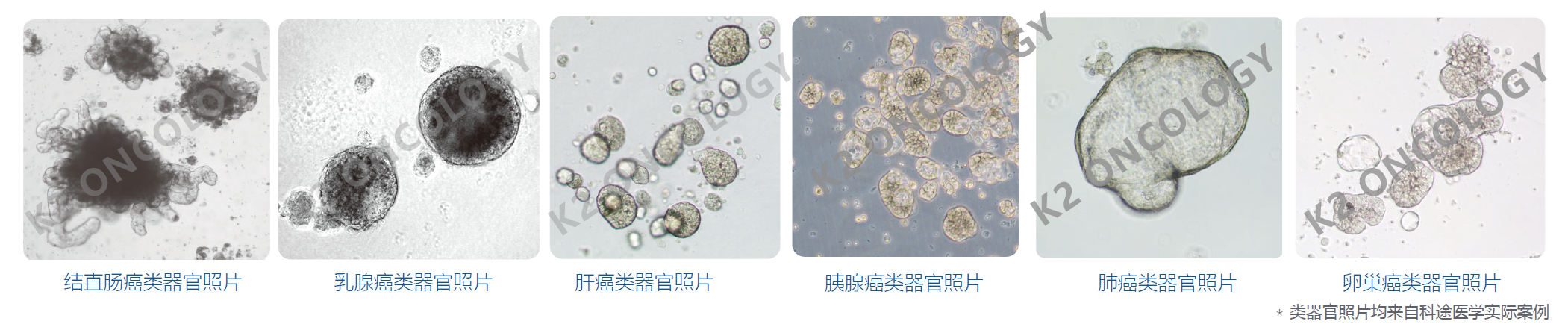
Schematic Diagram of Tumor Organoid Models Established by K2 Oncology
This is closely tied to the team’s foundational DNA. The three founders of K2 Oncology combine academic, industrial, and entrepreneurial backgrounds: one is Professor Xie Dong, an oncogeneticist at the Shanghai Institute of Nutrition and Health, Chinese Academy of Sciences; another founder, Kang Ping, is a serial entrepreneur and former co-founder of ACROBiosystems, as well as an expert in the field of protein factors, providing a robust foundation for upstream formulation screening and reagents at K2 Oncology.
Sun Zhijian possesses extensive experience in the pharmaceutical industry. He previously held a drug development position at the Novartis Institutes for BioMedical Research (NIBR) Shanghai Center, and subsequently witnessed BeiGene’s entire journey from its inception to its public listing, where he was responsible for researching the biological mechanisms of innovative drugs. His tenure in the pharmaceutical sector gave Sun Zhijian a firsthand understanding of the industry’s demand for modeling systems, prompting him to embark on an entrepreneurial venture in the field of organoids.
In the process of exploring business models, Sun Zhijian and his team have also developed their own insights on the further commercialization of organoids.
VCBeat New Medicine:"From the perspective of the richness of application scenarios, K2 Oncology's business model has already proven to be quite viable, is that correct?"
Sun Zhijian:Our three directions, the first one isBiobank CRO, providing customized database construction for pharmaceutical manufacturers and hospitals, and conducting new drug R&D services; the second is classDomestic Substitution of Organs, namely upstream reagents, including assay kits, hydrogels, proteins, and specialized consumables; the third isDatabase Establishment and Discovery of Innovative Pipelines。
At present, the majority of K2 Oncology's orders are concentrated in preclinical testing, including translational medicine and pharmacodynamic and pharmacological evaluations.. Although the commercialization model has been partially validated, we are still striving to understand and explore the most authentic needs of end users, with the aim of identifying a viable path for practical commercial implementation.
VB New Medicine:How do you view the commercialization prospects of the organoid field?
Sun Zhijian:When a new technology emerges, it is initially surrounded by high expectations and anticipated to solve numerous problems. However, as implementation proceeds, more specific challenges arise, leading stakeholders to gradually adopt a more realistic perspective. Over time, the aspects that truly deliver value gain broader recognition.
Organoids are indeed a hot topic, with significant enthusiasm in academia and a large volume of academic papers published annually. However, achieving commercialization or progressing toward stable and reliable applications still faces numerous challenges.The primary question is whether organoid technology can deliver greater value than previous models and provide it to end users in a standardized and reproducible manner. This is the key criterion for evaluating the commercial viability of this technology.
For instance, can personalized medicine truly benefit patients? This requires firsthand understanding of the clinical context.
In the industrial sector of drug development, it is also essential to identify the application scenarios for organoids and determine whether there is genuine demand; specifically, whether they can help pharmaceutical companies improve the efficiency of new drug development and reduce R&D risks.
We often ask ourselves internally in which areas we can deliver core products and value. Only after the “concept trial” phase, having withstood scrutiny and refined into high-quality offerings, can they enter the stage of commercial growth.
VCBeat New Medicine:Therefore, to demonstrate value, one must gain insight into needs.
Sun Zhijian:Yes. We must approach the issue from the end-user’s perspective. Questions such as how to build a database, how to implement quality control after its establishment, how to accumulate data over time, and how to deliver services—all of these must be answered by looking to the end-user terminal. Only in this way can we precisely shape the company’s product and service positioning.
VCBeat New Medicine:From the current perspective, what are the competitive barriers for companies in the organoid industry?
Sun Zhijian:I understand that the primary barrier on the clinical side is data, requiring extensive data accumulation to establish standards for models evaluating effectiveness. The barriers on the industrial side are multifaceted; as previously mentioned, these include model stability, clear background data, robust model architecture, sufficient data volume, as well as service capability and quality.
Accumulating comprehensive background data for models is critically important. For instance, a drug-resistant organoid model requires substantial data support, including clinical drug response data, genomic data, gene expression profiling data, potentially proteomic data, standard-of-care (SOC) drug data, and targeted therapy sensitivity data. The accumulation of such data typically demands significant financial investment and considerable time. Therefore, the requirement for clear and robust model background data alone demonstrates that the barriers to industrial application are quite high.
Moreover, providing professional services using organoid models also presents a high barrier to entry. This phenomenon has precedents in other fields; for instance, although Patient-Derived Xenograft (PDX) services have been available for many years and numerous teams have developed PDX model libraries, only a few have achieved successful commercialization. The key differentiator lies in the establishment of a standardized service system. Without substantial investment and diligent efforts to productize model offerings, even the largest model libraries will struggle to identify scalable application scenarios, thereby hindering the company’s commercialization process.