

The End of the 'Lucrative Myth' in Dental Implants: A Major Turning Point for China's Oral Healthcare Industry
MEI WEI DENTAL GROUP
Oral Health Service Provider
A single piece of news has sent the entire private dental industry into a frenzy.
Recently, after a three-week public consultation period, the National Healthcare Security Administration officially issued the "Notice on Launching Special Governance of Service Charges and Consumable Prices for Dental Implant Services" (hereinafter referred to as the "Notice"). The Notice specifies that dental implants will be subject to centralized procurement, while dental crowns will be listed through competitive bidding. Price controls will be implemented for dental implant medical services; for instance, the target for regulating the entire process of medical service prices at tertiary public hospitals is set at 4,500 yuan per tooth.
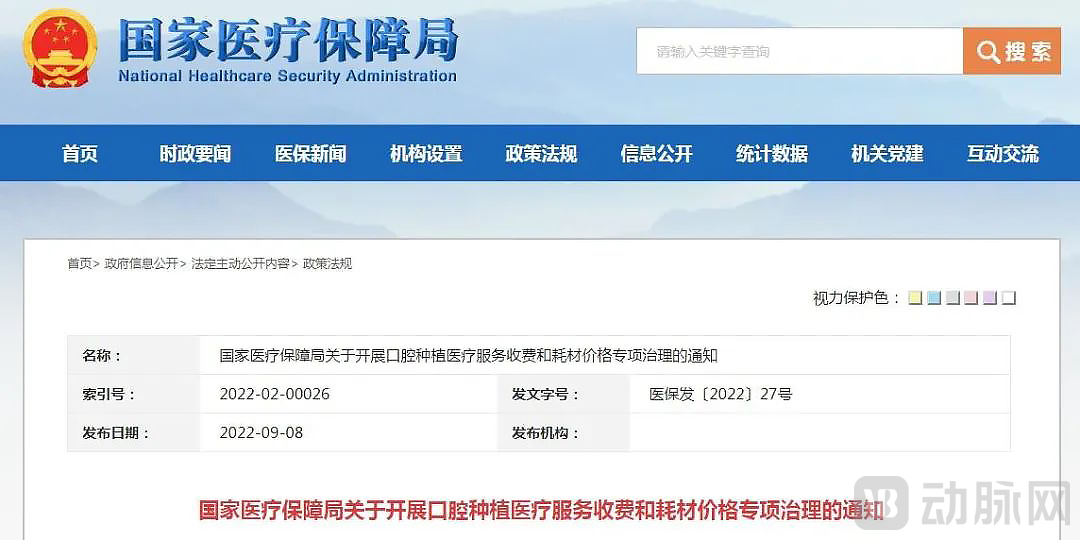 (Image source: Official website of the National Healthcare Security Administration)
Affected by this news, numerous dental-related stocks experienced a surge.On that day, Topchoice Medical, Rongyu Group, and Yuexin Health hit their daily price limits; Arrail Group surged by approximately 36.8% at one point; while Angelalign, Sinocera, Modern Dental, and Medprin Biomedical all posted gains exceeding 7%.
It is worth noting that dental implants, which previously cost tens of thousands to over a hundred thousand yuan, have long resisted significant price reductions. This is because the pricing structure for dental implants is relatively complex, encompassing both consumables such as implant fixtures and the professional service fees of dentists, making it difficult to coordinate and price these components separately.
This notice mandates the “separation of technical services and consumables,” requiring both medical consumables and healthcare service fees to be reduced to reasonable levels. This signifies that the centralized procurement of dental implants has entered a critical phase.
However, logically speaking, price reductions should squeeze corporate profit margins. Why, then, have they sparked such strong optimism across the industry?
“Previously, the industry was particularly concerned that medical service fees would drop too sharply; currently, the situation appears better than market expectations. Therefore, the announcement has boosted confidence in the dental sector within the secondary market,” a head of securities told VCBeat.The decline in dental implant prices helps increase patient visits to oral healthcare institutions, particularly for basic treatments. Furthermore, as the current policy primarily targets public hospitals while private providers retain operational autonomy, the overall impact on the industry is positive.
It is worth noting that the issuance of this notice has also sparked some concerns within the industry. For instance, the centralized procurement of dental implants will directly lower the entry threshold for implant consumption, making it a critical issue for the industry to determine how to maintain the quality of medical services amidst overall fee reductions. Additionally, there are concerns that dentists in public hospitals, who are more significantly affected by the centralized procurement, may migrate in large numbers to private institutions, thereby driving substantial changes in the industry landscape.
As the centralized procurement of dental implants is set to roll out, how will the oral care industry evolve, and what new challenges and opportunities will emerge? To address these questions, VCBeat interviewed multiple industry experts to gain insights into potential answers.
For years, dental implants have been prohibitively expensive, giving rise to the saying that “a full set of dental implants costs as much as a house in a county-level city,” thereby imposing a heavy financial burden on many patients.
According to statistics from the National Working Commission on Ageing, 50% of elderly people aged 65 to 74 in China are missing more than 10 teeth due to various reasons; among those over 74, 26% have lost all their teeth, and this proportion continues to rise.This means that amid the accelerating aging of the population, the market demand for dental implants is gradually expanding and has become an issue of public livelihood.
Yet, why is a single tiny tooth so expensive?
This lies in,The price of a single dental implant includes both the cost of materials and the physician's labor fees.
Let’s first examine the prices of consumables. Dental implants mainly consist of three components: the implant fixture, the abutment, and the crown. The implant fixture is the core consumable in the dental implant procedure, accounting for approximately 10% of the total payment cost. Currently, the market is dominated by imported brands, with a low rate of domestic production. Among these, European and American brands, as well as South Korean brands, are the mainstream options.
In terms of price, dental implants from European and American brands generally cost RMB 3,000 or more, while those produced in China and from South Korean brands are priced at around RMB 1,000 to RMB 2,000.
In the distribution chain of medical consumables from manufacturers to healthcare service providers,Device distributors also account for a certain portion of the costs.According to previous research by VCBeat, the downstream market comprises tens of thousands of private dental clinics, characterized by a fragmented landscape of small, dispersed operators. Coupled with the wide variety of clinical SKUs at the upstream level, the midstream sector plays a critical role as an intermediary, generating profits through economies of scale. In this process, the overall cost of dental implants accounts for approximately 10%.
Finally, there is the cost of physicians' professional services.At the downstream end, surgical fees constitute the largest portion of the cost for dental implant treatment. From an industry perspective, the educational and time investment required to become a dentist is substantial, taking at least 10 to 13 years from undergraduate medical studies through graduate and doctoral training. Furthermore, implant dentists must devote significant time to each patient for diagnosis, treatment planning, and the execution of follow-up care. Naturally, there is considerable variation in surgical proficiency among dentists with different levels of experience, leading to significant disparities in their fees.
Preliminary results from a recent nationwide registration-based survey indicate that, taking the average cost of single-tooth conventional implantation at public medical institutions in each province as an example, the average fee for medical services exceeds RMB 6,000, with some provinces and municipalities reporting costs exceeding RMB 9,000.
It is not difficult to see that the majority of the overall cost of dental implant treatment is attributed to physicians' professional fees, which account for more than 50% of the total expense and have become one of the key reasons for the high cost of dental implants.
To address the high cost of dental implants, various regions have long been preparing for centralized procurement.It was not until the end of last year that the centralized procurement process for dental implants began to accelerate.
· In November 2021, the Sichuan Provincial Drug and Medical Device Centralized Procurement Service Center took the lead in launching information declaration for high-value medical consumables in dentistry, such as dental implants and restorative abutments;
· On January 11, the Ningbo Municipal Healthcare Security Administration in Zhejiang Province took the lead nationwide in introducing a price-capped payment policy for dental implants under medical insurance, with one hundred medical institutions across the city actively responding to and implementing the insured dental implant program;
· On August 18, the National Healthcare Security Administration released the “Notice on Launching Special Governance of Service Charges and Consumable Prices for Dental Implant Services (Draft for Comment),” signaling that centralized procurement is imminent.
From the perspective of the preparation cycle, centralized procurement poses significant challenges.The reason is that, unlike consumables such as coronary stents and artificial joints, the overall price of dental implants is more closely tied to the cost of medical services; an excessive price reduction would inevitably dampen dentists’ enthusiasm. This has also earned the centralized procurement of dental implants the moniker of “the most difficult centralized procurement in history.”
To this end, after extensive research, this notice clarifies that,Promoting centralized procurement of dental implants by adopting a pricing model that separately charges for “service items” and “dedicated consumables.”
In the section on medical services, the notice states that, after synthesizing input from the public, medical institutions, and professionals, the price control target for dental implant medical services at tertiary public hospitals was ultimately set at RMB 4,500. Conditions allowing for appropriate relaxation of this target were also specified for regions or medical institutions meeting certain criteria. This represents a notable reduction compared to the previous medical service fees exceeding RMB 6,000.
It should be noted that the price of 4,500 yuan is not fixed. According to the previous pricing principles for medical service fees in various regions, Tier-2 and Tier-1 hospitals may offer a discount of 10%–20% below the standard rates set for Tier-3 hospitals.
Meanwhile,Given that regions and cities with advanced levels of economic development indeed face higher costs in terms of resources, manpower, and other factors, the Notice permits a relaxation of the overall regulatory targets for medical services.In other words, the price for physicians’ services can be further increased, up to a maximum of 6,300 yuan.
It is worth noting that the current reduction in medical service prices for dental implants primarily targets tertiary public hospitals, while the focus for private medical institutions is on strengthening regulation and guidance of oral implant pricing.
“Private dental hospitals/clinics still retain the right to set their own prices.“The aforementioned securities firm executive stated, ‘However, the price reduction for dental implants in public hospitals will certainly serve as a reference point, imposing constraints on private dental hospitals and clinics. Consequently, overall market prices will decline to varying degrees.’”
In the consumables section, the notice stated that relevant departments would successively release tender announcements for the centralized volume-based procurement of dental implants, implement online bidding and listing for dental crowns used in implant procedures, and that various localities would promptly formulate and release policies on items and pricing for dental implant medical services; by March of the following year, prices for dental implants, crowns, medical services, and other related items would be sequentially implemented across all provinces.
As can be seen, the medical service component, which constitutes the bulk of dental implant costs, has experienced a relatively modest price reduction. Coupled with the fact that private dental service providers retain pricing autonomy, the overall impact on dental implant prices remains moderate.
“When the news of volume-based procurement first broke, the entire industry viewed it as a storm brewing; yet upon seeing the official notice, we breathed a sigh of relief,” remarked the co-founder of a dental chain in Chongqing.
As the centralized procurement of dental implants approaches, the oral care industry is undergoing accelerated consolidation, with new opportunities beginning to emerge.
In the upstream consumables segment, domestic substitution will accelerate.As is well known, the development of domestically produced dental implants in China started relatively late, resulting in a low market share. By the end of 2021, there were 117 registered approvals for dental implants and implant systems marketed in China, including 99 imported products and 18 domestically produced ones, with domestic products accounting for only 15% of the market.
Behind this lies both the insufficient accumulation of technology and experience in domestically produced dental implants, as well as shortcomings in areas such as clinical data support.
In terms of technology, China’s dental implant sector is generally still in a phase of technological follow-up. Taking surface treatment technologies as an example, the two industry leaders, Nobel Biocare and Straumann, have adopted fourth-generation techniques—TiUnite anodic oxidation and SLActive (hydrophilic SLA) hydrophilic sandblasted and acid-etched treatments, respectively—which offer superior biocompatibility, corrosion resistance, and bone-to-implant contact strength. In contrast, most domestically produced dental implant brands in China remain at the second- or third-generation levels, relying on simple coatings and basic sandblasted and acid-etched treatments, thereby lagging behind.
Furthermore, due to the lack of scientific data supporting five- and ten-year success rates for domestically produced dental implants, dentists remain somewhat hesitant in selecting Chinese brands, which has also limited the widespread adoption of these implants.
In contrast, European and American brands and South Korean brands hold market shares of 35% and 58%, respectively. Among these, South Korean brands are priced lower and command the largest share among C-end consumers. Although Chinese-made dental implants are priced similarly to their South Korean counterparts, their later market entry has subjected them to competitive pressure from the higher cost-performance ratio of South Korean products. European and American dental implants offer superior performance and currently dominate the high-end market segment.
The inclusion of dental implants in the centralized procurement program has promoted the development of domestically produced dental implants.“Volume-based procurement has provided domestic dental implant manufacturers with a highly favorable window of opportunity. I personally believe that two or three dark-horse companies will emerge from this opportunity,” Lv Sang, strategic consultant at Gaofeng Medical, told VCBeat.
Because the dental implant industry achieves scale through volume, profitability improves once sales volume increases. Therefore, driven by provincial and national centralized procurement initiatives, the market share of domestically produced dental implants in China will gradually rise.
However, Lu Sang also believes that the challenges are formidable. “Once a bid is won in the national volume-based procurement (VBP), it poses a significant test to domestic implant brands in terms of production capacity, supply chain distribution, and personalized clinical guidance. In addition, providing customized abutments and frameworks represents another challenge for implant manufacturers in supporting the national VBP program.”
At the downstream service provider level, the quality of dental services will become a key focus of market competition.Following centralized procurement and online listing, the costs of medical consumables will become transparent. For healthcare institutions, the core focus going forward will be to compete on service, technology, and talent.
As seen in the notice,Policy-level measures encourage premium pricing for high-quality medical services.For instance, among the three scenarios where price controls may be relaxed, regions with leading dental implant technologies can enjoy a maximum relaxation of up to 20%.
For example, medical institutions that are designated as National Clinical Key Specialties in the field of dental implantology under the National Center for Stomatology, or those with high dental implant success rates that publicly disclose service quality information and commit to accepting supervision and inspection, shall be granted a 10% relaxation margin.
“Currently, I believe the pricing of national centralized procurement is quite fair.”Reasonable Pricing Is a Guarantee of Quality.” Zhu Liya, founding partner and CEO of MEI WEI DENTAL GROUP, told VCBeat.
Additionally,The Matthew Effect in the downstream service sector is intensifying.For companies with weaker brands, this may result in “revenue growth without profit growth,” or even a decline in business profits. In contrast, industry leaders can leverage their superior service resources and capabilities to siphon off the majority of patients within the region. By offering comprehensive oral health solutions—such as family-oriented dental care services in addition to dental implants—they can enhance customer stickiness and achieve higher premium pricing.
“Moving forward, we will intensify our efforts to recruit high-caliber physicians. In particular, the recently introduced equity incentive plan has proven highly effective in motivating internal talent and bolstering confidence in the company’s rapid future growth,” stated Ding Ning of Rongyu Group. “The policy fully affirms the value of dental implant medical services. Building on this new regulatory framework, we will leverage the market-oriented complementary advantages of private institutions to provide multi-tiered dental implant services.”
“MEI WEI DENTAL GROUP will continue to prioritize medical quality and informatization,” stated Zhu Liya, Founding Partner and CEO of MEI WEI DENTAL GROUP. “Healthcare is a highly rigorous field, and time is an insurmountable hurdle.”
Multiple industry experts agree that,The higher the market penetration of dental implants, the more effectively the market can be educated, and the more consumers will recognize the importance of oral prevention and periodontal maintenance. This, in turn, will drive the development of the dental industry.
Moreover, from a societal perspective, the decline in dental implant prices will enhance the well-being of hundreds of millions of Chinese citizens in the future.
In this process, dental healthcare enterprises must be adept at discerning the evolution of market demands and prioritize the quality of medical services to seize emerging opportunities and achieve rapid growth.