

Jingli Tech Launches DAEA Value Model to Empower Pharma Companies in Digital Patient Management
With the deepening reform of China’s healthcare system, the market for out-of-hospital patient management is experiencing rapid growth. The traditional physician-centric healthcare delivery model is gradually shifting toward a patient-centric approach. How to establish and improve an out-of-hospital patient management system that provides real-time, precise, efficient, and safe digital health services has become a key concern across the industry.
Driven by policies such as centralized drug procurement and the outflow of prescription drugs from hospitals, the out-of-hospital pharmaceutical market has experienced rapid growth. A significant number of pharmaceutical companies are shifting from a traditional “physician-centric” model to a “patient-centric” one. Moving away from the previous approach of influencing patient outcomes indirectly by shaping physicians’ decisions through expert consensus, these companies are now directly engaging consumers—who hold decision-making power—by embracing “out-of-hospital patient management.”
Furthermore, patients’ personalized demands for out-of-hospital care continue to emerge. Beyond in-hospital diagnosis and treatment, patients have a growing need to improve their disease management outside the hospital setting; however, physicians, constrained by limited time and energy, often struggle to meet these needs. As China’s population ages, the number of patients—including those with chronic diseases—is increasing, further driving sustained growth in demand for personalized out-of-hospital disease management. This trend has, in turn, spurred a shift in market supply, with numerous enterprises entering the field of “out-of-hospital patient management.”
However, in the face of a market with broad development prospects, “out-of-hospital patient management,” whether led by pharmaceutical companies or by a consortium of enterprises, faces a common challenge: how to provide effective out-of-hospital patient management solutions.
At the recently held 4th Digital Healthcare and Marketing Innovation Summit, VCBeat observed that Jingli Technology (hereinafter referred to as “Jingli”), a company specializing in digital patient management, launched its new DAEA value model for private-domain healthcare engagement along with three major digital solutions. As a “dark horse” entrant in the healthcare sector, how has Jingli achieved large-scale out-of-hospital patient management through private-domain operations within just two years? What foundational insights underpin the creation of the DAEA value model? And how does the company view the current industry trends in digital transformation? We spoke with Lai Gangbin, Founder and CEO of Jingli Technology.
Weak user stickiness and low willingness to pay among participants,
Numerous Pain Points Exist in Out-of-Hospital Patient Management
Kevin (Lai Gangbin, CEO of Jingli Technology, hereinafter referred to as Kevin), who has a background in science and engineering, demonstrates the rigor and perseverance characteristic of professionals in these fields during interviews. Perhaps, as the founder, he has long studied the issues existing in out-of-hospital patient management and repeatedly asked himself similar questions. Unlike most companies that prioritize profitability on paper, what he constantly emphasizes are “patients” and “services.”“We always stand on the side of patients, aiming to provide them with patient management solutions that are truly effective,” he told VCBeat.
When asked about his views on the shortcomings of previous out-of-hospital patient management programs, he mentioned—
First, the core of healthcare is to address the problems faced by patients, whereas medical demand itself is low-frequency and “unsustainable.” In contrast, within the maternal and infant consumer sector, products often provide users with incremental happiness and can be repeatedly “consumed,” resulting in higher user stickiness. However, the healthcare sector differs: patients typically seek physicians’ assistance to resolve health issues. The experiences of these two types of “users” are entirely distinct. One of the key challenges lies in achieving sustained patient retention and encouraging them to accept and adhere to medical advice, thereby improving treatment compliance.
Secondly, in previous out-of-hospital patient management initiatives, the weak willingness of stakeholders to pay has hindered the establishment of viable business models. On one hand, although patients have demands for out-of-hospital disease management, their willingness to pay is extremely low. On the other hand, pharmaceutical companies, as potential participants, already possess highly mature business models that leverage physicians as a channel to influence patients, making them reluctant to invest in out-of-hospital patient management programs. The absence of paying parties has rendered corporate out-of-hospital patient management projects unsustainable.
Furthermore, even though policies such as centralized drug procurement have given rise to pharmaceutical companies as payers, the “overly heavy” operational models of project sponsors often result in a disproportionate return on investment. Certain out-of-hospital patient management projects adopt models such as developing dedicated mobile applications or establishing or relying on third-party call centers. In these cases, enterprises must incur substantial costs in both patient recruitment and patient management phases, yet the resulting “returns” are often unsatisfactory.
This is also due to the inability to establish truly low-cost, high-efficiency, large-scale patient management solutions, which makes it difficult for patients to benefit, for physicians to reduce their workload through out-of-hospital patient management programs, and for pharmaceutical companies to gain marketing benefits.
“Constructing a viable ‘economic’ model to address the challenges of out-of-hospital patient management from the perspectives of cost, efficiency, and scale, thereby enhancing patient adherence and lifetime value, is where out-of-hospital patient management initiatives should truly focus their efforts,” Kevin stated with considerable confidence.
Build the DAEA value model and upgrade product solutions,
Meeting Patients' Digital Management Needs
Kevin noted that they were frequently asked why Jingli chose to enter the healthcare sector to provide patient services. In reality, the decision to focus on out-of-hospital patient management was not solely driven by the identification of pain points and market opportunities. Leveraging its profound expertise in private-domain operations within the maternal and infant consumer sector—a core “gene” of the company—Jingli was motivated to pursue more innovative trials and explorations. This endeavor culminated in the development and launch of GemCare, a patient-centric digital platform. By integrating an evidence-based digital proactive intervention service system and AI-powered health service tools, supported by a team of over 100 health management specialists and medical assistants, Jingli has successfully implemented out-of-hospital patient management solutions across multiple disease areas, including diabetes, cardiovascular diseases, and oncology. Consequently, leading pharmaceutical companies such as AstraZeneca and Roche have established partnerships with Jingli.
“The launch of the current DAEA value model and its three major solutions is, in fact, the result of our in-depth exploration in the field of out-of-hospital patient management. Through extensive communication with hospital physicians, patients, and pharmaceutical companies, we have gained a thorough understanding of their needs and pain points, ultimately leading to the implementation of this value model and the three major solutions.”He mentioned that this value model leverages AI-powered tools to conduct patient education and engagement within the WeCom ecosystem, enabling refined management services. This approach enhances patient adherence and patient lifetime value, thereby achieving the accumulation of patient assets.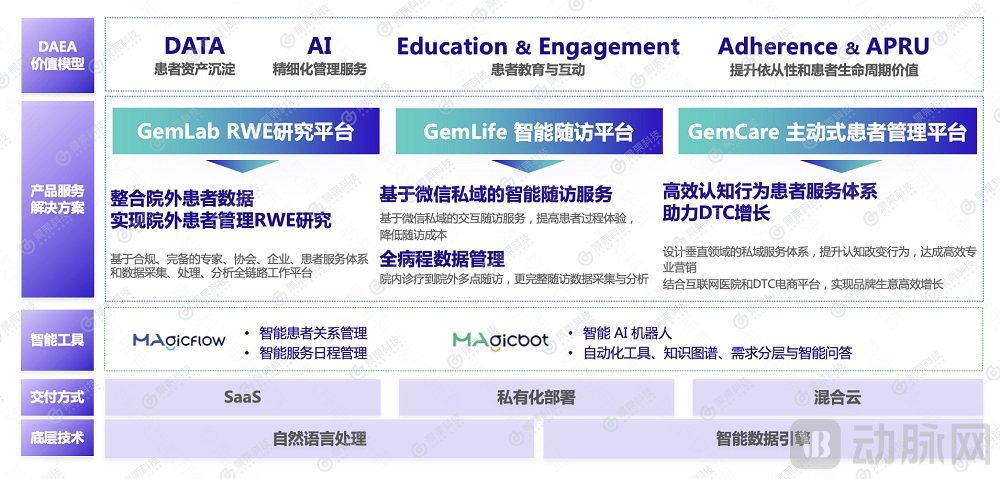
By integrating data, algorithms, and a proactive patient intervention service system, and leveraging the DAEA value model, Jingli has developed three core product and service solutions: the GemLab RWE Research Platform, the GemLife Intelligent Follow-up Platform, and the GemCare Proactive Patient Management Platform. This has established a comprehensive business ecosystem covering real-world evidence (RWE) studies, data insights, and out-of-hospital patient services and management. By linking these components through data, Jingli has created a closed-loop service that truly meets patients’ needs for digital health management.
“Jingli Technology’s DAEA value model has truly achieved a balance of benefits for physicians, patients, and pharmaceutical companies, resulting in support for physicians, benefits for patients, and profits for pharmaceutical companies.”He mentioned—
First, for patients, it transforms passive patient management into active patient management, enabling more effective disease intervention and facilitating early detection, early warning, and early management of disease progression. By integrating data, algorithms, and service systems, Jingli has established a systematic patient intervention service framework. This approach provides patients with end-to-end support—from disease awareness to disease management—and delivers more personalized solutions based on the dynamic status of each patient’s condition.
Secondly, for physicians, it serves to alleviate their clinical workload and facilitate academic advancement. Traditional management approaches often lead to patient treatment dropout and attrition, while failing to capture real-world medication adherence data. Leveraging the DAEA model and its three core solutions, physicians can access continuous patient management data, thereby enhancing both clinical care outcomes and academic research.
Furthermore, for pharmaceutical companies, improved patient adherence translates to reduced patient dropout rates and extended duration of therapy (DOT). Concurrently, this facilitates the acquisition of more robust efficacy data feedback. Moreover, when innovative pharmaceutical firms seek market approval for their novel drugs, they can leverage patient insights derived from operational activities to promptly disseminate information to users, thereby enabling more effective outreach to patients in need.
Build a Knowledge Graph and Upgrade the Operational Middle Platform
Achieving Large-Scale Out-of-Hospital Patient Management
Unlike solutions that remain at the strategic level, the DAEA model is built on insights derived from practical experience and applied back into projects. Through continuous summarization and iteration, it creates a positive flywheel effect.
On the patient front, Jingli has currently provided high-quality and efficient digital health services to over 1.6 million patients. For instance, its “28-Day Light Sugar Training Camp,” co-established with Roche, not only helps participants master scientific blood glucose control knowledge but also encourages patients to develop self-driven habits of blood glucose monitoring and management, thereby enhancing their awareness and attention to their own conditions.
In terms of pharmaceutical company collaborations, it has jointly established multiple patient management programs with major multinational pharmaceutical companies such as Roche, AstraZeneca, Takeda, and Viatris. For instance, in partnership with AstraZeneca, it designed a real-world study protocol for post-hospital breast cancer care, providing scientific and convenient solutions for post-diagnosis patient management. This initiative also helped improve medication adherence and extend the duration of therapy (DOT).
In real-world studies, leveraging the continuous accumulation of patient treatment data, Jingli is not only helping physicians reduce the burden of disease management but also facilitating their academic research progress.
“Perhaps more importantly, by building an integrated system of software and hardware services, Jingli has achieved efficient, low-cost, and scalable patient management. This has changed the previous situation where 1-on-1 services were inadequate when facing a patient volume of hundreds of thousands or even higher.”
“Healthcare services connect people with people. Our entry into the healthcare industry is not aimed at merely relying on software tools for patient management, but rather at enhancing service quality and efficiency through the integration of algorithms, data, and service systems.”To further enhance its service capabilities, Jingli has also made numerous attempts—
For example, by developing disease-specific knowledge graphs centered on specialized departments and conditions. Through the creation of a suite of products, including a disease-related Q&A database, and leveraging these as service touchpoints to deliver relevant services, continuous adaptation via data and algorithms has enabled more effective patient care.
For another example, in building its service system, Jingli has further refined and upgraded its operational middle platform over the past year. By continuously exploring how to standardize service implementation and establish a closed-loop workflow, the company has further enhanced service efficiency, reduced service costs, and made services more accessible and affordable for patients.
For Kevin, proactive post-discharge patient management is a long-term endeavor that demands both patience and professionalism.To ensure medical professionalism, the medical content at Jingli is led by a former oncologist from Shanghai Ruijin Hospital; its medical director is a seasoned professional with decades of medical experience, thereby upholding the “rigor” of healthcare throughout.
Continuously Iterate, Upgrade, and Refine the Life and Health Model
Promoting the Development of Proactive Out-of-Hospital Patient Management
In Kevin’s view, it is intrinsic to the company’s development to further build an integrated service management system under compliance prerequisites, advance the refinement of out-of-hospital patient management data, develop life and health models, and drive the continuous iteration and upgrading of product solutions.
“Centered on the DAEA value model, Jingli also hopes to collaborate and explore new initiatives with industry peers, fostering a more robust ecosystem to better benefit patients.”“Out-of-hospital patient management will become a major trend over the next 10 to 20 years. Jingli is committed to working alongside industry peers to undertake difficult yet correct initiatives, thereby truly advancing the implementation of ‘Healthy China’ while benefiting a broad patient population,” Kevin stated firmly at the end of the interview.