

UK-China Joint Initiative: Building a Global Hub for Medical Talent Collaboration and Exchange
Safeguarding human life and health is an important mission entrusted to us by the times.
Accelerating the construction of a global community of health for all requires breaking down barriers, facilitating mutual exchange, and fostering solidarity within the healthcare sector. In the current era of economic and informational globalization, deepening international exchanges and cooperation in global health and establishing high-quality international platforms for healthcare are essential pathways to improving medical quality and building world-class hospitals.
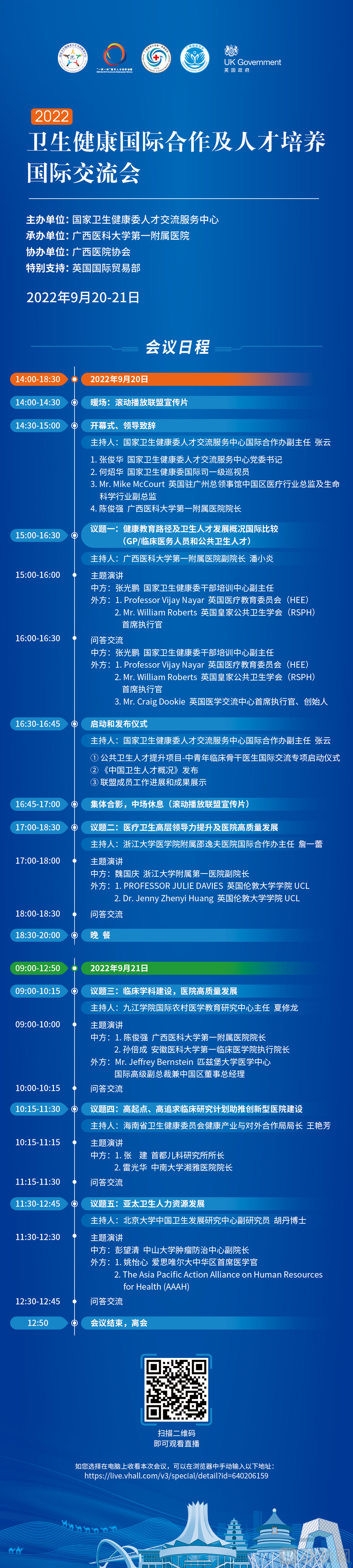
To deepen exchanges and cooperation in health and healthcare between China and other countries, vigorously promote the high-quality development of Chinese public hospitals, strengthen international cooperation and exchanges in the medical field, and enhance the global influence of public hospitals,The Talent Exchange and Service Center of the National Health Commission of China, in collaboration with the First Affiliated Hospital of Guangxi Medical University and the Guangxi Hospital Association, and with special support from the UK Department for International Trade, will jointly host the “2022 International Conference on Health Cooperation and Talent Development” on September 20–21, 2022.
This ConferenceFocusing on International Cooperation and Talent Development in the Health Sector, featuring opening remarks and keynote speeches, and will host the launch ceremony for the International Exchange Program for Young and Middle-Aged Core Clinical Physicians under the Public Health Talent Enhancement Project.
Discussions will center on topics such as “International Comparison of Health Education Pathways and the Development of Health Workforce,” “Enhancing Senior Leadership in Healthcare and Promoting High-Quality Hospital Development,” “Clinical Discipline Construction and High-Quality Hospital Development,” “High-Starting-Point, High-Aspiration Clinical Research Programs to Drive the Development of Innovative Hospitals,” and “Development of Health Human Resources in the Asia-Pacific Region.”
The conference will invite Chinese and international experts, scholars, hospital administrators, and representatives from industry associations in relevant fields to attend and deliver keynote speeches, providing a high-level platform for information exchange.
At that time, representatives from renowned UK medical institutions and universities will deliver online speeches and participate in interactive discussions, including:
· Health Education England
· Royal Society of Public Health
· University College London
· Elsevier
· London Medical Exchange (LME)
Meeting the growing healthcare needs of an aging population and the demand for a supply of well-trained health professionals is a challenge for both China and the UK. The UK’s healthcare system ranks among the world’s leading, and as a global expert in responding to changing healthcare demands,The United Kingdom places great emphasis on professional medical education and training, serving as a model and leader for many countries.
“UK higher medical education is built on evidence-based medicine as its guiding principle and the General Medical Council as its foundation, ensuring high-quality teaching standards by issuing overarching medical education frameworks and establishing codes of practice for physicians.”
The UK’s medical education and training system ensures that each generation of healthcare professionals can learn, develop their skills, and achieve the highest standards. Accordingly, the UK’s medical education and training programs have produced many world-class physicians, nurses, medical specialists, and senior healthcare administrators.
As the world’s largest integrated healthcare system, the UK National Health Service (NHS) is also addressing the growing demand for healthcare by launching globally renowned education and training programs to cultivate professional medical personnel who meet current and future needs.
Among them,Health Education England (HEE)It is the strategic delivery body of the UK National Health Service (NHS), dedicated to ensuring that the NHS provides high-quality healthcare services by utilizing the right skills, at the right time, and in the right place. HEE plays the following key roles within the UK National Health Service:
· Ensure that the future health system workforce is maintained at an appropriate level and possesses the right skills to deliver high-quality care.
· Cultivate and enhance the professional skills of existing employees to address new technologies and emerging demands.
· Ensure a conducive learning environment to support patient safety and health.
In fact, the UK’s healthcare education and training network is extensive, offering a wide range of options beyond NHS hospitals, including numerous colleges, universities, Royal Colleges, and both private and public providers.
These training programs are delivered through various modalities, offering internationally based or locally conducted courses. Options include continuing professional education at clients’ sites, courses held within the United Kingdom, online learning, and blended learning models. The curriculum covers multidisciplinary clinical education and training, nursing, leadership and management training for healthcare professionals, and medical English training.
For instance, in the field of medical leadership and management training, the UK already had more than 140 colleges and universities offering healthcare management programs, including MBA and EMBA programs in healthcare. Among them are highly representative top-tier universities—University College London (UCL).
Founded in London, United Kingdom, in 1826, this public research university is a founding college of the University of London, as well as a founding member of the Russell Group and the League of European Research Universities. It is acclaimed as one of the “Golden Triangle” universities and part of the “G5 Super Elite” universities. Its UCL Global Business School for Health (UCL GBSH) is the world’s first business school dedicated exclusively to the health sector.
In addition to medical education and training, the United KingdomPrimary Healthcare, Public Health, Cancerand other key areas of medical breakthroughshave made significant contributions.
Since its establishment in 1948, the UK’s National Health Service (NHS) has been primarily based on primary care, with 90% of patient interactions falling within the scope of primary care services. The NHS is currently exploring new healthcare models, including an integrated care model that encompasses system-wide medical services and population-wide health coverage, as outlined in its Five-Year Forward View.
The United Kingdom also makes substantial investments in public health, with significant practices in the three major areas of health protection, health improvement, and healthcare public health, fully embodying the principles of “prevention first, prioritizing prevention, and proactive service.” Furthermore, the UK’s public health profession is highly developed and renowned worldwide, with its educational quality and practical standards being exceptionally advanced. A large number of universities in the UK offer programs in public health.
It is worth noting that,Royal Society of Public Health (RSPH)Founded in 1856, it is one of the oldest public health institutions in the world. The Royal Society for Public Health (RSPH) is an independent educational charity dedicated to improving and protecting the health of people in the UK and around the globe. Its membership comprises tens of thousands of healthcare professionals, food safety experts, environmental health specialists, policymakers, academics, students, and individuals from a wide range of sectors.
In the field of oncology, the United Kingdom is home to some of the world’s most prestigious cancer diagnosis and treatment hospitals. By bringing together renowned experts from around the globe, the UK remains at the forefront of cancer research, continuously leveraging the latest diagnostic and therapeutic technologies to benefit patients. Indeed, British experts are driving advancements in every stage of anticancer therapy, continually updating treatment protocols and improving patient care models to achieve better clinical outcomes.
London Medical Exchange (LME)Headquartered in the United Kingdom, this healthcare development and training institution specializes in enhancing the skills and knowledge of hospital administrators, physicians, and nurses through specialized courses. The UK Medical Communication Centre has extensive experience in collaborative projects in China, working with the National Health Commission, hospitals, and medical institutions to support the needs of China’s healthcare system. In 2021, the Centre, together with its partners, provided continuing professional development for over 3,000 Chinese professionals. Its UK educational partners include universities, hospitals, and private institutions, collectively delivering the latest medical knowledge. The Centre offers a range of specialized courses, including Medical English, clinical observerships, and leadership training.
In addition, the United Kingdom is also home to world-renowned publishing houses—Elsevier, a subsidiary of the UK-based RELX Group. Founded in 1880, Elsevier is an international multimedia publishing group that primarily provides information products and innovative tools for scientists, researchers, students, and professionals in medicine and information processing.
Elsevier publishes more than 2,800 journals, including the world-renowned *The Lancet*. Each year, 350,000 articles are published in Elsevier’s journals. Elsevier owns Scopus, the world’s largest abstract and citation database, which contains 61 million records from over 5,000 publishers. Nearly all Nobel laureates have published their work in Elsevier’s publications.
At this conference, representatives from the aforementioned UK healthcare institutions and universities will deliver presentations and engage in interactive discussions on topics including medical education and training in the UK, primary care, public health, and cancer treatment.
Therefore, this serves as a premium platform for international exchange, collaboration, and advocacy in the healthcare sector, as well as a special invitation to attract more professionals to join the UK’s medical education and training system. We look forward to meeting you at this summit to jointly explore cutting-edge global healthcare trends and drive the development of the medical industry.
Event Date: September 20-21, 2022
Registration Method: Chinese attendees, please long-press the QR code below to join the group and register for the conference.

(Join the exclusive Chinese-English medical education and training group,
(Answered by UK Trade and Investment Commissioners, with pre- and post-event communication and liaison with UK experts)
References
“British Medical Education Model and Its Implications for Medical Education in China,” excerpted from Issue 5, 2020 of the Journal of Nanjing Medical University, by Xu Tao and Zhou Hong