

The Ophthalmic Drug Market Race Has Just Begun: What Has Zhaoke Ophthalmology Delivered One Year After IPO?

Zhaoke
Ophthalmic Drug Developer
The ophthalmology sector boasts a market worth hundreds of billions, yet ophthalmic drugs were once described as an “untapped diamond-grade track.” Among all competitors, Yisheng Biopharma and Xingqi Eye Medicine established their presence earliest, while Zhaoke Ophthalmology and Ocumension Therapeutics have emerged as rising stars in recent years.
At the end of 2019, Xingqi Eye Hospital began conducting remote consultations and selling medications via the internet. With the addition of online distribution channels for its atropine products, the stock price of Xingqi Pharmaceutical surged more than tenfold.
An early move does not guarantee a winning outcome. In late July this year, Shenyang Xingqi Pharmaceutical issued an announcement that it would suspend the sales of low-concentration atropine eye drops through its internet hospital, thereby weakening its first-mover advantage. Other companies, such as He Eye Specialist and Autek China, which also sell atropine eye drops using a similar model, have successively announced the suspension of their related businesses.
The competition in the ophthalmic drug market has only just begun, with more high-potential companies gearing up and biding their time to overtake competitors on the bend.
Zhaoke Ophthalmology is one such company, with a product pipeline covering anterior segment conditions (dry eye, myopia, presbyopia), posterior segment conditions (wet age-related macular degeneration, diabetic macular edema), and glaucoma, among others, having already reached the starting line for commercialization. On August 24, Zhaoke Ophthalmology announced its semi-annual report, revealing a total loss of approximately RMB 161 million in the first six months of the year, compared to a total loss of RMB 1.9877 billion during the same period in 2021.
In the year since its listing on the Hong Kong Stock Exchange, Zhaoke has made progress in its product pipeline, digitalization, and commercialization strategy, in addition to achieving growth in financial performance—The company has achieved data-driven management internally. Despite the impact of the pandemic, its multiple pipelines in dry eye disease, myopia, and glaucoma have continued to advance at their original pace, while commercialization has officially commenced.
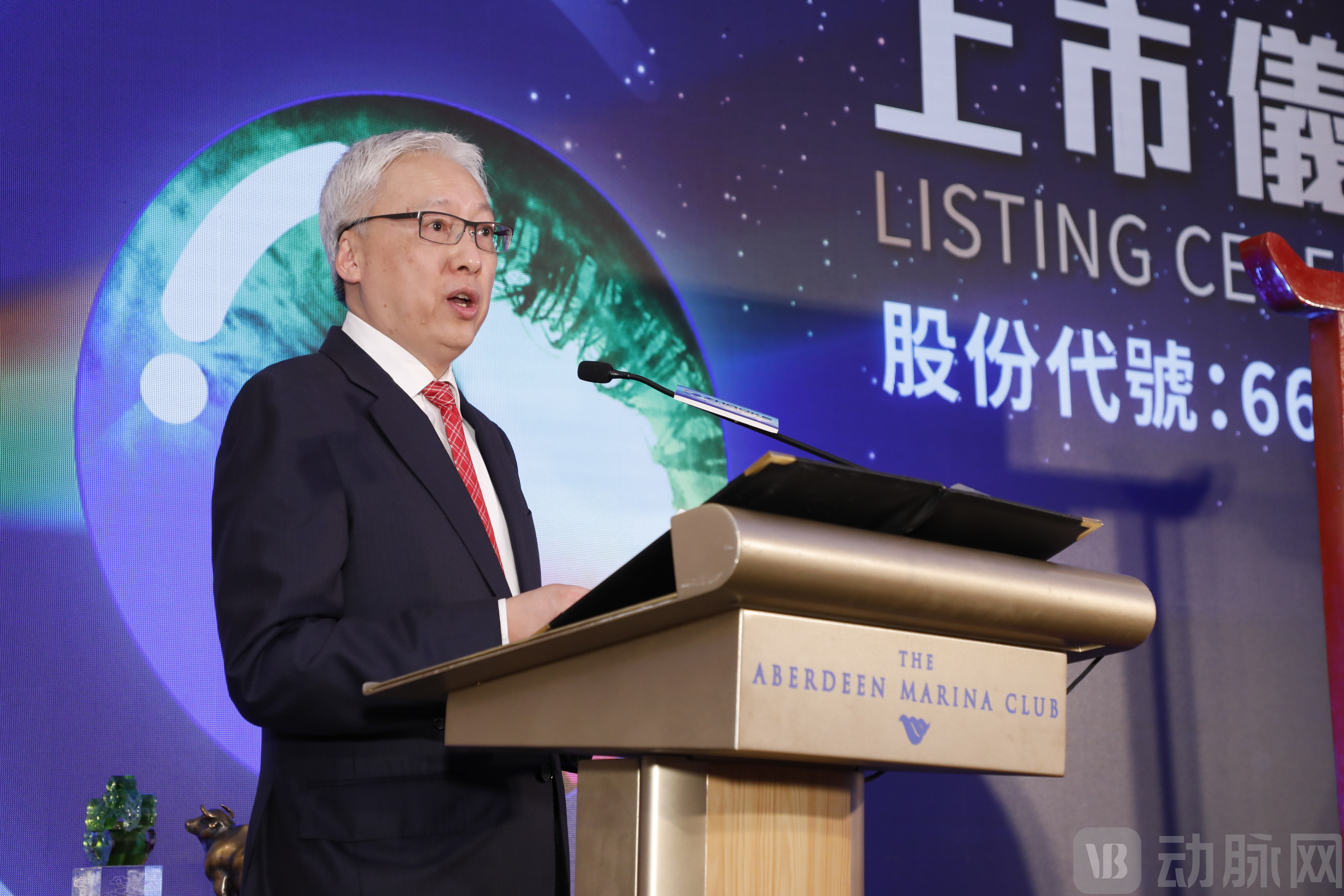 Figure: Dr. Li Xiaoyi speaking at the Hong Kong stock listing ceremony of Zhaoke Ophthalmology
Dr. Li Xiaoyi, Chairman of the Board, Executive Director and CEO of Zhaoke, stated: “Innovation and commercialization were two key priorities for Zhaoke in 2022. We can proudly say that in the first half of 2022, despite severe challenges faced by China and the world, we still achieved multiple significant milestones.”
Ophthalmology, a field that combines medical and consumer attributes, has undoubtedly become an emerging golden track. As a rising star in the ophthalmology industry, how is Zhaoke’s commercialization progressing? To find out, VBInsight interviewed Dr. Li Xiaoyi, CEO of Zhaoke Ophthalmology, and Ms. Feng Xinyan, CFO.
In-house R&D or Licensing? How to Strategize for a First-Mover Advantage in the Ophthalmology Market?
Targeting the dry eye market, Zhaoke is promoting its independently developed innovative drug, Cyclosporine A Ophthalmic Gel. The hydrogel formulation prolongs the drug’s residence time on the ocular surface, with onset of efficacy observed within two weeks. Furthermore, the once-daily dosing regimen enhances patient compliance. The New Drug Application (NDA) for this product has been submitted and was successfully accepted in June this year.
The low-concentration atropine sector continues to gain momentum, with Hengrui Medicine, Xingqi Eye Care, He Eye Hospital, and Autek China already entering the market. Zhaoke’s innovative imported product, NVK002, successfully completed patient enrollment for its Phase III clinical trial in the first half of 2022, a period marked by recurring pandemic outbreaks. Patient recruitment took only four months, significantly ahead of schedule.
In the field of presbyopia, Zhaoke and Visus Therapeutics announced in May this year a collaboration regarding the presbyopia eye drop BRIMOCHOLTMZhaoke has entered into an exclusive licensing agreement for the innovative drugs PF and CARBACHOL PF. Under the agreement, Zhaoke will be responsible for the clinical development, regulatory approval, and commercialization of the two eye drop formulations in Greater China, South Korea, and designated Southeast Asian countries.
Additionally, TAB014, Zhaoke’s first innovative drug for the treatment of wet age-related macular degeneration (wAMD), a posterior segment eye disease, enrolled its first patient in Phase III clinical trials in June 2022.
For pharmaceutical manufacturing, Zhaoke has established a production base in Nansha, Guangzhou, covering processes such as production, compounding, filling, and packaging, while also being equipped with a comprehensive quality assurance system. Even before the formal commercial production of drugs commenced, the company had already established committees including the Drug Safety Committee, Compliance Committee, and Production Safety Committee.
VBInsight: Has the clinical progress of Zhaoke’s atropine drug been affected by the pandemic? How important do you consider the clinical development and regulatory application timeline of atropine to be for the myopia market?
Zhaoke:A phase of the NVK002 atropine clinical trials was primarily conducted at the Eye, Ear, Nose, and Throat Hospital of Fudan University in Shanghai. The citywide lockdown in Shanghai posed a significant challenge to us, with the potential to delay the entire program by several months. However, through the collective efforts and collaboration of our colleagues, we ultimately accelerated patient enrollment by three months.Regarding the progress of atropine, our advantages are quite pronounced, and we may be among the first two companies to launch atropine in the Chinese market. We speculate that in the field of low-concentration atropine, whichever company completes the regulatory process earlier will gain a dominant market position.
VCBeat: What considerations underpin Zhaoke’s pipeline strategy of combining in-house R&D with in-licensing? What are its key priorities moving forward?
Zhaoke:From an industry perspective, we boast the most robust pipeline, covering ophthalmic conditions such as myopia, presbyopia, dry eye disease, glaucoma, wet age-related macular degeneration (wAMD), and diabetic macular edema (DME)—diseases characterized by large target patient populations or significant unmet medical needs. We aim to capture a larger market share through the breadth of our pipeline. Meanwhile,We aim to develop flagship products in every domain—superior, more compelling, and best-in-class.。
Taking atropine as an example, we initially invested significant effort in independent R&D. However, we ultimately chose to license Vyluma’s product from the United States, as it is likely the first low-concentration atropine drug to receive FDA approval. This medication has gained recognition in more countries worldwide, been evaluated in clinical trials involving a larger patient population, and accumulated longer-term clinical data. Similarly, our independently developed cyclosporine A ophthalmic gel remains on the ocular surface longer than competing products, demonstrates efficacy within two weeks, and delivers superior therapeutic outcomes. Therefore, we are leveraging this proprietary product to capture share in the dry eye disease market.
In addition to the continued advancement of our anterior segment drug portfolio, we believe the posterior segment holds greater strategic importance. There is significant room for improvement in the dosing frequency and administration routes for drugs targeting posterior segment diseases. We strive to achieve profit margins comparable to those in the United States, and we are actively advancing two products in our pipeline.
VCBeat New Medicine: What other changes have taken place within Zhaoke in the year since its IPO?
Zhaoke:The most significant change is that our company’s management model and various rules and regulations have become more robust, which is one of the most critical factors for sustainable future development. Meanwhile, we have implemented digitalization initiatives to interconnect various systems through data integration, making work processes more efficient, orderly, transparent, and clearly accountable. In terms of team growth, our staff has expanded from over 100 to nearly 300 members. Following our IPO, we have redirected the majority of our focus back to core business operations, pursued strategic partnerships, and initiated explorations in both online and offline channels as well as B2B and B2C models, beginning to turn our original blueprint into reality.
Medical and Consumer Attributes Coexist: How Can Zhaoke Break Through in Commercialization?
The ophthalmology industry is referred to as a "trinity" sector, characterized by the interactive integration of three segments: pharmaceuticals, medical devices, and services.
According to VCBeat, over the ten-year period from 2011 to 2020, the number of registered ophthalmic companies in China surged from 1,066 to more than 10,300, representing a tens-fold increase. In terms of market size by segment, ophthalmic services accounted for the largest share at approximately 72%, followed by medical devices at around 17%. Although the ophthalmic pharmaceuticals sector started later and currently holds the smallest market share, it is experiencing the most rapid growth, with a growth rate of approximately 15%, ranking first among all sub-sectors.
In the ophthalmology industry, the track record of the “triune model” facilitating commercialization is already evident. However, the challenge lies in leveraging online and offline channels to create interactive synergy among “pharmaceuticals + devices + services,” based on the medical and consumer-oriented attributes of ophthalmic care. This is a key concern for all ophthalmology companies.
This year marks the first year of Zhaoke’s commercialization, as it transforms from an R&D-focused company into one with commercialized products, presenting a relatively clear business plan under industry scrutiny.
VCBeat New Medicine: How does the commercialization of ophthalmic drugs currently differ from that of other pharmaceuticals?
Zhaoke:Many ophthalmic products possess both pharmaceutical and consumer attributes, with online channels playing an increasingly vital role. For ophthalmic pharmaceutical companies, a key challenge lies in transforming their traditional offline, B2B-oriented commercial activities—which focused exclusively on promoting to doctors and hospitals—into a multi-channel, B2B2C approach that engages more directly with patients and consumers across both online and offline platforms. Over the past year, our team has devoted considerable time to reflecting on and experimenting with this transition.
VCBeat New Medicine: Some time ago, Zhaoke launched the Baodeshi Eye Hot Compress Therapeutic Patch. What is the strategic positioning of this product and the underlying business logic?
Zhaoke:This is our first commercialized product. Functionally, this eye patch for ocular application serves as an adjunctive therapy for dry eye disease. From a corporate commercialization strategy perspective, we aim to leverage this product to identify and engage a larger population of dry eye patients prior to the commercial launch of our cyclosporine A ophthalmic gel. Another strategic significance lies in its role as a novel initiative for our online distribution channels.We hope to take this product as the first step to bridge the gap between Zhaoke and patients/consumers.Ultimately, we aim to integrate patients, physicians, and our company into a unified ecosystem, building both online and offline components step by step.
VCBeat New Medicine: In building the ophthalmologist ecosystem, what online initiatives has the Zhaoke team undertaken? Has it collaborated with other online platforms?
Zhaoke Ophthalmology:In September last year, we launched the WeChat official account “Zhaoke Boshi” to meet ophthalmologists’ demand for high-quality content and insights into cutting-edge ophthalmic research in China and globally. We have established a KOL expert community to facilitate online communication and discussion among ophthalmology specialists. In its first year, the platform has attracted nearly 10,000 followers, with more than 60 leading ophthalmologists across various subspecialties contributing content and participating in live broadcasts. Beyond our own online channels, Zhaoke has established online collaborations with partners such as the Chinese Journal of Ophthalmology and Happy Life Technology, a subsidiary of Yidu Cloud. Through these efforts, we serve physicians via content and platforms, providing professional information and training to enhance the efficiency of clinical trials.
Artery New Medicine: Does Zhaoke also maintain good interaction with doctors through offline channels? What initiatives have been undertaken?
Zhaoke:We believe that innovative pharmaceutical companies must maintain close ties and relationships of trust with hospitals and physicians. Zhaoke has consistently maintained positive engagement with hospitals. During the clinical development of our dry eye disease medication, we collaborated with more than 40 centers across China. This year, our clinical trials for low-concentration atropine have been supported by 35 to 36 major hospitals nationwide.
VBInsight: In the process of drug commercialization, apart from strengthening connections among physicians, patients/consumers, and enterprises, what else do you think pharmaceutical companies should focus on?
Zhaoke:The current challenges in ophthalmology extend beyond low diagnosis rates to include erosion of profit margins. Specifically, patients are prone to discontinuing treatment during long-term management; for instance, a patient who requires one year of medication for cure may actually cease drug therapy after only one month.
Therefore, we believe that the sale of a drug does not mark the end of its lifecycle.We aim not only to develop ophthalmic pharmaceutical products, but also to assist, serve, and manage patients through data-driven solutions.。For example, during the treatment period for glaucoma patients, tonometers can be provided to enable patients to measure their intraocular pressure at home and track the progression of their condition. This approach facilitates patient management while enhancing patient engagement with the product. We aim to achieve our commercial objectives through this strategy while helping patients attain better therapeutic outcomes.
VCBeat New Medicine: Will Clinical Spending Increase in the Second Half of the Year? What Are Zhaoke’s Plans for the Second Half of 2022?
Zhaoke:Clinical expenditures in the second half of the year will be higher than those in the first half, as we are currently conducting two parallel Phase III clinical trials for atropine, and also have a product in the Phase III clinical stage for posterior segment eye diseases. Fortunately, as of June 30, Zhaoke Ophthalmology’s total cash reserves amounted to approximately RMB 1.86 billion, indicating a relatively ample funding position.
We are confident about the second half of the year. We will be fully prepared to undergo the GMP compliance inspection and registration verification for Cyclosporine A Ophthalmic Gel. We also hope that our generic glaucoma medication will receive approval and successfully launch on the market by the end of the year. Furthermore, we look forward to further accelerating the growth of our online channel, specifically our Tmall Flagship Store.