

Innovative Multimodal Collaborative Rehabilitation Training: A Minnan Southwest Tech Board Company Drives Rehabilitation Accessibility
In China, the number of patients rendered immobile due to paralysis caused by stroke, cerebral palsy, and accidents is countless. Meanwhile, with the accelerating pace of population aging and the year-on-year increase in the number of patients with chronic diseases, there is a large population in need of rehabilitation, including those with neurological disorders, musculoskeletal and joint diseases, and the elderly. This has generated substantial demand for rehabilitation medical services and rehabilitation medical devices.
According to statistics from the Ministry of Civil Affairs, the scale of China’s rehabilitation assistive device industry was approximately RMB 700 billion in 2020. It is projected that by 2025, the industry’s market size is expected to surpass RMB 1 trillion.
The vast market potential has attracted numerous entrepreneurs to enter the field. Dr. Miao Ji, who worked at the Hong Kong Innovation and Technology Commission (now the Innovation and Technology Bureau) for nearly six years, came into contact with many rehabilitation-related projects due to his professional responsibilities. During this process, he discovered that a large number of patients did not receive systematic rehabilitation treatment. This is partly because stroke patients have limited awareness of rehabilitation, and partly because, after completing acute-phase emergency care in hospitals, they return to their communities and families lacking access to affordable, effective, and convenient rehabilitation options. Furthermore, uneven distribution of medical resources means that equipment and resources in many primary-care and community hospitals fail to meet patients’ diverse rehabilitation needs.
He believes that the vast rehabilitation market urgently needs cost-effective rehabilitation equipment with proven therapeutic efficacy to fill this gap, enabling stroke patients to undergo comprehensive and all-around effective rehabilitation training throughout the entire process—whether in the early or chronic recovery phase, and whether in hospitals, communities, or at home. Meanwhile, innovative service models are also needed in rehabilitation care.
In March 2020, Dr. Miao resigned to embark on an entrepreneurial venture, collaborating with a team from the Department of Biomedical Engineering at The Hong Kong Polytechnic University to establish Xiamen Zhanhong Chuangjian Technology Co., Ltd. (hereinafter referred to as “Zhanhong Chuangjian”) in the Xiamen Haicang Biopharmaceutical Industrial Park.
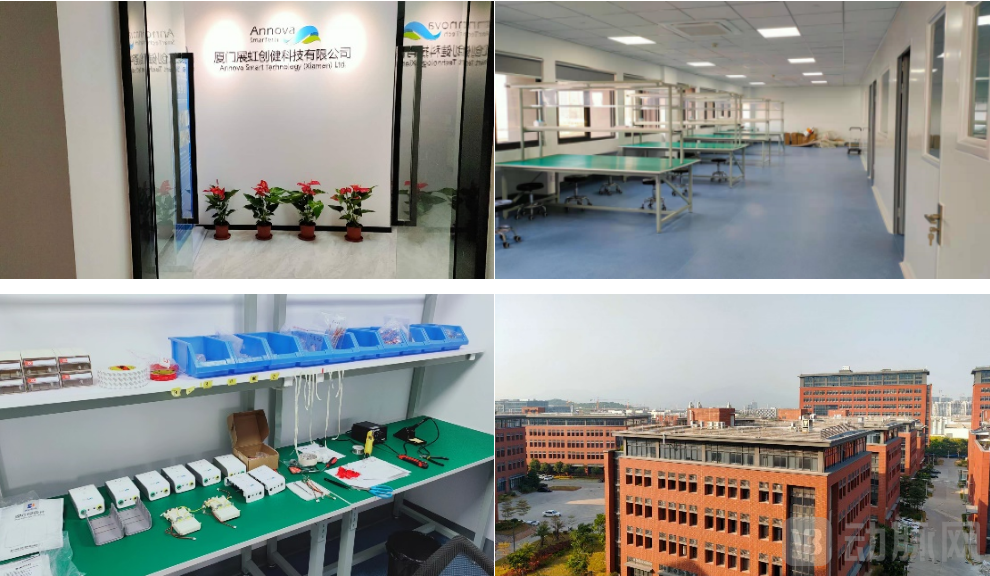
Real Photos of Zhanhong Chuangjian's Environment
Zhanhong Chuangjian's flagship product is an upper limb rehabilitation training device—Mobile External Neuromusculoskeletal System Flexon。
This is a mobile communication-based, flexible wearable brain-limb collaborative rehabilitation device that integrates neural electrical stimulation, exoskeletons, artificial pneumatic muscles, and modern outdoor sportswear technology. It is designed for upper limb rehabilitation treatment and brain function recovery training in stroke patients during the acute, subacute, and chronic phases.
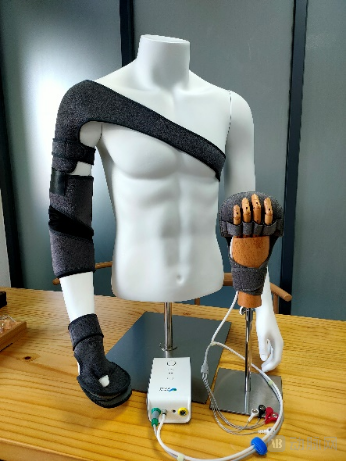
Flexon Mobile Peripheral Neuromusculoskeletal System
According to Dr. Miao, the main features of this device are as follows:
One innovative approach is the multimodal design that combines pneumatic soft exoskeletons with electrical nerve stimulation, effectively and precisely rehabilitating the function of specific paralyzed muscles.This design features three key characteristics. First, the integration of mechanical assistance with electrical stimulation reduces the system’s scale and power consumption, significantly lowering manufacturing costs and system weight. This enables convenient, mobile rehabilitation for users, unrestricted by location. Second, by leveraging outdoor sports textile materials, the robot’s main components are integrated into a wearable, easy-to-clean garment format that is easy to don and doff, soft, comfortable, and offers a superior user experience. Third, the combination of mechanical assistance and electrical stimulation significantly enhances rehabilitation efficacy and accelerates the recovery process. Clinical evaluations demonstrate that, compared to mechanical assistance alone, this system more effectively improves muscle coordination.
Second, it enables real-time surface electromyography (sEMG) acquisition and electrical stimulation control on specified muscles using the same electrodes across multiple channels.. The main challenge lies in the susceptibility of surface electromyography (sEMG) to electrical stimulation artifacts and various complex environmental noises. By employing unique circuit amplification and anti-interference designs, the system accurately captures weak myoelectric signals from patients and identifies motor intent. It then drives functional electrical stimulation to activate specific paralyzed muscles and utilizes external forces provided by a flexible exoskeleton to assist patients in performing upper limb movements, thereby helping them complete actions.
Third, it enables multi-joint movements of the fingers, wrist, and elbow at multiple angles, either independently or in a coordinated manner.Compared to single-joint or localized upper limb exercises available on the market, this product offers multiple joint training options tailored to the needs of different patients. It enables patients to perform coordinated, multi-joint upper limb movements involved in daily activities such as grasping, holding, and gripping, thereby facilitating generalized activities of daily living (ADL) training. Additionally, it can locally strengthen the function of weakened joints, improving both the precision and strength of affected limb muscle movements, while enhancing patients’ self-care abilities and overall rehabilitation outcomes.
Fourth, an active-assisted training mode triggered by surface electromyography (sEMG) is adopted.By capturing residual electromyographic (EMG) signals from the affected limb, this approach triggers the training process driven by the patient’s own motor intention, transforming passive training into active rehabilitation and enhancing therapeutic efficacy. This model enables patients to perceive joint and muscle feedback during each exercise session, facilitating a motor relearning process characterized by spiral progression, which is conducive to the restoration of cerebral motor function.
Furthermore, the device is operated via a mobile app, enabling real-time acquisition and recording of patient rehabilitation training data. This not only allows patients to clearly monitor their training outcomes during home-based exercises but also assists healthcare professionals in remotely evaluating patients' rehabilitation progress. Leveraging AI algorithms, the device continuously provides personalized and precisely optimized training prescriptions based on improvements in patients' limb function. Additionally, interactive features among patients enhance the engagement and enjoyment of the training process.
Zhanhong Chuangjian has distinguished itself in various competitions through its innovative technologies and robust products. In 2019, it won the Gold Medal, the Grand Prize for Excellence, and the Special Grand Award from the Polish Patent Office at the Geneva International Exhibition of Inventions. In 2020, it received the Excellence Award at the 6th Xiamen “Egret Star” Innovation and Entrepreneurship Competition. In 2021, it successively won the Excellence Award at the 6th Yangcheng Cup (Sci-Tech Innovation Cup) Innovation and Entrepreneurship Competition, the Second Prize in the finals of the 2021 Qingdao Lanbei International Innovation and Entrepreneurship Competition, and the First Prize in both the semi-finals and the grand finals of the 4th China Medical Device Innovation and Entrepreneurship Competition.
Meanwhile, Zhanhong Chuangjian was successively selected for the Incu-bio incubation program at Hong Kong Science Park and a major biomedical project supported by the Xiamen Municipal Science and Technology Bureau, receiving various innovation and entrepreneurship policy supports from both local governments. In 2021, Zhanhong Chuangjian was successfully listed on the “Min-Southwest Science and Technology Board” under stock code 861654. To date, the company has filed nine new patent applications, seven of which have been granted.
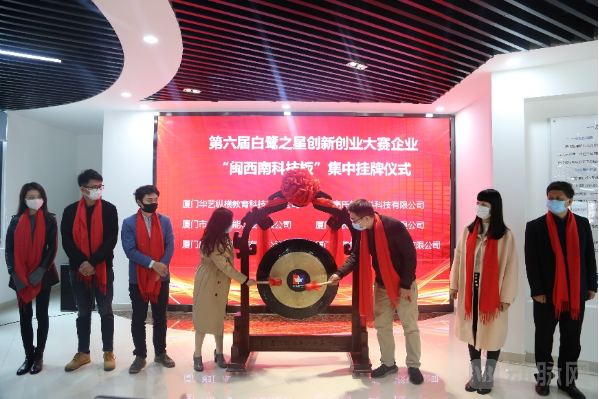
Listing Ceremony
Clinically, the product has completed clinical efficacy evaluations in hundreds of patients at dozens of hospitals, including Queen Elizabeth Hospital Hong Kong, Sha Tin Hospital Hong Kong, Prince of Wales Hospital Hong Kong, Hong Kong Jockey Club Rehabilitation Clinics, National Research Center for Rehabilitation Technical Aids, The First Affiliated Hospital of Sun Yat-sen University, The Second Affiliated Hospital of Zhejiang University School of Medicine, and Xiamen Taihe Rehabilitation Hospital. Results demonstrated that after 40 hours of training over four weeks, the product enhanced coupling strength between the cerebral cortex and muscles, reduced muscle spasticity in the affected limb, improved motor coordination of the affected limb, and enhanced wrist and finger joint function, thereby significantly accelerating the limb rehabilitation process and improving rehabilitation outcomes.
Commercialization has tripped up countless rehabilitation robotics and assistive device companies, yet Dr. Miao remains unfazed: “Imported products from abroad often cost millions of yuan, while some domestic upper-limb rehabilitation systems are priced as high as hundreds of thousands. Such expensive products are inevitably affordable only for large medical institutions. Zhanhong Chuangjian’s original mission is to enable more patients to access rehabilitation training; therefore, the company targets grassroots hospitals, community centers, and home settings, pursuing a differentiated competitive strategy. While ensuring convenience and effectiveness of training, our selling price will be significantly lower than that of approved upper-limb rehabilitation training devices on the market, allowing ordinary households to easily conduct professional rehabilitation training.”
Dr. Miao also revealed that the company is optimistic about the future home rental and shared service models for rehabilitation devices and assistive technologies, as well as the application prospects of mobile wearable rehabilitation equipment and remote rehabilitation management for patients. To this end, the company is actively strategizing to leverage its product advantages to build an innovative ecosystem for rehabilitation services. In the future, the company’s product portfolio will gradually expand from stroke rehabilitation to the prevention and treatment of various other conditions, including orthopedic rehabilitation, spinal cord injury, and peripheral nerve injury.
It is reported that Zhanhong Chuangjian has completed the construction of its manufacturing facility in Xiamen and conducted multiple batches of pilot-scale production. The company is currently advancing product registration applications and expects to obtain the registration certificate by the end of this year or early next year. At present, the company is seeking financing to accelerate the certification process, strengthen its team, and initiate new product development.