

Noah Medical Logistics Robotics, Founded by Former Huawei Executive, Files IPO Prospectus as a National "Specialized, Sophisticated, and Innovative" SME
In the post-pandemic era, unmanned intelligent logistics in hospitals has become a major trend.
The pandemic has accelerated policy enhancements, ushering in a new wave of healthcare infrastructure development. On July 1, 2021, the Construction Standards for General Hospitals (Jianbiao 110-2021), compiled by the National Health Commission, officially came into effect. For the first time, logistics equipment was incorporated into these standards, providing a crucial basis for the planning, design, and construction of modern hospitals. As a key component of this new healthcare infrastructure, intelligent hospital logistics systems will facilitate upgrades in hospital management, enhance efficiency, reduce costs, and establish a comprehensive logistical support system for hospital administration, medical staff, and patients.
According to the "China Health and Health Statistical Yearbook 2021," the national budget for intelligent hospital logistics is projected to exceed RMB 200 billion. The average cycle for hospital renovation and expansion is five years, with a natural annual growth rate of 20% and an additional annual growth rate of approximately 7%-8% from newly established hospitals. In terms of market size, the annual increase in hospital logistics budgets is approximately 27%, meaning that beyond the existing storage capacity valued at RMB 200 billion, there is an additional annual increment of around RMB 60 billion.
Currently, hospital logistics transmission systems mainly include traditional mechanical logistics (pneumatic tube systems, rail-guided vehicles, and box-type conveyor systems) as well as third-generation robotic logistics. However, traditional mechanical logistics share a significant common drawback: they must be incorporated into the design during the hospital’s architectural planning phase, entail high construction costs, and have limited load capacity. For hospitals that are already built, retrofitting these systems is extremely difficult.
The emergence of hospital logistics robots has effectively addressed the aforementioned issues. These robots offer numerous advantages, including high payload capacity, efficient transportation, low deployment costs, safety and reliability, minimal impact on existing infrastructure, and flexible, convenient deployment. They not only resolve the longstanding problems of low efficiency and high error rates associated with traditional manual transport but also avoid the drawbacks of conventional mechanized logistics, which often require costly modifications to hospital buildings. Furthermore, robotic logistics systems can be rapidly reconfigured to switch between infection control zones and adjust route planning as needed, thereby effectively preventing cross-infection within healthcare facilities.
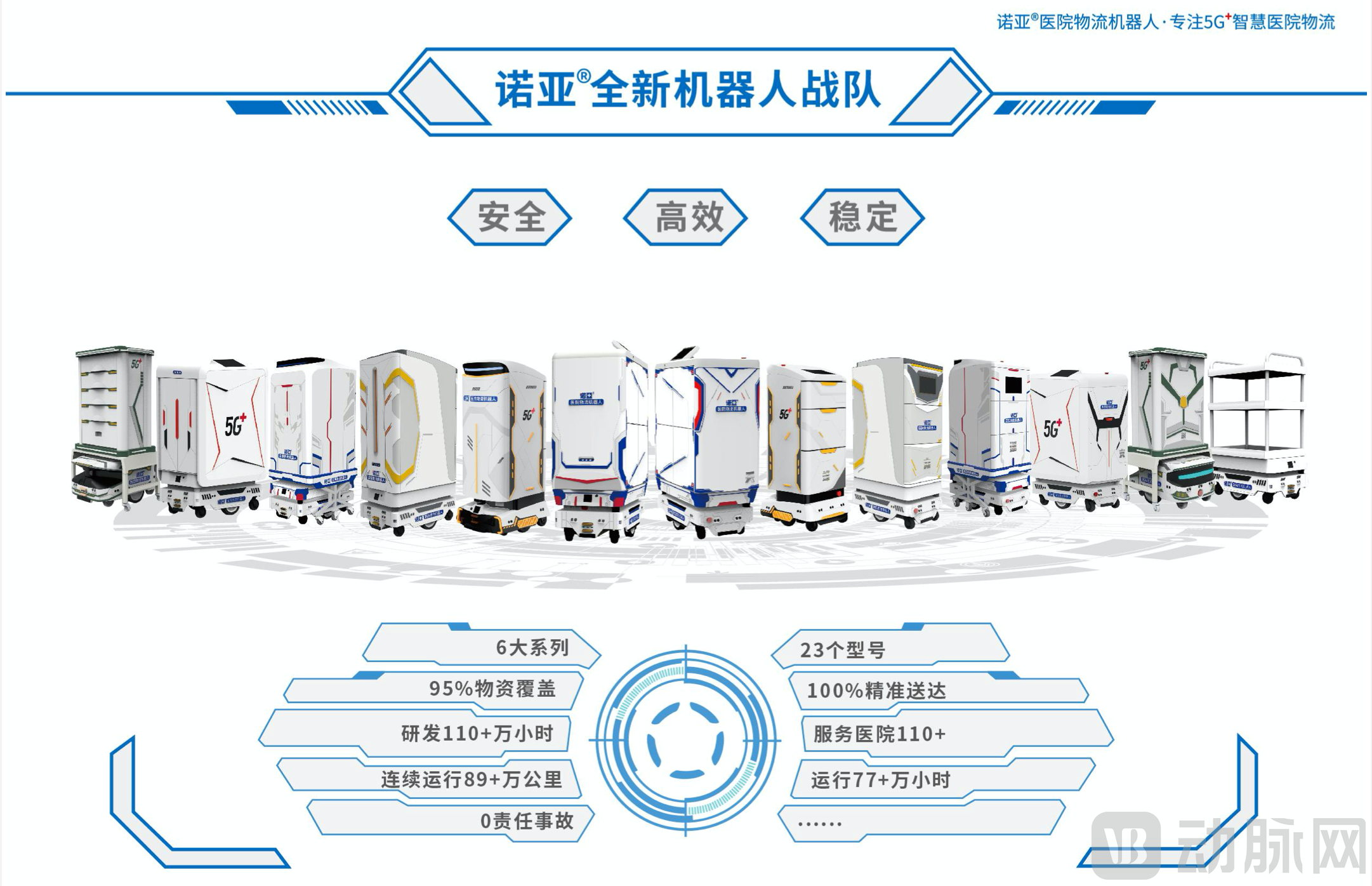
Since 2014, after rapid adjustments, the entity formerly known as “Mrobot”Noah®Hospital Logistics Robotsfocus on and commit toCreating a Hospital-Wide 5G Smart Logistics Solution for Hospitals. Based on the three core technologies of 5G, artificial intelligence, and autonomous driving, it realizes "dynamic object recognition," "intelligent scheduling," and "intelligent IoT" within the hospital, creating a hospital-wide intelligent real-time scheduling system that enables fully automated delivery of materials throughout the entire hospital.
For hospital logistics robots to deliver genuine value to hospitals and healthcare professionals, they must be deployed across the entire hospital’s logistics network, rather than operating in isolated, localized scenarios to address individual problems. This requires manufacturers of hospital logistics robots to both pinpoint specific departmental needs for targeted breakthroughs and maintain a holistic perspective that integrates the hospital’s overall logistics flow. By addressing challenges such as cross-floor transportation, these systems can ensure efficient and seamless operation throughout the institution.
Hospital logistics solutions must not only possess robust capabilities for multi-robot, multi-task scheduling to address challenges in robot reuse and flexible dispatching, but also provide intelligent IoT systems deeply integrated with hospital environments and clinical workflows, along with advanced technologies and solutions such as complex communication and anti-interference mechanisms, and unmanned automatic loading and unloading.
Compared with other hospital logistics robot companies on the market, Noah®Logistics robots offer the following advantages:
Noah’s core founding team and key members mostly hail from Huawei, all being seasoned technology experts.Jiang Huabing, Chairman of the Board and Chief Product Officer, has 17 years of experience at Huawei and is one of the founders of Huawei Mobile. As a high-tech company with Huawei’s DNA, Noah deeply understands the importance of mastering core technologies in-house. The company currently employs over 100 people, with R&D personnel accounting for more than 60%. In its early stages, the company allocated most of its resources to technological R&D and product development to build strong technical barriers. It now holds more than 220 nationally authorized patents (including over 90 invention patents) and has achieved a technology reserve strategy of “producing one generation, developing the next, and storing the subsequent one.”
"Eight years of dedicated development have established a hospital-wide logistics and all-scenario material distribution system."Noah®The predecessor of the hospital logistics robot was Mrobot, founded in 2014. Over the eight years since its establishment, Noah®Hospital logistics robots have remained deeply rooted in their specialized domain, pursuing in-depth innovation and launching six major series comprising 23 products. These solutions enable hospital-wide logistics operations, covering 95% of in-hospital material distribution. To date, Noah®Hospital logistics robots have been deployed in more than 110 hospitals, including Ruijin Hospital Affiliated to Shanghai Jiao Tong University School of Medicine, the First Affiliated Hospital of Zhengzhou University, the First Affiliated Hospital of China Medical University, West China Hospital of Sichuan University, the First Affiliated Hospital of Nanhua University, the Affiliated Hospital of Qinghai University, and Guangxi International Zhuang Medicine Hospital.
Refined Material Management: Helping Hospitals Reduce Costs and Improve Efficiency.Based on years of precise identification of hospital needs and bold innovation, Noah®Hospital logistics robots have pioneered the industry’s first smart cabinets, featuring automatic multi-destination identification, mixed-item recognition, professional-grade communication antennas with anti-interference design, and precise one-item-one-code tracking for high-value supplies. These solutions enable hospitals to achieve refined material management, reduce labor costs associated with medical supply administration, and allow healthcare professionals to focus squarely on patient care.
Full-stack in-house R&D to master core technologies, with self-built factories to ensure product stability.The Noah team has been forging ahead in technological R&D, launching innovative technologies such as Escape Algorithm 1.0 and StereoEye™, continuously innovating to provide smarter, more efficient, safer, and more stable hospital logistics solutions. The company has also established its own manufacturing facilities in Nantong, Jiangsu Province, and Jiaxing, Zhejiang Province, ensuring the production of core components and product stability. Noah® Hospital Logistics Robots are among the few products to have obtained dual certification from both the China Robot Certification (CR) and the manufacturing facility.
Furthermore, Noah®Hospital Logistics Robots Are StillLead Drafter of International Robotics Standards, National Drafter of Robotics Standards, National Drafter of Artificial Intelligence Standards, actively participated in the drafting and co-editing of multiple national and industry association standards, served as the lead author for one international robotics standard (IEC/TC125), and contributed to the development of ten national standards (eight of which have been officially released), thereby facilitating the standardized development of the industry.
Among the various technologies,Escape Algorithm 1.0andNoah®StereoEye™It's Noah®The Most Representative Technologies of Hospital Logistics Robots.
“Unlike service robots in hotels or restaurants, where staff can promptly respond to a robot’s distress call and clear obstacles if it gets stuck, hospitals have many floors but limited personnel. Moreover, the specimens, medications, and other items transported by these robots are highly time-sensitive, as patients and doctors often need them urgently. This necessitates that the robots possess superior self-rescue capabilities,” explained Jiang Huabing.
The operational environment within hospitals is more complex, and human-robot interaction is more frequent, imposing stricter technical requirements on the navigation and scheduling systems of mobile robots. How to plan travel paths, how to avoid obstacles, how to extricate itself when trapped, and what to do when battery power is low—all these decisions are executed by algorithms within the robot’s processor. As the core of “intelligence,” a mature set of algorithms determines the behavior of hospital logistics robots.
To this end, the R&D team at Mrobot has, through years of iterative research and exploration, continuously pushed the boundaries of scenario-based applications for hospital logistics robots’ obstacle-clearance algorithms, officially launchingEscape Algorithm 1.0. Even in "hell-level" escape scenarios, such as being only 10 cm from a wall with obstacles both in front and behind, Noah®Hospital logistics robots can also safely and accurately autonomously extricate themselves and drive out, significantly enhancing their adaptive operational capabilities in the dynamic and complex hospital environment.
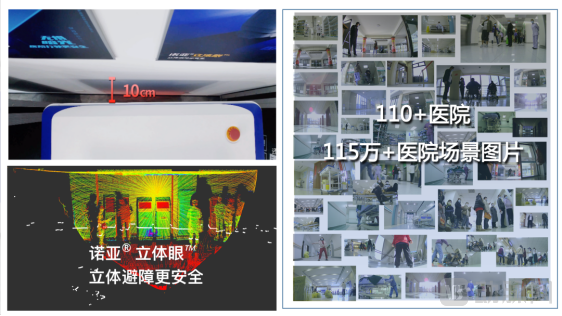
Noah®StereoVision™, safer stereo obstacle avoidance.This marks the first application of 3D laser aerospace technology in the field of hospital logistics robots. Driven by a relentless pursuit of technological excellence, Noah’s new generation of “Stereo Eye” series hospital-wide logistics robots come standard with 3D LiDAR across the entire product line. The multi-sensor fusion localization algorithm has been comprehensively upgraded, enabling the industry’s first achievement in 3D high-precision map building and localization. This advancement increases real-time localization data volume by up to 100 times, making robot localization more precise and reliable across all scenarios throughout the hospital.
Meanwhile, Noah has comprehensively upgraded its multi-sensor data fusion visual recognition technology to enhance obstacle detection capabilities. It remains unaffected by challenging lighting conditions such as strong light, reflections, and low light, enabling more accurate perception, identification, and localization of obstacles by the robot, thereby ensuring safer autonomous navigation across all hospital scenarios. Leveraging high-precision autonomous positioning and superior obstacle perception, Noah utilizes the industry’s most extensive dataset of autonomous driving in hospital environments to optimize algorithms through deep learning. This allows the robot to handle complex pedestrian scenarios throughout the hospital with greater ease, ensuring efficient and safe passage.
Recently, Noah®Hospital Logistics Robot Wins Award2022 “Little Giant” Enterprise Designation for Specialized, Refined, Differential, and Innovative SMEs, becoming a leading enterprise in the field of hospital logistics.
Regarding the future evolution of the hospital logistics robot industry, Noah®Jiang Huabing, founder of hospital logistics robots, stated that logistics robots based on autonomous driving technology will become one of the priority development directions in the field of hospital logistics, thanks to their advantages such as high efficiency, contactless operation, flexible application scenarios, and rapid deployment. Meanwhile, he believes that the most important competitiveness in the future field of hospital logistics robots is“Hospital Needs Insight + Product Technology Barriers”, to create logistics robots that better understand hospitals.
According to Noah®aspects revealed,The company's revenue and profits have both grown continuously over the past three years, with a business growth rate of 100%.Going forward, the company will continue to focus on hospital logistics and transportation scenarios, intensify efforts in original innovation and market expansion, deepen its development as a “specialized, refined, distinctive, and innovative” enterprise, leverage its role as a model “Little Giant” firm, achieve comprehensive integration of healthcare and robotics, and facilitate the smart transformation of hospital logistics.