

Shenling Rui Files IPO Prospectus: Advancing Global Innovative CNS Therapies and Building a Proprietary Pipeline in a Billion-Dollar Market
The nervous system is the most intricate and structurally and functionally complex system in the human body. The sophisticated activities of billions of neurons and glial cells collectively give rise to human consciousness, perception, thought, and behavior.
The prevalence of central nervous system (CNS) disorders is comparable to that of oncology and cardiovascular diseases, indicating a substantial market potential. However, the success rate for CNS drug development stands at only 6%, which is less than half that of other therapeutic areas.
Yan Jun, Co-founder and CEO of NeuroFrontIt was stated that the mechanisms underlying central nervous system (CNS) diseases are complex, and due to various factors such as the blood-brain barrier, challenges in conducting clinical studies, and the placebo effect, CNS drug development is highly difficult. Over the past two decades, there have been few major breakthroughs in neuroscience research and development.
Given the complexity of the nervous system and the challenges in drug development,There is a substantial unmet clinical need for pharmacological treatments in the field of central nervous system (CNS) diseases.According to Frost & Sullivan statistics, the global CNS drug market size was $124.5 billion in 2019, making it the fourth-largest pharmaceutical market. Over the next 15 years, the global CNS drug market is expected to maintain steady growth, reaching $172.1 billion by 2034. In 2019, China's CNS drug market size was $29.6 billion and is projected to experience rapid growth in the future.Behind this lies a market worth hundreds of billions.
NeuroFrontis a clinical-stage neuroscience biotechnology company,Dedicated to the development and commercialization of innovative neuroscience therapies, and building an innovative pipeline of CNS treatments.Including therapies for migraine, diabetic peripheral neuropathic pain, depression, attention-deficit/hyperactivity disorder (ADHD), and other central nervous system (CNS) diseases with significant unmet clinical needs, to address unmet needs in China and Asia and improve patients’ lives.
Core Team: 30 Years of Deep Expertise in the CNS Field, with a Differentiated Strategic Layout in a Trillion-Yuan Market
NeuroFront was established in the second half of 2020, incubated by two life science investment platforms: Nf Life Sciences and Dingfeng Life Science Capital. The core team has been deeply engaged in the CNS field for many years, possessing extensive experience in CNS drug R&D and commercialization.

Ms. Yan Jun, Co-Founder and CEO of NeuroFront Pharmaceuticals
Ms. Yan Jun, Co-founder and CEO of NeuroFront Pharmaceuticals, brings over 20 years of business and management experience in the pharmaceutical industry, spanning the U.S., Asian, and Chinese markets.
Prior to founding NeuroFront, Yan Jun held key management positions, including Vice President of the CNS Business Unit and General Manager, at multinational pharmaceutical and biotechnology companies such as Eli Lilly, Celgene, and BeiGene. He has accumulated extensive experience in product commercialization and corporate management, having overseen the promotion of well-known neurological drugs including Cymbalta, Zyprexa, Prozac, Strattera, and Symbyax.
Dr. Tong Gang, Co-Founder and Chief Medical Officer of NeuroFront
Dr. Tong Gang, Co-Founder and Chief Medical Officer of NeuroFront Pharmaceuticals, brings over 30 years of experience in the field of neuroscience. He has previously served as Head of Clinical Science and Executive Medical Director at Takeda, Lundbeck, and Bristol Myers Squibb, where he led the clinical development of more than 20 CNS drugs.
In Ms. Yan Jun’s view, unlike the intense competition (“involution”) seen in novel oncology drugs, the domestic CNS field has witnessed very few innovative new drugs over the past two decades. There remains a significant gap between China’s R&D progress and that of overseas markets, with very few companies truly engaged in innovative drug development.
However, this also means that competition in the CNS field is less intense compared to other therapeutic areas, offering significant opportunities for truly innovative products and substantial market potential.
Based on this thinking, NeuroFrontDifferentiation Strategy Breakthrough,In the early stage, leveraging the license-in model to introduce globally leading breakthrough therapies, on the one hand, to address unmet therapeutic needs in China and Asia, and on the other hand, to leverage thisBuild capabilities in product R&D, clinical trials, and commercialization to lay a solid foundation for the future pipeline of self-developed products., contributing to the company's long-term development.
Introducing Global Breakthrough Therapies to Drive the Development of Proprietary Pipeline
Since the second half of last year, the capital market has been gripped by a chill, and the entire healthcare sector is fraught with uncertainty. How to navigate this capital winter smoothly is a question that startups currently need to consider.
The cooling of the capital market has also sparked considerable skepticism within the industry regarding the license-in model. With project costs rising continuously, and domestic national reimbursement drug list (NRDL) negotiations and volume-based procurement (VBP) exerting persistent cost pressures, should the profitability of products acquired at high prices be called into question?
Yan Jun, however, believes that the license-in model should not be summarily dismissed.The success of a license-in deal depends on multiple factors, including the degree of product differentiation, whether it truly meets patient needs, the team’s capabilities in clinical registration and commercialization, as well as project terms and production costs.
“License-in actually provides us with an opportunity to leapfrog competitors by introducing breakthrough therapies from abroad into China under controlled risk. This approach first addresses some unmet medical needs while generating revenue, thereby supporting the company’s continuous capacity building in R&D innovation, clinical development, and commercialization platforms,” said Yan Jun.
Most importantly, although the license-in model is currently viewed with skepticism, it still holds unique advantages in the central nervous system (CNS) field, particularly for assets in relatively early stages that entail significant R&D challenges.
Based on this, NeuroFront established its drug pipeline and medical device product line after conducting thorough industry research and analysis, taking the lead in introducing global innovative therapies in the CNS field.
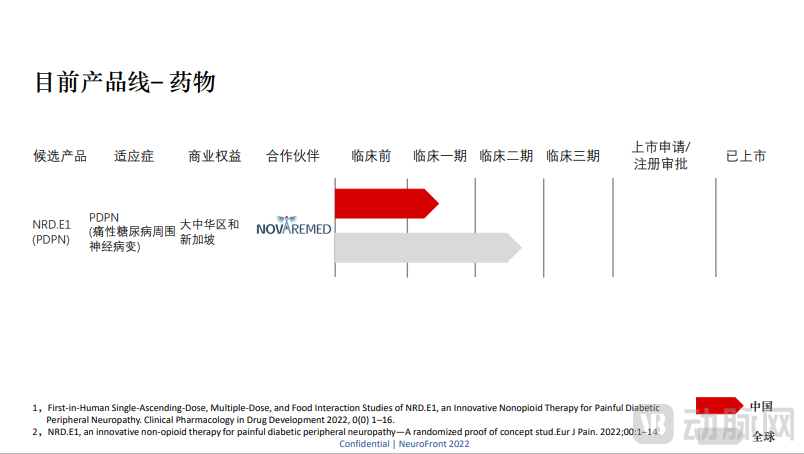 Drug Pipeline: Approval Progress of NRD.E1
In terms of pharmaceuticals, NeuroFront received approval in July this year for the treatmentThe world’s first-in-class novel drug for neuralgia, NRD.E1, atExclusive license for clinical development, commercialization, and manufacturing in Greater China and Singapore.NRD.E1 is a global first-in-class novel drug with a unique mechanism of action, developed by the Swiss biotechnology company Novaremed, for the treatment of painful diabetic peripheral neuropathy (PDPN).
Currently NRD.E1Completed three Phase I clinical studies and one randomized, double-blind, placebo-controlled Phase IIa clinical study, the results showed that NRD.E1 provided clinically meaningful improvement in patient pain and was well tolerated at all studied doses. Meanwhile, the drug has been granted FDA Fast Track designation and received full funding from the NIH for its Phase 2b clinical trial.
“Diabetic peripheral neuropathic pain is one of the most common, complex, and severe complications in patients with diabetes. There are nearly 19 million patients with diabetic peripheral neuropathic pain in China, yet no innovative drugs have been launched in this field for over a decade, resulting in a significant unmet medical need,” said Yan Jun.
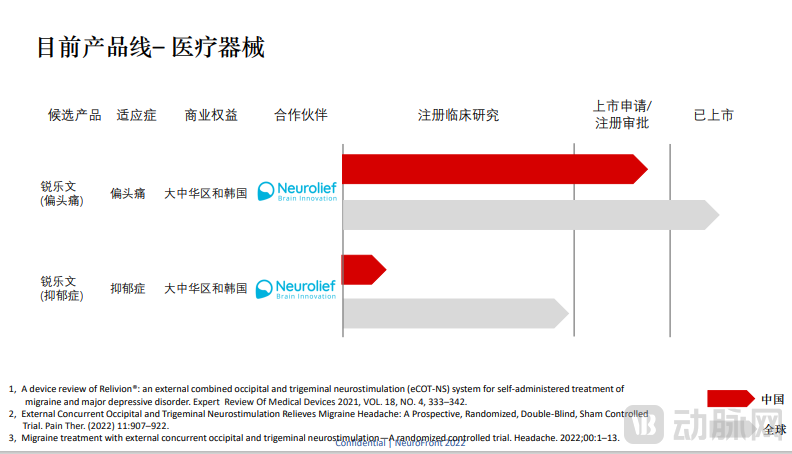
Medical Device Product Line: Approval Progress of Relivion
In the field of medical devices, NeuroFront has obtainedExclusive License Agreement for the Development and Commercialization of Relivion in Greater China and South Korea.Relivion is a product developed by the Israeli company Neurolief through innovative research and development of transcutaneous occipital nerve stimulation technology.Non-invasive Transcutaneous Electrical Nerve Stimulation Device, through transcutaneous nerve stimulation for combined occipital and trigeminal nerve stimulation,To provide a safe, effective, and fast-acting treatment for migraine-related pain.
Results from overseas clinical studies demonstrate that Relivion provides significant pain relief for the acute treatment of migraine: more than 60% of patients experienced pain improvement within 2 hours after treatment initiation (compared with 37% in the control group), nearly 50% achieved pain freedom (compared with 11% in the control group), and 75% reported resolution of their most bothersome migraine symptom (compared with 47% in the control group). Participants reported a favorable overall impression of its therapeutic efficacy, and the device exhibited a good safety profile.
Relivion has received CE marking for the treatment of migraine in adults and FDA clearance for the treatment of adult migraine with or without aura. Relivion is also developing a new indication for the treatment of depression and has received FDA Breakthrough Device Designation.
Tackling CNS New Drug Development Across Four Dimensions to Develop Independent, Innovative Therapies for Patients
The CNS field is highly complex, encompassing more than 1,500 disease types. In light of this, NeuroFront has been analyzing the overall landscape of CNS disorders in China since its inception, using four dimensions as evaluation criteria to guide its strategy for introducing external assets and developing internal pipelines, as well as for positioning its indications.
First,Market Potential, with the number of patients, unmet needs, and competitive landscape as the primary considerations. Second,R&D Progress, progress in this field regarding new targets and mechanisms of action, as well as the demand for R&D resources. Third,Market Entry Mode, evaluated from dimensions such as inclusion in the national medical insurance scheme, patient population characteristics, and market competition. Finally,Team Capabilities, Based on the core team's in-depth research into the overall landscape of CNS and its disease areas, NeuroFront is confident in delivering more effective new drugs to patients with CNS disorders.
Based on the above assessment, NeuroFront focuses on the CNS field, with indications covering four to five diseases including migraine, neuralgia, and depression. The company is currently advancing both in-licensing and self-developed projects in an orderly manner.
In addition to leveraging introduced projects to rapidly meet patient needs, NeuroFront alsoPlace greater emphasis on cultivating intrinsic motivation.
Given the significant challenges and high risks associated with CNS drug development, startups that pursue original drug discovery from scratch will incur substantial time costs and face a very high probability of failure. Furthermore,Currently, innovative CNS drugs in China are all in the early stages, and it will take at least 5–8 years to achieve commercialization.Whoever can shorten R&D time and rapidly drive products to market will gain a first-mover advantage.
NeuroFront leverages the license-in model to rapidly build its clinical development, drug registration, and commercialization platforms, effectively mitigating time-related uncertainties, accelerating R&D progress, and reducing R&D risks. Meanwhile,In terms of pipeline strategy, NeuroFront has chosen to combine lower-risk, short-term projects with long-term innovative initiatives, thereby building a healthy pipeline ecosystem.
Currently, leveraging its accumulated experience and preliminary work, NeuroFront has partnered with third-party R&D platforms to develop innovative drugs, starting with relatively low-risk targets validated by clinical data and gradually transitioning to higher-risk, novel, and pioneering targets.
Meanwhile, NeuroFront is also embarking onEstablish an in-house R&D platform to prepare for the development of innovative drugs targeting novel therapeutic targets.
The CNS therapeutic area harbors immense market opportunities. Driven by growing unmet medical needs, a competitive landscape significantly more favorable than that of oncology and other fields, rapid iteration of innovative technologies, and increasing attention from government, society, capital, and industry in recent years, the CNS sector is on the verge of an explosive breakthrough.
Looking ahead, Yan Jun stated that since the implementation of the Marketing Authorization Holder (MAH) system, a large number of biotech companies have emerged in China over the past five to six years, with the effects of market leadership beginning to take shape. However, in the field of central nervous system (CNS) disorders, no clearly leading dominant players have yet arisen. For startups, the ability to achieve rapid growth and make phased progress will determine whether they can secure a foothold in the industry in the future.
“Leveraging our core team’s years of research experience in the CNS field, along with our steadily built capabilities in R&D innovation and commercialization, we aim to establish NeuroFront as one of the leading enterprises in the CNS sector. We aspire to evolve from an outstanding biotech company into a top-tier biopharma leader, dedicated to developing better therapies for more patients facing complex neurological diseases,” said Yan Jun.