

Shanghai Children's Medical Center's Fu Wei Proposes Novel Regenerative Medicine Strategy Combining mRNA Technology and Cell Therapy to Unlock a Billion-Dollar Market
“Regenerative Medicine” Is Igniting a Multi-Billion-Dollar Market.
According to analysis by market research firm Verified Market Research, the global regenerative medicine market was valued at $27.7 billion in 2020 and is projected to reach $149.8 billion by 2028, with gross profit margins generally exceeding 70%, making it veritably “a major gold mine.”
In China, regenerative medicine materials have achieved large-scale clinical application and industrialization. As the cornerstone of the entire development of regenerative medicine, stem cells have currently yielded few outcomes in clinical use, but the pace of clinical translation has been accelerating in recent years.
It is reported that in 2020, the number of enterprises in China's regenerative medicine sector reached 4,899. Furthermore, from 2018 to 2020, companies with a scale exceeding RMB 10 million accounted for 34.5% of all regenerative medicine enterprises in China.
In academia, regenerative medicine has also garnered significant attention. National Children’s Medical Center (Shanghai), Shanghai Children’s Medical Center Affiliated to Shanghai Jiao Tong University School of MedicineProfessor Wei FuHaving focused on the field of regenerative medicine research for over a decade, his team is dedicated toLeveraging mRNA technology in combination with cell therapies (including induced pluripotent stem cells and mesenchymal stem cells) for the regenerative repair of various tissues and organs.
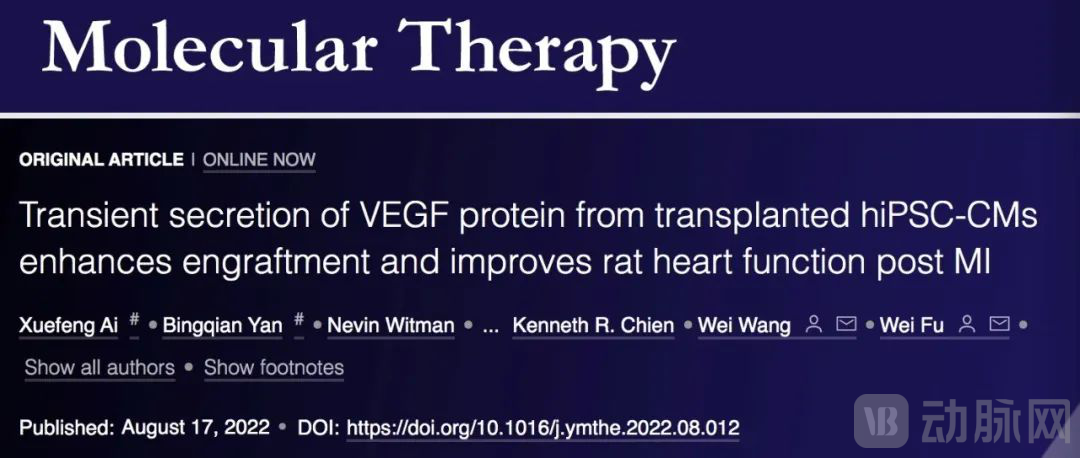
This August, Fu Wei’s team published online in *Molecular Therapy*, the official journal of the American Society of Gene & Cell Therapy.Transient secretion of VEGF protein from transplanted hiPSC-CMs enhances engraftment and improves rat heart function post MI(A Study on Transient Secretion of Vascular Endothelial Growth Factor by Human Induced Pluripotent Stem Cell-Derived Cardiomyocytes to Promote Grafted Cell Survival and Improve Cardiac Function). After the article was published,VCBeat Orange BureauAn interview was conducted to understand its technical advantages and applications, as well as its plans for future commercialization of research outcomes.
From Interest to Expertise
In his original plan, Fu Wei aspired to become an elite in the computer industry. During the college entrance examination, he applied for the Computer Science program at Southeast University in Nanjing.
However, in that year, Nanjing Railway Medical College was merged into Southeast University, which inadvertently led Fu Wei, who had originally applied for a computer science major, to become one of the inaugural students at the newly established Southeast University School of Medicine.
Choosing to pursue research in regenerative medicine is driven by personal interest.
Like most medical students, Fu Wei initially studied clinical medicine. It was only after he was admitted to Shanghai Ninth People’s Hospital, Shanghai Jiao Tong University School of Medicine—the pioneer of tissue engineering and regenerative medicine in China—for his graduate studies that he became inspired by Professor Cao Yilin and his famous “mouse with a human ear” experiment. He came to believe that the ability to regenerate various human tissues and organs would hold immense application value.
At this moment, a seed of regeneration was sown in Fu Wei’s heart, namelyUpon graduation, one is not necessarily required to work as a physician treating patients; one may also engage in the research and development of tissue and organ products, thereby alleviating patient suffering from a different perspective and serving a broader patient population.
What truly allowed the seeds to take root was Fu Wei’s in-depth research in the field of stem cell tissue engineering during his doctoral studies. After earning his Ph.D., unlike his peers who chose clinical careers, Fu Wei joined the Shanghai Children’s Medical Center affiliated with Shanghai Jiao Tong University School of Medicine, where he established a research group from scratch and independently conducted stem cell research, embarking on a new chapter in his life.My First "Startup Venture"。
In 2016, Fu Wei had the opportunity to visit and study at the Karolinska Institutet in Sweden, where he studied under Professor Kenneth R. Chien, a renowned expert in cardiovascular regeneration and mRNA technology. As early as 2010, Professor Kenneth R. Chien co-founded Moderna, a pioneering company in the mRNA field, together with Robert Langer and several other partners. In Professor Kenneth R. Chien’s laboratory at the Karolinska Institutet, Fu Wei was exposed to and gradually mastered a comprehensive suite of technologies encompassing mRNA design, preparation, and application.
After completing his studies in 2017, he returned to the Shanghai Children's Medical Center. At that time, before the outbreak of COVID-19, there were very few laboratories in China engaged in mRNA research, and the technology enjoyed limited recognition. Fu Wei once again started from scratch to build an mRNA technology platform integrated with cell therapy, embarking onThe Second “Startup”。
Deep Integration of mRNA Technology with Cell Therapy Across Multiple Application Scenarios
In the latest study, the team pretreated human induced pluripotent stem cell-derived cardiomyocytes with vascular endothelial growth factor A (VEGFA) mRNA (modified messenger RNA), enabling them to secrete VEGFA protein in a pulsatile, highly efficient, and transiently rapid manner after transplantation. This approach promotes rapid vascularization and proliferation of the grafts, significantly improves the survival rate of transplanted cardiomyocytes, and facilitates functional recovery of the heart.
This is internationallyFirst timeProposing a Strategy to Combine mRNA Technology with Human Induced Pluripotent Stem Cell-Derived Cardiomyocytes (iPSC-CMs) for the Treatment of Myocardial Ischemia.
In fact,“The Dual-Concept Synergy of ‘mRNA Technology + Cell Therapy’”, offering numerous advantages.
Originally, in the field of regenerative medicine research, cell therapy and mRNA therapy for heart failure were two distinct and separate therapeutic approaches, each with its own advantages and limitations. Specifically, cell therapy faces the challenge of low post-transplantation cell survival rates, while mRNA therapy struggles with rapid degradation in vivo and low transfection efficiency. However, by organically integrating these two approaches, it is possible toSimultaneously achieving the dual effects of improving cell viability and transfection efficiency.
Fu Wei revealed, “In this study, on the one hand, cardiomyocytes derived from human induced pluripotent stem cells (hiPSCs) provide a new source of cardiomyocytes for the heart after myocardial infarction. Meanwhile, the cardiomyocytes themselves serve as vehicles for the delivery and expression of mRNA, eliminating the need for encapsulation and delivery via lipid nanoparticles. On the other hand, mRNA is used to achieve efficient, transient, and specific expression of factors promoting angiogenesis, thereby facilitating the rapid formation of new blood vessels. This provides nutrients and a favorable local microenvironment that enhance the survival of transplanted cardiomyocytes, significantly improving the efficacy of cell therapy.”
This study holds strong translational potential, not only due to the advantages of mRNA technology in engineering and modification, but also because somatic cells can be obtained from heart failure patients, reprogrammed into induced pluripotent stem cells (iPSCs), and subsequently differentiated into cardiomyocytes.
In addition, Fu Wei also stated that,“mRNA technology + cell therapy” is a platform-based technology that is not limited to integration with iPSCs; it can also be combined with mesenchymal stem cell (MSC) therapy, NK cell therapy, and T cell therapy. Leveraging this technology, products suitable for multiple application scenarios can continue to be developed.
For instance, in the currently burgeoning field of mesenchymal stem cell (MSC) therapies, challenges persist, including a significant age-related decline in MSC quantity and expansion capacity, as well as a marked reduction in differentiation potential. In particular, unmodified cells lack disease-specific targeting. By integrating mRNA technology, however, the specificity of disease treatment can be enhanced safely and efficiently, thereby substantially improving the therapeutic efficacy of MSCs.
In fact, even before the outbreak of COVID-19, the team collaborated with Professor Zhang Wenjie from the Shanghai Key Laboratory of Tissue Engineering at Shanghai Ninth People’s Hospital to publish research on mRNA combined with fibroblasts for the treatment of lower limb ischemia. To date, the team has joined forces with multiple research groups from institutions such as Shanghai Ninth People’s Hospital, Zhejiang University School of Medicine, and Wenzhou Medical University to conduct regenerative studies on tissues including joints, skin, and corneas, resulting in the publication of a series of papers.
withSkin and Corneal RegenerationFor example, by isolating adipose-derived mesenchymal stem cells and subsequently engineering them using specific mRNA technologies, the specificity of stem cell therapy can be significantly enhanced.
In the field of skin regeneration, this approach will be applied to the treatment of diabetic skin ulcers and scar repair in medical aesthetics. In ophthalmology, it is reported that modifying adipose-derived stem cells using mRNA technology can achieve perfect corneal repair and regeneration within approximately two weeks, offering new hope to patients with corneal injuries.
“We are not suggesting that the task ends with the publication of a research paper; rather, we aim to expand the multiple application scenarios of this technology and translate our research findings into products that benefit patients,” said Fu Wei.
Regarding the market and academia, Fu Wei stated, “After enduring a prolonged trough, regenerative medicine is poised for a surge in China over the next decade, driven by gradual breakthroughs in foundational life science technologies and the relaxation of, along with supportive incentives from, national policies.”
Platformization of Achievement Transformation
Leveraging Fu Wei’s interdisciplinary background in stem cell-based tissue regeneration and mRNA technology, as well as the unique features of “mRNA technology + cell therapy,” Fu Wei also hopes for the commercialization of these technological achievements.Capable of building the team into a platform-based research organization or company。
Regenerative medicine encompasses a broad spectrum, playing a pivotal role not only in wound repair but also holding immense potential in the field of anti-aging. To facilitate further in-depth research, a multi-faceted technological platform serves as an ideal framework for team-based translational efforts.
A technology-driven platform serves as a source of innovation, enabling teams to conduct research on diverse application scenarios by integrating mRNA technology with cell therapy.
“Leveraging our technology research platform, we have a steady stream of regenerative medicine achievements and product outputs. However, as we move toward industrialization, it is neither feasible nor necessary for us to handle everything in-house. Therefore, our team adopts a flexible approach to technology transfer: we can license or assign part of our portfolio to other companies, while selectively commercializing a small subset of products ourselves.”
By leveraging a technology-driven platform, the team maximized its strengths and mitigated its weaknesses in the process of translating research outcomes into practical applications. Specifically, it capitalized on its expertise in R&D while circumventing its shortcomings in product manufacturing and management.
Although the team’s commercialization logic is clear, building a technology-driven platform is no easy feat. Platform operations require a systematic approach, as well as capital and resources to keep the ecosystem dynamic—this brings us to the critical role of co-founders.
Amid the startup boom, what China lacks most is not scientists, but partners who can collaborate with them.
CEOs who can effectively collaborate with scientists typically possess three key characteristics: first, technical literacy, enabling them to understand the language of scientists; second, market acumen, allowing them to guide products through clinical development; and third, operational expertise, ensuring effective post-launch product management.
The team is currently engaging with the industry, meeting numerous investors and large corporations. Through these discussions, we have gained valuable insights into how to identify ideal partners:
First, both scientists and investors need to shift their mindsets. Many investors transitioning into the life sciences investment sector must understand the long-term nature and complexity of biomedical technology and product development, while scientists need to ground their technologies in market demand to ensure their products gain market acceptance. Second, it is essential to find partners with aligned values, mutual recognition in terms of personality and goals, which is crucial for long-term success.
Starting from clinical medicine, persisting in stem cell regenerative medicine research, and then leveraging the advantages of mRNA technology, Professor Fu Wei’s multidisciplinary and cross-cutting research experience has laid a solid foundation for incubating the translational pathway of “mRNA technology + cell therapy” in the field of regenerative medicine. Meanwhile, Professor Fu Wei also hopes to use this as an opportunity to initiateThird “Startup”。