

How High Is the Market Ceiling for the Overnight Sensation—Targeted Pathogen Sequencing?
KingMed Diagnostics
Third-Party Medical Testing and Pathological Diagnosis Service Provider
In 2022, metagenomic next-generation sequencing (mNGS), once extremely popular, encountered unprecedented challenges.
The emergence of pathogen-targeted sequencing (targeted NGS, tNGS) has further complicated the increasingly saturated competitive landscape of the pathogen metagenomic sequencing market.
On one hand, pathogen-targeted sequencing is more cost-effective, easier to perform, and faster, earning immediate favor from clinicians and patients upon its debut. This stands in contrast to pathogen metagenomic sequencing, which has been commercialized for many years yet has struggled to truly achieve these goals.
On the other hand, unlike the relatively pure technology-driven approach seen at the inception of the commercialization of pathogen metagenomics, the participant landscape in the pathogen targeted sequencing market is evidently more complex. It includes large-scale third-party medical laboratories with strong distribution capabilities, such as KingMed Diagnostics, Dian Diagnostics, and Huayin Health; it also encompasses leading players from the pathogen metagenomics sector, such as Jinshi Medicine and Jieyi Biotechnology; and it even involves testing service companies primarily focused on tumor genetic testing, such as Geneseeq. This technological application, characterized by lower barriers to entry and greater certainty, is undoubtedly driving profound changes in the pathogen diagnostics market.
So, what is the actual market size for pathogen-targeted sequencing? And what opportunities will it bring to companies already involved or preparing to enter this field? We attempt to provide answers.
Pathogen-targeted sequencing has a short commercialization history but strong momentum.
“In April 2021, our ‘pathogen-targeted sequencing’ product began clinical trials, making it one of the earliest in its category,” Li Pei, Director of the Infectious Disease Line at KingMed Diagnostics and Head of the Group’s Infectious Diseases Department, told VCBeat. According to her, after more than six months of clinical promotion, clinicians gradually recognized the technical advantages of this product, and the level of clinical acceptance for this innovative approach exceeded expectations.
In a sense, the rapid adoption of pathogen-targeted sequencing products has benefited from the prominence of pathogen metagenomic next-generation sequencing (mNGS) products. In clinical practice, most physicians lack sufficient diagnostic acumen to identify infectious pathogens; consequently, mNGS products gained immediate popularity upon their market launch. Over the past few years, substantial capital influx has propelled star enterprises in the pathogen mNGS sector—such as Weiyuan Gene, Jinshi Medicine, and Jieyi Biology—into the spotlight. These companies have accelerated the clinical application of this innovative technology and helped establish market awareness among frontline physicians and patients regarding precise pathogen diagnosis. Currently, hundreds of thousands of patients annually rely on pathogen mNGS to identify their infecting pathogens.
However, metagenomic next-generation sequencing (mNGS) for pathogenic microorganisms is not without its limitations, with detection sensitivity being a notable one. In pathogen metagenomic sequencing, host-derived sequences account for more than 90% of the total sequencing data, while signals from pathogenic microorganisms are relatively weak. Additionally, challenges such as host genetic interference and difficulties in strain typing further constrain performance, thereby imposing stringent requirements on detection sensitivity. In response, various companies are actively optimizing technologies to enhance microbial signal detection, creating opportunities for targeted sequencing technologies to play a significant role.
Pathogen-Targeted Sequencing TechnologyBy combining ultra-multiplex PCR amplification with high-throughput sequencing, pathogen-targeted sequencing technology detects dozens to hundreds of known pathogenic microorganisms, as well as their virulence and antibiotic resistance genes, in test samples. In its commercial application, this approach focuses on clinically common infectious pathogens. It employs specifically designed primers and an ultra-multiplex PCR library preparation system to perform targeted amplification and enrichment of target sequences, followed by simultaneous detection of the amplification products via high-throughput sequencing. Since only the nucleic acids of pathogenic microorganisms are sequenced, the detection sensitivity for these pathogens is significantly enhanced.
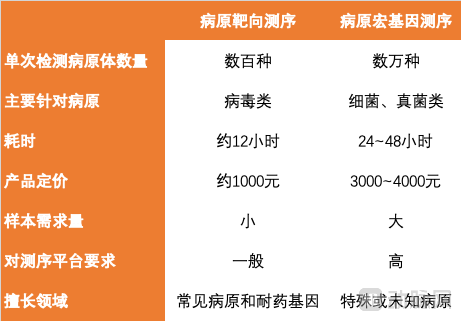
Comparison Between Pathogen-Targeted Sequencing and Pathogen Metagenomic Sequencing
This new diagnostic product strives for “what you see is what you get; detection equals infection,” enabling the process from sample collection to report issuance to be completed within12completed within hours, it is a pathogen diagnostic product with greater clinical accessibility and operability. KingMed Diagnostics’ core pathogen-targeted sequencing product, “Upper Respiratory50and respiration100” as an example, they can achieve higher detection sensitivity for specific pathogens, such as the Mycobacterium tuberculosis complex, Chlamydia psittaci, and Cryptococcus neoformans, than metagenomic next-generation sequencing (mNGS) products, while also balancingDNAandRNAViruses can also provide more comprehensive information for the identification of pathogenic subtypes and subspecies.
“For physicians lacking expertise in infectious diseases, pathogen-targeted sequencing provides the majority of the diagnostic answers, significantly reducing the required knowledge base and skill set, thereby lowering the difficulty and entry barrier,” pointed out Li Pei. “Currently, we have achieved a market-leading position in this niche sector.”
Another advantage of pathogen-targeted sequencing is its low cost. Compared with the currently well-known mNGS products, the cost of pathogen-targeted sequencing is only 1/4 to 1/3 of that, offering greater health economic value. First, in terms of the selection of gene sequencers, pathogen-targeted sequencing can utilize relatively simpler and lower-priced gene sequencers. The data volume of pathogen-targeted sequencing is 1/200 of that of pathogen metagenomic sequencing, resulting in a much smaller amount of sequencing data. For instance, KingMed Diagnostics uses low-throughput gene sequencers to perform pathogen-targeted sequencing, whereas pathogen metagenomic sequencing often requires high-throughput large-scale gene sequencers. Second, the reagents configured for the operation of the sequencer are also relatively simpler, corresponding to lower costs. Finally, at the level of sequencing operations, pathogen-targeted sequencing does not require a high level of professional expertise from users, and the overall degree of automation is higher, which will reduce labor costs to some extent.
VCBeat has learned that KingMed Diagnostics can currently complete nearly2Testing of 10,000 samples. In Li Pei’s view, based on the growth momentum of pathogen-targeted sequencing, the number of pathogen-targeted sequencing samples received annually will exceed5010,000 cases.
In fact, beyond KingMed Diagnostics, a wave of companies specializing in pathogen-targeted sequencing is emerging. VCBeat’s analysis reveals that these pathogen-targeted sequencing products are largely similar in terms of technical approaches and the number of pathogens covered; all aim to detect clinically common DNA pathogens, RNA pathogens, and drug-resistance genes, with differences lying primarily in pathogen panels, sequencing platforms, and clinical promotion strategies.
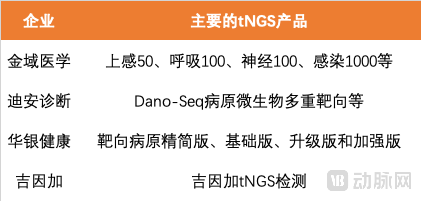
Major Pathogen-Targeted Sequencing Products Currently on the Market
For example, in October 2021, Illumina launched in the United States a broad-spectrum respiratory pathogen antimicrobial resistance (AMR) gene detection kit based on targeted sequencing technology. This kit can simultaneously detect 282 DNA and RNA pathogens, including certain AMR-related genes. Meanwhile, Huayin Health’s flagship basic and upgraded versions of its pathogen targeted sequencing products cover approximately 200 types of DNA and RNA pathogens, as well as nearly 100 AMR genes with clear clinical guidance value for anti-infective therapy. These products are primarily designed for initial pathogen screening in hospitalized patients with infections, with pricing at the thousand-yuan level.
Gene+’s pathogen-targeted sequencing product is also used for the initial screening of hospitalized patients with infections. The key difference lies in Gene+’s focus on detecting low-abundance pathogens, antibiotic resistance genes, and virulence genes, collaborating with hospitals through customized design and development. In contrast, Dian Diagnostics has launched Dano-seq, a multiplex targeted assay for pathogenic microorganisms, characterized by real-time sequencing analysis using third-generation nanopore sequencing technology. By integrating this approach with conventional microbiological testing methods, it delivers an integrated report combining “sequencing + smear” results.
Clearly, for companies specializing in pathogen-targeted sequencing, it is no easy task to secure and sustain a competitive advantage, given the technology’s short commercialization history.
“Once hospitals adopt pathogen-targeted sequencing, it basically leaves pathogen metagenomic sequencing with only a few remaining applications.” An industry practitioner once described the impact of pathogen-targeted sequencing products in this way. This inevitably raises suspicion that the rapid advancement of pathogen-targeted sequencing is encroaching upon the market for pathogen metagenomic sequencing.
In fact, rather than saying that pathogen-targeted sequencing replaces the clinical application space of pathogen metagenomics, it is more accurate to say that the two complement each other, jointly improving the efficiency of in-hospital pathogen diagnosis.
In clinical practice, traditional microbial culture methods and empirical diagnosis remain the mainstream. It is well known that while the clinical management of pathogenic infections is often straightforward, identifying the specific causative pathogens is challenging. For instance, based on patient presentations, clinicians can diagnose conditions such as pneumonia, urinary tract infections, cholecystitis, meningitis, and endocarditis. However, pinpointing the exact pathogen from a broad spectrum of potential agents—including Staphylococcus aureus, Escherichia coli, Klebsiella pneumoniae, Acinetobacter baumannii, Pseudomonas aeruginosa, and Mycoplasma—poses significant difficulties.
This is because traditional pathogen diagnostic methods are not highly efficient. Bacterial culture requires a considerable amount of time, whereas in clinical practice, treatment cannot be delayed until the results of pathogenic microbiology tests are available. Furthermore, the positive rate of microbial cultures is relatively low, meaning that causative pathogens often fail to be isolated in many infectious cases. For instance, culturing pathogens from community-acquired pneumonia is particularly challenging and rarely successful.
Consequently, empirical diagnosis and treatment remain widely used in antimicrobial therapy. This pathogen-directed approach typically formulates treatment regimens by integrating factors such as the site of infection, common pathogens, and their corresponding antimicrobial agents. For instance, since Escherichia coli and Staphylococcus saprophyticus are the most common pathogens causing urinary tract infections, empirical guidelines recommend cephalosporins, quinolones, and other similar agents. As a result, the precision of clinical antibiotic application remains relatively low.
The emergence of pathogen metagenomic sequencing has, to some extent, improved this situation. However, as mentioned in the previous section, due to its high cost and low accuracy, the clinical application of pathogen metagenomic sequencing remains limited to a narrow scope, thereby creating opportunities for synergy with pathogen-targeted sequencing.
This synergy is reflected, on one hand, in the chronological sequence. During clinical promotion, manufacturers often recommend advancing the timing of pathogen-targeted sequencing. The rationale behind this is that pathogen-targeted sequencing covers both DNA and RNA viruses, enabling early identification of pathogens at the initial stage of infection, thereby allowing for more targeted treatment. For instance, Gene+’s tNGS testing technology focuses on targeted detection of specific pathogens, reduces human background noise, increases enrichment by tens to hundreds of folds, enhances sensitivity, and achieves efficient detection of Firmicutes, intracellular bacteria, RNA viruses, and drug-resistance markers.
In most cases, pathogen-targeted sequencing can identify the infectious agent responsible for a patient’s infection. Current data indicate that there are only approximately 200 clinically common pathogens. For patients with suspected infections, targeted sequencing should be employed as an initial test to provide clinicians with information on common pathogenic microorganisms and their associated antibiotic resistance profiles. If the causative pathogen is not covered by the targeted sequencing panel used, it may be a relatively rare or even novel pathogen. At this stage, metagenomic next-generation sequencing (mNGS) should be initiated to conduct a comprehensive, “needle-in-a-haystack” search for pathogen identification.
On the other hand, this is also reflected in the selection of application scenarios. Based on current concentrated application areas, pathogen-targeted sequencing is mostly applied in respiratory diseases, focusing on viral infections, while pathogen metagenomic sequencing is more commonly used in severe infection cases, such as central nervous system infections and bloodstream infections, comprehensively covering diverse pathogens including bacteria, fungi, and viruses.
In this sense, pathogen-targeted sequencing and pathogen metagenomic sequencing have distinct clinical application objectives. The former aims to facilitate the earlier initiation of optimized antibiotic therapy, reducing the need for broad-spectrum coverage and prolonged treatment courses, thereby enabling more targeted therapy and lowering medical costs, while the latter can serve as a definitive diagnostic solution for complex infectious diseases.
In the future, as the cost of NGS sequencing continues to decline and operational convenience further improves, metagenomic and targeted sequencing technologies will advance in tandem and complement each other in the field of microbial NGS sequencing. It is anticipated that serving clinical practice through product combinations of these two approaches will become a prevailing trend.
An undeniable fact is that the market ceiling for pathogen-targeted sequencing is not high if confined to current application scenarios. Assuming an annual volume of one million tests at a price of RMB 1,000 per test, the total market size would amount to only RMB 1 billion, which is clearly insufficient to be shared by the numerous companies rushing into the pathogen-targeted sequencing sector.
For pathogen-targeted sequencing, the greater market opportunity lies in breaking through the boundaries of existing application scenarios.
First is the type of pathogen targeted. At present, pathogen-targeted sequencing primarily serves patients with respiratory infections, covering more than 95% of clinical infection scenarios, with viral infections being predominant in respiratory cases. In reality, however, pathogens causing hospital-acquired infections include bacteria, viruses, and fungi. Among these, bacterial infections are the most common, accounting for over 90% of hospital-acquired infections, predominantly caused by Gram-negative bacteria such as Escherichia coli, Klebsiella pneumoniae, Pseudomonas aeruginosa, and Acinetobacter baumannii. In other words, existing pathogen-targeted sequencing products cover only the tip of the iceberg of hospital-acquired infection pathogens, leaving substantial room for further application and exploration.
For example, pathogen-targeted sequencing products enable earlier and more precise diagnosis of pathogens in bloodstream infections. When a bloodstream infection is suspected, targeted antibiotic therapy can be initiated promptly based on the test results. “The series of products based on pathogen-targeted sequencing can meet the needs of departments including pediatrics, respiratory medicine, and infectious diseases,”ICU, and nearly all other departments, including tuberculosis specialties, have a demand for diagnostic identification of infectious pathogens.” Li Pei also stated to VCBeat that infections accompany humans throughout their lives, and as the product portfolio continues to expand, the application scenarios for pathogen-targeted sequencing will further diversify.
Secondly, regarding application scenarios. At present, despite its earlier launch, pathogen-targeted sequencing remains primarily limited to hospitalized patients with infections. In the outpatient setting, the penetration rate of pathogen-targeted sequencing is still very low due to the relatively long turnaround time for test results and the persistently high costs. As technology and product design continue to mature, the pathogen-targeted sequencing market that comprehensively covers both in-hospital and out-of-hospital infected patients will clearly represent a larger blue ocean opportunity.
Overall, the emergence and commercialization of pathogen-targeted sequencing technology have provided a more efficient tool for the diagnosis of infectious pathogens, which remains inefficient. We look forward to the continuous iteration of this tool, enabling its implementation in more diverse clinical scenarios.