

Provention Bio Submits New Prospectus Highlighting PRV-031 (Teplizumab) for Type 1 Diabetes Prevention and Pipeline Expansion

Provention Bio
Biopharmaceutical Manufacturer

Hercules Capital
Non-Bank Lenders
In the past two years, Provention Bio, a biopharmaceutical company dedicated to blocking and preventing immune-mediated diseases, has frequently appeared in the public eye, generating significant buzz.
Despite its core productsPRV-031 failed to demonstrate PK after the FDA application was submitted(PK is the primary endpoint metric for demonstrating comparability between two products)failed to pass the Biologics License Application (BLA) review due to comparability issues, but as the first immunomodulator for type 1 diabetes (T1D), each phase of clinical trials triggered fluctuations in its stock price.June 2019,Provention Bio Announces at the American Diabetes Association Annual MeetingPRV-031 trial results met clinical endpoints, driving a 300% surge in the stock price on the same day.
As of this September, after several rounds of share issuance,Provention Bio’s market capitalization has reached $411 million (approximately RMB 2.9 billion).
In September this year, Provention Bio announced that it had secured a $125 million term loan financing from Hercules Capital, with the second tranche of this financing round to be disbursed upon the company’s key productPRV-031 received FDA approval for market launch.January,Provention Bio Resubmits FDA Application; FDA Accepts Filing and Extends PDUFA Target Date from August 17, 2022, to November 17, 2022。
From its Series A financing through multiple follow-on offerings leading up to its IPO, Provention Bio has collaborated with major institutions on the research and development of therapies for immune-mediated diseases. Although none of its drug candidates have yet received FDA approval, its strategic path has become clearly defined. So, how has Provention Bio earned the favor of its key partners?
Provention Bio was founded in October 2016. Headquartered in New Jersey, USA, it is a clinical-stage biopharmaceutical company focused on blocking and preventing immune-mediated diseases. The company went public on the NASDAQ in July 2018.Provention Bio’s key product isPRV-031(teplizumab), initially by Eli Lilly (Eli Lilly) co-developed,This is an anti-CD3 monoclonal antibody drug used to intervene in and delay type 1 diabetes.. In addition,Provention Bio also has multiple clinical-stage drug candidates targeting autoimmune diseases such as type 1 diabetes, lupus erythematosus, and celiac disease.
Ashleigh Palmer, Co-founder and Chief Executive Officer (CEO) of Provention Bio, holds an MBA from the University of Bradford and an honors bachelor’s degree in Biochemistry and Applied Molecular Biology from the University of Manchester.HeWith over 30 years of experience in the biopharmaceutical industry, developed and commercialized INOmax®, the world’s first selective pulmonary vasodilator, while serving as Chief Executive Officer of iNO Therapeutics.
Francisco Leon, another co-founder and Chief Scientific Officer (CSO) of Provention Bio, earned his Ph.D. in Mucosal Immunology from the Autonomous University of Madrid,With over 20 years of experience in academic research and biopharmaceuticals, successfully developed and launched five drugs to the market.
Can Type 1 Diabetes Be Prevented?
Type 1 Diabetes (T1D) is a chronic health condition caused by the immune-mediated destruction of insulin-producing cells in the pancreas. To date, there is no cure. The only way to manage this disease is through lifelong blood glucose monitoring and insulin injections. To prevent this disease,Provention Bio has initiated clinical studies on multiple drug candidates.
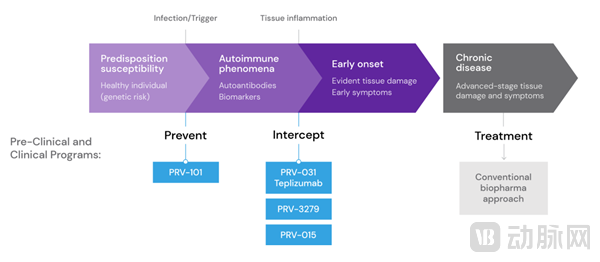
Mechanism of Action of Candidate Drugs Source:Provention Bio Official Website
A study indicates that Coxsackievirus B (CVB) infection may be a triggering factor for type 1 diabetes (T1D), as the onset of T1D often occurs following CVB infection. CVB is a common and potentially severe infection that damages insulin-producing cells and intestinal epithelial cells, eliciting a T-cell immune response that can lead to susceptible immune-mediated diseases. Therefore, if CVB infection can be blocked, vaccinating high-risk populations against CVB could potentially prevent or delay the onset of T1D.
The CVB vaccine was initially developed by the Finnish biotechnology company Vactech Ltd. and received certification approval in April 2017. In July 2017,Provention Bio Licenses Vactech’s CVB Vaccine Platform to Advance PRV-101 (Coxsackievirus B Vaccine) with Investment Support from the JDRF T1D Fund
In 2018, Provention Bio andDutch biotechnology company Intravacc has become a partner. Launched in 2020PRV-101 First-in-Human Clinical Trial,If successful, PRV-101 will become the first vaccine to prevent CVB infection and may reduce the incidence of T1D and celiac disease.。
In March this year, the clinical trial results for PRV-101 were released. Six months after the final vaccine dose, PRV-101 met its primary endpoint, confirming the tolerability observed in the previously reported interim analysis, with no serious adverse events, special adverse events, or adverse events leading to discontinuation of the study drug. The results also demonstrated the durability of the virus neutralizing antibody (VNT) response. At the six-month time point following the final administration, the percentage of subjects maintaining high VNT titers in the high-dose PRV-101 group was 100% for most serotypes included in the vaccine and no less than 90% for all serotypes.
In May 2018, Provention Bio announced an agreement with MacroGenics to acquire PRV-031 (Teplizumab), an anti-CD3 monoclonal antibody drug for the intervention and delay of type 1 diabetes. This drug was previously co-developed by MacroGenics and Eli Lilly.
In April 2019, Provention Bio announced the initiation of a Phase 3 clinical trial for PRV-031. The trial enrolled a total of 300 patients with type 1 diabetes. Its objective was to evaluate the efficacy of PRV-031 in preserving β-cell function in children and adolescents aged 8–17 years with type 1 diabetes. Data from this 18-month trial were scheduled to be released in the first half of 2023.
In June 2019, the National Institutes of Health (NIH)-sponsored “At Risk” study evaluated PRV-031. The study enrolled 76 patients with type 1 diabetes (T1D), aged 8 to 49 years, who were considered “at risk” due to the presence of two or more T1D autoantibodies and abnormal glucose metabolism (dysglycemia). Seventy-two percent of the participants were under 18 years of age. Subjects were randomly assigned to receive either PRV-031 (teplizumab) or placebo.
The evaluation results indicated that, compared with placebo, a single 14-day course of PRV-031 (teplizumab) significantly delayed the onset and diagnosis of clinical type 1 diabetes (T1D) by two years in children and adults considered at high risk. During the trial, 72% of participants in the placebo group developed clinical diabetes, whereas only 43% did so in the PRV-031 (teplizumab) group.In the study, approximately 60% of subjects who received only one course of PRV-031 treatment did not develop T1D, which was twice the rate observed in the placebo group, indicating a 50% reduction in incidence.
The results of this study indicate that,PRV-031 has become the first immunomodulator to demonstrate a delay in the clinical onset of type 1 diabetes, holding promise for intervening in and fundamentally altering the progression of T1D in high-risk populations.。
Because of this study,PRV-031 was granted Breakthrough Therapy Designation (BTD) by the FDA and received Priority Medicines (PRIME) designation from the European Medicines Agency (EMA).—Provide special support, including enhanced interaction and dialogue, as well as expedited pathways for assessment and review.
In 2020, Provention Bio announced at the American Diabetes Association (ADA) Scientific Sessions that results from studies conducted by TrialNet, a network of type 1 diabetes (T1D) researchers, showed thatCompared with placebo,PRV-031(Teplizumab) a 14-day course of treatment significantly delayed the onset of type 1 diabetes (T1D) in patients, with a median delay of approximately three years, representing a one-year increase compared to previous results from “high-risk” studies. Additionally, it was found that PRV-031 significantly reversed the decline in C-peptide levels—a decline that predisposes individuals to diabetes—indicating that PRV-031 is more effective at maintaining stable C-peptide levels.
Based on these significant trial results, Provention Bio submitted a Biologics License Application (BLA) for PRV-031 to the FDA in early 2021. The FDA rejected the application on the grounds that PRV-031 failed to demonstrate pharmacokinetic (PK) comparability. Previously, during the qualification review of PRV-031, the FDA convened an advisory committee meeting, at which members voted on the question, “Do the benefits of PRV-031 outweigh the risks supporting approval for delaying clinical type 1 diabetes?” The vote resulted in a 10 (in favor) to 7 (against) split.
In February this year, Provention Bio resubmitted its BLA application to the FDA;In March, the FDA accepted the resubmission and extended the user fee goal date to November 17, 2022.。
The BLA application for this drug will determine whether Provention Bio can secure its Series B financing from Hercules Capital, and also whether a new breakthrough has been achieved in T1D therapeutics.
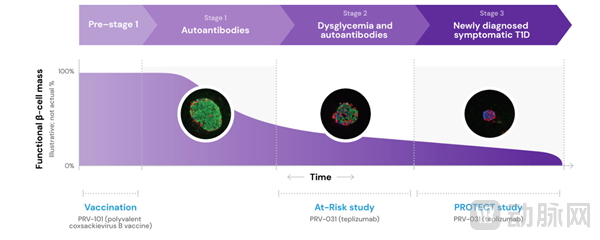 PRV-101 vs. PRV-301: Different Stages of Action Source: Provention Bio Official Website
Other Immune-Mediated Candidate Drugs
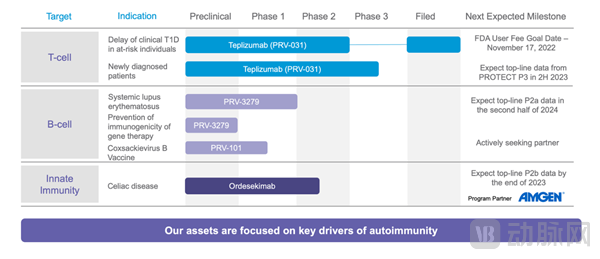
Provention Bio’s Multi-Asset Drug Development Pipeline Source: Provention Bio Official Website
Systemic Lupus Erythematosus (SLE) is a chronic autoimmune disease that can cause systemic inflammation and pain. Patients with SLE may experience joint pain, photosensitivity, rashes, and issues affecting internal organs (brain, lungs, kidneys, and heart). Currently, there is no cure for lupus; the goal of treatment is to alleviate symptoms and reduce organ damage.
PRV-3279 is an investigational humanized bispecific DART molecule targeting the B-cell membrane proteins CD32B and CD79B, developed by MacroGenics. A collaboration agreement was reached with MacroGenics in 2018 to continue its development. In 2019, Provention Bio initiated a randomized, double-blind, placebo-controlled Phase 1b/2a clinical trial conducted in the United States and Hong Kong, China, to evaluate the efficacy of PRV-3279 in reducing SLE flares.
In 2021,Provention Bio and Hangzhou Zhongmei Huadong Pharmaceutical Co., Ltd., a wholly-owned subsidiary of Huadong Medicine Co., Ltd., Announce Strategic Partnership, Zhongmei Huadong Pharmaceutical Co., Ltd. will obtain the rights to develop and commercialize PRV-3279 in the Greater China region in the future.
Celiac disease is a chronic, hereditary, systemic, immune-mediated inflammatory disorder that causes damage to the inner lining of the small intestine, leading to gastrointestinal dysfunction and other complications.
PRV-015, also known as AMG 714, is a human immunoglobulin monoclonal antibody that binds to IL-15. In 2018, PRV-015 underwent two clinical trials. Currently,Provention Bio is recruiting patients for a Phase 2 clinical trial, aiming to enroll individuals aged 18–70 years with confirmed celiac disease in a 32-week study to evaluate the safety and efficacy of PRV-015. Results from this study are expected by the end of 2023.
Crohn's disease isInflammatory bowel disease of unknown etiology can occur in any part of the gastrointestinal tract, but it most commonly affects the terminal ileum and the right hemicolon. This condition and chronic nonspecific ulcerativeColitisCollectively referred to asInflammatory Bowel Disease(IBD). There is currently no general cure for Crohn's disease; surgical intervention is required when complications arise.
PRV-6527, developed by Janssen Pharmaceuticals, has undergone clinical trials in 178 subjects to date. It is a highly potent and selective small-molecule oral inhibitor of CSF-1R. Provention Bio is developing this inhibitor with the aim of halting the progression of Crohn’s disease before it becomes a chronic, life-altering condition.
PRV-6527 is currently undergoing a randomized, double-blind, placebo-controlled Phase 2a trial, which was initiated in the first quarter of 2018.
Ulcerative colitis is a type of inflammatory bowel disease (IBD) that causes persistent inflammation and ulcers in the digestive tract. It affects the innermost lining of the colon, with symptoms developing gradually over time rather than appearing suddenly. Although current treatments for ulcerative colitis can alleviate symptoms and induce long-term remission in some patients, there is no cure. Most patients experience cycles of debilitating flare-ups and relapses, which can be life-threatening.
PRV-300, also developed by Janssen Pharmaceuticals, is a first-in-class fully human IgG4κ monoclonal antibody (mAb) that binds to the extracellular domain of Toll-like receptor 3 (TLR3) with high specificity and affinity.
PRV-300 is currently undergoing a randomized, double-blind, placebo-controlled Phase 1b clinical trial—the PULSE (Provention ULcertification Colitis Study Evaluation) study, which was initiated in the first quarter of 2018.
According to the company's financial report,As of June 30, 2022, the Company had $135.6 million of available capacity under its 2021 ATM Program.Provention Bio ended the second quarter of 2022 with $96.1 million in cash and recognized $7 million in revenue from its collaboration with Hangzhou Zhongmei Huadong Pharmaceutical Co., Ltd.
Although the BLA review for PRE-031 was once again extended by three months, the recently secured loan financing still enables Provention Bio to recognize its potential commercial value.