

Alibaba Health Enters Digital Patient Management, Reshaping the Chronic Disease Management Market

AliHealth
Medical and Health Services Network Service Provider
“I’ve been admitted!” Upon receiving the long-awaited graduate school admission letter, Zhou Ting immediately shared the good news with her family, classmates, and a community—home to a group of special “comrades-in-arms.”
One noon four years ago, Zhou Ting walked into the cafeteria as usual when she was suddenly struck by an unprecedented stabbing pain. She collapsed to the ground in convulsions, her jaw clenched tight, scattering her meal across the floor. Following an electroencephalogram (EEG) examination, Zhou Ting was diagnosed with epilepsy. Epilepsy is a paroxysmal neurological disorder whose etiology is often unclear and largely unpreventable; once seizures occur, long-term medication is required to control the condition. In China, the prevalence of epilepsy is as high as 7‰, meaning nearly 7 out of every 1,000 people are affected by the disease.
For a long time, Zhou Ting needed to find a way to live with her illness. Taking medication on schedule and getting adequate sleep are the most basic requirements; overcoming psychological fear and facing oneself with equanimity is a more challenging task.
Fortunately, Zhou Ting found a group of fellow patients who shared her struggles. In the community at the AliHealth Epilepsy Rehabilitation Center, Zhou Ting and hundreds of other epilepsy patients regularly completed health check-ins and answered questions to learn about disease management. When encountering issues, she habitually consulted rehabilitation managers in the group and engaged in discussions with her fellow patients.
“We’re just a bunch of mischievous neurons. With proper understanding, epilepsy is not such a frightening disease,” Zhou Ting reassured her fellow patients in the group chat, offering comfort to herself as well. The online community where Zhou Ting and her peers connect represents a key area of focused commitment for AliHealth.
On September 15, at the 2022 Digital Pharmaceutical Industry Forum held in Hangzhou,AliHealth Internet Hospital Unveils Digital Patient Management Model for the First Time, Leveraging Leading Digital Technology and Operational Capabilities to Provide Accessible Disease Management for Patients and New Pathways for Pharmaceutical Companies to Serve Patients in the Out-of-Hospital Market.
As is well known, chronic diseases have become the leading cause of death and the primary source of disease burden among residents in China. According to the Healthy China Action (2019–2030), chronic diseases account for more than 70% of the total disease burden, representing a significant constraint on population health. Furthermore, individuals with chronic conditions require long-term, often lifelong, follow-up visits and medication, thereby enduring substantial psychological and financial pressure.
Therefore, the industry urgently needs to adopt more efficient and standardized management models to address the current situation characterized by the high susceptibility and prevalence of chronic diseases, as well as the significant challenges in their prevention and control. However,Numerous challenges arise in the process of translating theory into practice., encompassing resource integration, technological aspects, and service models. One of the most critical challenges is the ability to understand patients’ true needs.
In this regard, AliHealth has a natural advantage,Leveraging the hundreds of millions of consumers connected through AliHealth Pharmacy, we can gain deep insights into user needs.According to AliHealth’s fiscal year 2022 financial report, as of March 31, 2022, the annual active consumers of its online self-operated stores exceeded 110 million, and the number of patients with chronic diseases served reached 6.5 million, representing a year-on-year increase of 119%.
Two years ago, AliHealth embarked on an exploration of digital patient management. Through analysis of patients’ medication habits and extensive research, AliHealth discovered that many patients hold a fragmented understanding of their diseases and are highly susceptible to external influences. This often leads to poor adherence to medication and treatment regimens, thereby compromising effective disease management.
“We have been contemplating the essence of chronic disease management. I believe it lies in changing an individual’s cognition, thereby modifying their behavior and enabling lifestyle changes,” said Zhang Wen, Head of the Rehabilitation Center at AliHealth Internet Hospital.We have been seeking a way to profoundly and sustainably influence patients’ cognitive levels over the long term.”
It is reported that the newly released digital patient management model has undergone three iterations while serving a large number of patients, ultimately establishing a service strategy centered on online communities. Specifically, patients are precisely recruited into corresponding communities based on their disease types and medication habits; AliHealth integrates resources to provide personalized services tailored to the characteristics of each community.
A community typically features a professional coaching team comprising five key roles: rehabilitation managers, rehabilitation ambassadors, a panel of medical experts, a specialized medical team, and nutritionists. These professionals provide patients with disease management advice through live lectures, online Q&A sessions, and lifestyle guidance.
Patients or their family members, as community members, are deeply involved in the process, ultimately achieving the goal of effective disease management.
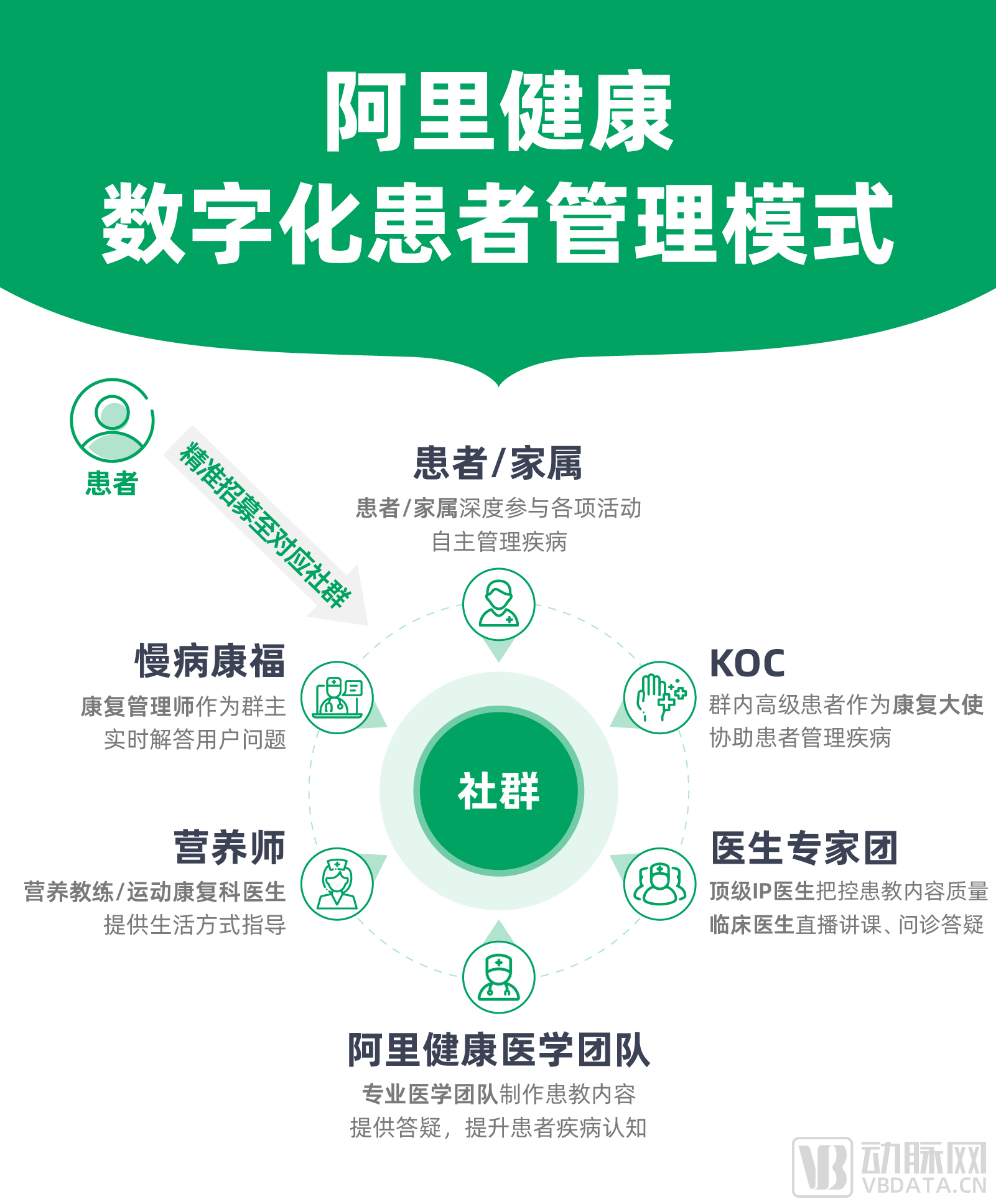
Currently, AliHealth has established patient management capabilities across 12 disease areas, including epilepsy, asthma, diabetes, hepatitis B, and enteral nutrition, achieving preliminary yet promising clinical outcomes. Under the digital patient management model, patients’ proactivity in self-managing their conditions is more readily stimulated, leading to significant improvements in medication adherence and quality of life.
Taking the Enteral Nutrition Rehabilitation Center as an example, the average number of days patients received medication increased by 70% at 95 days after enrollment in the management program. Continuous follow-up revealed that among patients participating in the enteral nutrition project who were underweight (BMI < 18.5) at initial registration, over 83% experienced improvements in body weight.
For example, at an asthma rehabilitation center, the average number of medication days per patient increased by 58% after 75 days of patient engagement in management. Additionally, 87% of patients with well-controlled asthma at initial record creation maintained stability; among those with poorly controlled asthma at initial record creation, over 75% experienced improved asthma control.
The results indicate that AliHealth’s digital patient management model has achieved notable success. In addition to establishing online communities,, more meticulous patient services are the cornerstone of long-term management, which can be summarized into four points: targeted education, precise follow-up, peer support, and welfare programs.
When discussing “targeted education,” Zhang Wen candidly admitted that the concept behind this term was inspired by “targeted therapy.” Unlike the “carpet-bombing” approach of traditional treatments, targeted therapy designs corresponding therapeutic agents based on the pathogenesis or specific molecular targets of a disease, thereby achieving precise intervention. “Targeted education” follows the same principle.“Targets” are derived from insights into patients’ diseases and medication habits.
For example, asthma medications are typically available in three dosages: 100ml, 250ml, and 500ml. Generally, parents who purchase the 100ml formulation tend to join online communities, while the actual patients are children; middle-aged individuals are more likely to purchase the 250ml formulation; and elderly individuals are more likely to purchase the 500ml formulation.
Due to varying levels of internet familiarity among different groups, their engagement in online communities differs. Accordingly, management strategies must be tailored to these distinct characteristics. For instance, younger participants tend to be more active; in addition to regular expert lectures and themed sessions, the community periodically hosts quiz competitions to deliver patient education through an engaging and entertaining approach.
For instance, patients using hormonal medications often fear the side effects of hormones, necessitating guidance to help them develop a correct understanding of hormone therapy. In contrast, patients using non-hormonal medications typically present with milder symptoms and are prone to incomplete treatment courses, leading to inadequate therapy; in these cases, it is essential to help them gain a proper understanding of their disease.
The next step in addressing cognitive issues is outcomes management: Is patient management truly effective? To answer this question,AliHealth has independently developed an intelligent follow-up system that implements tiered follow-up management for registered patients, enabling precise patient follow-up.Specifically, various roles within the community can provide precise interventions and support to patients with poorly controlled diseases based on their individual conditions; the poorer the patient’s disease management status, the more intensive and frequent the interventions. Meanwhile, this system conducts long-term tracking of patient behaviors following interventions, ensuring that cognitive education translates into actual behavioral changes and ultimately drives positive disease outcomes.
“Peer support” is also crucial during the lengthy rehabilitation process. AliHealth’s patient management model features two core capabilities:First, to empower patients with self-management skills within a short period, capabilities that can last a lifetime; second, to provide continuous support throughout the long course of their disease, ensuring their questions are answered and they have companionship in managing their condition.In response, the community will irregularly invite "Recovery Ambassadors" among patients to share their experiences, leveraging the power of role models to help patients build confidence.
 (Zhang Wen, Head of the Rehabilitation Center at AliHealth Internet Hospital)
As the digital patient management model proves viable, AliHealth is also bringing new possibilities to the entire chronic disease management market. More than 20 pharmaceutical companies have joined this innovative exploration, including global giants such as GlaxoSmithKline and Merck & Co. At the 2022 Digital Pharmaceutical Industry Forum, many pharmaceutical companies also expressed their support for explorations in digital patient management.
Zhu Lili, Vice President of AstraZeneca China and Head of the Digital & Commercial Innovation Department and the Commercial Strategy & Operational Excellence Department, stated: “The medical value of chronic disease management lies in its impact on patient outcomes. To achieve this, we must first gain insight into patients’ true needs, an area where digitalization can play a significant role.“Chronic disease management is not a low-touch, light-service model; rather, it is a comprehensive solution for patients and users, with strong collaboration across every link to enhance precision.”
Zhang Shenying, Head of Internet Hospital and E-commerce Business at Sanofi, also believes: “The core of chronic disease management lies in better leveraging digital tools to uncover patient needs and provide them with professional advice and guidance. Patients have many unmet expectations; implementing scenario-based management stratified by disease type and care pathway can directly address their concerns and largely resolve this issue.”
Currently, the state is vigorously promoting the construction of a tiered diagnosis and treatment system, strengthening the integration between basic public health services and family doctor contract services, thereby positioning family doctors as the “health gatekeepers” for community residents. Meanwhile, various policies are also encouraging the incorporation of digital tools into chronic disease prevention and control efforts.
The “Medium- and Long-Term Plan for the Prevention and Control of Chronic Diseases in China (2017–2025)” explicitly states that information technology should be fully leveraged to enrich the methods and scope of chronic disease prevention and control, promote the application of online services such as appointment-based diagnosis and treatment, online follow-up, disease management, and health management, and provide high-quality and convenient medical and health services. The “14th Five-Year Plan for National Health” also proposes advancing “Internet + Chronic Disease Management.”
AliHealth’s digital patient management model fully leverages the characteristics of the internet. With the support of medical experts, it has expanded patient reach and improved the efficiency of patient management outside hospital settings, making healthcare resources readily accessible.In lower-tier cities with scarce high-quality medical resources, this community-centric management approach will further demonstrate its value by efficiently providing patients with trustworthy and accessible disease management knowledge and methods.
Two years ago, at the inception of the project, Zhang Wen changed her DingTalk signature to “Freeing Chinese Families from the Burden of Chronic Diseases,” reflecting her original intention in launching the initiative. As AliHealth’s digital patient management model continues to iterate, this vision has remained unwavering and will continue to underpin the accumulation of capabilities in patient management.
“Having worked as a product manager for many years, this project has given me the closest sense of connection to patients for the first time. Every day, I engage with patients across numerous online communities, gaining insight into their true needs,” said Zhang Wen. “I hope to take practical, down-to-earth steps to make a meaningful difference in their lives.”
VCBeat: A consensus within the industry is that a key challenge in chronic disease management is, in essence, a struggle against human nature. How does AliHealth’s digital patient management model help patients contend with this aspect of human nature?
Zhang Wen: First, regarding chronic diseases, most people define this term narrowly as the “three highs” (hypertension, hyperglycemia, and hyperlipidemia). In fact, the spectrum of chronic conditions is broad, encompassing a range of diseases that persist long-term and coexist with patients; all such conditions are categorized under the umbrella of chronic diseases.
“The struggle against human nature” often specifically refers to diabetes. As the field of chronic disease management expands, we find that while lifestyle interventions are indispensable for treating certain conditions, not all disease management pathways pose significant challenges to lifestyle modification. For instance, asthma patients using corticosteroids often fail to complete the full course of treatment due to an irrational fear of side effects, leading to recurrent disease exacerbations.
We must adopt a vertically segmented approach to examine each disease, and even the issues of individual patients, to identify the “key targets” for intervention.
VCBeat: Are there any differences in the difficulty of patient management across various diseases? If so, what differentiated services has AliHealth implemented?
Zhang Wen: Each disease and every population exhibits heterogeneity. I believe that when identifying “targets,” several key factors should be considered: 1) the burden of the disease; 2) the identity of participants and patients—whether it is patients or their family members who participate, and if family members are involved, whether the patient is a child or an elderly person; 3) the age of the participants.
The combination of three factors gives rise to distinct characteristics. These characteristics help us determine which interventions are truly effective, identify the individuals who require management, and establish the appropriate duration of such management. Subsequently, we will match communities with suitable service content and delivery models based on these characteristics.
Currently, we have accumulated nearly 20 functional modules, which are customized and combined based on different communities to configure unique operational strategy models.
VCBeat: Currently, most innovative chronic disease management models on the market emphasize the integration of advanced diagnostic and therapeutic technologies with digital technologies such as the Internet of Things (IoT) and big data. What foundational capabilities has AliHealth accumulated in this regard?
Zhang Wen: The prerequisite for precise patient management is to understand the individual’s physical condition, and as the management process unfolds, health data must undergo multiple rounds of iteration. Consequently, Internet of Things (IoT) technology has gained significant traction, as it enables continuous uploading of data to the cloud while patients are at home, thereby guiding service providers to deliver precise care.
Currently, the data collected by Internet of Things (IoT) technology remains relatively limited, while the cost of deploying IoT devices is far higher than anticipated. For instance, replacing conventional glucometers with smart glucometers incurs a cost of hundreds of yuan per unit, significantly hindering coverage.
I believe it is essential to look beyond surface phenomena and grasp the underlying essence. Within our community, we establish a consensus on goals with patients. Upon joining the rehabilitation center, each patient has a personal profile created, through which they independently upload and update their health status throughout the process. Meanwhile, AliHealth has developed an intelligent follow-up system that tracks patients’ disease management in real time, customizes personalized patient education content and frequency as needed, and encourages adherence to learning, follow-up visits, and medication regimens, ultimately improving clinical indicators. This approach not only facilitates more effective implementation of patient management but also enhances the generalizability of the entire model.