

Exclusive Interview with Guo Jierdi, Deputy Director of the Scientific Research Institute of National Health Commission: Deploying Smart Terminals to Deliver Professional and Systematic Early Childhood Care Services
The first few years of life, particularly ages 0–3, are critically important and represent a “window of opportunity” for children’s growth and development.
During this period, providing children with adequate nutrition, early stimulation, and a safe, nurturing environment can promote optimal brain development and help them reach their full potential. Yet today, too many children still lack the “nutrition, play, and care” essential for healthy brain development.
Therefore,Guo Jiti, Deputy Director of the National Health Commission’s Institute of Scientific and Technical InformationandProfessor Dai Yaohua, Director of the WHO Collaborating Centre for Maternal and Child HealthSpearheaded the establishment of a team to provide assessment guidance and one-on-one family services tailored from the perspective of early childhood development, covering areas such as physical growth monitoring, motor development, nutrition and feeding, psychological and behavioral development, and sleep monitoring.
To better facilitate the implementation of achievements in early childhood development and fulfill the functions of a national-level research platform, the National Health Commission’s Institute of Scientific and Technical Information has entered into a collaboration with Fiske Health Technology on technological innovation and the translation of research outcomes."Guidelines for Comprehensive Evaluation of Early Childhood Development",Launch of Intelligent Terminal for Integrated Management of Early Childhood Development, and popularize it among frontline childcare institutions.
So, what are the specific challenges facing infant and toddler care services in China? And what issues can the intelligent terminal for comprehensive management of early childhood development, developed by Director Guo Ji’s team, address? Influenced by ““Sci-Tech China” The 2nd Biomedical High-Value Patent Project Selection Activityinvitation, with these questions in mind,VCBeat Orange BureauwithDirector GuojiA deep conversation was conducted.
Care Demand Continues to Rise, Yet Supply Remains Significantly Inadequate
According to a survey, approximately 34% of children aged 0–3 in China have a strong demand for childcare services, yet the current supply stands at only 5.5%. There is a significant gap between demand and supply.
From the demand side, China’s large population base of children aged 0–3, coupled with consumption upgrading, is driving a continuous rise in demand for infant and toddler care services.。
On one hand, there is a large demand base. Data shows that although China’s birth rate and the number of newborns generally declined from 2016 to 2020, the population of infants and toddlers aged 0–3 remained at a relatively high level of approximately 42 million, due to the country’s large overall population base.
On the other hand, consumption levels are upgrading. With the sustained growth of the national economy, the disposable income of Chinese residents has been continuously increasing: from 2016 to 2020, the disposable income of Chinese residents grew steadily, rising from 23,821 yuan to 32,189 yuan. Meanwhile, under the trend of consumption upgrading, young parents have become significantly less price-sensitive and are more willing to make substantial investments in their infants and young children.
From the supply side, the shortage of professional care institutions and talent is a common dilemma currently faced by infant and toddler care services.。
In terms of care institutions, data from the “China Childcare Industry Analysis Report” shows that currently, only about 10% of kindergartens nationwide provide childcare services for children aged 0–3 years. The enrollment rate of children aged 0–3 in childcare institutions is merely 4.1%, significantly lower than that in developed countries (25%–55%).
Furthermore, there is an imbalance and inadequacy in the regional distribution of childcare institutions. The enrollment rate for children in daycare centers in economically developed regions such as Shanghai and Nanjing is significantly higher than that in less developed areas.
In terms of the supply of specialized personnel, China currently faces a shortage of professional child care resources. For instance, the ratio of childcare workers to children is far lower than the average caregiver-to-child ratio (1:6) in formal care institutions across Organisation for Economic Co-operation and Development (OECD) countries.
Meanwhile, due to the absence of occupational standards, the quality of practitioners in China’s child care services is uneven.
Taking childcare specialists as an example, a profession dedicated to providing specialized services and guidance to children and mothers, the basic educational requirement for their certification examination is junior high school or above. The assessment primarily consists of written tests, with minimal practical training, making it difficult to ensure the quality of instruction.
Developing Norms for Early Childhood Development Assessment Is a Prerequisite
Targeting the pain points in the early childhood care market, Director Guo Ji’s team began developing a professional and user-friendly system for assessing early child development.
Director Guo Ji told VCBeat’s Orange Bureau: “It is not easy to develop a tool with national norms that is suitable for assessing developmental and behavioral disorders in Chinese children; extensive field visits, surveys, and assessments are required in the early stages.”
The assessment of scales related to early childhood development was carried out step by step by a team of experts in the field of child health care, covering all stages from the formulation and revision of the scale library to rigorous psychometric analysis and presentation of results.
Taking the motor scale as an example, assessments began in July 2019 and data collection was essentially completed by April 2021. Data were collected from six representative hospitals across Beijing, Sichuan, Yunnan, Guangdong, Shandong, and Inner Mongolia. Child healthcare specialists conducted the assessments on participating children in quiet, noise-free, standardized testing rooms to ensure objective and valid results.
Furthermore, the nutritional balance monitoring tool was developed by an expert team that surveyed 103 single-week menus from over 80 kindergartens across China in 2020, analyzing the dietary diversity of approximately 16,000 young children over one week. Regarding psychological, behavioral, and emotional issues in children, assessments were conducted between August 2018 and June 2019 among children aged 2 to under 7 years enrolled in 35 public and private kindergartens in Beijing, yielding a total of 7,109 reports.
Following the completion of assessments related to early childhood development, the collected data were coded and subjected to statistical analysis by the research team. The process began with descriptive statistics of the sample characteristics, such as sex, age in months, and geographic region, to determine whether the sample size was sufficient. Subsequently, the reliability and validity of the scale were evaluated through methods including internal consistency analysis of items, criterion-related validity testing, and expert item validation. Finally, normative data for the scale were established.
Director Guo Ji revealed to VCBeat’s Orange Fruit Bureau that all survey data have now been collected and analyzed. “It was only through statistical validation based on nationwide large-scale data that the Intelligent Terminal for Comprehensive Management of Early Childhood Development could be developed.”
It is reported that this terminal mainly covers three major fields:Motor Development Assessment、Child Mental Health AssessmentandNutritional Balance Monitoring。
Motor Development Assessment involves the scientific, real-time monitoring and evaluation of children's physical health, including motor abilities, physical fitness, height, and weight. For infants and toddlers aged 0–3 years, the assessment focuses on fine and gross motor development. For children aged 3–6 years, it evaluates motor fitness components such as agility, balance, coordination, and flexibility.
Child Psychological Health Assessment is based on the developmental characteristics of children’s psychology, conducting a comprehensive evaluation of individual children’s psychological, behavioral, and emotional aspects. For children aged 1–2 years, the assessment covers socio-emotional domains such as impulsivity, aggression, separation anxiety, and withdrawal. For children aged 2–7 years, the assessment addresses psychological, behavioral, and emotional issues, including social withdrawal, emotional reactivity, and psychosomatic symptoms.
Balanced Nutrition Monitoring is a sustainable management system equipped with functions for monitoring nutritional balance and providing improvement guidance. By monitoring and managing the daily intake of the ten major nutrient groups, assessing children's poor dietary habits, and providing corresponding recipes to support nutritional monitoring, it ensures dietary diversity for children.
Intelligent Terminals Enable Synchronization of Primary Care Services with High-Level Expert Guidance
In response to the three major areas mentioned above, the intelligent terminal for comprehensive management of early childhood development has been divided into six functional modules, includingInfant and Toddler Motor Development Assessment Module、Toddler Emotional and Social Assessment Module、Assessment Module for Children's Psychological, Behavioral, and Emotional Issues、Personal Nutrition Management Module、One-on-One Service ModuleandUser Management Module。
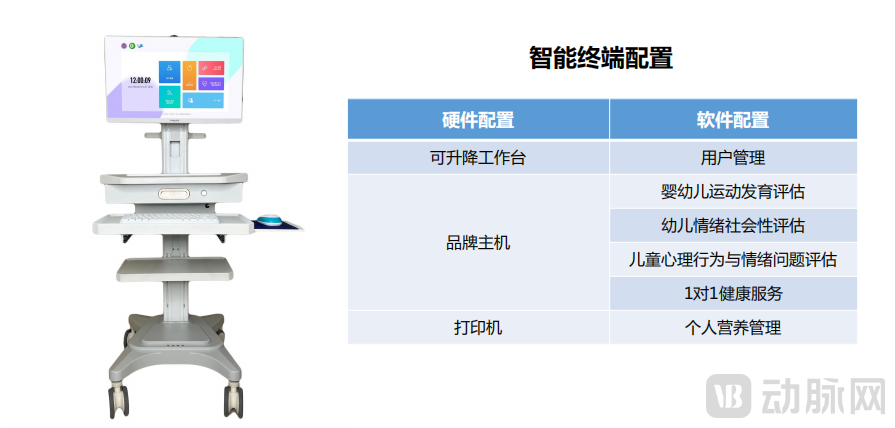
Taking the assessment module for children’s psychological, behavioral, and emotional issues as an example, users access the corresponding system, select the degree to which the child’s behaviors over the past two months align with each statement, and input the data into the system. Through data analysis, a printable result report is automatically generated, evaluating whether the child’s status is normal or abnormal across seven dimensions: anxiety level, social withdrawal, emotional stability, psychosomatic symptoms, attention-deficit/hyperactivity disorder (ADHD), aggressive behavior, and oppositional behavior.
For children with psychological and emotional issues, the system provides video-based solutions based on the assessment results after the evaluation is completed (parents can scan the QR code to watch via the WeChat Mini Program). These video solutions help parents understand their child’s current status of psychological development and developmental characteristics, as well as practical strategies for specific situations.
In addition, this smart terminal alsoBuilt an Intelligent Data Analysis Add-on Module, supports functions such as data statistics and report generation. All analytical statistics allow for customizable object scopes, including but not limited to date ranges, assessment content, age groups, gender, and regions.
In this way, smart terminals can not only create health records for all infants and young children and automatically analyze patterns in data changes, but also help local authorities monitor real-time trends in the healthy growth of infants within their jurisdiction, thereby providing a scientific basis for regional comprehensive health management.
“Our next R&D plan is to make the terminal more intelligent,” said Director Guo Ji. He stated that they are currently collaborating with a research team from Beihang University, aiming to integrate devices such as a plantar pressure detection system, a 3D force platform, an attention monitor, a decibel meter, 3D motion capture equipment, a facial recognition system, and a wireless electromyography (EMG) sensor into the smart terminal.
“Integrate data from these smart instruments with existing assessment scales to establish an intelligent center for early childhood development and healthy growth, thereby reducing personnel costs while serving children’s healthy growth in a smarter and more convenient manner.”
With technical safeguards now fully in place, an additional RMB 5–10 million in funding is required to advance the implementation and application of the technology.
Director Guo Ji stated that the intelligent terminal for comprehensive management of early childhood development will be deployed in scenarios closer to parents in the future, such as childcare centers, early childhood education institutions, and medical facilities, providing relevant professionals with assessment methods, screening indicators, and analytical bases.
Currently, this smart terminal is being piloted in Chengdu, with implementation partnerships established with local community health centers. “We hope to see more medical institutions, community organizations, and childcare facilities join us in delivering high-quality care services to the grassroots level.”
“Many parents actually lack a clear understanding of how to effectively carry out child-rearing responsibilities. Nowadays, young parents tend to rely heavily on textbooks and manuals, but the guidance provided in these books often lacks specificity,” continued Director Guo Ji. “Our deployment of smart terminals aims to expand access to high-quality resources by migrating professional knowledge systems to the cloud, thereby enabling grassroots services to align and synchronize with expert-level guidance.”
Meanwhile, to ensure the professionalism of the assessors and the reliability of the assessment results, a child-rearing guidance team with extensive training experience will provide frontline staff with theoretical and practical training on assessment during project implementation.
Frontline service personnel may only commence their duties after gaining a deeper understanding of the conditions for use, administration procedures, and precautions associated with assessment scales, and upon passing the relevant examinations.
“Offline training is absolutely essential,” stated Director Guo Ji. “For both products and services, we must establish an evaluation system that is measurable, standardized, and includes verification and accreditation processes. Only in this way can parents confidently consult with child care institutions, undergo early childhood development assessments under their guidance, and receive the corresponding services.”
From the perspective of Director Guoji,China’s Basic Early Childhood Care Services Meet Standards, but High-Quality Services Are in Short Supply。
“We aim to popularize professional infant and toddler care services through the widespread adoption of intelligent terminals for comprehensive early childhood development management, raise societal awareness of the importance of infant and toddler care, and promote high-quality development of China’s infant and toddler care industry.”