

HumanTech Bio Advances Affordable Pan-Cancer Early Detection with Chromatin Accessibility-Based Liquid Biopsy Platform
According to the U.S. SEER database, the 5-year mortality rate for patients with metastatic cancer is 79%, whereas it is 11% for those without metastasis. Meanwhile, the treatment costs for early-stage cancer patients are approximately only 1/15 of those for late-stage cancer treatment, making early cancer screening particularly important.
Over the past decade, the Chinese government has introduced multiple policies to promote early screening and diagnosis of cancer, serving as a significant driving force for the development of this field. Early cancer screening remains a challenging endeavor; compared with developed countries, China’s five-year survival rate and early detection rate for cancer patients are substantially lower. Furthermore, the high cost of current early screening products severely limits their widespread adoption and application. Consequently, there is an urgent market need for an “inclusive-tier” early screening product that offers high sensitivity in early cancer detection, precise traceability, and a more affordable price point.
In response to these industry challenges and needs, Tsinghua University and Peking University Cancer Hospital jointly developed a new generation of early cancer screening technology. The founding team established Renke Bio, a high-tech biotechnology company specializing in liquid biopsy, through the commercialization of research achievements from both institutions.
Through years of research, the company’s core R&D teamIndependently Developed Chromatin Accessibility Profiling Technology, with the aim ofDeveloping an "Affordable" Cancer Early Screening Product with High Sensitivity and Precise Lesion Source Identification, build a blood health big data platform.
Lan Xun, Founder of Renke BiologyIn 2006, he was introduced to omics data analysis in the United States. Driven by the continuous advancement of high-throughput sequencing technologies at that time, techniques such as RNA sequencing, methylation sequencing, and transcription factor binding site sequencing emerged one after another. With over a decade of experience in multi-omics analysis research, Lan Xun has developed profound and unique insights into the experimental background, principles, potential issues, biases, and roles in cancer gene expression regulation associated with each new multi-omics technology. At the early stage of each new technology’s emergence, he promptly devised novel algorithms tailored to the specific characteristics of the technology to analyze the resulting data, thereby accumulating extensive research experience in early cancer screening.
2012, Lan XunPh.D. in Biomedical Sciences from The Ohio State University, later studied under U.S. Academician Jonathan Pritchard,Completed postdoctoral research in the Department of Genetics at Stanford University from 2013 to 2017.. After returning to China in 2017, Lan XunSchool of Medicine, Tsinghua UniversitywithTsinghua-Peking University Joint Center for Life SciencesServes as a Doctoral Supervisor and Researcher.
With comprehensive support from the School of Medicine at Tsinghua University and Peking University Cancer Hospital, and leveraging 15 years of research experience and achievements in cancer multi-omics, Lan Xun founded Renke Biotechnology in November 2021.
To enhance the product’s diagnostic accuracy in molecular symptom assessment and source tracing, as well as to improve the algorithm’s efficiency in data security, read processing, and computation,The company has recruited multiple professionals with extensive backgrounds in oncology, in vitro diagnostics (IVD), and sequencing technology development to establish its core technical team.. The team members are primarily from top universities and research institutions such as Tsinghua University, Peking University Cancer Hospital, the Chinese Academy of Sciences, and Nankai University. The management team also consists of talented professionals with many years of experience in relevant large enterprises.
Pan-cancer screening has now evolved to its third generation, progressing from first-generation protein biomarker technologies, to second-generation gene mutation and methylation techniques, and finally to third-generation fragmentomics and nucleosome footprinting technologies. Issues such as stability, sequencing depth, and automation have been gradually resolved.
The human genome is vast, comprising approximately 3 billion base pairs. Among these, regions that influence gene expression account for about 3%, while less than 0.1% are involved in regulating this gene expression.This region is referred to as the “chromatin accessible region” and plays a crucial role in cellular development, differentiation, and other processes.. It isKey Elements Regulating the Transformation of Normal Cells into Tumor Cells。
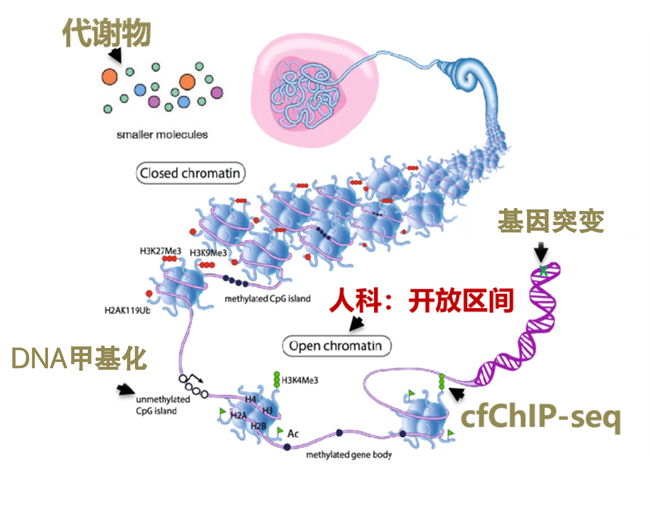
Renke Bio's technology, through "cfATAC-seq Specifically Captures Open Regions of Cell-Free DNA”、“Targeted Capture of Chromatin Accessibility Probes“These two technical approaches conduct targeted detection on these open intervals. If traditional technologies capture only a single point or a single line of cancer, then Renke Biologics”By detecting open intervals and then leveraging its innovative multi-omics AI model, information on the origin, metastasis, and drug resistance of tumor cellsConduct a comprehensive multi-dimensional analysis and interpretation, reducing the misdiagnosis rate.
Currently, Renke Bio has completed testing on over 1,800 samples, andAdopting the REACT-seq library preparation technology,Establishment of a Database of Chromatin Accessible Regions at the Single-Cell Level. By detecting only the 0.1% open regions in the genome, combined withRenke’s Proprietary Database and AI Models, enabling precise cancer screening and source tracing.Significantly reduces testing workload and lowers testing costs。
At the same time, this technology can achievePooled Testing. Unlike COVID-19 testing, Renke Biology pre-treats the samplesAdd "Label Snippet", even with pooled testing of multiple samples, the corresponding subjects can be identified through "labels."Currently capable of simultaneously detecting 10–100 sample items., the sample size willNo restrictions。
By integrating these innovative technologies, Renke Biology has achieved the goal of “low cost and high precision” in its testing. With the expansion of the chromatin accessibility region library, testing costs are expected to decrease further in the future.
In just 10 months since its establishment, fromEarly Screening for Tumors、ChinaEarly Diagnosis, and then toSubsequent Treatment and Monitoring, Renke Biologics has already laid out its related technologies and product pipelines.
As a key core business, early screening has been strategically positioned by Renke Biotechnology with the following layout: 1.Pan-cancerChromatin Accessibility Assay Kit; 2.Gastric CancerChromatin Accessibility Assay Kit; 3. Tumor Tissue Origin GenesMonitoring Kit; 4.Gastric PolypsChromatin Accessibility Assay Kit; 5.Pulmonary NodulesChromatin Accessibility Region Detection Kit, wherein the pan-cancer chromatin accessibility region detection kit has obtainedEU CE Certification. For the diagnostic phase, the company has laid out: 1.Multiple MyelomaMutation and Chromatin Accessibility Detection Kit; 2.Brain TumorMutation and Chromatin Accessibility Assay Kit. For patients in the detection phase, the following have also been deployed: 1.Gastric Cancer、Lung Cancer、Multiple MyelomaMonitoring Kit; 2.Gastric Cancer、LungCancer、Multiple Myeloma MRDMonitoring Kit.
Within a short period, Renke Biology developed nearly 10 products,Gastric cancer detection sensitivity is 90.2%., with a specificity of 97.2%;Lung cancer detection sensitivity >80%;> Specificity for Eight Cancer Types Exceeds 90%. Significantly higher than the testing products of leading international companies in the industry (with a sensitivity of approximately 30-40%).
The breakthrough in detection sensitivity stems from its chromatin accessibility profiling technology, while the rapid development of multiple high-quality diagnostic products in a short period is attributable not only to years of prior research accumulation but also toRenke Biology is buildingAn Iterative Technology Platform with Positive Feedback。
Given the low cost and high sensitivity of the technology itself, Renke BioBy simply expanding the chromatin accessibility database through increased testing and summarizing the chromatin accessibility features across different cancers and their subtypes, it is possible to build diverse cancer detection platforms without the need for developing separate pipelines.
Meanwhile, by integrating the health information of the examinees, individuals with the same disease can be grouped together, such as those with diabetes or Alzheimer's disease.Chromatin accessibility profiling of blood samples enables the identification of biomarkers associated with non-cancerous diseases, laying the foundation for the development of novel products targeting new disease indications.。
The greater the number of tested samples, the larger the data scale, and the more robust the product pipeline. Renke Biology can continuously expand the application scenarios of its products through this iterative technology platform that operates on a positive feedback loop.
As a data-driven platform and enterprise, Renke Biotech collaborates with clinical departments,Conduct product development and clinical trials based on actual clinical needs., to obtain authentic and rich clinical trial data.
Currently, Renke Biotech has partnered withPeking Union Medical College Hospital、Beijing Tsinghua Changgung Hospital、Cancer Hospital, Chinese Academy of Medical Sciences、Peking University First Hospital、Peking University Cancer Hospital、Beijing Chaoyang Hospital, Capital Medical University, and other hospitals, collaborating on a wide range of cancers including colorectal cancer, lung cancer, liver cancer, pancreatic cancer, breast cancer, endometrial cancer, ovarian cancer, and brain cancer.
In the near future, Renke Biotech willStillFocusing on Early Cancer Screening as the Core Development Strategy, enhancing product performance, obtaining Class III medical device certification from the National Medical Products Administration (NMPA), and gaining recognition from the NMPA and oncology experts.
By the end of 2022, we plan to complete quality inspections for our gastric cancer products, initiate applications for the Green Innovation Channel, and launch large-scale clinical trials for our gastric cancer detection products. In 2023, we aim to commercialize our pan-cancer Laboratory Developed Tests (LDTs), accumulate a total of 1,000 cases in clinical trials for our gastric cancer products, and simultaneously commence clinical trials for our lung cancer, pulmonary nodule detection, and gastric cancer monitoring products. In 2024, we plan to obtain Class II medical device registration for our software and Class III medical device registration for our gastric cancer products, complete clinical trials for our pulmonary nodule detection and gastric cancer monitoring products, and initiate clinical trials for our pan-cancer products.
In the long term, hominidsAiming to Build a Chronic Disease Detection and Screening Platform Through This Innovative Technology, combined with regular personal health check-ups, to dynamically track changes in their physical condition.
Lan Xun stated in the interview: "We want to becomeA ‘Router’ in the Big Health Sector, identify high-risk individuals who are asymptomatic but exhibit ‘molecular symptoms’ through our highly accurate, large-scale chronic disease screening.” ThroughDetecting "Molecular Changes" Within the Body”, to achieve the goal and effect of early detection, early intervention, and early treatment,Significantly Advance the Timing of Health Interventions, buying people more time for health management.
In the future, Renke Bio will uphold the philosophy of pursuing excellence and leading innovation, striving to be a pioneer in technology, a forerunner in early screening, and a guardian of life!