Regeneron's Otarmeni (lunsotogene parvec-cwha): The World’s First AAV-Based Gene Therapy for Genetic Deafness Receives FDA Accelerated Approval

Regeneron
Biopharmaceutical Manufacturer
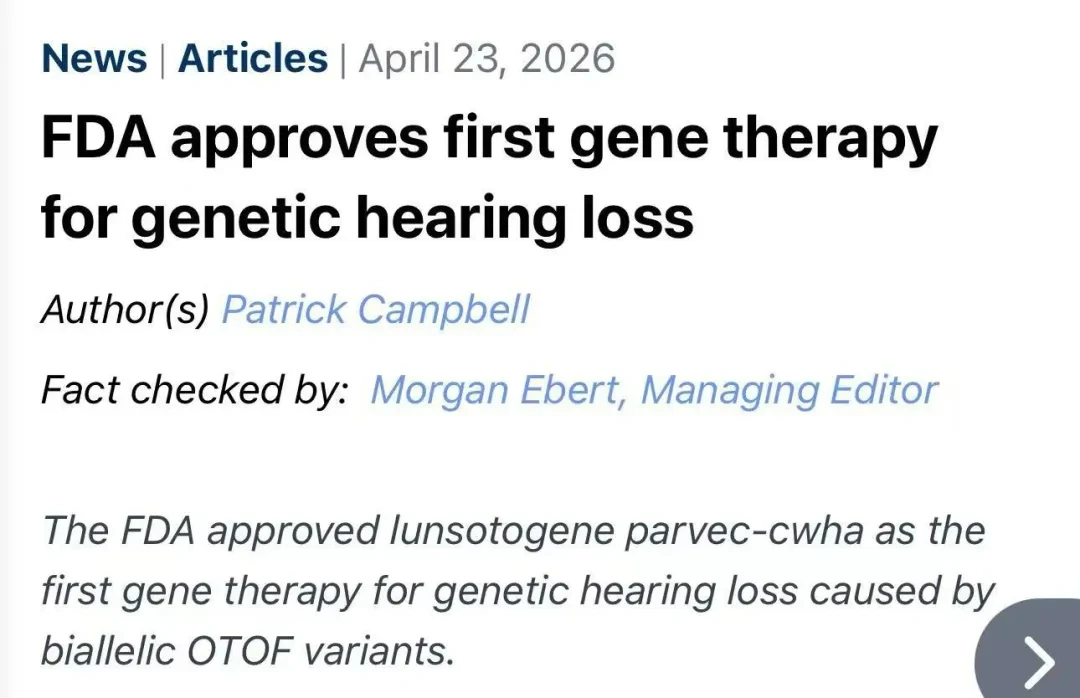
On April 23, 2026, the FDA granted Regeneron Pharmaceuticals, Inc. accelerated approval for lunsotogene parvec-cwha (Otarmeni) to treat severe to profound sensorineural hearing loss caused by biallelic variants in the OTOF gene.This is the world's first approved gene therapy for hereditary deafness., it is also the first approved drug aimed at restoring normal auditory nerve function and achieving round-the-clock "natural hearing." With the approval of "gene therapy for deafness" as a watershed moment, the field of neurosensory repair is entering a brand-new phase. However, this groundbreaking technology also offers thought-provoking insights into the development pathway, regulatory framework, pricing strategy, and the landscape of next-generation treatments.
Precise Positioning of the Technical Pathway: Why DFNB9?
The treatment of hereditary deafness has long relied on assistive devices (such as hearing aids and cochlear implants) rather than etiological interventions. The recently approved Otarmeni has chosen a highly "druggable" entry point in genetics and inner ear pathology—DFNB9-type nonsyndromic autosomal recessive deafness caused by OTOF gene mutations.
From the pathological mechanism of the inner ear, the otoferlin protein encoded by OTOF is a key mediator in synaptic signal transmission between cochlear inner hair cells and the auditory nerve. The patient's inner ear structure remains intact, with outer hair cell function often preserved, while the pathophysiological defect is precisely localized at the molecular level — a typical example of gene replacement therapy characterized by "clear target, feasible delivery, and preserved microenvironment." Regeneron has adopted an AAV dual-vector delivery strategy to overcome the capacity limitations of a single vector, while using the Myo15 promoter to restrict otoferlin expression to the inner hair cell compartment, thereby reducing off-target safety risks.
But an important question forces the industry to think: does this treatment approach, which relies on the complete anatomical structure of the inner ear (especially the preservation of outer hair cell function), suggest that the research and development strategy for "precise indications" may become the prevailing logic in otology gene therapy?
Innovative Leverage in Regulatory Dimensions: Insights from Accelerated Approvals
FDA Approval Sends a Positive but Clearly Constrained Signal. The indication is limited to patients with molecularly confirmed biallelic OTOF variants, hearing loss above 90 dB HL, intact outer hair cell function, and no cochlear implant in the treated ear—this precise positioning identifies patients most likely to benefit while confining the treatment window to the early stages of pathophysiological development, rather than applying to all patients with OTOF-related deafness. This approval is based on data from the CHORD I/II trial (NCT05788536), in which 16 out of 20 subjects (80%), aged 10 months to 16 years, reached the primary endpoint by week 24 (pure-tone audiometry thresholds improved to ≤70 dB HL). More notably, long-term follow-up data showed that 42% achieved normal hearing recovery over extended observation periods, with some patients able to perceive whisper-level sounds and enjoy music.
From the perspective of regulatory strategy, Regeneron achieved rapid market entry by leveraging the FDA’s accelerated approval pathway. However, the approval came with a clear condition: subsequent confirmatory data must validate sustained efficacy and long-term safety. This indicates that the FDA has adopted a balanced approach of "conditional approval + real-world ongoing verification" for groundbreaking therapies. For large-molecule drugs like gene therapies, where long-term follow-up is critical, this model is likely to continue.
Another dimension that cannot be underestimated is the medical insurance access and pricing strategy. Regeneron announced that it would provide Otarmeni free of charge to eligible patients in the United States. This is not purely driven by charitable logic — in return for a Rare Pediatric Disease Priority Review Voucher, the company can transfer it in the future to profit hundreds of millions of dollars, effectively forming an innovative payment structure of "access cost transfer." This strategy represents a new paradigm for the commercialization pathway of gene therapies for rare diseases: covering patient access barriers with a free product, while offsetting R&D costs with the economic value of the priority review voucher.
The Most Underrated Insight: China's Cohort Has Reached the World's Strongest Long-Term Evidence
When the FDA prioritized the CHORD trial as the basis for approval, the industry's focus was more on clinical data led by the United States. However, just one day prior, on April 22, 2026, the multi-center clinical research results of OTOF gene therapy led by Professor Shu Yilai and Professor Li Huawei's team from the Eye, Ear, Nose, and Throat Hospital of Fudan University were published online in the journal *Nature*. This multi-center clinical trial, which included 42 participants (ranging in age from 9 months to 32 years, marking the widest age range globally) with the longest follow-up of 2.5 years, set three records in the global field of genetic treatment for congenital deafness: the earliest initiation, the largest number of patients enrolled, and the longest follow-up period.
Data Level: 90% of subjects achieved clinically significant hearing recovery. In the medium- to long-term follow-up, all effective patients who completed the 2.5-year follow-up recovered their hearing to the level of recognizing daily conversation sounds. Among them, 57% could recognize library-level light music background sounds, and 43% could hear whisper-level sounds. No serious adverse reactions were observed throughout the study, and the long-term safety over 2.5 years was confirmed.
More importantly, the research team revealed for the first time the three core biomarkers affecting efficacy: younger age leads to better outcomes (100% effectiveness in patients aged 0.5–3 years), outer hair cell function (DPOAE elicitation) can predict the level of recovery, and while OTOF mutation types influence the degree of recovery, they do not determine whether treatment is effective or not. In the adult group, two-thirds achieved hearing improvement, breaking the preconceived notion that "gene therapy is only effective for young children."
From an industry perspective, the follow-up duration advantage of the China cohort is crucial for verifying the long-term efficacy of gene therapy. The 2.5-year follow-up results show a continuous and gradual improvement in hearing recovery—auditory brainstem response (ABR) average thresholds improved from >97 dB nHL before treatment to 42 dB nHL after 2.5 years, and behavioral audiometry thresholds improved from >96 dB HL to 37 dB HL. This evidence of long-term stability effectively compensates for the time-limited data of early trials like CHORD, which only provided follow-up data for 24–48 weeks.
The OTOF gene therapy currently being conducted by the Chinese team has received clinical trial approval for new drugs from the NMPA and is accelerating towards the final stage of drug market launch. For companies looking to deepen their presence in gene therapy for deafness, the long-term follow-up system and biomarker research framework of this Chinese cohort are crucial industry resources that cannot be overlooked.
Competitive Landscape: From a Duel to a Multi-Dimensional Race
Globally, gene therapy for hereditary deafness has moved from the early exploratory phase into a competitive race. Regeneron was the first to reach the finish line, but Akouos, under Eli Lilly, is no mere spectator — as early as October 2025, AK-OTOF (AAV1-hOTOF) announced positive Phase I/II results, with one child achieving hearing restoration within 30 days of treatment. Additionally, France's Sensorion is advancing its otology drug pipeline with a GJB2-targeted gene therapy approach, while at least two China-based R&D projects are in clinical or pre-clinical stages. On the global market level, the 2025 hearing loss treatment market size is approximately $13.84 billion, projected to reach $23.05 billion by 2032, with an annual compound growth rate of about 7.56%, making the vast potential of this market evident.
However, this competitive landscape should not be simply understood as a "race-grabbing" type of commercial competition. In the next 2-3 years, gene therapy for deafness will face deeper choices at a crossroads: evolving from "precision targeting" of specific single-gene mutations (e.g., OTOF/GJB2) to multi-gene coverage or multi-technology pathways (AAV replacement/CRISPR editing/RNA trans-splicing correction). Eli Lilly has already demonstrated this trend through a three-pronged technology strategy — accelerating AAV gene replacement (AK-OTOF), while investing in precise DNA editing (in collaboration with Seamless Therapeutics) and RNA trans-splicing correction technology (via partnership with Algenomics). This indicates that the next generation of hereditary deafness treatments will move beyond the mindset of "gene repair" toward a collaborative approach using a "diversified therapeutic toolbox."
Clinical Translation of Inner Ear Drug Delivery: Bridging the Surgical Technology Gap
The success of gene therapy for deafness does not solely depend on molecular design; the precision of inner ear drug delivery pathways is another barrier restricting the transition from laboratory to clinical application. Regeneron explicitly stated in its approval that treatment is not recommended when preoperative imaging examinations show that the anatomical structure of the inner ear is not feasible. This reflects that precise drug delivery to the inner ear still faces significant surgical challenges.
Current clinical trials for OTOF-related deafness mainly adopt the strategy of injecting AAV vectors via the round window membrane or cochleostomy. Key technical requirements include: maintaining the homeostasis of the inner ear fluid microenvironment, controlling the disturbance of injection volume on the vestibular pressure gradient, and precisely targeting therapeutic agents to the Corti organ hair cell layer without damaging surrounding structures. Teams in China have also developed minimally invasive drug delivery devices that enable precise delivery of the AAV-hOTOF dual vector at the clinical operation level. In the future, with the development of new minimally invasive surgical technologies, the standardization of surgical procedures and controllable risks will become prerequisites for the large-scale application of gene therapy for deafness.
It is worth emphasizing that the arrival of such new therapies calls for an upgrade in traditional cochlear implant surgical thinking—surgeons are no longer just playing the role of end-stage supporters but are becoming key implementers of the "first line of defense" in genetic repair. This shift is redefining the interdisciplinary boundaries of otology, audiology, and hearing reconstruction technology.
Future Outlook: Three Major Trends That May Change the Industry Landscape in 3-5 Years
Starting from this FDA breakthrough approval, and combining the Chinese cohort with international typical cases, the deafness gene therapy track is expected to undergo three qualitative changes in the next 3-5 years.
First, the efficacy verification framework shifts from short-term hearing thresholds to long-term speech development hard endpoints. As the Chinese cohort fully releases 2.5-year follow-up data, longer tracking durations are moving the endpoint criteria from "decibel reduction" to "speech recognition ability + quality of life improvement." This will have a profound impact on the clinical endpoint design and anticipated compliance pathways for subsequent products.
Second, Exploration of Commercial Pathways: One-time Cure with Gene Therapy vs. Continuous Monitoring Payment Model. Regeneron's innovative model of free drug supply + priority review voucher has set an example, but there remains a structural gap between the expectation of gene therapy as a "one-time treatment, lifelong benefit" and the long-term payment framework of health economics. In the future, mechanisms such as efficacy-based profit sharing, pay-for-performance, or phased national health insurance access are highly likely to emerge in order to promote the continued adoption of gene therapies.
Third, the generational leap in technological routes—from single-gene replacement to RNA and gene-editing platforms. When a large number of hereditary deafness genes break through capacity limitations and carry more complex mutation profiles, although the AAV dual-strategy replacement marks a crucial step, the third-generation gene correction platforms with higher editing precision (CRISPR/Cas9), lower immune risks, and broader mutation coverage will gradually dominate the upstream voice of the industry chain. This progress is expected to be driven by cross-regional technical cooperation among China, the United States, and South Korea.
Conclusion
FDA Approves First Gene Therapy for Hereditary Deafness: A Historic Turning Point for Auditory Medicine and a New Starting Point for Neurosensory Repair in the Molecular Era. From regulatory openness to clinical validation, from competitive landscape to payment pathways, the industry needs to approach this breakthrough with "cautious optimism." The "Eastern Force," created by a Chinese team with the longest follow-up records, the largest cohort, and the earliest global clinical start time, not only solidifies China's leading position in the field of deafness gene therapy but also sends a clear signal to global industry participants: the next key answer to revolutionizing auditory reconstruction may come not only from the United States but also from China.
In Vivo CAR-T Therapy: A Regulatory Perspective on Viral Delivery Vectors
In Vivo CAR-T Therapy: The Critical Leap from Animal Models to Human Trials
In Vivo CAR-T Therapy: Latest Strategies for Lentiviral VSV-G Envelope Modification
In Vivo CAR-T Therapy: In-Depth Analysis of Technological Frontiers and Industry Transformation
In Vivo CAR-T Therapy: In-Depth Analysis of the ESO-T01 Pipeline
Exosome Therapy: Feasibility Analysis of In Vivo Delivery of CAR-T