

Theator Builds AI-Powered Surgical Intelligence Platform with 300,000 Hours of Surgery Video, 1.2 Million Intraoperative Moments, and Nearly 1 Billion Video Frames

StageOne Ventures
Venture Capital Firms

Theator
Surgical Decision Support Tool Developer

Blumberg Capital
Venture Capital Firm

iAngels
Angel-Stage Venture Capital Firms

Mayo Clinic Ventures
Venture Capital Firm
On July 22, 2022, medical technology company Theator announced that it had raised $24 million in financing. This round served as an A+ extension to its Series A funding completed in 2021. The round was led by Insight Partners, with participation from existing investors Blumberg Capital, Mayo Clinic, NFX, StageOne Ventures, iAngels, and former Netflix Chief Product Officer Neil Hunt.
This additional investment will be used to continue Theator’s commercial expansion and accelerate the rollout of its AI surgical platform in North American operating rooms and healthcare systems.
To date, the medical technology company, founded in 2018, has secured a total of $42.5 million in financing. Since its initial Series A round, Theator has maintained a partnership with the Mayo Clinic and continues to collaborate with the Canadian Association of General Surgeons (CAGS).
Integrating artificial intelligence into surgical procedures is not a novel concept, with numerous companies operating in the same space as Theator. Among the many medtech firms striving to build AI-powered surgical platforms, what sets Theator apart and has enabled it to secure renewed support?
Founder: Patients Need the “Right” Intervention from the “Right” Surgeon
Founded in 2018, Theator is a medical technology company headquartered in Palo Alto, USA, and Tel Aviv-Yafo, Israel, dedicated to building an intelligent surgical platform that integrates artificial intelligence and computer vision. Theator’s first product, Minutes, was launched in April 2019 as a powerful scrolling and analysis tool that provides intelligently edited versions of surgical procedures. Currently, Theator is developing a SaaS platform to offer AI-driven decision support tools for surgeons.
Theator’s Co-Founder and Chief Technology Officer is Dotan Asselmann, a graduate of Tel Aviv University in Israel. Dotan began his career as the Head of Computer Vision at the Israeli Military Intelligence Directorate. Six years later, he co-founded EyeOnn, an electronics company that leverages computer vision to address drowning incidents in swimming pools. Additionally, Dotan leads Computer Vision Israel Meetup, the largest computer vision community in Israel, which boasts over 3,500 members and continues to grow steadily.
Tamir Wolf is the other co-founder and CEO of Theator. He earned his M.D. from the Technion – Israel Institute of Technology in 2001 and an MBA from Harvard Business School in 2010, and has authored numerous medical publications. Prior to co-founding Theator, he held executive positions at several healthcare companies, including Accelmed and Digma Medical. In 2014, he co-founded NiTiNOTES Surgical, which offers a non-surgical solution to help obese patients lose weight.
The impetus for Tamir Wolf to found Theator stemmed from a chance experience. In 2015, Tamir’s wife and his boss both developed appendicitis. As a physician, he accompanied them to the hospital for treatment. “They received care at two different hospitals, and I was shocked by the starkly contrasting levels of care they experienced, even though the facilities were only seven miles apart.” His wife was discharged home 12 hours after treatment, while his boss spent several weeks in the intensive care unit. The disparity in treatment standards and approaches for such a common condition prompted Tamir to reflect on the widespread variability and inconsistency in medical practice, and he began seeking ways to change this status quo. “Patients need to receive the ‘right’ intervention from the ‘right’ surgeon.,“Moreover, the ideal procedure should be performed efficiently, skillfully, safely, and at low cost,” said Tamir Wolf.
Minutes: The World’s First and Only Real-Time Surgical AI Video Platform
For a long time, surgeons have learned surgical techniques through an apprenticeship model, where the depth of learning depends on the mentor’s expertise, operative skills are honed through clinical practice, and intraoperative decision-making relies solely on direct experience. This approach overemphasizes hands-on practice, thereby limiting the expansion of surgeons’ theoretical knowledge. Furthermore, although various intraoperative data points may be correlated with postoperative complications, such data are not always prioritized by all surgeons or may lack sufficient precision.
According to a study published in *Pediatrics*, Black children in the United States are three times more likely to die after surgery than White children.It is estimated that at least 7 million people experience postoperative complications annually, including 1 million deaths, and at least 50% of these complications and deaths are preventable.。Another study has shown that surgical complications are significantly fewer in specialized medical centers than in other healthcare facilities. The differentiation and variability within the medical field not only limit physicians’ proficiency but also expose patients to greater risks.
The Minutes platform, developed by Theator, captures data from surgical videos and leverages AI and computer vision to automatically analyze each procedure. This helps surgeons understand the reasons behind changes in patient prognosis, while streamlining operating room workflows and reducing costs. The platform also provides additional data, including the time required to complete each step of a surgery. According to Theator, the platform has secured six patents to date.
More than a dozen medical centers are contributing to Theator’s surgical video dataset, which has now become the world’s largest intelligent surgical registry.This dataset currently contains over 300,000 hours of surgical videos, covering more than 1.2 million intraoperative moments, analyzing nearly one billion frames, and generating over 7,000 visualized operative reports.
At the moment surgery begins, the platform automatically starts recording and analyzing to help surgical procedures proceed more smoothly.
The platform’s video technology can record the entire surgical procedure in real time, providing the medical team with a comprehensive view of the patient’s affected area. During surgery, the platform enables real-time updates and notifications, promptly alerting clinicians to critical intraoperative events—such as significant bleeding—allowing for timely feedback and optimization of surgical outcomes.
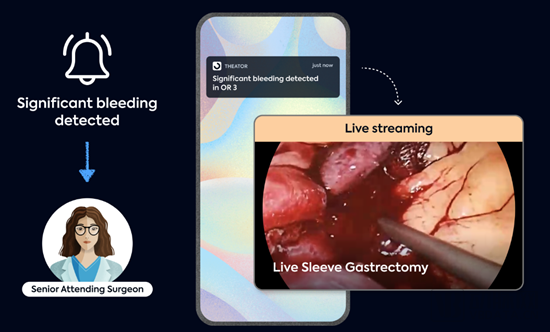 Hemorrhage Alert Illustration. Source: Theator Official Website
The platform also enables contactless viewing of surgical procedures anytime and anywhere. Senior clinicians can observe surgeries in real time during the operation, and physicians can retrospectively review intraoperative issues after the procedure. By studying diverse surgical videos and analyzing video imagery of patients’ diseased tissues, medical teams can enhance their work efficiency and reduce unnecessary surgeries.
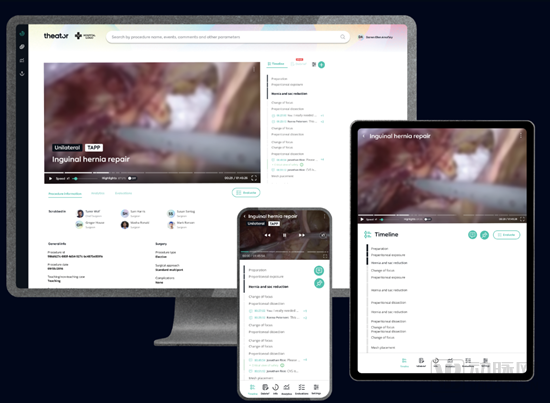 Multi-Platform Schematic Diagram Source: Theator Official Website
Each user’s video library is personalized based on individual surgical needs and curated through the “Featured,” “Shared,” and “Saved” buttons marked during use. The most prominent feature is the ability to view key moments of surgeries on demand.
By applying AI-driven analytics to video footage, Theator’s platform breaks down outcome data into steps, events, decisions, and milestones, facilitating postoperative review for surgeons. For example, in cholecystectomy procedures, it automatically tags three critical steps—adhesiolysis, cystic duct leakage, and the Critical View of Safety—allowing clinicians to directly access the relevant procedural nodes.
Additionally, intelligent annotations and filtering are provided at key points, enabling users to directly, quickly, and accurately view key segments.
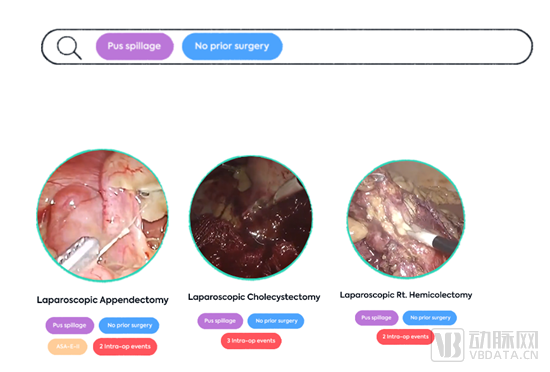
Keyword Index Source: Theator Official Website
The platform will also link surgical videos with postoperative outcome data via automated EHR, providing actionable insights to help improve subsequent care processes while reducing the incidence of related complications.
Once a surgical video is uploaded to the platform for intelligent processing, surgeons can immediately focus on reviewing the highlighted data packets of key moments selected by the AI platform, thereby making critical decisions. Each surgical procedure is added to Theator’s training dataset, expanding its model’s understanding.
The platform’s database contains thousands of similar medical cases. By leveraging machine learning and providing precise medical imaging, the platform assists healthcare teams in analyzing patient conditions and comparing surgical procedures with analogous cases, thereby reducing the risk of surgical failure.
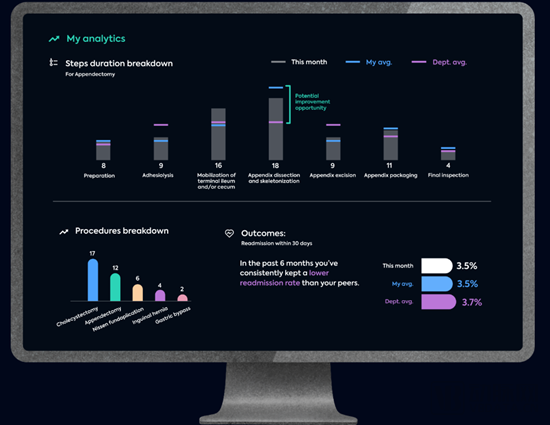 Comparison of Similar Case Data Source: Theator Official Website
“The lack of face-to-face interaction with experienced surgeons has accelerated demand for Theator’s solution, which expands surgeons’ expertise even in remote or asynchronous settings,” said Tamir Wolf, Co-founder and CEO. “Surgeons also used to learn new techniques and approaches at conferences, but these opportunities were largely eliminated due to the COVID-19 pandemic. Theator’s comprehensive surgical video dataset, which enables users to upload their own procedures, review similar cases, and exchange feedback, has become an increasingly vital tool as more ongoing development takes place remotely.”