

MIMETAS Files IPO Prospectus Highlighting Strategic Collaborations with HUB, Roche, and Merck and Leadership in Organ-on-a-Chip Technology
MIMETAS
Organ Chip R&D Manufacturer
Since 2009, when Hans Clevers, the pioneer of organoid research, led his team to culture the world’s first mini-gut organoids, organoid technology has witnessed tremendous advancement. In recent years, organoids-on-chips have garnered significant attention for combining the dual advantages of organoids and organ-on-a-chip technologies. This has spurred the emergence of numerous developers in the field, among which MIMETAS from the Netherlands stands out prominently.
MIMETAS is one of Europe’s most representative developers and manufacturers of organ-on-a-chip technologies. Founded in the Netherlands in 2013, the company is dedicated to transforming drug discovery and development through organ-on-a-chip cell culture models.
In 2013, MIMETAS was co-founded in Leiden, the Netherlands, by Paul Vulto (Co-CEO), Jos Joore (Co-CEO), and Bas Trietsch (CTO).
Paul Vulto previously served as a Development Engineer at the high-tech company Silicon Biosystems, and subsequently held key positions at the Department of Microsystems Engineering (IMTEK) at the University of Freiburg in Germany and the Centre for Drug Research at Leiden University in the Netherlands. Jos Joore holds an M.Sc. in Biology, a Ph.D. in Developmental Biology, and an M.Sc. in Business Marketing, and has previously held management roles at the biotechnology companies Pepscan, Skyline Diagnostics, Kreatech, and Westburg. Bas Trietsch earned his Ph.D. from Leiden University and conducted research at the Amsterdam Center for Drug Research and the Netherlands Metabolomics Centre.
MIMETAS is headquartered in the Netherlands. As the birthplace of Hubrecht Organoid Technology (HUB), the world’s first organoid R&D center, the Netherlands has seen early industry development and attracted a cluster of organoid companies. MIMETAS has established its headquarters in Oegstgeest, the Netherlands, where it conducts the majority of its development work on biological models, new hardware, and assays, while its production facility in Enschede, the Netherlands, is dedicated to manufacturing the OrganoPlate.®and other products.
Since its inception, MIMETAS has maintained a collaboration with HUB. In May this year, MIMETAS announced the expansion of its licensing agreement for HUB’s organoid technology to include all organ types, marking a significant complement to MIMETAS’s organ-on-a-chip disease models. This development enables MIMETAS to extend its product offerings to other organs, such as the lungs, kidneys, and pancreas. Previously, MIMETAS collaborated with the Hubrecht Institute (HUB) using the MIMETAS OrganoPlate organoid platform to evaluate whether venom molecules produced by snake venom gland organoids could replicate the effects of actual venom.
Subsequently, MIMETAS established subsidiaries in Gaithersburg, Maryland (USA) in 2013 and in Tokyo, Japan in 2018, to expand its operations in the Americas and Asia. Today, MIMETAS employs over 100 people across four locations in the Netherlands, the United States, and Japan. Additionally, MIMETAS is actively exploring the Chinese market.
MIMETAS developed the OrganoPlate®technical platform, which is a microfluidic 3D tissue culture plate that can support 96 tissue models per plate. By leveraging a technology called PhaseGuide™With its patented liquid handling technology, OrganoPlate enables free cellular interaction and migration between channels, as well as membrane-free co-culture for extracellular matrix, optimized microenvironments, and perfused tubular tissues.
Furthermore, continuous medium perfusion through the microfluidic network in the OrganoPlate simulates blood flow and enables the exchange of nutrients, oxygen, and metabolites. The unique gravity-driven leveling technology maintains flow without the need for pumps or tubing, making the OrganoPlate suitable for any throughput.
OrganoPlate is suitable for the culture and application of all in vitro tissues. Based on this organ-on-a-chip technology platform, MIMETAS has launched a series of complementary products and services, including the OrganoPlate product line, dedicated OrganoPlate equipment, ready-to-use 3D tissue models (OrganoReady), the OrganoStart software package, and professional OrganoServices.
The OrganoPlate product series comprises four distinct variants—2-lane 96, 3-lane 40, 3-lane 64, and Graft—to facilitate the development of complex 3D tissue and organ models. The final number indicates the quantity of independent tissue culture chips accommodated on a 384-well plate, while the leading number denotes the number of adjacent channels per chip.
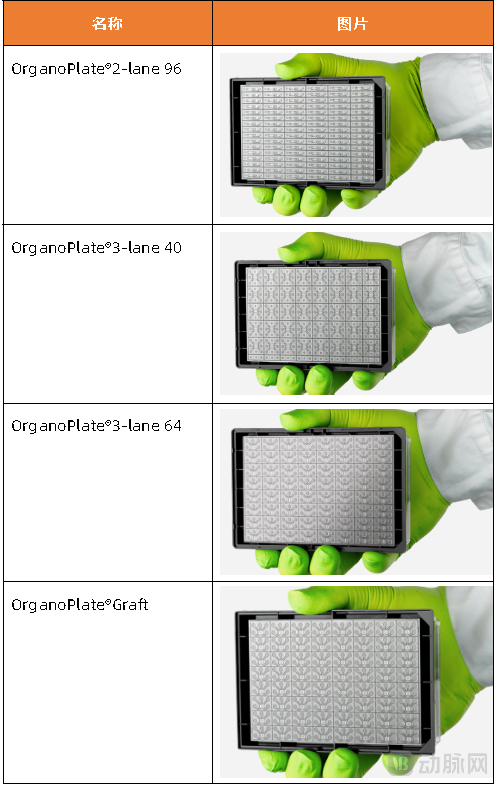
OrganoPlate Series Products
The OrganoPlate 2-lane 96 allows direct access to the apical compartment of tubular cultures; the OrganoPlate 3-lane 40 enables direct access to both the apical and basolateral compartments of renal tubules; the OrganoPlate 3-lane 64 is designed for automated workflows; and the OrganoPlate Graft is the first in vitro tissue culture platform capable of co-culturing spheroids, organoids, tumors with perfused microvascular beds, and 3D vascular tissues.
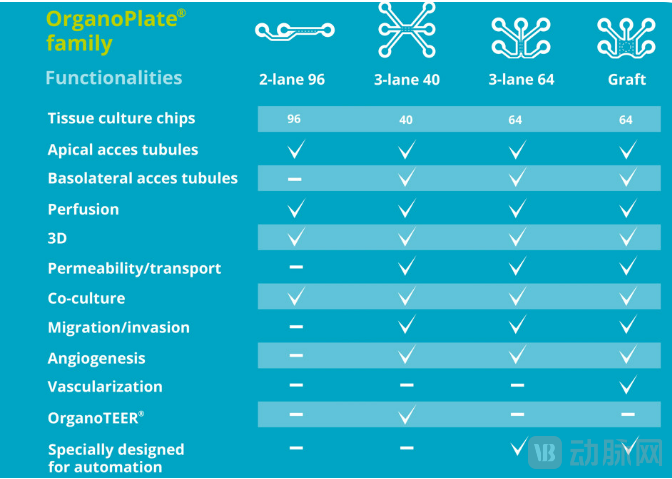
Differences Between OrganoPlate Series Products
In addition to a variety of microfluidic design products, MIMETAS also equips the OrganoPlate technology platform with dedicated devices to facilitate better tissue culture and applications. The dedicated devices for OrganoPlate mainly include the monitoring device OrganoTEER.®, OrganoFlow Blood Flow Simulation Shaker®S and OrganoFlow®L。
OrganoTEER enables rapid, automated, impedance-based transepithelial/endothelial electrical resistance (TEER) measurements in the OrganoPlate. With just a few clicks, 40–64 tissue culture chips can be assayed in under one minute.
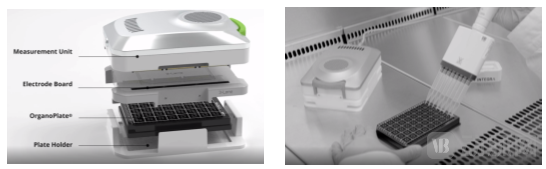
OrganoTEER
OrganoFlow is responsible for precisely controlling the perfusion flow within the OrganoPlate platform, enabling detailed programming of intermittent rocking motions. By placing the OrganoPlate platform on the OrganoFlow, perfusion can be maintained indefinitely. The customized rocking platform can be easily installed in an incubator, supporting intermittent rocking (with side-switching intervals ranging from 5 seconds to 999 minutes) and adjustable rocking angles (0° to +25°). OrganoFlow is optimized for use with OrganoTEER, allowing TEER measurements during perfusion flow.
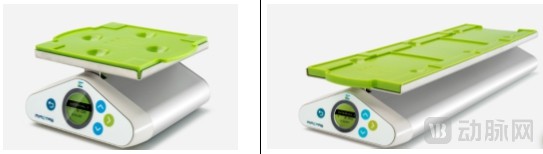
Left: OrganoFlow S; Right: OrganoFlow L
MIMETAS’s ready-to-use 3D tissue model, OrganoReady, can be used for drug exposure, transport, and permeability studies, primarily featuring the ready-to-use intestinal tubule OrganoReady.®Colon Caco-2, Ready-to-Use Vascular Tubules OrganoReady®Blood Vessel HUVEC, Organoid-Ready Angiogenic Tubules®Angiogenesis HUVEC and Ready-to-Use Primary Human Microvascular Endothelial Cell Tubules OrganoReady®Blood-Brain Barrier HBMEC: These Four Types.
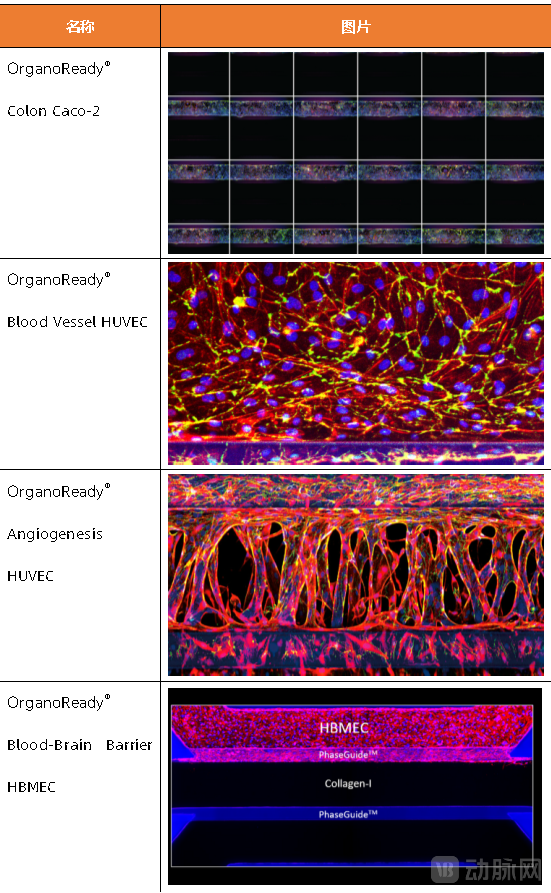
Ready-to-Use 3D Tissue Model: OrganoReady
Furthermore, MIMETAS also provides services such as compound analysis and screening, custom model and assay development, and collaborative drug development.
Although organ-on-a-chip technology holds immense potential, funding in this field has not been robust over the past few years, with only a select few startups securing investment. Mineta, a standout player in the sector, has completed approximately $30 million in financing.
Furthermore, MIMETAS secured £1 million in Stage 2 and £100,000 in Stage 1 of the CRACK IT Challenge this year and last year, respectively, to develop a human in vitro T cell-dependent antibody response (TDAR) assay for evaluating the immunoenhancing properties of immunomodulators during drug development.
Currently, organ-on-a-chip startups primarily operate under three business models: providing ready-to-use microfluidic devices; offering fully operational, ready-to-use organ-on-a-chip systems; and delivering comprehensive service solutions ranging from initial design to after-sales support.
MIMETAS has focused on the organ-on-a-chip field for 10 years and has successfully covered the above three business models. Its diversified products and services have enabled MIMETAS to secure a place in the fiercely competitive market, and it is now further expanding its business collaborations.
MIMETAS has established collaborations with multiple large multinational pharmaceutical companies, including Roche and Merck. Previously, MIMETAS jointly developed a high-throughput intestinal mucosal permeability assay system with Roche. In July 2021, MIMETAS announced a new collaboration with Roche to co-develop human disease models for characterizing novel compounds in inflammatory bowel disease (IBD) and hepatitis B virus (HBV) infection.
To align with the company’s commercial growth, MIMETAS promptly optimized its talent structure. In 2019, Jacquelien ten Dam joined the core management team as Chief Financial Officer (CFO) to strengthen the company’s commercial expansion and financial management. Holding a Master’s degree in Biomedical Sciences from Leiden University, Ms. ten Dam previously worked at the Dutch startup Picnic, where she led a team providing big data consulting and e-commerce advisory services to fast-moving consumer goods (FMCG) companies such as PepsiCo, Unilever, and Anheuser-Busch InBev, thereby accelerating the company’s B2B business development.

From left to right: Paul Vulto (CEO), Jos Joore (CEO), Bas Trietsch (CTO), and Jacquelien ten Dam (CFO)
Last April, MIMETAS announced the appointment of Patrice Denèfle, who has over 35 years of experience in the pharmaceutical and biotechnology industries, as its Scientific Advisor to accelerate collaborations with pharmaceutical companies leveraging MIMETAS’s phenotypic modeling and screening capabilities. On September 8 this year, MIMETAS announced the appointment of Dhaval Patel as the new Chairman of its Board of Directors. Dhaval Patel is Executive Vice President and Chief Scientific Officer at the Belgian biopharmaceutical company UCB, a Clinical Professor at the University of North Carolina at Chapel Hill, and former Head of Research at the Novartis Institutes for BioMedical Research in Europe.
Although organ-on-a-chip technology still faces numerous technical bottlenecks that need to be overcome, MIMETAS has demonstrated the potential and maturity of organ-on-a-chip systems in in vitro tissue culture and applications. With continuous technological advancements and iterations, it is believed that organoid-focused innovative companies represented by MIMETAS will drive transformative changes in scientific research.