

Exclusive Interview with Dr. Peigen Ren, CEO of Zhongke Xinjin: World's First Orally Available Peptide Drug for Obesity Unveiled, New Funding Round Imminent
Too busy to cook, relying on takeout meals high in oil and salt for every meal; too busy to sleep until 2 or 3 a.m.; too busy to find time for daily exercise... These unhealthy lifestyle habits pose significant health risks to the body, with obesity being the most immediately apparent consequence.
Obesity is no trivial matter; it not only affects physical appearance but also leaves many diseases with an “opportunity to take hold.” In March 2021, obesity was defined by the European Union as“Chronic relapsing diseases, thereby becoming a gateway to a range of other non-communicable diseases”, such as type 2 diabetes, hypertension, hypercholesterolemia, fatty liver disease, and even certain types of cancer.
Although attention has been paid to the issue of obesity for a long time, the global obese population remains substantial to date. According to"World Health Statistics 2020", Currently, there are over 300 million obese patients worldwide, and by 2030, the number of obese individuals will exceed 1 billion, accounting for 20% of the world's adult population.
Therefore, weight management for overweight and obese patients has become an urgent clinical need!
Dr. Peigen RenAfter being invited to return to China in 2012, he keenly recognized that the obesity epidemic had become increasingly severe both in China and worldwide, creating an urgent market need for pharmaceutical interventions. Drawing on more than two decades of research, he identified a candidate for the treatment ofNon-alcoholic Steatohepatitis (NASH)andObesitya novel polypeptide drug, and founded Zhongke Xinjin to bring more health possibilities to patients suffering from metabolic diseases.
So, what exactly sets Zhongke Xinjin’s new peptide drug apart? And where is Zhongke Xinjin headed next? With these questions in mind,VBInsightandDr. Peigen RenEngaged in an in-depth exchange.
Metabolitin’s Secret to Combating Obesity: Low Absorption, High Expenditure
Among the numerous drug pipelines newly introduced by Zhongke Xinjin, one has caught our attention—a therapy targeting obesityMetabolitin: A Novel Peptide-Based Innovative Drug, is scheduled to enter Phase II clinical trials in 2026.
According to Dr. Ren Peigen, “Metabolitin primarily treats obesity by inhibiting the absorption of lipids by the small intestinal villi. Based on our current experiments in rodents, Metabolitin has demonstrated highly promising efficacy against both obesity and non-alcoholic fatty liver disease.”
Small intestinal villi, as their name suggests, are slender, hair-like structures lining the interior of the small intestine. They increase the surface area of the intestine, facilitating the absorption of nutrients and fats from food as it passes through the digestive tract. Therefore, the absorptive capacity of small intestinal villi is closely linked to human nutrient absorption, weight gain, and fat accumulation.
Simply put, weight gain occurs primarily because the body absorbs excess energy, including lipids, which is ultimately stored in the form of fat.
Metabolitin, which can be translated as "metabolin," is a mammalian peptide hormone. Upon entering the intestine, this compound interacts with GPRC6A expressed on small intestinal epithelial cells, thereby inhibiting the secretion of neurotensin (NT) by N-cells, a subtype of enteroendocrine cells (EECs), in the small intestine.
Dr. Ren Peigen discovered that when neurotensin in the small intestine is inhibited, the absorption of lipids from the intestinal lumen by the small intestinal villi is also suppressed. After administration of Metabolitin, compared with the control group, the lipid substances in the mouse feed, particularlyAbsorption of triglycerides was reduced by nearly 70%., thereby blocking the intake of a large amount of lipids.
In addition to reducing the absorption of lipids by the body, Metabolitin can also “cooperate” with small intestinal receptors to promoteGLP-1secretion. GLP-1 not only suppresses appetite but also promotes fat breakdown. By stimulating insulin secretion, GLP-1 helps lower blood glucose levels. Stable blood glucose levels can influence the rate of fat metabolism in the body, thereby indirectly addressing obesity.
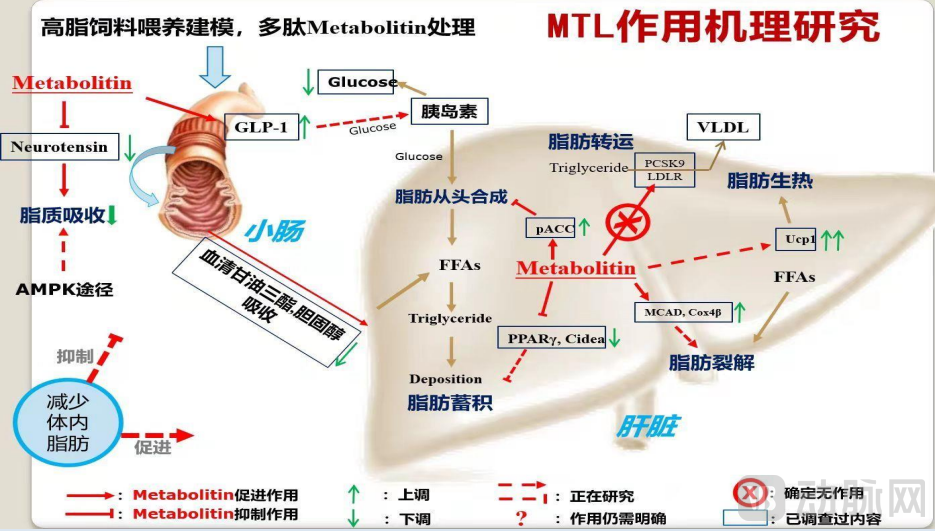
Therefore, Metabolitin not only inhibits the entry of lipids into the human body for fat synthesis but also metabolizes existing fat, thereby tackling obesity at its source through a dual-pronged approach.
The First Oral Peptide Drug Has Been Launched
As with most chronic disease management companies, improving patient adherence has long been a major challenge. Clinical data indicate that reducing the complexity of patient operations is one of the effective ways to enhance adherence.
Oral administration is naturally the simplest route of drug delivery; however, oral delivery has long remained a major challenge for peptide-based therapeutics. Because most peptides are rapidly degraded in the gastrointestinal tract and eliminated before exerting their pharmacological effects, there are very few orally available peptide drugs on the market.
If Metabolitin could only be administered via injection, user compliance would inevitably be significantly compromised. Therefore, Dr. Ren Peigen modified Metabolitin to address its poor tolerance to trypsin, while preserving its advantageous resistance to pepsin and gastric acid, thereby achievingOral。
Dr. Ren Peigen told VCBeat’s Orange Fruit Bureau, “To my knowledge, Metabolitin is likely the first natural peptide that is orally bioavailable and has demonstrated clear efficacy against metabolic disorders such as obesity, non-alcoholic fatty liver disease (NAFLD), and type 2 diabetes mellitus (T2DM). It has currently been granted eight Chinese and international invention patents in China, the United States, Japan, and South Korea.”
In addition to its ease of use, Metabolitin’s"Minimal Side Effects"It also provides patients with a better medication experience.
According to statistics, only seven drugs for the treatment of obesity have been approved on the market, with orlistat being the sole approved option in China. All seven medications are associated with varying degrees of side effects while addressing obesity.
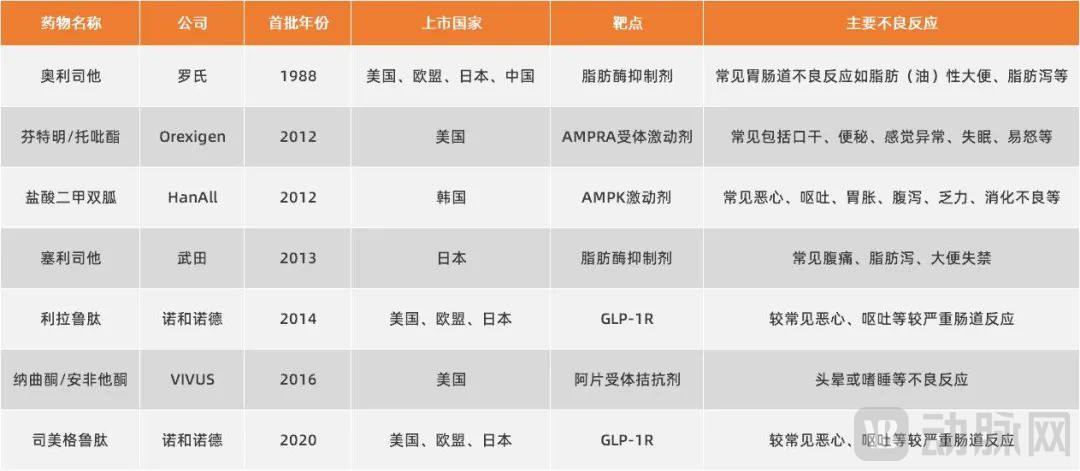
Taking orlistat, the only obesity medication currently available on the Chinese market, as an example, its primary mechanism of action involves inactivating gastric and pancreatic lipases within the stomach and small intestine lumen, thereby reducing the absorption of lipids by the human body.
However, this approach is highly likely to result inSteatorrhea...the occurrence of which, while chronic steatorrhea may lead to symptoms such as physical fatigue in patients; severe cases can also cause tetany, edema, and even persistent nausea and vomiting, resulting in significant damage to health.
Metabolitin primarily reduces fat accumulation by inhibiting lipid absorption in the small intestinal villi and promoting GLP-1 secretion. Its underlying mechanism is fundamentally different from that of orlistat, so it does not cause steatorrhea.
Dr. Ren Peigen stated, “In numerous experimental animal model studies,Neither steatorrhea occurred nor was a large amount of high-fat feed observed in the excretion area of the mouse cages."Therefore, it is basically proven that Metabolitin has very few side effects and will not cause inconvenience to patients' lives."
Securing Millions in Funding Within Six Months of Founding: How Will He Choose This Time?
Within less than six months of its establishment, Zhongke Xinjin secured investment led by Silver River Capital, with participation from Nanshan Venture Capital, Qianhai Great Wall, and Fupeng Asset Management.Tens of Millions in Angel Financing, the company has also been recognized by multiple venture capital firms as a “dark horse.” After a year of consolidation, Zhongke Xinjin is now poised to take the next step forward.
Dr. Ren Peigen revealed, “We are now preparing to organize the existing data, with the aim ofThe second round of financing will officially commence in September.. However, our primary focus will remain on scientific research, so this round of financing will be closed in a relatively short period of time.”
The funds raised by Zhongke Advanced in this round will be primarily allocated to product regulatory filings. Dr. Ren Peigen currently plans to pursue simultaneous regulatory submissions for Metabolitin in both China and the United States. The initial strategy involves conducting Phase I clinical trials in Australia and China, while Phase II and Phase III clinical trials will be carried out as international multicenter studies, including sites in the United States.
Furthermore, Zhongke Xinjin plans to submit an Investigational New Drug (IND) application for Metabolitin in 2023, with the product expected to be officially launched in 2029.
Meanwhile, Zhongke Xinjin also plans to upgrade its hardware facilities to enhance its research capabilities and facilitate the commercialization of more pipeline achievements. After all, as a researcher, Dr. Ren Peigen is most concerned with scientific outcomes. The team at Zhongke Xinjin includes many seasoned professionals with extensive market experience, most of whom have20+ Years of Experience in Listed Pharmaceutical Companies, with an in-depth understanding of the market. It is precisely for this reason that Dr. Ren Peigen has been able to devote himself wholeheartedly to scientific research without any distractions.
He said, “I am still learning how to transition from a ‘researcher’ to an ‘entrepreneur’; I have simply added the slash of ‘founder’ after ‘research.’ In the future, I will continue to cultivate the field of scientific research, bringing the possibility of health to more patients.”