

Shengxing Medical Secures China's First VR Medical Device Certification, Accelerating XR Integration in Clinical Settings
The development of VR technology in the medical field is progressing in a spiral upward trajectory.
As early as 2016, when various new internet technologies such as AI, big data, and 5G were rushing into the healthcare industry, VR/AR experienced an explosive surge. However, for a long period after 2019, VR’s development in the medical field fell into stagnation due to limited applications and less-than-perfect user experiences.
Nevertheless, humans remain enthusiastic about exploring the application potential of virtual reality technology. In 2020, Johnson & Johnson entered this field by partnering with Osso VR to develop VR headsets for surgical training.Last year, Hangzhou Shengxing Medical Co., Ltd. (hereinafter referred to as “Shengxing Medical”) secured China’s first “VR Medical Device Certificate,” further boosting confidence in this niche sector.
“The operating room has long been regarded as an ideal application scenario for this technology and one of the earliest to be implemented in the medical field. Traditional two-dimensional images used for reference in surgery suffer from key limitations: poor clarity, inaccuracy, and incomplete visibility. Endoscopic images, based on surface imaging, offer a narrow field of view and lack subcutaneous information; ultrasound images, based on cross-sectional echo imaging, are prone to significant noise interference and lack three-dimensional information; X-ray images, based on fluoroscopic projection, involve superimposition of multiple tissues and also lack three-dimensional information. In contrast, XR technology can reconstruct the three-dimensional topological structure of human tissues and organs, reducing surgeons’ reliance on mental imagination. By assisting physicians in decision-making, it significantly shortens intraoperative time and accelerates the learning curve for less-experienced surgeons. This technology holds strong potential for large-scale adoption in the future.”Before the interview, Yu Lang told VCBeat.
Shengxing Medical is a national-level high-tech enterprise, a Zhongguancun Golden Seed Enterprise, and a Zhongguancun High-Tech Enterprise. The company’s founder, Yu Lang, recognized the value of applying VR/AR and other technologies to the medical field as early as 2014, when these technologies were still immature.
Yu Lang initially served as Chairman of York Animation & Film Co., Ltd. Listed on the National Equities Exchange and Quotations (NEEQ) in 2014, York Animation was among the earliest companies in China to venture into VR and AR gaming. During this period, Yu Lang accumulated extensive technical expertise. Through discussions with surgical department directors and relatives and friends working in the medical device industry, he identified significant pain points in traditional imaging and surgical procedures that urgently needed addressing. Consequently, he made a full-time career transition into the healthcare sector and founded Shengxing Medical in 2016, focusing on the research and development of holographic preoperative planning systems for medical imaging and holographic intelligent surgical navigation and guidance systems.
Yu Lang told VCBeat: “Traditional surgical planning involves department heads reviewing 2D CT scans for internal discussion. This consultation method relies heavily on physicians’ experience, not only limiting their ability to judge the three-dimensional structure of lesions based solely on empirical judgment, but also lacking sufficient standardization, which poses challenges for grassroots areas with relatively scarce medical resources. We conducted on-site observations of over 200 surgical procedures and found that hepatobiliary surgery, urology, neurosurgery, and oncologic surgery are the four specialties most in need of holographic imaging assistance. Our new image-guided surgical planning system provides physicians with more concrete, precise, and comprehensive support. It significantly improves surgical accuracy, effectively alleviates the shortage of medical talent in China, and reduces iatrogenic injuries to both patients and healthcare providers. Furthermore, our new image-guided surgical planning system offers substantial benefits in clinical teaching, doctor-patient communication, and telemedicine.”
Today, the company not only maintains long-term strategic collaborations with over 100 renowned hospitals and clinical experts across China—including the PLA Strategic Support Force Characteristic Medical Center, Beijing Friendship Hospital, and Peking University Shougang Hospital—but has also partnered with the Advanced Institute of Information Technology at Peking University to establish China’s first medical holographic imaging laboratory.
It is understood that the company has filed for and entered the substantive examination stage for over 30 intellectual property rights, with 16 already granted. These include two invention patents, 12 software copyrights, two trademarks, and four Beijing New Technology and New Product Certificates. Notably, its Holographic Preoperative Planning System for Medical Imaging has obtained China’s first VR software medical device registration certificate.
Taking traditional orthopedic surgery as an example, its most significant challenge lies in the fact that surgeons cannot directly visualize the patient’s bone structure under conventional surgical conditions. Complex anatomical systems such as the spine, due to their intricate architecture and proximity to critical blood vessels and nerves, impose extremely high requirements on the precision of preoperative planning, localization, and intraoperative maneuvers. Surgeons must possess strong spatial imagination and extensive experience, relying on repeated measurements and comparisons of patients’ X-rays to ensure surgical accuracy while completing the procedure.
By leveraging 3D imaging to reflect the true three-dimensional relationships among a patient’s bones, muscles, neural tissues, and blood vessels, this approach facilitates preoperative planning and accurately predicts intraoperative changes in patient positioning. This not only reduces surgical complexity, enhances procedural precision, and decreases the number of X-ray exposures required during minimally invasive surgeries, thereby effectively lowering the risk of iatrogenic injury to both physicians and patients. Furthermore, it helps address the scarcity of high-quality medical resources through visualization systems, unlocking greater possibilities in healthcare.
Shengxing Medical’s independently developed “Holographic Display Operating System for Medical Imaging” includes basic operations and viewing modes such as 720-degree rotation, translation, zooming, slicing, endoscopic visualization, distance measurement, angle measurement, and built-in consumables management. It also enables color-coded rendering for different anatomical regions.Transparency settings are applicable to the basic models for clinical medical care and medical education.
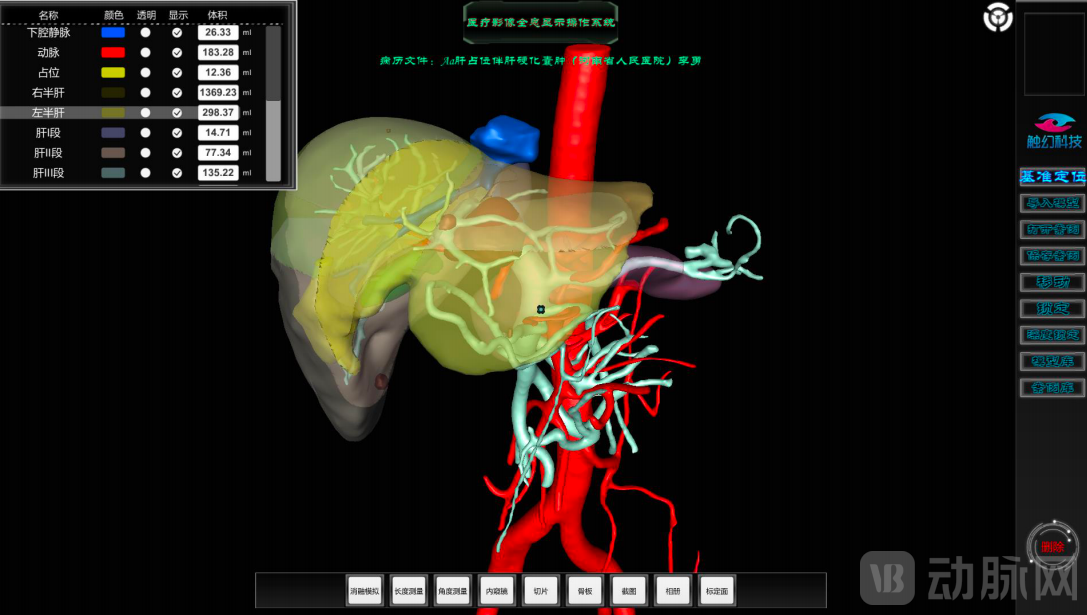
The system is capable of automated analysis and processing using multiple algorithms.. Including deep learning image algorithms, 3D spatial transformation imaging algorithms, precise spatial navigation and positioning algorithms, consumable simulation algorithms, and precise registration algorithms. It is also equipped with terminal devices such as holographic stereoscopic optical tracking glasses, interactive holographic displays, and interactive styluses, comprehensively empowering physicians’ preoperative planning from the perspectives of “eyes, hands, and brain.”
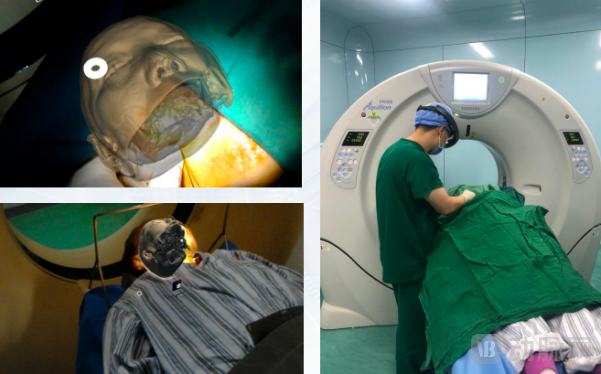
Among them, the holographic stereoscopic optical tracking glasses feature five tracking points and deliver a holographic 3D visual effect.When in use, moving the head causes the viewing angle to change according to the operator’s head position, aligning with real-world visual experience. The interactive holographic display can be placed freely to achieve a holographic stereoscopic effect, breaking through the planar limitations of traditional PC interfaces and providing a sense of space and positional awareness. The interactive stylus serves as an extension of the human hand, enabling operators to manipulate objects with six degrees of freedom (which is typically not possible with a mouse in 3D space). Furthermore, the stylus can simulate various surgical instruments and tools, offering practical operational realism.
In addition, Shengxing Medical has made strategic arrangements around intraoperative navigation products, aiming to achieve a holographic imaging solution that covers the entire process of surgical operations in the future.
The holographic intelligent surgical positioning and guidance system, independently developed by the company, is primarily based on VR/AR and artificial intelligence technologies. It reconstructs traditional two-dimensional images, such as CT and MRI scans, into holographic three-dimensional visuals, which are then displayed and interacted with through an XR system. The system provides physicians with various surgical simulation options, enabling them to design surgical procedures according to their specific needs, including simulated resection of anatomical regions, planning for puncture procedures, screw fixation, and implantation of consumables. Furthermore, by visualizing the patient’s anatomical relationships and leveraging intelligent algorithmic prompts (e.g., angle and distance indicators), the system facilitates precise intraoperative localization and puncture.
By assisting physicians with puncture procedures, it reduces the number of needle insertions and shortens operative time. This subsequently decreases radiation exposure for physicians, thereby lowering the risk of iatrogenic injury to both medical staff and patients. Meanwhile, it also reduces intraoperative bleeding and the incidence of complications.
Many investors are actually more concerned about the commercialization of surgical navigation products, yet at Shengxing, we have seen a different answer.
Supported by national development policies, pricing directory codes have been established in multiple provinces across China. Currently, among the two products under development by the company, the preoperative planning product has obtained regulatory approval and is reimbursable in over ten provinces nationwide, demonstrating a complete commercial value chain.Shengxing Medical has currently established collaborations with over 100 hospitals across China, and its independently developed preoperative planning product has been put into clinical use. Leveraging practical clinical applications and the accumulation of case data, the company will continue to optimize its products and implement iterative upgrades to better align with clinical needs.
Yu Lang told VCBeat“Compared with surgical robotics projects that have been widely sought after in the capital market, holographic surgical navigation provides a lightweight and visualized solution for clinical practice. First, holographic surgical navigation is less expensive than traditional surgical robot products, facilitating widespread adoption in primary-care hospitals. Second, it is easy to operate with a short learning curve. Finally, its compact size and strong adaptability enable deployment across most clinical departments. Therefore, Shengxing Medical aims to deliver higher-quality medical services at patient-affordable prices through the development of holographic surgical navigation.”
In secondary hospitals, where the demand for Level 3 and Level 4 surgeries is more extensive and frequent, and given the limited equipment affordability of hospitals and patients’ willingness to pay, Shengxing Medical’s products have been widely promoted and adopted. Furthermore, these products serve as a navigational compass for surgeons without requiring changes to their established surgical practices.
However, the company also stated“The core of surgical robots lies in ‘know-how’ and data accumulation, rather than in externally sourced hardware such as robotic arms. Therefore, as the technology matures, the level of automation in surgical robots will increase. Meanwhile, with the maturation of the domestic robotic arm supply chain, it is possible that Shengxing Medical may develop more intelligent surgical robot products.”
Amid continuous technological iterations, XR’s B2B applications are now flourishing. Major manufacturers are conducting in-depth explorations in areas such as physical and psychological rehabilitation training, ophthalmic digital therapeutics, preoperative planning, surgical navigation, and disease diagnosis, with the expectation that this technology will deliver value in medical scenarios.
On the one hand, it improves diagnostic accuracy by providing timely and accurate information along with corresponding solutions based on specific scenarios. On the other hand, it leverages technology to compensate for the scarcity of high-quality medical resources, thereby unlocking greater possibilities in healthcare.
It is reported that Shengxing Medical has jointly established a Medical Holographic Imaging Laboratory with the Advanced Institute of Information Technology at Peking University, leveraging the academic strength of Peking University (with Chief Scientists including Academician John Hopcroft, a Turing Award laureate, and other academicians). Through industry-academia-research collaboration, the partnership aims to promote the integrated application of technologies such as 3D visualization of medical imaging, holographic preoperative planning, and intraoperative navigation, thereby accelerating the deployment of XR technology in clinical settings. Currently, the company has reached cooperation intentions with well-known industry players, and it is believed that XR is poised to become a “unicorn” in the field of future precision medicine.
In response to the recent issuance of the "Notice on Regulating the Use and Charging Practices of Surgical Robot-Assisted Operating Systems" by the Hunan Provincial Healthcare Security Administration, an informed source from a local healthcare security administration revealed that Hunan’s robot-related charging policy currently applies only within the province. Such stringent healthcare security policies are indeed rare, and other provinces may likely adopt a wait-and-see approach.
Based on the current status of medical insurance negotiations across various provinces, each province is formulating its own reimbursement policies for robotic systems based on local conditions, with differentiated coverage for different surgical procedures. In contrast, Shandong and Hebei provinces have already included surgical planning products in their medical insurance coverage, offering hope and clarity regarding the future direction of surgical navigation reimbursement.
In fact, the precision, digitalization, and intelligence of healthcare represent a major trend for future development. However, due to supply chain issues affecting cost control capabilities among surgical robot manufacturers, service fees remain excessively high. It is evident that regulatory policies aim to ensure fee rationality and prevent duplicate or cumulative charging. In this context, the market will impose stricter requirements on cost control for surgical robots. The ability to deliver high-quality medical services to patients at lower costs remains the core criterion by which the market evaluates providers of precision medicine.