

"The Role Question": Division of Labor and Collaboration Among Participants in Next-Generation Technology Commercialization
First, the process is progressive: moving from the laboratory to the market requires navigating distinct stages, each with its own characteristics and requirements. Second, the roles involved are diverse, as different stakeholders must engage and collaborate at each stage. Therefore, a critical question arises: which roles participate in the technology transfer ecosystem, and what functions do they serve?
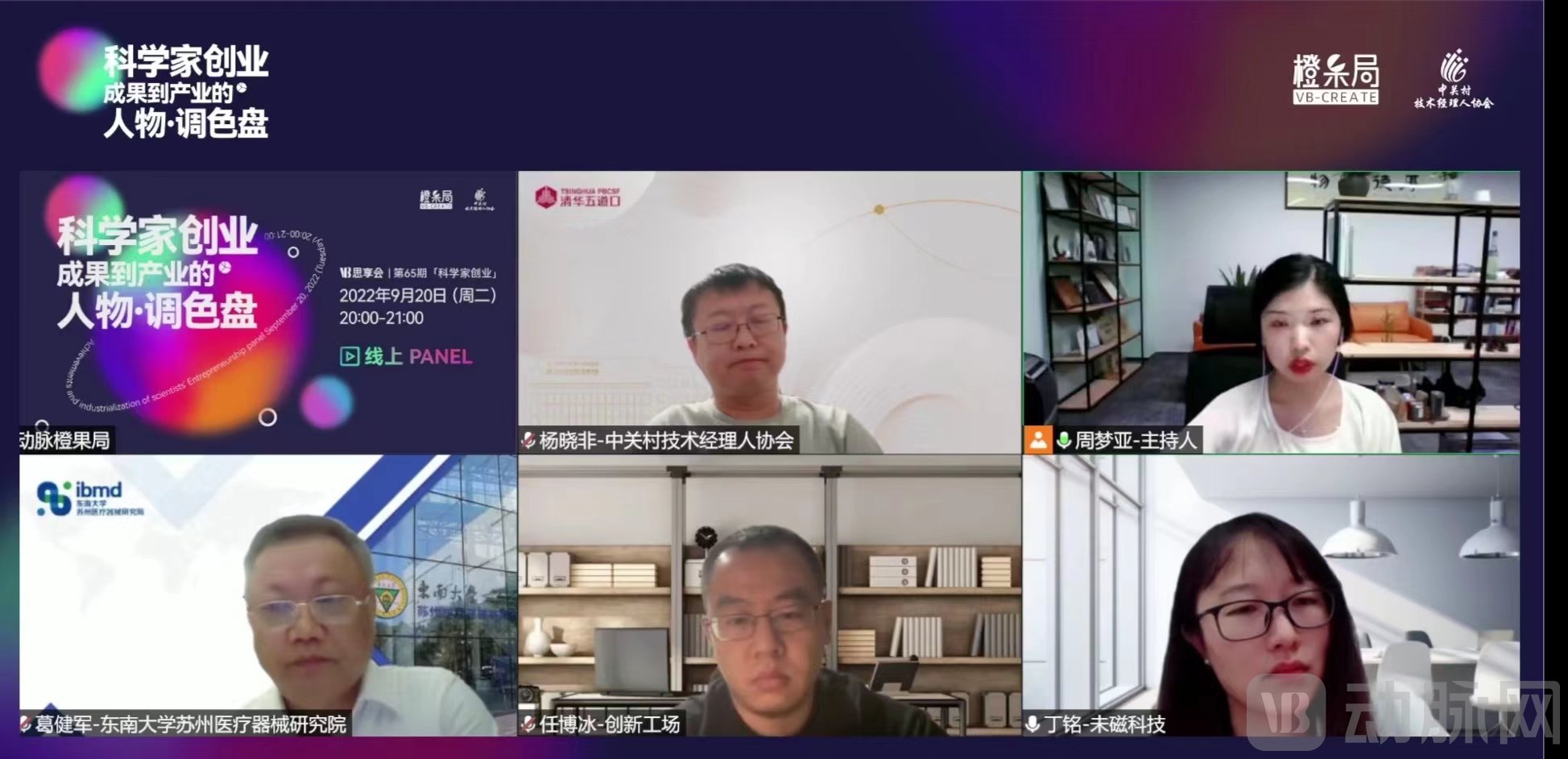
Recently, Artery Orange Bureau, in collaboration with the Zhongguancun Technology Managers Association, jointly organized an online panel titled “Scientists’ Entrepreneurship: From Research Achievements to Industry—‘Figures & Palette’,” focusing on the “question of roles” in the process of achievement transformation. The event specially invited the Deputy Dean of the Suzhou Medical Device Research Institute of Southeast UniversityGe Jianjun, Secretary-General of the Zhongguancun Technology Managers AssociationYang XiaofeiCo-founder of Weici TechnologyDing MingExecutive Director of Sinovation Ventures and General Manager of the Frontier Technology FundRen Bobing, a heated discussion was held on “what each stakeholder did” in the process of translating scientific and technological achievements into practical applications.
Different Roles, Different Responsibilities
VCBeat: What are the core functions of Southeast University Suzhou Medical Device Research Institute in the process of technology transfer? What role does the institute play?
Ge Jianjun:The Suzhou Medical Device Research Institute of Southeast University has two core functions in the technology transfer and commercialization chain:
On the technical front, the core functions of the Research Institute areSecondary Development of Technology. As a new type of R&D institution, unlike the basic research conducted by universities or frontier technology development, we place greater emphasis on aligning with industrial and market demands to carry out follow-up experimentation and development of academic research achievements, thereby forming mature technologies applicable in production;
On the server side, the core functions of the Research Institute areBuild an Innovation and Entrepreneurship Service System. The incubation of scientific and technological achievements requires a comprehensive service system to facilitate their market entry. In this regard, as a specialized mass innovation space in Jiangsu Province, the Research Institute has not only established a general service system but also developed a specialized engineering translation service system for medical devices.
The Research Institute’s receipt of the top prize at the inaugural National Disruptive Technology Innovation Competition and its recognition as one of China’s Top 100 Specialized Platforms fully embody these two core functions.
In the process of technology transfer, the Institute undertookBridgeOn one hand, it serves as a bridge to build communication and trust between research teams and enterprises, extending academic research capabilities while studying the industry landscape and aligning closely with industrial needs. On the other hand, it bridges the “Valley of Death” between scientific achievements and product commercialization by establishing multiple translation platforms, including technical service platforms, investment and financing platforms, and industrial incubation platforms, thereby providing comprehensive and meticulous services for the translation of scientific achievements.
VCBeat Orange Bureau: What Role Do Scientist-Entrepreneurs Play in the Commercialization of Scientific Achievements? With Which Stakeholders Do They Have Strong Associations?
Ding Ming: In fact, the value or role demonstrated by scientist-entrepreneurs varies across different stages of the commercialization of scientific and technological achievements.
In the early stages of a startup, scientists playThe Critical Role of Breakthrough Frontier Technologies. Especially in the current environment of entrepreneurship focused on specialized, sophisticated, and innovative hard technologies, scientists have long been deeply engaged in scientific research. They possess profound and cutting-edge expertise in specific niche fields, enabling them to build technological barriers and identify breakthroughs.
During the mid-stage of a startup, frontier technologies have achieved breakthroughs and entered the phase of transitioning from proof-of-concept prototypes to engineering prototypes. At this point, the role of engineers becomes more critical. However, scientists’ focused thinking differs significantly from engineers’ divergent thinking, so in the mid-stage, the role of scientists will shift toContinued Breakthroughs in Fundamental Research;
In the later stages of entrepreneurship, “hard” products must achieve a “soft” landing, which includes market promotion. At this stage, in addition to continuing product research, development, and iteration, scientists also need to engage with specialized customers.Assist the marketing department in promoting products。
Overall, in the process of translating scientific achievements into practical applications, the roles and functions of scientists are undergoing a transformation. However, the extent to which scientists can exert influence depends on their mindset—whether they engage in entrepreneurship on a part-time basis or fully immerse themselves in the venture. If they pursue entrepreneurship only part-time, their role throughout the process may be relatively limited. In contrast, if they commit wholeheartedly, adapt their mindset during the entrepreneurial journey, and continuously learn, scientists can potentially assume a more leading role.
Regardless of the mindset with which they embark on entrepreneurship, scientists andTechnical Departmentthe link is always essential and long-lasting. Additionally, when assisting in market promotion, scientists andMarketing DepartmentCollaborative synergy is also quite important.
VCBeat Orange Fruit Bureau: How Have the Roles of Investors Changed in the Investment Process of Achieving Result Transformation?
Ren Bobing:In recent years, the translation of technological achievements into industrial applications has only truly gained attention from the investment industry and become one of the competitive advantages for hard-tech investment firms. In reality, this change poses a considerable challenge for ordinary investors. This is because, when genuinely engaging with technology transfer, investors need to understand both technology and industry, which involves significant cross-disciplinary difficulty and high barriers to entry. As a result, very few investors are deeply or proactively involved in this process.
In fact, investors also play a role in the commercialization of technological achievements.May transition directly from investor to co-founder,In both pre-investment and post-investment services, investors are required to devote substantial time and effort, yet the ultimate outcomes remain uncertain. This necessitates that investors not only expend greater efforts but also confront the challenges posed by uncertainty.
For most investors, the process of translating technological achievements from 0 to 1 is a highly unfamiliar domain. This is evidenced by the scarcity of established methodologies, necessitating fresh exploration in areas such as team incubation models, management systems, product definition, and translation metrics. Furthermore, the underlying investment logic has undergone significant changes. Previously, most investors adopted a top-down approach when evaluating and sourcing projects; however, in the context of technology transfer, investors may need toBottom-Upground research technologies and projects.
VBInsight: What Roles Do Technology Managers Play in Current Achievement Transformation Efforts?
Yang Xiaofei: The term “technology manager” has gained considerable traction in recent years, but in fact, this role has existed since the launch of China’s reform and opening-up policy.
To date, the development of the technology transfer professional workforce still faces numerous challenges: first, a dedicated professional cohort has not yet fully taken shape, with many technology transfer professionals scattered across various specialized institutions and not relying on this role as their primary livelihood; second, there is a scarcity of senior-level technology transfer professionals, making it difficult for the broader pool of practitioners to independently manage the entire process of achieving commercialization of scientific and technological achievements.
Senior Technology Managers embody a multitude of strengths. Specifically, first, they possess a scientific aptitude, enabling them to understand the language of scientists; second, they demonstrate the ability to drive change and provide leadership by analyzing and assessing the strengths and weaknesses of projects, thereby persuading scientists to implement improvements; and finally, they excel at organizing and coordinating large-scale projects, operating from multiple perspectives including business, capital, and market dynamics.
In fact, it is extremely difficult to concentrate all these advantages in a single individual; therefore, for the vast majority of technology transfer professionals,Lead a team, leveraging the strengths of multiple parties, also help scientists with commercialization, and throughout the entire team and process, the vast number of technology transfer professionals mainly serve toGuidethe role of.
Can Stones from Other Hills Polish Jade?
VBInsight Orange Bureau: What Can China Learn from the UK and the US at the Level of Universities and Research Institutions?
Ding Ming:Take the Optoelectronics Research Centre at the University of Southampton, the largest optoelectronics research center in the UK where I studied, as an example; all research conducted at the center isDemand-Oriented, which is mainly reflected in two aspects:
One aspect is that nearly 80% of the research center's projects originate from industry, with research activities driven by specific demands. Therefore, from this perspective, technology transfer and patent sales represent a clear and viable pathway.
On the other hand, the Research Center also incubates numerous technology-driven startups, including market leaders in specialized niches. Throughout the incubation process, the Center remains focused on early-stage R&D. Once a breakthrough in technological principles is achieved, the technology is promptly transferred to a newly established company, where a professional CEO joins to lead the team in driving subsequent commercialization and outcome translation.
Of course, incubated enterprises also establish joint technical laboratories with research centers. After technology transfer, scientists can continue to further develop and iteratively update the technologies, thereby providing the enterprises with cutting-edge technical support.
VCBeat Orange Bureau: The U.S. translational system and research culture—are there any lessons for us to learn from them or other regions?
Ren Bobing:There is still a significant gap between China and the United States in terms of systems and culture.
First, in terms of institutional frameworks,U.S. Universities Have a Relatively Comprehensive Support System, for example, MIT’s incubator provides full-cycle services, including industry research, connecting with potential clients, and legal advisory services. Overall, this offers scientists a clearer set of values, whereas in China,The core issue remains the positioning of universities regarding the commercialization of research outcomes.;
Secondly, culturally,Overseas Professors’ Rich Entrepreneurial Experience, some professors already own dozens of companies, including even four or five publicly listed ones; in comparison,Domestic professors are still relatively conservative.. Additionally,The Boundaries of Entrepreneurship for Scientists in China Are Still Unclear, whereas foreign investment institutions generally impose a series of requirements, such as scientists not being allowed to hold a majority stake in the company, full-time entrepreneurs not holding public office, and relatives not being employed by the company. Therefore, the red lines in China still need to be further clarified and refined.
VCBeat: In the R&D and commercialization efforts at VCBeat Institute, have there been any groundbreaking initiatives? What results and insights have been gained?
Ge Jianjun:In fact, our breakthrough has been achieved with the support of relevant departments such as universities and government agencies. Taking the Research Institute's self-initiated project—Research and Development and Industrialization of Organ-on-a-Chip—as an example, the Institute has made some groundbreaking attempts from project initiation to achievement transformation.
First, in the project initiation phase, the project isOfficially Approved for Project Initiation by the Research Institute Following Expert Review from the Technical Committee, which demonstrates greater strength than other projects. It can be said that the initiative was fundamentally sound and well-positioned from the outset, laying a solid foundation for our subsequent work;
Secondly, in the R&D phase, the research institute leveraged government R&D funding as initial impetus to align the university’s original basic research with market demands and product development.Secondary Development;
By the time the project reaches the stage meeting commercialization criteria, the transfer of intellectual property rights involves changes in state-owned assets, resulting in a relatively protracted administrative process at the university. In response, the Research Institute has adoptedFlanking Tactics, by securing support as a key government project following evaluations and endorsements from the Jiangsu Provincial Department of Science and Technology and the Provincial Industrial Technology Research Institute, and subsequently obtaining decision-making support from the university, achieved breakthrough success in technology transfer.
Finally, after the transformation of achievements, the team followed the achievement transfer measuresReasonable Allocation of Returns, the team members voluntarily donated all their equity to the company to support its growth.
In this process, we have also summarized two key lessons:
First, we must strictly adhere to the Ministry of Education’s regulations and rules governing technology transfer in higher education institutions. While pursuing breakthroughs, we must maintain clear boundaries and avoid crossing any red lines. Although the path is long, every step must be solid and well-grounded. Second, we should facilitate technology transfer through the comprehensive relocation of both technology and the associated team. Specifically, team members transition to the company alongside the technology, which not only enhances transfer efficiency but also mitigates the risk of post-transfer operational disruptions. By appointing scientists as the company’s Chief Technology Officer (CTO), we can bolster the confidence of technology recipients and investors.
VCBeat Orange Fruit Bureau: Regarding China’s system, environment, and culture for translating scientific achievements into practical applications, what are the current bottlenecks that are difficult to break through, and in which areas can we learn from overseas practices?
Yang Xiaofei:China’s Technology Transfer Has Always Followed Its Own Path, primarily for two reasons. First, China’s scientific research system was established during the Soviet era, and the model for scientist-led entrepreneurship differs from that in Europe and the United States. Second, China has less than two decades of experience with truly market-driven, independent innovation. In light of this, it can be said that we have been navigating our own entrepreneurial path by “crossing the river by feeling the stones.”
Solely from a legal formal perspective, China has made more significant breakthroughs than the United States. The Law on Promoting the Transformation of Scientific and Technological Achievements enables technology transfer offices to reasonably determine ownership of service inventions and appropriately allocate resulting benefits to scientists, thereby ensuring that the transformation of scientific and technological achievements proceeds without legal barriers.
Although there is substantial legal support, in practice, institutions of different naturesLeadership Liability Exemption IssuesGreater attention is still needed. Furthermore, scientists must be exposed to market opportunities to incentivize the translation of their research findings into practical applications, which requires a professional service team to assist scientists inTransforming High-Value Outcomes Based on Respect for the Laws of Innovation。
Translation of Achievements Requires Local Innovation
VBInsight Orange Bureau: From the Perspective of Researchers, What Overseas Technology Transfer Strategies Can Be Adopted, and Which Need to Be Adapted to China’s Context?
Ding Ming:Scientists Need to Shift Their Mindset When Starting Businesses, although scientists hold a certain degree of authority in the academic realm, the vast majority are not suited to lead enterprises during the entrepreneurial process. In such cases, scientists must fully recognize their roles and contributions. If they lack entrepreneurial qualities and the capacity to rapidly acquire robust business knowledge and competencies, pursuing alternative commercialization pathways—such as seeking more suitable partners or licensing patents—represents a highly effective strategy for technology transfer.
VCBeat Orange Bureau: As investors, where can we draw lessons from Europe and the United States, and which advantages need to be reconsidered when investing in China?
Ren Bobing:In the investment and incubation of biomedical ventures, successful models employed by renowned international biotech venture capital firms such as Flagship Pioneering, Third Rock, and Arch serve as key references; however, practical strategies in China differ.
For example, in terms of technology, wePursuing Global Leadership in Technology, thereforeThe search for scientists has also expanded globallyMeanwhile, how to identify a top-tier CEO who can complement leading scientists, or an operational partner with deep expertise in the local market and business ecosystem, as well as how to build an efficient global organization, have all become new questions for investors. Although China continues to draw on foreign talent and technology, Chinese tech investors are also leveraging their own advantages to break through, such asLeveraging the Advantages of Local Intelligent Technologies, adopting AI + biotechnology, etc.
Artery Orange Bureau: What experiences can the research institute share regarding its technology transfer system and bridging the gap with industry?
Ge Jianjun:First, from a macro perspective, the commercialization of scientific and technological achievements requiresAligned Goals, Integrating Resources from All Parties, integrate multiple factors effectively and maintain firm confidence in the willingness and ability to accomplish tasks; secondly,Let Professionals Handle Professional Matters, cultivate the core competitiveness of the team, and involve professional technology managers in the process of achievement transformation; finally, integrate with the Suzhou Medical Device Research Institute of Southeast University,Leverage the Advantages of Technology Plus Platform, providing one-stop and professional services to accelerate the process of achievement transformation.