

Angelexo's LiteStepper™ Single-Limb Exoskeleton Robot Receives NMPA Approval, Ushering in a New Era of Intelligent Neurorehabilitation
ANGELEXO
R&D and Manufacturer of Intelligent Rehabilitation Robots
On September 22, AngelRay’s independently developed LiteStepper™ single-leg exoskeleton rehabilitation robot received NMPA medical device registration approval, officially entering clinical commercial application.
This is a rehabilitation medical robot specifically designed for hemiplegia patients, primarily used to assist them in undergoing rehabilitation training for the affected lower limb. This approval not only marks a phased milestone in Anjielai’s development but also fills a gap in the international field of single-lower-limb rehabilitation robots, providing an innovative intelligent neurorehabilitation solution for hemiplegia patients worldwide.
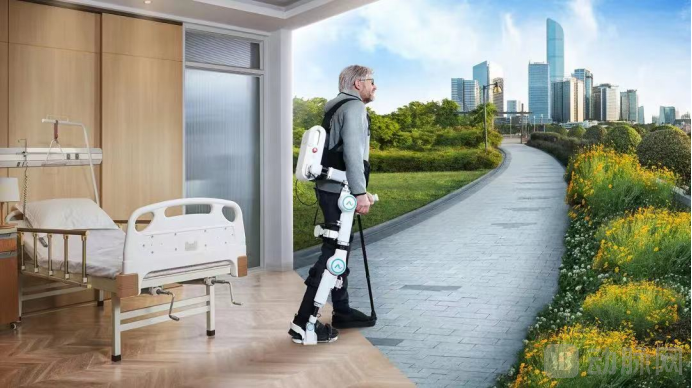
Angel LiteStepper™ Single-Leg Exoskeleton Rehabilitation Robot Propels Rehabilitation to New Heights
China has a large population of patients with lower limb diseases, and the number of individuals requiring rehabilitation is substantial.
According to KPMG’s 2021 report, “Rehabilitation Medical Trends Lead a New Blue Ocean,” the compound annual growth rate (CAGR) of China’s rehabilitation medical industry market size is projected to reach 20.9% from 2020 to 2025, with the market size exceeding RMB 200 billion by 2025.
From a policy perspective, in June 2021, eight departments—including the National Health Commission, the Ministry of Education, the Ministry of Civil Affairs, the Ministry of Finance, and the National Healthcare Security Administration—jointly formulated the “Opinions on Accelerating the Development of Rehabilitation Medical Services.” The opinions propose striving to gradually establish a reasonably sized and highly qualified professional workforce for rehabilitation medical services by 2022, with a ratio of 6 rehabilitation physicians and 10 rehabilitation therapists per 100,000 population. By 2025, these ratios are targeted to reach 8 rehabilitation physicians and 12 rehabilitation therapists per 100,000 population. Against the backdrop of “new infrastructure development for rehabilitation,” rehabilitation medical equipment is expected to experience significant growth in volume.
Demand and Policy in Resonance: The Steady Rise of Rehabilitation Medicine.
However, there is still a significant supply gap in China’s rehabilitation medical market. On one hand, there is a shortage of rehabilitation professionals, and rehabilitation resources are scarce and unevenly distributed. According to estimates by iResearch, China currently has only 2.2 rehabilitation physicians and 4.3 rehabilitation therapists per 100,000 people. This severe lack of specialized talent has led to insufficient rehabilitation medical resources and unequal distribution. Existing clinical rehabilitation pathways mostly involve “one-on-one” treatment between physicians and patients, resulting in high workloads for physicians and low rehabilitation efficiency for patients. Clinically, the lack of support from intelligent medical devices makes it difficult to implement modern advanced neurological rehabilitation therapies.
On the other hand, although there are approved lower-limb rehabilitation robots on the market, most are dual-lower-limb devices primarily used for daily living assistance in patients with paraplegia or passive training in those with hemiplegia. There is a lack of effective, actively driven rehabilitation solutions specifically designed for patients with hemiplegia. Furthermore, some products are imported, and their high prices have become a major obstacle to the widespread adoption and commercial scale-up of rehabilitation robots.
The vast market demand for rehabilitation calls for a “technological revolution” to meet it. AngeCare has keenly identified this challenging market landscape, conducted in-depth research into the clinical rehabilitation mechanisms and logic for hemiplegic patients, and integrated neurorehabilitation theories based on brain plasticity to launch the LiteStepper™ single-lower-limb rehabilitation training robot, which recently received registration approval from the National Medical Products Administration (NMPA).
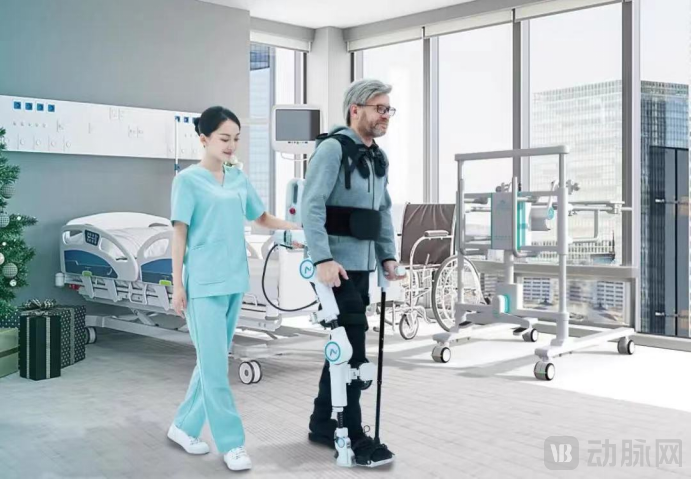
Hemiplegia Patients Walking with the Angelai Robot
Compared with dual-lower-limb exoskeleton robots available on the market, the LiteStepper™ single-lower-limb rehabilitation training robot offers more targeted therapy for patients with unilateral lower-limb motor dysfunction caused by stroke or traumatic brain injury, those undergoing postoperative orthopedic rehabilitation of a single lower limb, and individuals exhibiting unilateral lower-limb muscle atrophy, weakness, or gait abnormalities due to nerve injury or pathology. Furthermore, this product features the following significant advantages:
Human-Machine Interaction and Integration: Transforming Passive Rehabilitation into Active Rehabilitation to Enhance Efficiency and Outcomes.The LiteStepper™ Single-Leg Rehabilitation Training Robot System collects gait data from the patient’s unaffected side during voluntary movement, identifies the patient’s motor intent, and drives the affected limb to perform rehabilitation exercises synchronized with the unaffected side. By establishing an interactive pattern between the unaffected and affected limbs, the system promotes neuroplasticity of brain motor control functions, ultimately achieving seamless human–robot integration. This approach delivers significant therapeutic efficacy while substantially shortening the rehabilitation period.
Motor imagery is demonstrated through real-time controlled gait, efficiently reconstructing neural conduction pathways.The LiteStepper™ single-leg rehabilitation training robot can perceive the output results of patients' motor imagery from their brain through gait information, and use machine learning to transfer the mechanical, kinematic, and dynamic characteristics of the healthy limb to the affected limb, controlling the interaction between the affected and healthy limbs to form a coordinated gait. It drives the affected side and the healthy side to maintain consistent movement balance and gait rhythm, helping to improve central nervous system function in the brain, achieving systemic bilateral joint motion rehabilitation, promoting functional reorganization of the central nervous system, thereby enhancing the quality of rehabilitation training.
Motor Relearning: Assisting the Affected Side in Reconstructing Motor Neural Control Pathways.This rehabilitation robot features self-learning capabilities, enabling it to adjust personalized rehabilitation protocols based on patient feedback such as limb movement and gait. Long-term gait rehabilitation helps patients gradually restore their normal walking pattern. Additionally, the device offers multiple options for walking modes and rehabilitation training programs, allowing physical therapists to design efficient, scientifically optimized clinical rehabilitation pathways.
"Original R&D, self-built factory, providing cost-effective solutions."Compared with imported dual-lower-limb rehabilitation robots, Anjielai’s device is entirely independently developed and has undergone five iterations, resulting in a mature product. The company has mastered core industrialization technologies and established a stable, efficient production supply chain, completely eliminating dependence on external suppliers for critical components and key technologies. With its self-owned manufacturing facility, supported by a mature industrial ecosystem and favorable policy incentives, Anjielai offers a cost advantage of approximately one-third to one-half compared to other products priced at millions of yuan, while ensuring quality, therapeutic efficacy, and patient experience. This enables broad deployment across rehabilitation medical institutions at all levels, addresses the issue of homogeneous quality in rehabilitation care, and helps clients recoup their procurement investment costs more rapidly.
Anjie Lai’s ability to efficiently translate clinical needs into industrial language, deeply integrate technology, products, and clinical practice, and launch internationally pioneering products is inseparable from its multidisciplinary team composed of experts in clinical medicine, medical devices, robotics, and other fields.Interdisciplinary R&D Team in Medicine and Engineering. Meanwhile, to further refine the technical excellence of its products, Anjielai has assembled a team comprising top scientists and clinical experts from Beijing Rehabilitation Hospital, Zhengzhou University Rehabilitation Hospital, Zhejiang University, and other leading institutions.Expert Advisory Team.Angelai also obtained in April this yearOctober CapitalandShanghai XuyuanInvestmentTens of Millions in Pre-A RoundFinancing.
Driven by concerted multi-party efforts, Anjielai has entered a fast track of development. The company has been successively recognized as a National and Zhejiang Provincial Science and Technology-based Small and Medium-sized Enterprise (SME). In 2021, it successfully applied for and obtained certification as a National High-Tech Enterprise, and independently undertook a key project under the 2021 Zhejiang Provincial Key Research and Development Program. Currently, the company has mastered key technologies including intelligent autonomous gait learning, human-machine integration, bone-muscle metabolic information sensing, and rapid donning of exoskeletons, and holds proprietary intellectual property rights.70+ items, including invention patentsOver 20 items.
According to the “2019 Research Report on the Development Potential of the Rehabilitation Industry” released by VCBeat, China’s rehabilitation medical market reached RMB 45 billion in 2018 and is projected to reach RMB 103.3 billion by 2022, representing a compound annual growth rate (CAGR) of 23% from 2018 to 2022. Compared with markets in developed countries in Europe and the United States, China’s rehabilitation medicine sector is still in its early stages. Coupled with the trend of population aging, this will unleash greater demand for rehabilitation services.
The LiteStepper™ single-limb exoskeleton rehabilitation robot, recently approved for Angelai, is not only another breakthrough in China’s rehabilitation robotics sector—accelerating the commercialization of rehabilitation exoskeleton robots in the country and marking a milestone for the rehabilitation industry—but also the starting point of Angelai’s journey toward global expansion.
“Mobile Robot-Assisted Lower Limb Gait Training”Has been included in the medical insurance catalogs of multiple provinces and municipalities,This demonstrates the endorsement of such products by policymakers and their broad application prospects. Amidst the widespread adoption of DRG/DIP payment models within the medical insurance system, the LiteStepper™ single-lower-limb exoskeleton rehabilitation robot will provide a win-win solution for patients, physicians, and rehabilitation institutions, owing to its significant clinical superiority.
Moving forward, the company will pursue both organic growth and external expansion, as well as horizontal and vertical diversification, in product technology and commercialization. According to Angelai, the company has established collaborations with the Affiliated Rehabilitation Hospital of the National Research Center for Rehabilitation Technical Aids, the Yangzhi Rehabilitation Hospital (Shanghai Sunshine Rehabilitation Center) affiliated with Tongji University, the First Affiliated Hospital of Zhejiang University, the Second Affiliated Hospital of Zhejiang University, Hangzhou First People’s Hospital, and the Fifth Affiliated Hospital of Zhengzhou University, among others.Established clinical research collaborations with dozens of domestic and international medical institutions.
Dr. Li Luya, founder of Angelic, believes that in the field of rehabilitation, there is an urgent need to address diverse requirements ranging from the hand, wrist, and shoulder to the hip, knee, and ankle; spanning psychology to cognitive science; and serving populations from children with cerebral palsy to elderly individuals with muscle weakness. In response, Angelic closely aligns with these rigid demands in rehabilitation by constructing a multi-tiered product portfolio. This includes single-leg exoskeletons, unilateral/bilateral ankle-foot orthoses, upper-limb devices, hand function trainers, rehabilitation robots for children with cerebral palsy, trunk rehabilitation robots, and balance training robots. The company is steadily advancing the research, development, and production of each product line, providing patients with a one-stop intelligent rehabilitation solution.
In terms of commercialization, Angele revealed that it will accelerate the market launch of the recently approved products. Meanwhile, the company has established an overseas business division in Seattle, USA,Clinical trials are expected to be conducted in the United States by the end of this year., thereby expanding into global markets and sales to provide rehabilitation physicians and patients worldwide with more efficient, safe, reliable, and accessible intelligent rehabilitation solutions made in China.